Politics
What Is Canada For?
Might Canada’s fate foreshadow that of other advanced but dependent democracies, clinging to old ideals of cooperation and diplomacy as they’re rolled under the treads of China’s or America’s naked self-interest?
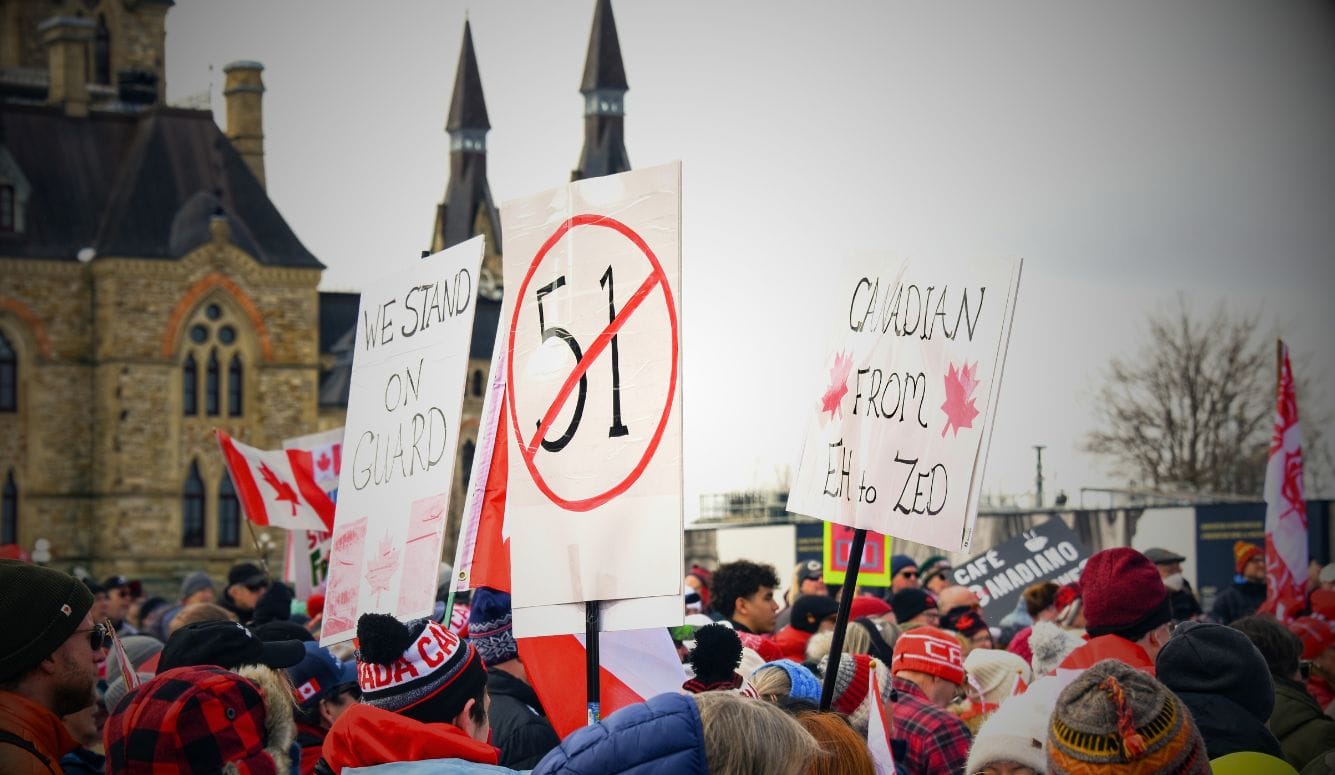

Of all countries reeling from the United States’ return to realpolitik, none has more history with that American strategy—and none is more vulnerable to it—than Canada. US president Donald Trump’s disparaging social-media posts depicting Canada as the 51st state, his references to former Canadian prime minister Justin Trudeau as the “governor” of that state, and his haphazard imposition of crushing tariffs on a hitherto free-trading Canada-US partnership, doesn’t differ appreciably from his treatment of other allies. But as the United States’ closest neighbours, Canadians are especially sensitive to it. When White House advisor Stephen Miller declared in January 2026 that the world is only governed by strength, force, and power, he was just expressing in particularly aggressive language what Canadians have long assumed to be America’s underlying motivations.
What, then, is Canada’s place in this transforming geopolitical order? Is it destined to be absorbed by the United States as the planet divides into Chinese-, Russian-, and American-anchored empires, like George Orwell’s Eastasia, Eurasia, and Oceania? Will Canada become Airstrip Two? In a post-national age, what purpose do sovereign nations—the borders, governments, and identities of which emerged in the 18th and 19th centuries—actually serve? Might Canada’s fate foreshadow that of other advanced but dependent democracies, clinging to old ideals of cooperation and diplomacy as they’re rolled under the treads of China’s or America’s naked self-interest?
An answer to these questions has already been offered by Canadian prime minister Mark Carney in a widely discussed speech given before the World Economic Forum in Davos Switzerland in January. “Canadians know that our old, comfortable assumptions that our geography and alliance memberships automatically conferred prosperity and security—that assumption is no longer valid,” he said. “We are calibrating our relationships so their depth reflects our values. We are prioritising broad engagement to maximise our influence, given the fluidity of the world order, the risks that this poses, and the stakes for what comes next.” Carney’s message was that middle powers like Canada and European nations still held one advantage: “The powerful have their power. But we have something too—the capacity to stop pretending, to name reality, to build our strength at home, and to act together.”
Keep reading
How France Lost Control of Its Streets
How to Suppress Men’s Writing

Back to the Dark Ages
Prison or Peer Review

France’s Imaginary Austerity