Art & Culture
Never Neverland
The new Michael Jackson biopic and the campaign to whitewash the King of Pop’s reputation.

I.
Michael, Antoine Fuqua’s new biopic of Michael Jackson, has broken multiple box-office records since its release on 24 April 2026. Jackson’s global fanbase is rejoicing in the note-perfect portrayal of the star by his nephew Jaafar Jackson, and some screenings have been followed by dance parties in the auditoriums. The sprawling Michael Jackson industry—family members, managers, PR agents, bodyguards, celebrities, and thousands of other hangers-on—is revelling in the film’s impact as Jackson’s reputation at last sheds its baggage, and the coffers of the businesses associated with his legacy start to swell once more.
Fuqua and his screenwriter John Logan portray Jackson as a sensitive child who discovered his talent under the tutelage of his overbearing father, Joseph. A steelworker by trade, Joseph Jackson had settled in the town of Gary, Indiana, with his wife Katherine in 1950. After an abortive attempt to launch his own musical career in the following years, he conscripted five of his nine children into a musical ensemble in the early 1960s and subjected them to a gruelling regimen of constant rehearsal and strict physical discipline. Just six years old when he joined the group, Michael was the youngest member of what would become known as the Jackson Five. Propelled by their talent and 1970s Hollywood’s hunger for family-friendly “ethnic” entertainers, the quintet signed with Motown Records in 1968, appeared on network television, and were even granted a short-lived television variety series.
Michael Jackson emerged as the brightest star in the Jackson Five firmament during the 1970s, and he released his breakthrough solo album, Off the Wall, in 1979. Three further albums followed over the next twelve years, each of which was promoted with all the resources the American music industry could summon. Jackson was an extremely gifted dancer and performer, and his music merged crisp, funky arrangements with infectious vocals: a high-tenor punctuated by percussive yelps and hiccups. His unthreatening, oddly androgynous demeanour and his approachable music expanded his following into the hundreds of millions and propelled him into pop superstardom.
As Jackson’s fame grew during the 1980s, he shared his newly acquired wealth with his parents and siblings. He established his own quarters in a separate part of the Hayvenhurst mansion they had all shared since 1971. He also began undergoing treatment to trim his wide nose (which his brothers had mocked) and lighten his skin. Jackson suffered from vitiligo, an autoimmune condition that produces patches of discolouration across the body. In 1984, while filming a Pepsi commercial, Jackson’s hair was set on fire by a pyrotechnic device, and the burns he received required several painful operations. The accident also destroyed the hair follicles on the back of his head, which meant that, for the rest of his life, he would wear a variety of wigs and hats—often his trademark fedora—in public and private. During this period, he developed an addiction to prescription painkillers.
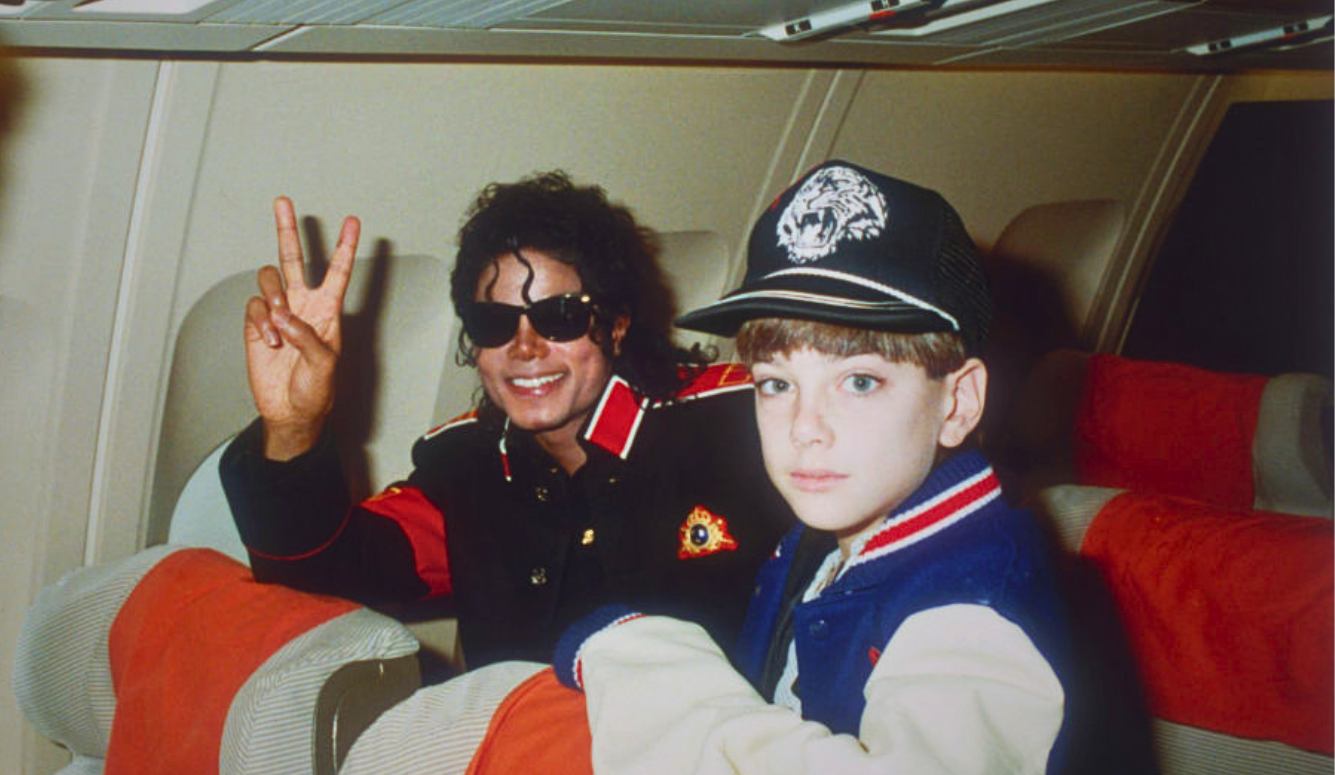
In the mid-1980s, a more disturbing character trait began to emerge: Jackson’s tendency to associate with pre-pubescent boys. In March 1987, Jackson met a nine-year-old actor named James “Jimmy” Safechuck during the filming of a commercial for Pepsi. Jackson would later invite Safechuck to visit him at Hayvenhurst, and he repeatedly visited the Safechuck family’s modest home in Simi Valley, California. Jackson met an Australian boy named Brett Barnes on the Australian leg of his Bad tour on 13 November 1987, and they were often seen in public together afterwards. A few weeks after Jackson met Barnes, he met a five-year-old fan named Wade Robson in Brisbane.
Safechuck, Barnes, and Robson would remain in touch with Jackson for decades, but their attitude towards the star would change over time and diverge dramatically. Barnes is now a married father, and he remained Jackson’s friend until the star’s death in 2009. Although he has said that he shared a bed with Jackson over a period of more than a year, unlike Robson and Safechuck, he insists that nothing untoward occurred to this day. His profile on X currently proclaims his membership of “Applehead Club Doodoohead”—two terms of endearment that Jackson used with him and other young boys.
Whenever he was asked about his friendships with young children, Jackson invariably replied that he had been denied a real childhood by his martinet show-business father, and that these relationships were an attempt to recapture the phase of innocent play and exploration that he had been denied. Jackson also supported many children’s charities and was the driving force behind the 1985 charity single “We Are the World,” which became the eighth bestselling single of all time.
In 1988, Jackson bought a large ranch near Los Olivos, California, which Paul McCartney had rented during the recording of the 1983 McCartney/Jackson duet “Say Say Say.” Jackson renamed the complex “Neverland Ranch” after the magical island retreat in J.M. Barrie’s play Peter Pan, and transformed it into a miniature theme park maintained by dozens of staff members, featuring a carousel, Ferris wheel, train track, and petting zoo. Jackson repeatedly invited large groups of children to Neverland, where they enjoyed its amenities free of charge. In the 2019 documentary Square One, a Jackson supporter estimated that Michael Jackson invited some 22,000 children to Neverland each year.
II.
A formal investigation into a case of alleged sexual activity between Jackson and a minor was first revealed by journalist Diane Dimond. In her 2005 book Be Careful Who You Love (reissued and updated in 2019), Dimond reports meeting a go-between for an anonymous source at an Italian restaurant in Santa Monica, California, on 23 August 1993. This person provided Dimond, then a reporter for the tabloid TV show Hard Copy, with leaked reports from the Los Angeles Department of Children and Family Services about an investigation into Jackson’s alleged sexual abuse of a child named Jordan “Jordie” Chandler. The go-between said the motivation of the source was to ensure Jackson would “not get away with it again,” which suggests that this was not the first time the agency had been made aware of Jackson’s activities.
Keep reading
A Pop Fiction Master and Monster
Australia’s Coming Censorship Machine

Anatomy of a Book Promotion

They Walked in Line
Anti-Catholic Social Panics, Then and Now