Iona's Reading Room
Infinite Ingenuity: Andy Weir’s Optimistic Vision in ‘Project Hail Mary’
The new film 'Project Hail Mary' based on Andy Weir's bestselling novel, celebrates scientific problem-solving on a cosmic scale. There are striking parallels with David Deutsch's radical optimism.
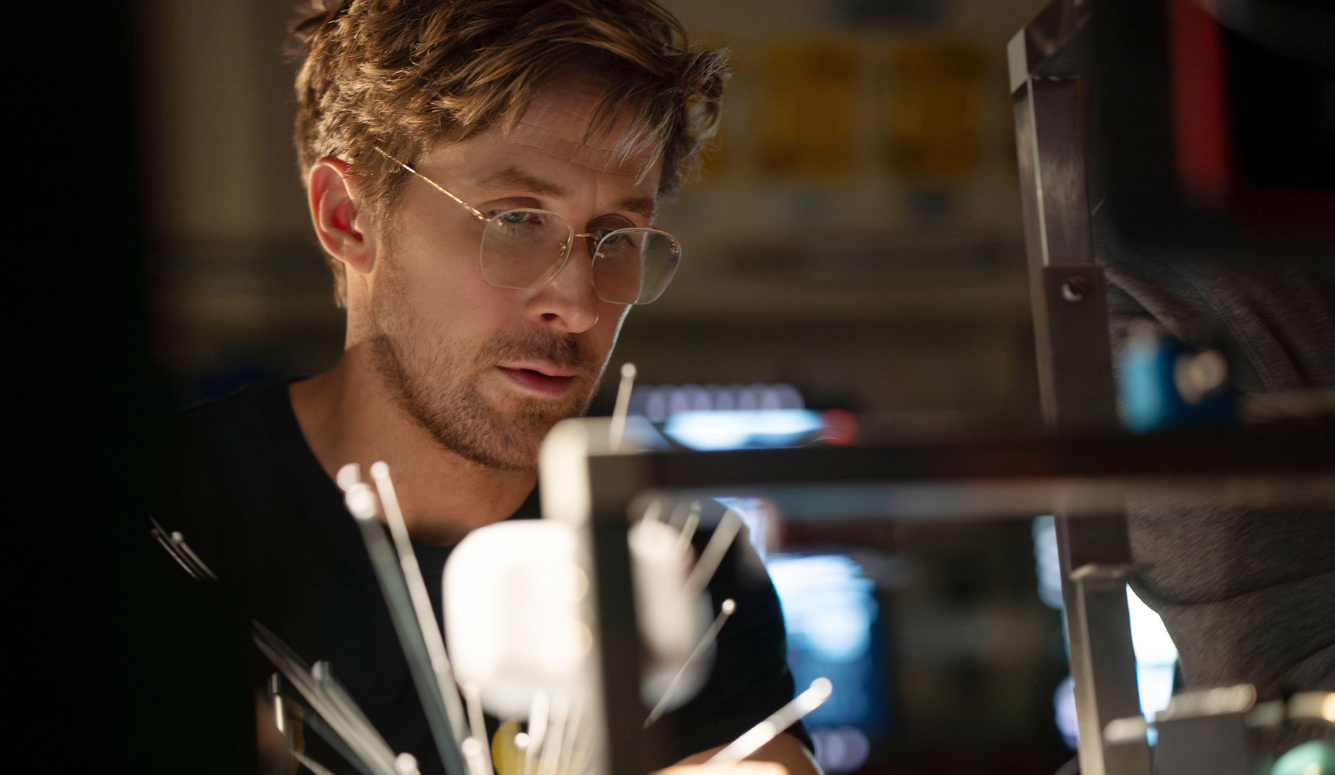
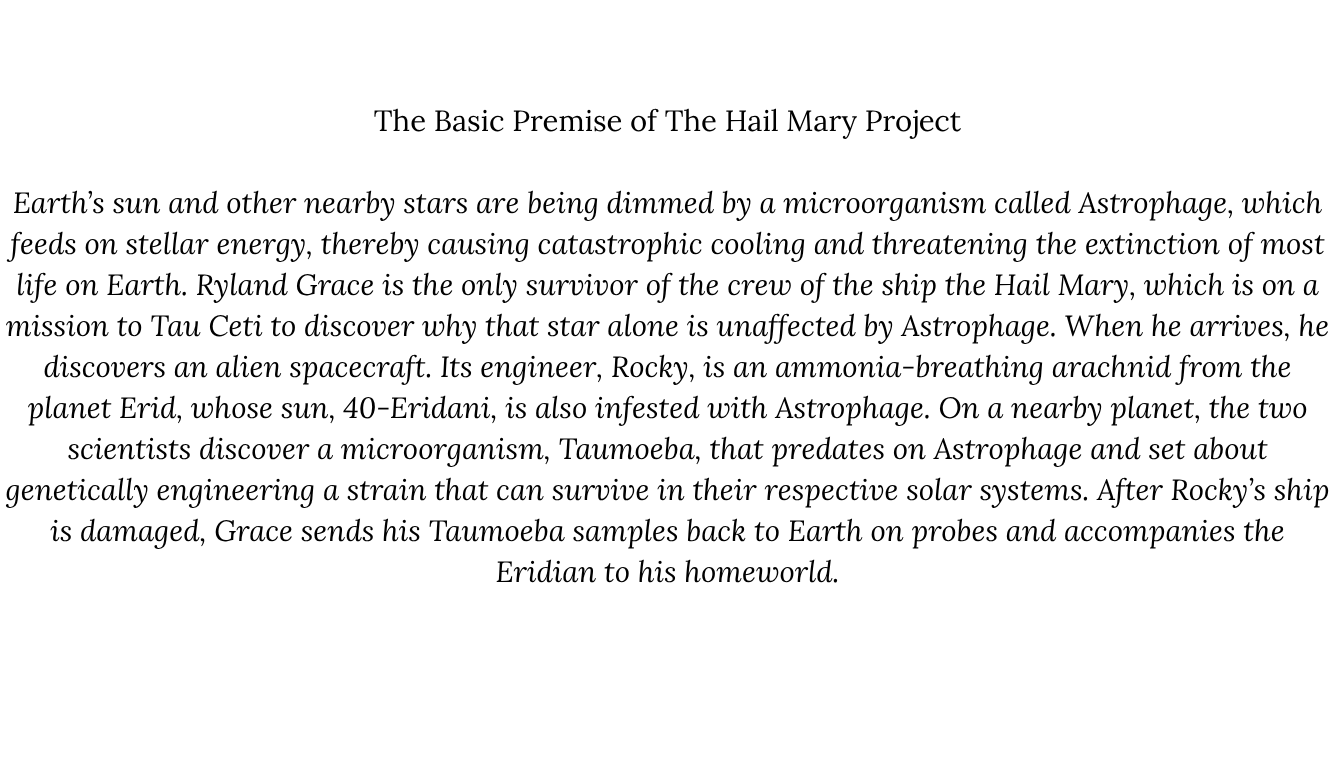
This piece contains major spoilers for both the book and film versions of Andy Weir’s Project Hail Mary. I also include a brief plot summary in a textbox below.
There is a pessimistic worldview in which we live on a planet with limited resources and are—and always will be—engaged in a struggle for control over those resources. The most important divides here are sociopolitical—between haves and have-nots, oppressors and oppressed, workers and bosses, indigenous people and settler colonialists, whitefellas and blackfellas, Israelis and Palestinians, your tribe and my tribe—all the familiar binaries that have most recently been framed in the fashionable language of critical theory but that ultimately go all the way back to humanity’s origins. The most important questions facing us, in this light, are about how to husband and divide up our world’s scant allocations of space and energy, questions that will be decided largely through power struggles.
At its most extreme, in this worldview human beings are parasites on our planet, exploiters and destroyers of nature. The recently deceased Paul Ehrlich was one of the most outspoken proponents of this idea. In his 1968 book The Population Bomb, Ehrlich predicts the death by starvation of hundreds of millions of people over the coming decades. Despite the fact that none of his predictions were fulfilled and he was proven definitively wrong about almost everything, he held a prestigious chair at Stanford University, continued to publish in peer-reviewed journals, was awarded a number of important prizes, and even received some glowing obituaries. There is an appetite, clearly, for doom-mongering of this kind.
But recent events have also demonstrated people’s deep longing for the opposite: for an optimistic vision in which problems are challenges to be solved by human ingenuity and in which, through cooperation, we can escape the zero-sum battle over resources and instead increase the riches and opportunities open to us. This vision is deeply uplifting because it celebrates humanity and especially human creativity and resilience. Every time people are given a glimpse of that vision, all but the most depressed and cynical are captivated by it—even if only temporarily. This is because it appeals to a profound and I believe hardwired psychological need, which evolved in us as a replacement for the blind instinct that drives other animals. Other animals have evolved to be adapted to their environments. We alone have evolved to adapt our environment to us.
We caught a glimpse of this longing in the delight with which people all around the world watched as four astronauts flew by the Moon in the Artemis II mission and sent stunning images of its far side back to Earth, which were greeted with a euphoria that NASA dubbed “moon joy.” We also caught a glimpse of this longing in the critical acclaim and box office success of the film of Andy Weir’s book Project Hail Mary. Weir himself has repeatedly stated that he writes to entertain, not to persuade readers of any particular worldview:
I’m not trying to change society and I’m not trying to change anyone’s opinion of anything. … I’m just writing stories to entertain. I’m not trying to set your opinion or change your mind on anything. … I’m not here to solve a pessimism epidemic. All I can do is just be me. I’m not pessimistic. I think humans are really awesome. I think technology is really awesome because technology is then put into the hands of humans who are awesome.
But, of course, this rejection of an overt political stance is part of the charm of Weir’s vision. It’s a worldview that is not ideological—i.e., it is not primarily about trying to mould society in accordance with a set of political preferences. It’s about a joyful curiosity about the world as it is. Weir is a nerd: someone more interested in how things are than in his ideological fantasies of how he would like them to be. This is why his protagonists—like the astronauts on the Artemis Moon-run—are not primarily strongmen, intrepid explorers, visionaries, or warriors of any kind; they are engineers. The most thorough philosophical statement of the vision implicit in Weir’s fiction can be found in David Deutsch’s radical optimism.
In his 2011 book, The Beginning of Infinity, Deutsch presents a thought experiment: could you create an entire civilisation using only the matter found in a solar-system-sized area of deep space?
While the Earth is inundated with matter, energy and evidence, out there in intergalactic space all three are at their lowest possible supply. There is no rich supply of minerals, no vast nuclear reactor overhead delivering free energy, no lights in the sky or diverse local events to provide evidence of the laws of nature. It is empty, cold and dark.
Or is it? Actually, that is yet another parochial misconception. Intergalactic space is indeed very empty by human standards. But each of those solar-system-sized cubes still contains over a billion tonnes of matter—mostly in the form of ionized hydrogen. A billion tonnes is more than enough mass to build, say, a space station and a colony of scientists creating an open-ended stream of knowledge—if anyone were present who knew how to do that.
With sufficient knowledge, humans or other higher sentients could make even an area of the universe that seems completely barren, sterile, and inhospitable into their home and flourish there. We know that we are capable of moulding our environment to suit our needs, Deutsch argues, because we have already done so, here on Earth. Our lives would be short and brutal without the human inventions that make this a welcoming place for us: “clothes, houses, farms, hospitals, an electrical grid, a sewage system … a safe water supply, and medical equipment, and comfortable living quarters.”
If Earth is a spaceship, Deutsch writes: “we have never been merely its passengers, nor … its stewards, nor even its maintenance crew: we are its designers and builders. … The ‘passengers’ metaphor … implies that there was a time when humans … were provided for … without themselves having to solve a stream of problems in order to survive and to thrive.” He considers such a view narrowly “anthropocentric.” Weir’s vision is more expansive and, on their actual starships, Rocky and Grace are designers and builders solving one problem after another in order to survive.
Mysteries within Mysteries
A man is alone in deep space. His ship is pursued by a vessel that dwarfs it. The mysterious inhabitant of that vessel sends a tentacle out across the void, creating a tunnel to his spacecraft. In that pitch-black tunnel, he encounters a giant, faceless arachnid. It is easy to see how, with this premise, Weir could have written a classic sci-fi thriller featuring a terrifying alien life form. His characters themselves joke about this: “Good,” Rocky tells Grace in the book, on learning about human arachnophobia. “I am scary space monster.”
As Jason Parkin notes in his own remarks on the film,
so much of our storytelling is about how all of the problems in society are the result of a villain that must be overcome. ... most of the world’s problems are just objectively not like that. It’s fun to read stories about good guys and bad guys fighting over a resource … In the real world, it usually comes down to somebody figuring out how to produce more of it.
Project Hail Mary is, as Parkin suggests, a tale not about people fighting, but about people figuring things out. There are no real bad guys in this tale at all. The mysteriously powerful Eva Stratt, who masterminds the Hail Mary Project, is the closest thing the story has to a villain. “I don’t care about morality,” Stratt declares earlier in the story, as the project leaders prepare to nuke Antarctica to release the methane trapped within the ice, “I care about saving humanity.” She is willing to ignore conventional pieties: for example, she demands (in the book) that only heterosexual men be considered for the Hail Mary crew—a pragmatic sexism that is vindicated when the mission’s male science officer and his attractive female alternate embark on an affair. Stratt, then, is precisely the unsentimental leader humanity needs, willing to do whatever it takes to get the job done—even when this includes betraying Grace himself.
Grace is unwilling to join the mission—“I put the not in astronaut,” he quips. So, Stratt has him physically overpowered, injected with sedative and amnesiac drugs, and hauled onto the spaceship unconscious, to go to Tau Ceti, find out how to combat Astrophage, and then die in space. “You will be remembered as a hero,” she tells him. In the book, Grace is uniquely suited to the mission partly because he possesses a gene that confers resistance to the artificial coma in which the crew will be held on their interstellar journey, a gene held by only one in every 7,000 people. After the original science officer and his alternate both die in an explosion, Grace is the most qualified person left in possession of the gene. (Weir has told interviewers that he now regrets having resorted to that clunky plot device.) In the film, we are simply told that the mission must not miss its launch window (an explanation that makes little sense, given that they will be travelling beyond our solar system) and that there is not enough time to bring anyone else up to date. And yet, the skilful storytelling leads us to accept this premise.
In the movie, in Grace’s last conscious moments on Earth, he is lying pinned to the ground by Russian soldiers under Stratt’s command. He looks up to see secret agent Carl—the closest thing to a friend he seems to have on Earth—watching the procedure. “You know who you are,” Carl tells him. “You’re going to do great.” Had this scene been introduced earlier, we would surely have felt a keen sense of betrayal. But the story is not told chronologically and by the time we learn about all this, in a flashback, Carl and Stratt have been vindicated. The film version underlines this at the end, when we see an older Stratt, on board an icecutter, chuckling over video footage of Rocky and then, with all her old authoritativeness, giving the signal—“Let’s begin.”—to start the operation to save Earth. As one commentator puts it, “The lesson, if there is one, is that we sometimes need to be pushed in order to realise our potential. Others may see us more clearly than we do.” In the book, when Grace finally remembers what happened, he tells the reader, “‘God damn you, Stratt,’ I mumble. What ticks me off the most is that she was right.”
Even Astrophage, the microorganism responsible for dimming the sun, is not a purely negative phenomenon. It is an extraordinarily powerful source of energy, energy that is harnessed to propel the spaceship that transports Grace to Tau Ceti and thereby enables him to find the solution to the problem it caused. Just as in Weir’s previous book, The Martian, the contest at the heart of the book is not between man and man (or woman) but between engineer and problem. Project Hail Mary does not shy away from the darker implications of its plot—this is a book in which the protagonist wakes up alone with two corpses, while back home, half the population of Earth is dying (albeit off-screen and -page). Yet the book is infused with optimism because it is an engineer’s eye-view of life: engineers love to fix things—and to fix them, they must first be broken. Grace is the perfect candidate for the Hail Mary mission because of his irrepressible delight in problem-solving. “I’m going to have to science the shit out of this,” exclaims Mark Watney in The Martian, another of Weir’s ingenious heroes. In similar vein, even as the Astrophage proliferation threatens the survival of the entire human race, Grace exclaims, “The situation was terrifying, but the project itself was awesome. My inner nerd couldn’t help but be excited.” Elsewhere, he recalls, “‘You know,’ I told the Astrophage, ‘if you boys weren’t threatening all life on my planet, you’d be pretty awesome. You have mysteries within mysteries.’”
Deutsch describes the excitement of being confronted by a puzzle to solve in an evocative passage about the original Moon mission that is of special relevance in the wake of the Artemis II voyage:
President John F. Kennedy said in 1962, in a celebrated example of an optimistic approach to the unknown, “We choose to go to the moon. We choose to go to the moon in this decade and do the other things not because they are easy but because they are hard.” Kennedy did not mean that the moon project, being hard, was unlikely to succeed. … What he meant by a hard task was one that depends on facing the unknown. And … although such hardness is always a negative factor when choosing among means to pursue an objective, when choosing the objective itself it can be a positive one, because we want to engage with projects that will involve creating new knowledge. And an optimist expects the creation of knowledge to constitute progress—including its unforeseeable consequences.

Life Is Reason
Project Hail Mary also reverses the trope of humans encountering a superintelligent, technologically superior species at First Contact. In fact, if anything, humans have the edge over Eridians. “I’m an advanced alien race with knowledge far beyond Eridian science,” Grace quickly realises. Rocky is delighted when Grace gives him a present of a laptop packed with data, which Rocky dubs “my own human thinking-machine!” In the book, the two speculate about the origins and constraints on intelligence in some fascinating ways that go beyond the scope of this essay. Amid those discussions, Rocky gives a plausible reason for the fact that Eridians and humans are at a similar stage of development:
“Has to be, or you and I would not meet,” Rocky says. “If planet has less science, it no can make spaceship. If planet has more science it can understand and destroy Astrophage without leaving their system. Eridian and human science both in special range: Can make ship, but can’t solve Astrophage problem.”
As Arthur C. Clarke noted, any sufficiently advanced technology is indistinguishable from magic and it is a staple sci fi meme that therefore the leaders of any sufficiently advanced civilisation will be indistinguishable from gods in the eyes of more technologically primitive beings—an idea explored to tremendous dramatic effect with the Ori in the long-running sci fi series Stargate SG-1. David Deutsch completely rejects this idea: “There can only be one type of person: universal explainers and constructors. The idea that there could be beings that are to us as we are to animals is a belief in the supernatural.”
Of course, making Rocky and Grace equals also allows the story to focus on the bromance between the protagonists, heightened by their shared experience of tragedy (all members of both crews having died en route to Tau Ceti) and by the intrinsic loneliness of space: “the vastness … bearable only through love,” as Carl Sagan writes in Contact. Back on Earth, Grace tells Yao Tang, the original captain of the Hail Mary, that he cannot imagine having the courage to undertake such a mission. “You just need to find someone to be brave for,” Yao tells him—and Grace finds that person, 11.9 light years from Earth, in the form of an igneous spider.
That Rocky and Grace are able to connect across a vast species divide makes sense if we follow Deutsch’s line of thinking. For Deutsch, as Clovis Roussy has argued, “the idea that there is a human condition or a human nature is the epitome of the wrong way of explaining humans.” Deutsch took issue with evolutionary psychologists like Geoffrey Miller, who regard personhood as a matter of evolved traits shaped by experiences in the ancestral environment. For Deutsch, at root, people are problem-solvers, generators of knowledge—an idea backed up in Project Hail Mary by Rocky’s clear personhood. Although Rocky has evolved on a dark world more than sixteen light years away, with twice the gravity and 29 times the sea-level atmospheric pressure of Earth, he is very much a problem-solving agent.

Deutsch sees a parallel between the way in which evolutionary adaptations arise through natural selection and the accumulation of knowledge, through “conjectures and refutations,” to use Karl Popper’s terminology or, as Deutsch puts it, “by conjecture and criticism of ideas, rather than the variation and selection of genes.” Likewise, in Weir’s story, there are two ways to tackle Astrophage: one is by thinking through the problem, as Grace and Rocky do. The other is to keep the population in check through predation. Taumoeba have used the blunt force method of evolution to find a solution to the Astrophage infestation: they have adapted to feed on the organisms. When the two engineers first look at a sample from Adrian’s atmosphere and discover a rich, microscopic ecosystem, Rocky bursts out with a phrase that beautifully expresses both aspects of this Deutschian vision, “Life is reason!”
“Deutsch even proposed a new way of formulating the laws of physics, not in terms of initial conditions and laws of motions, but in terms of what transformations are possible … In this worldview, knowledge is not a fringe phenomenon in physics: it is … of immense, cosmical importance,” writes Roussy. In Weir’s vision, the knowledge necessary to save entire planets is embodied in just two thinking individuals and, together, Grace and Rocky take actions that will indeed have cosmical importance, that will restore the full luminosity of stars.
Amaze! Amaze! Amaze!
When the story ends, Grace is living on Rocky’s homeworld of Erid. As he cannot survive in Erid’s scorching, high-pressure ammonia atmosphere, he is confined to a geodome, cleverly engineered to resemble a foggy beach in the Bay Area, where he lives with Armando, the robot from the Hail Mary’s sickbay. Rocky is able to visit him, wearing a custom-fitted EV suit. In the book, a number of years have passed since the two landed on Erid and Grace now walks with a cane—living under twice Earth gravity is hard on the human skeleton. While Sol has returned to full luminosity and the Eridians are willing to refurbish his ship, it seems unlikely that he will ever embark on the long and dangerous journey home. And that means that he will never speak to another human being, never directly physically touch someone or something living again. (In the film, he still bears the trace of Rocky’s stumpy fingers burned into the flesh of his arm, from when the scorching alien carried him to sickbay in their only direct contact.)
This could be viewed as a melancholy fate—but the narrator’s mood is buoyant in the book and, in the film, actor Ryan Gosling’s Grace is effortlessly cheerful. Grace is a schoolteacher again, just as he was back on Earth, asking a room (in this case a cave) of excited youngsters, “Who can tell me the speed of light?” That the youngsters are skittery rock spiders on a profoundly alien world does not matter, since science is universal. Or, as David Deutsch puts it:
the fundamental laws of nature are so uniform, and evidence about them so ubiquitous, and the connections between understanding and control so intimate, that, whether we are on our parochial home planet or a hundred million light years away in the intergalactic plasma, we can do the same science and make the same progress.
Although so much of the story focuses on the relationship between Grace and Rocky, giving the film the aura of a classic buddy movie, at its heart, it is a celebration of intellectual curiosity, a romance of ideas. Perhaps the most important of these is that the universe, with its “treasures to satiate desires both subtle and gross” is, as Deutsch writes, “our home, and our resource.” We can and will expand out among the stars—and not just in imagination. The crew of Artemis II—Reid Wiseman, Victor Glover, Christina Koch, and Jeremy Hansen—watched Project Hail Mary together during pre-launch quarantine. When Wiseman described the view of the Earth and Moon from their capsule to Mission Control, Houston replied with Rocky’s catchphrase: “Amaze! Amaze! Amaze!”
Quillette invites thoughtful responses to its essays.
Selected responses are published once per week as part of a curated Letters to the Editor feature. If selected, letters appear under the contributor’s real name and may be edited for clarity and length.
To submit a letter for consideration, please email [email protected].