Art and Culture
Rohmer at Camelot
Éric Rohmer’s Perceval le Gallois (1978) vividly recreates the imaginative world in which the people of the Middle Ages lived inside their heads.

I.
Éric Rohmer’s Perceval le Gallois (Perceval the Welshman, 1978), about a knight of King Arthur’s Round Table, is probably the strangest movie the long-lived (1920–2010) and astonishingly prolific (27 feature films) French director ever made. Rohmer is a specialty taste to begin with; you will either love his work or find yourself bored to tears by his miniaturist—and perhaps too visually pleasing—brand of cinematic realism. The vast bulk of his films explore the moral dilemmas of attractive young moderns in lovely and tranquil upper-middle-class exteriors, as they try to navigate between the things they profess to believe in and the things they actually want (usually each other). Rohmer fan-favourites like Ma nuit chez Maud (My Night at Maud’s, 1969), Le Genou de Claire (Claire’s Knee, 1970), Pauline à la plage (Pauline at the Beach, 1983), and Le rayon vert (The Green Ray, 1986) all display their director’s interest in intimacy, his focus on shadings of character and tones of conversation, and the ordinary-life naturalism that placed him in the company of François Truffaut and Jean-Luc Godard as a leading light of the French postwar New Wave. (Rohmer had been editor of the leading New Wave journal Cahiers du Cinéma from 1957 to 1963.)
 Jaspreet Singh Boparai
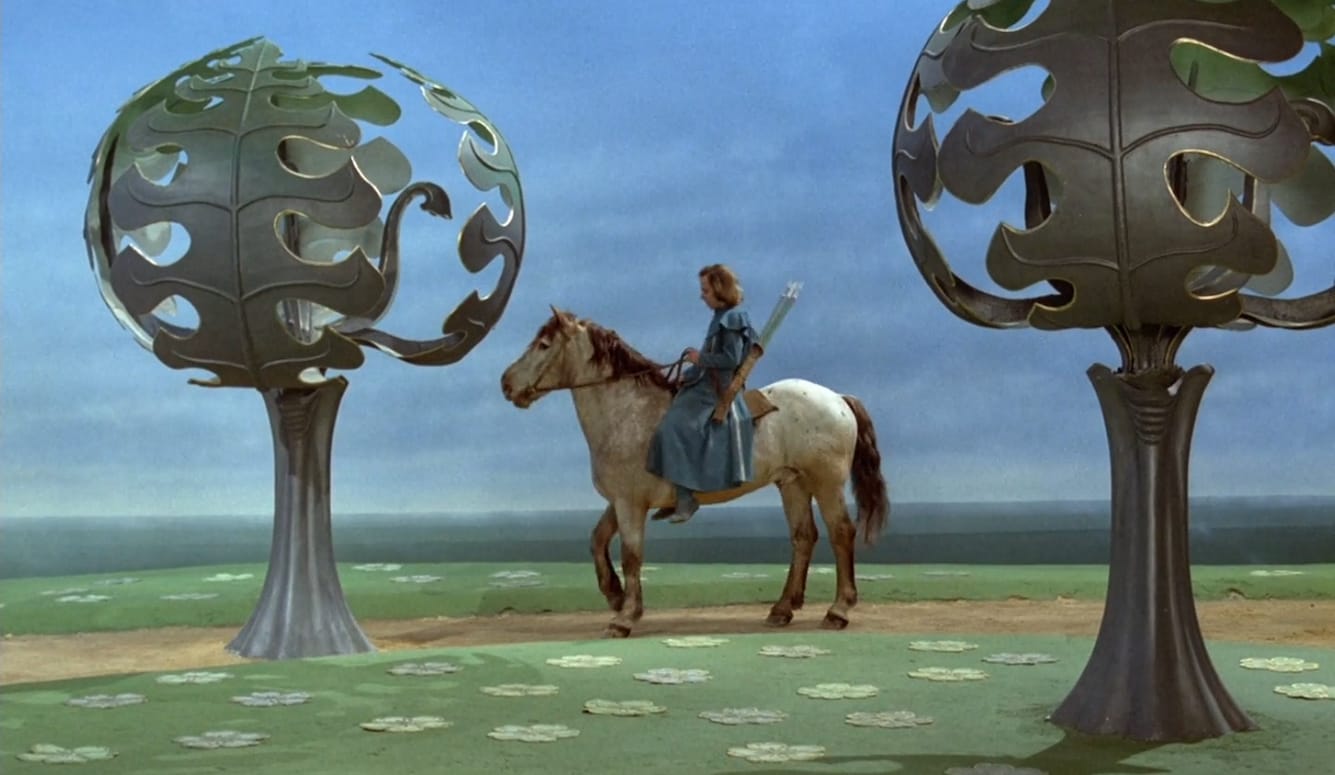
Perceval, on the other hand, is filmed entirely on a circular sound stage at the Epinay Studios outside Paris with the camera and audience placed in the middle of the action. Cinematographer Néstor Almendros bounced his lighting to create flat and shadowless compositions, and the bright costumes mimic the colour schemes of 12th-century manuscripts. With a handful of enormous steel trees standing in for the forest—the futuristic creations of the film’s set designer, Jean-Pierre Kohut-Svelko—and castles clearly constructed out of plywood, the film is artificial from top to bottom. Even the sky is a painted backdrop. The whole thing resembles a cross between a theatrical production and The Wizard of Oz, another colour-saturated sound-stage creation.
And unlike so many of Rohmer’s other movies, which found solid if never huge art-house audiences and garnered awards, Perceval was a resounding flop. It attracted fewer than 145,000 viewers during its entire first run in France, and it fell into obscurity elsewhere. Antoine de Baecque and Noël Herpe, co-authors of the massive Éric Rohmer: A Biography (2014), quote from the “chorus” of film critics of the time who “deplored the film’s coldness, its schoolmasterly or theatrical rigidity.” Jean-Louis Bory of Le Nouvel Observateur was especially sarcastic. He bemoaned the “ugliness” of Rohmer’s stylised stage-forest (“a bed of Brussels sprouts on long stems”) and called the film’s eponymous hero “a charmless nincompoop.” Even de Baecque and Herpe groused about what they considered Perceval’s “tedious length” of two hours and forty minutes. So unpopular has Perceval proved to be over the years that the only way to view it in the United States right now is to buy a used VHS tape or DVD. (I had to do both in order to write this essay, obliged to spring US$102 for the increasingly unavailable DVD after the US$12 tape I got from Amazon split into two unspliceable ends halfway through.)
Perceval is based on an Arthurian legend, but not an Arthurian legend that most people have ever heard of, such as Lancelot and Guinevere’s forbidden-love story in Camelot. Instead, Rohmer based his film on an unfinished 9,000-line narrative poem written by Chrétien de Troyes, a 12th-century French poet whose name is probably only familiar to French schoolchildren who studied him as part of their cultural heritage. The protagonist, Perceval, is the same “Parsifal” who encounters the Holy Grail, the miraculous chalice in Wagner’s eccentric opera that was said to have contained Christ’s blood. The “quest for the Holy Grail,” a perennially favourite theme for centuries of Western storytellers, should have sparked some audience interest, if only because the Monty Python take on it had been released just three years earlier. And Chrétien describes his poem as “the story of the Grail” right in his prologue (no “Holy” or overt connection with the blood of Christ—that was the handiwork of later medieval authors).
Unfortunately, Chrétien died in around 1191 before he could finish the poem, so we never really learn very much about the Grail or any “quest” for it. It makes a single mysterious appearance: a luminous vessel that looks (in Rohmer’s movie) like a punchbowl and is carried by an equally mysterious maiden. The Grail comes to haunt Perceval as time passes, so we can assume that he will see it again sometime later. But Chrétien’s authorial pace is leisurely, and Rohmer’s adaptation declines to tie together any of the narrative strands that the poet’s death left in disarray. So the movie, like the poem, consists of a series of adventures involving Perceval on horseback as he grows from rustic-bumpkin youth (that was the Welsh stereotype during Chrétien’s day) to skilled knight and model of chivalry. There are also confusing digressions, in which Chrétien (and Rohmer) narrate unconnected adventures of a better-known Round Table knight, Sir Gawain, which also involve chivalry and knightly deeds. These subplot yarns are pleasant to watch onscreen, but they are also likely to inspire many viewers to throw up their hands in frustration: What exactly was Éric Rohmer trying to get at?
Not only is the story inconclusive, but Chrétien wrote the entire narrative in rhyming couplets, as was the practice of 12th- and 13th-century poets, and in Old French, the vocabulary, spelling, and word-order of which are markedly different from today’s modern French. Rohmer translated these lines into modern French for his movie, but he retained the octosyllabic (eight syllables per line) structure that Chrétien had used, as well as some of his archaic lexicon, creating a kind of hybrid language with elements of both the medieval and the modern. The delivery is deliberately singsong, and Rohmer occasionally employs an ensemble of musicians in period garb to sing portions of the verse while they play medieval musical instruments. (The music was courtesy of medieval-musicologist Guy Robert, who used 12th- and 13th-century manuscript notations as the basis of his compositions.) The actors themselves regularly break character to narrate—and sing—their own adventures in the third person. In this way, Rohmer was able to use about two-thirds of Chrétien’s material.
The only way in which Perceval resembles Rohmer’s other films is his casting of attractive young French actors to play his knights and damsels. Rohmer liked working with young people, whom he considered less set in their thespian ways than their older and more established counterparts, who tended to play themselves with all their personal idiosyncrasies instead of the characters he had created. (Legend has it that Gérard Depardieu applied for the role of Perceval and was turned down.) Rohmer populated Perceval with appealing youths who had appeared or would appear in some of his other films: 27-year-old Fabrice Luchini plays Perceval with brashness and subtle humour (he was quite the opposite of charmless); André Dussollier, then 32, as Gawain; and Arielle Dombasle, then 24 or 25, and with waist-length strawberry-blonde hair, as Perceval’s lady-love, Blanchefleur. Rohmer was famous for discovering exceedingly pretty budding actresses whom he liked to strew into his movies like flowers; in Perceval they’re ubiquitous, attired in clingy, jewel-tone medieval gowns. His friends dubbed them the rohmeriennes. Arielle Dombasle was queen of the rohmeriennes.
II.
I found all of this enthralling when I first saw Perceval almost 25 years ago. I was in the first semester of a doctoral program in medieval studies, and I had enrolled in too many courses to maximise my scholarship. As a result, I was struggling, especially with an advanced-level Latin class that was required for the degree but over my head. This was at the tail-end of the VHS heyday and there was a rental outfit two blocks from my apartment. To fill the tiny gaps of leisure in my around-the-clock schedule, and to get myself into the medieval spirit, I’d check out tapes of Middle Ages-themed movies and stuff them into the VCR to watch while I cooked myself some dinner: Ivanhoe, The Seventh Seal, The Passion of Joan of Arc, whatever. And there was Perceval, still in pristine condition because no one else wanted to rent it. It was magical. It was transformative. I wasn’t looking at a spruced-up, Hollywood-star version of the Middle Ages (Ivanhoe, El Cid), or at a mud-and-fleas, blood-and-bad-hair version of the Middle Ages (Monty Python, Robert Bresson’s 1974 Lancelot of the Lake). I wasn’t looking at any effort to recreate the actual Middle Ages at all. I was looking at a highly successful effort to recreate the imaginative world in which the people of the Middle Ages lived inside their heads.
The clear and brilliant colours of Rohmer’s palette and the gilding on the plywood castles, all of which was luminously filmed by Almendros, made every frame look like it had been lifted from the parchment page of an illuminated manuscript. The lilting verse couplets and the structure of the melodies that accompanied them seemed to come straight out of the lectures in my beginners’ survey course on medieval culture. My Latin class might have been a slog of long passages from St. Augustine and St. Jerome, but there in front of my eyes were delightful morsels of the ways in which medieval people entertained themselves in their spare time and in their own vernacular languages: îles flottantes on a bed of the more serious discourse in Latin that marked their religious lives and practices.
It was only while I was researching this essay that I learned that the effect Perceval had on me was the effect that Rohmer had specifically intended. In January 1978, Rohmer gave an interview to his longtime friend, the writer and filmmaker Nadja Tesich-Savage, who had played the lead role in his early film Nadja à Paris (Nadja in Paris, 1964). The six-page interview was published later that year in the bimonthly magazine Film Comment, and it dealt almost exclusively with the making of Perceval, which Rohmer had just begun to shoot. He told Tesich-Savage:
I am not trying to show the Middle Ages as we would see it if we could go back to it in a time machine and photograph it. I am searching to rediscover the mindset of the Medieval period as it saw itself. ... The Middle Ages are often seen as a dark period, full of barbarism. For me it is the opposite. I see the refinement in the art of the Middle Ages, in the architecture, paintings and music, and I believe that the people who composed such refined and beautiful music could not be barbarians. ... I believe that you can judge a period by the idealized image that it offers of itself, and often the period is better described by an idealized image than a “truthful” one.
Rohmer devoted meticulous attention to detail in his movies, down to the exact shades of the colours he wanted in each scene. He spent months setting up what he deemed the look and feel of medieval art and literature. He spent a year before shooting in dry rehearsals with his actors, training them not just how to deliver their octosyllabic lines, but also how to gesture in the manner of figures in the Romanesque painting and sculpture of the 12th century: elbows close to the waist, arms extended, and hands opened. A not-untalented artist himself, Rohmer made sketches of the way he wanted everything to look (Kohut-Svelko’s abstract-looking trees owed as much to Rohmer as they did to Kohut-Svelko himself).
The sets were to have the look of Romanesque paintings, which meant there was to be no attempt at creating perspective because in Romanesque painting “there is no perspective,” as he told Tesich-Savage. This meant that human figures were to be out-of-proportion—typically larger than—the castles they inhabited or the mountains they climbed, just as in 12th-century art. The only exception were the horses. In medieval manuscript art the horses are usually much smaller proportionally than their riders, because the riders are more important for the narrative than their mounts. But Rohmer wanted to use live horses on his set, so he made an exception for the exceptionally beautiful animals that many of his characters ride. He also had remarkably accurate-looking suits of armour fashioned for his knights by costume designer Jacques Schmidt: heavy chain mail and pointed steel helmets with nose-guards that looked like they had been lifted from the Bayeux Tapestry.
Rohmer was crazy about Chrétien de Troyes and especially about Perceval, which he made his adolescent students read during the decade he spent in his twenties teaching literature at a lycée before he could support himself in the film world. In 1964, he had made a 23-minute short film for French educational television titled Perceval ou le Conte du Graal (Perceval, or the Story of the Grail). For this project, he used illustrations from a 13th-century manuscript housed at the Bibliothèque Nationale de France in Paris. In an interview for L’Avant-Scène Cinéma, Rohmer described the text of Perceval as “one of the most beautiful in French literature.”
He was right. Chrétien de Troyes was not only a literary master in his own right but the inventor of “Arthurian” literature as a literary genre: stories about King Arthur and his court that have kept poets, novelists, playwrights, moviemakers, illustrators, and comic-book writers busy for more than 800 years. He didn’t invent King Arthur himself. Chroniclers in England and Wales had already taken note of Arthur—who might have been a real 5th- or 6th-century warlord, or might have simply been an invented folk-hero—as a majestic Celtic-British ruler who defended his country against the invading Angles and Saxons after the Romans deserted Britain. By the mid-12th century, thanks to the imaginative energy of chroniclers and bards, the canonical saga of Arthur’s life was well-established: the sword Excalibur, Merlin the magician, Queen Guinevere, the isle of Avalon.
But it was Chrétien who shifted the focus of the Arthurian stories away from King Arthur himself to his court and its individual knights. He likely invented Sir Lancelot as Guinevere’s secret lover in one of his narrative poems (five of them survive, and there may have been more), as well as Camelot as the site of one of Arthur’s castles. Perceval was another of his inventions, and he probably invented the Grail as well. His stories are so full-blown that generations of academic researchers and amateur scholars have searched for their possible sources in Welsh and Irish myths and legends, as well as in the oral lore of medieval Brittany, to which many Celtic Britons had fled after the Anglo-Saxon invasions.
And there are tantalising parallels to be found in some of those myths and tales, especially concerning the Grail, which might have originated as a magical dish of plenty that supplied endless food to those who possessed it. One of the most famous of the amateurs, Jessie L. Weston (1850–1928), wrote a book titled From Ritual to Romance (1920), in which she argues that the Grail had once been a primeval pagan fertility symbol. Her book so impressed T.S. Eliot that he incorporated Weston’s theories into his long poem The Waste Land (1922), in which he borrows motifs from Chrétien’s Grail story—the wounded, possibly castrated Fisher King (Roi Pescheor in Chrétien’s Old French) and the waste land itself (terres... essillees)—as representations of the ennui and moral dislocation into which Western society had fallen after the devastation of the First World War.
But none of these parallels conclusively link any of Chrétien’s narratives, even the Grail story, to earlier sources. His narratives seem to be whole-cloth creations in which he intermingles knightly deeds of valour with the knight’s devotion to his lady—the latter borrowed from the courtly-love motifs in the songs of the troubadours of Southern France. Chrétien’s narrative poems are structured as romances: knight meets girl, knight and girl are separated, knight and girl reunite in a happy ending. In that respect, Chrétien could be said to be the father of the modern romantic novel.
III.
We know next to nothing about Chrétien himself, except that he apparently had some connection to the city of Troyes in northeastern France. We have no idea when he was born, and even the approximate year of his death is a matter of conjecture. We do have the names of some of his aristocratic patrons because they’re preserved in the prologues to his poems. He was also an unusually felicitous writer. Many of the Old French authors who churned out octosyllabic couplets as though they were selling their verses by the yard wrote ploddingly and quasi-mechanically. Chrétien’s lines, on the other hand, are rhythmic and melodious. And most importantly, they move the action along, leaving the reader eager to find out what happens next. Here is a sample from Perceval’s opening:
Ce fu au tans qu’arbre florissent,
fuelles, boschages, pré verdissent,
et cil oisel au lor latin
dolcement chantent au matin
et tote rien de joie anflame,
que li filz a la veve dame
de la Gaste Forest soutainne
se leva, et ne li fu painne
que il sa sele ne meist
sor son chaceor et preist
iii javeloz, et tote ensi
for del manoir sa mere issi.
[It was at the time when the trees are in bloom—and the leaves, the woods, and the meadows turn green, the birds sing sweetly in their own language in the morning, and all is aflame with joy—that the son of the widow lady of the Waste Forest got up, saddled his hunting horse effortlessly, took three javelins, and went forth from his mother’s manor.]
We want to know what he did with those javelins—and we soon find out.
These very words, condensed only slightly, open Rohmer’s movie as well. Perceval, we quickly learn, is a young man with his heart in the right place, and he is certainly courageous as well as handy with a pike. But he is ignorant of social manners and mores, and he is also callow and selfish. His widowed mother (played by Pascale de Boysson in Rohmer’s movie) has raised him in isolation in the Welsh forest, to keep him away from the company of knights, because his two older brothers have been killed in knightly combat and his father has died of grief over their fate. Although she has taught him his Christian prayers, he is ignorant of Christian theology and doesn’t even know what a church is. But while riding with his javelins in hand, he runs into a group of knights so dazzling in their chain mail with their blazoned shields and their lances that he mistakes them for God and his angels. He immediately decides that he wants to be a knight himself. So he bids a hasty farewell to his mother—so hasty that she collapses into the arms of her handmaids while he refuses to look back—and takes off for King Arthur’s court.
He then has a series of bumbling adventures that somehow turn out all right. His mother has told him that it is fine for him to kiss a girl and to accept her ring but not to go any further, so when he encounters a comely young damsel (Clémentine Amoureux) sleeping alone in a tent, he grabs her and kisses her even as she tries to fight him off. He wants her ring, but when she tells him he will have to pry it off her finger, he takes her literally—and pries it off her finger. This gets the girl into trouble when her brutish lover (Jacques de Carpentier) returns to the tent later, accuses her of giving Perceval more than a kiss, and takes out his jealousy on her. When Perceval reaches Arthur’s court, he barges into the banquet room on his horse, because one of the knights he met earlier told him never to dismount. But he proves himself. He hurls one of his javelins into the eye of the Red Knight (li Vermauz Chevaliers, played by Antoine Baud) who has been threatening Arthur’s castle and stolen the King’s wine cup. This deed allows Perceval to strip the Red Knight’s body of its armour and weapons—and also to trade in his hunting horse for the Red Knight’s glamorous palomino—in order to become the Red Knight himself. He has the wine cup sent back to Arthur and takes off on his new mount.
Perceval’s next encounter is with an older knight named Gornemant de Goort (Raoul Billerey), who takes him under his wing. Gornemant teaches him how to ride in proper knightly fashion with stirrups, and also how to use the new knightly weapons of lance and sword that he has seized from the Red Knight’s body. Gornemant also instructs him in the knightly ethos: Go to church, come to the aid of maidens—or anybody else—you find in distress, and when you have disarmed an enemy in combat and have him at your mercy, show him that mercy and don’t kill him just because you can. Chivalry is more than being gallant to ladies; it is a code of conduct for warfare against men, and it demands humane treatment of one’s defeated enemies because war itself is brutal enough. And never be too talkative. “He who talks too much commits a sin,” Gornemant warns (“is a fool” in the English subtitles).
Perceval puts those principles into action when he comes across a deserted and starved-out town, most of whose inhabitants have fled. It is ruled by Blanchefleur, who is Gornemant’s niece (Dombasle looking resplendent in a scarlet dress). She offers him meagre but gracious hospitality. Later that night, she slips into the room where he is sleeping and tearfully confides in him that the castle has been under siege for months by the wicked lord Clamadieu (Guy Delorme), who has killed most of her knights and plans to make her his prisoner and concubine. Perceval promises to be her champion and invites her to lie next to him in his bed—but chastely, because he remembers his mother’s counsel never to go beyond a kiss. And so they sleep that night innocently entwined in each other’s arms, “boche a boche, braz a braz,” as Chrétien writes. It’s lovely and touching. The next morning, Perceval handily defeats both the strongman Anguingueron (Sylvain Levignac), whom Clamadieu has sent to take over the castle, and Clamadieu himself. But following his new chivalric morality, he declines to behead either man as was usually expected, and he sends them both to turn themselves in to King Arthur. (He later affords similar generosity to the lover of the tent girl whose ring he stole after he takes it upon himself to avenge her honour, and to the perennial Round Table malcontent, Sir Kay, who slaps a girl in his presence.) He rides off hoping to visit his mother, promising Blanchefleur that whether his mother consents or not, he will return and make her his wife.
But it is Perceval’s brief sojourn at the Fisher King’s castle that proves to be his undoing. The King (Michel Etcheverry) is so badly wounded that he cannot walk and must be carried about—and the wound will not heal. (He gets his name because all he can do is lie in his boat and fish.) While they are at supper, Perceval witnesses a puzzling procession around the table: a young man carrying a lance, the tip of which drips blood; two youths bearing lit candlesticks; the maiden with the Grail that gives off its own light, followed by another young woman carrying a kind of tray. Mindful of Gornemant’s counsel about chatterboxes, Perceval fails to ask the Fisher King what it all means. That is the single glimpse of the Grail that we have in Chrétien’s poem. It so fascinated readers that after Chrétien’s death, four different early-13th-century French poets working in succession grafted 54,000 more lines onto Chrétien’s original 9,000, and writers in other languages followed suit. These “continuations” add intricate plots involving other knights of the Round Table—Lancelot, Sir Galahad—and explicit Christian symbolism to the now-“Holy” Grail. But since Chrétien himself gave no indication of what he planned to do, beyond making the Grail the centre of his tale, his literary intentions are anyone’s guess.
We do know that Perceval’s silence at the Fisher King’s banquet works a curse on him. He is accosted by a hideously ugly young woman (Coco Ducados with Bride of Frankenstein hair in Rohmer’s film) who berates him for not asking the King about the meaning of the Grail and the lance. She informs him that if he had spoken up, the King’s wound would have been healed—but now, not only will his wound continue to bleed but his lands will be laid waste and their populations will die. Perceval seems to fall into a paralysed trance (for five years in Chrétien’s poem), during which he even forgets God. Finally, he comes across a procession of penitents who tell him he shouldn’t be bearing arms because this is Good Friday, the day that Jesus Christ was crucified for man’s sins. (In Chrétien’s text, although not in Rohmer’s film, the blame, in standard medieval fashion, falls upon the “wicked Jews” [fel Giu].) The penitents direct Perceval to a hermit living in the forest (Hubert Grignoux in Rohmer’s movie). He tearfully confesses that he sinned greatly by remaining silent about the Grail and the lance and by failing to make amends afterwards. The hermit informs him that he indeed committed a wrong: The Fisher King is in fact the brother of Perceval’s late mother—as well as the hermit’s own—and that every day the Grail is brought to the King, containing a single Eucharistic host, which is his sole nourishment.
In Chrétien’s narrative, Perceval spends the next day praying with his new-found uncle the hermit, and then receives Communion from him on Easter Sunday. And that is the last we hear from Chrétien about Perceval, although the poem itself continues for another 2,000 lines or so, detailing an adventure of Gawain’s that breaks off abruptly. Does Perceval try to return to the Fisher King’s domain? Does he finally marry Blanchefleur? Who knows?
Rohmer dramatically altered this last episode—the only major change he made to Chrétien’s source. He retained Perceval’s conversations with the penitents and the hermit in truncated form, but he eliminated the final Gawain episode and Easter itself; Perceval leaves the hermit after making his confession on Good Friday. In place of these omissions, Rohmer substituted a twelve-minute Passion play reenacting Jesus’s crucifixion that Perceval stumbles into when he visits a church later that day. It is an abrupt change of mood, prompted by the fact that Rohmer’s singers chanted the entire play a cappella and in Latin without subtitles—at least in French, as my own newly purchased DVD includes subtitles in English. Rohmer cast Fabrice Luchini himself as Jesus carrying his cross in this play-within-a-film, while Pascale de Boysson, Perceval’s mother, took the role of Jesus’s mother, Mary, and Arielle Dombasle played Mary Magdalene (those two didn’t survive the final cut). The drama ends with Jesus’s dead body being gored by a soldier’s lance as it hangs on the cross. Overwhelmed by this spectacle of blood and redemption, which he is clearly seeing and hearing for the first time in his life, Perceval bolts off on his horse. “The knight rode on through the forest,” the musicians sing in their Chrétien-esque French. And then we are done.
IV.
The Latin in Rohmer’s reworked finale probably turned off spectators, and it is all but certain that the transformation dumbfounded Perceval’s audience, who were likely to have been overwhelmingly secular. Rohmer was a practising Catholic, an anomaly in itself at a time when militant soixante-huitisme ruled France’s cultural institutions, so he kept his Catholicism to himself. He also subscribed to a royalist periodical, but he kept his political conservatism to himself as well. Indeed, Rohmer kept everything secret that might be associated with his private life, in contrast to his public life in the world of cinema. Even the name “Éric Rohmer” was a pseudonym adopted in 1955; he was born Jean Marie Maurice Schérer to a middle-class family in Tulle, Corrèze. He hid his public persona from his family just as assiduously. His mother went to her grave thinking he was still teaching at a lycée. Others among his closest relatives—his wife, his two sons, and a younger brother, René Schérer (a University of Paris philosophy professor and anarchist theorist)—didn’t cross paths with his longtime friends from the film world until his funeral. Rohmer’s movies often explore moral dilemmas that could be implicitly linked to a scholastic form of Catholic philosophy, but only in Perceval is his Catholicism explicit and lurid.
The Passion-play genre—a dramatisation of the bloody sufferings of Jesus performed inside and outside of churches—emerged during the Middle Ages. We have Latin texts dating back to at least the 13th century. The genre survives in Holy Week rituals, where the actor playing Jesus will sometimes even be fastened to the cross with real nails through his palms. Many modern Westerners, Christians included, find such literal performances of the sadistic infliction of suffering bizarre, distasteful, or both. But as Roger Ebert, himself a Catholic, remarked in response to the critics who belittled Mel Gibson’s The Passion of the Christ (2004) as an exercise in violence porn, the whole point of a Passion play is exactly that: “To make graphic and inescapable the price that Jesus paid (as Christians believe) when he died for our sins.” He added: “This is not a sermon or a homily, but a visualisation of the central event in the Christian religion. Take it or leave it.”
Most of Perceval’s critics seemed to have left it. At best, some of them have taken the stance of Karl Steel, a professor of English and medieval studies at the City University of New York, who argues that despite Perceval’s nod to piety, Rohmer’s presentation of Christ’s passion is essentially nihilistic; there is no Easter so there is no resurrection, and Perceval simply rides away into the forest after Jesus’s staged death. In a 2020 entry in the medievalist blog In the Middle, Steel asserts:
[Rohmer] builds the critique of “false closure” into his film, or, understood differently, extends the film past its ending into an unending, haunting the Passion Play and his own glossing of the narrative with what frustrates any foreclosure or eschaton of significance.
Shorter version: Rohmer cynically undermined his own religious creation. Even de Baecque and Herpe, who devote an entire chapter in their book to the mechanics of Rohmer’s construction of Perceval, complete with back-soundstage gossip, don’t really understand what Rohmer was trying to do. They describe the text that Rohmer used as “a series of Sulpician playlets,” as though it had been composed as a work of counter-Reformation emotional piety. In fact, the text, including the lance plunged into Jesus’s side, came word for word from St. John’s Gospel, the scriptural reading for Good Friday in Catholic churches to this day, although not usually in Latin.
It is clear, for example, that Chrétien wanted his Grail story to have some sort of Christian meaning—or else the Grail wouldn’t be a container for a Eucharistic wafer. The pair of candlesticks might be altar furniture, and the lance with its bleeding tip might have something to do with the lance in John’s Gospel. In Chrétien’s four other Arthurian romances, Catholicism hums along as cultural background noise; the characters go to Mass, and they hold tournaments on Catholic feast days. In Perceval, there is a conversion of heart and soul. Rohmer, similarly, was finally prepared to push his private Catholic faith into the limelight for a single adaptation of a text he loved. He was quite explicit about this aim in his interview with Tesich-Savage:
The end will be very Christian, closing with the Passion played with full force. Perceval in the beginning believes that God is a warrior. In the end he realizes that God is a victim, a man humiliated and beaten.
Rohmer’s Passion play is no Passion of the Christ, but it is bloody enough. Pointedly, Rohmer has his Roman soldiers with their spears and scourges costumed like the very knights whom Perceval comes close to worshipping at the beginning of the movie. His aim, I think, was to show that the luminous and idealised medieval high culture that he admired so much lay upon a substrate of a ghastly deed fuelled by human malice and indifference, and it was that dreadful thing, that primeval sacrifice, that made the high culture possible. Of course, Good Friday is not Easter. Of course, Perceval rides away to continue on, because he, like the rest of us, has to live his life in a world that is real and often ugly, not idealised. But Rohmer showed in Perceval that it is possible at least to imagine something beautiful.
Quillette invites thoughtful responses to its essays.
Selected responses are published once per week as part of a curated Letters to the Editor feature. If selected, letters appear under the contributor’s real name and may be edited for clarity and length.
To submit a letter for consideration, please email [email protected].
Keep reading
Rohmer at Camelot
Communism’s Obsolescence

To Meet a Chatbot

Searching for Structure

Strange Bedfellows

The Axis of Renewal