Skip to content

United Nations

The United Nations Is Going Broke

Too often, the UN’s valuable field work is overshadowed by cynical political posturing. As a result, collecting annual dues from member states has become more difficult.
· 8 min read
A franked stamp with “United Nations” written in English, Spanish, Russian, Chinese, and French and the UN flag.
A three-cent postage stamp issued by the United Nations postal administration in 1951.

From its earliest days, the United Nations has inspired a mix of reverence and ridicule. It is at once history’s most ambitious experiment in multilateralism, and, to conservative proponents of realpolitik (particularly in the United States), enduring proof of the doctrine’s limits.

Exhibit A—for both camps—is the radically democratic nature of the UN General Assembly, whose 193 members all get the same (single) vote. This egalitarian ethos provides smaller nations with the same nominal stature as great powers at the General Assembly. But it also means that dictatorships such as North Korea and Belarus are treated on par with the world’s leading democracies.

Of course, the real power at the UN lies with the Security Council, and especially its five permanent veto-wielding members. But the General Assembly is still billed as the “chief deliberative, policymaking and representative organ of the United Nations,” and its votes carry symbolic weight. Throughout much of the UN’s eight-decade history, communist nations and autocratic client states often voted as a bloc in reflexive opposition to the United States and its allies. The “Parliament of Man” has also served as a mouthpiece for Arab nationalists, and then Islamists, to launch an endless stream of rhetorical attacks against Israel. “The United Nations,” a great wit once quipped, “is not so much a solution to international disorder as a permanent alibi for it.”

Yet the United Nations endures, not because its critics are wrong about its shortcomings, but because it’s better than nothing. This is faint praise, I realise. Still, it’s sobering to consider that, for all its flaws, the UN remains the only permanent standing forum where representatives of every nation can speak to their international counterparts—and, occasionally, even find ways to co-operate productively.

To give one example, it was in large part thanks to the World Health Organization, a specialised agency of the United Nations, that smallpox was eradicated in the 1970s. Other agencies and related organisations include the Office of the United Nations High Commissioner for Refugees, International Atomic Energy Agency, International Court of Justice, International Monetary Fund, United Nations Educational, Scientific and Cultural Organization, and the World Bank. All of these multilateral entities have fairly earned their own critics. However, it’s hard to argue that the world would be a safer, healthier, or more culturally enriched place if they did not exist.

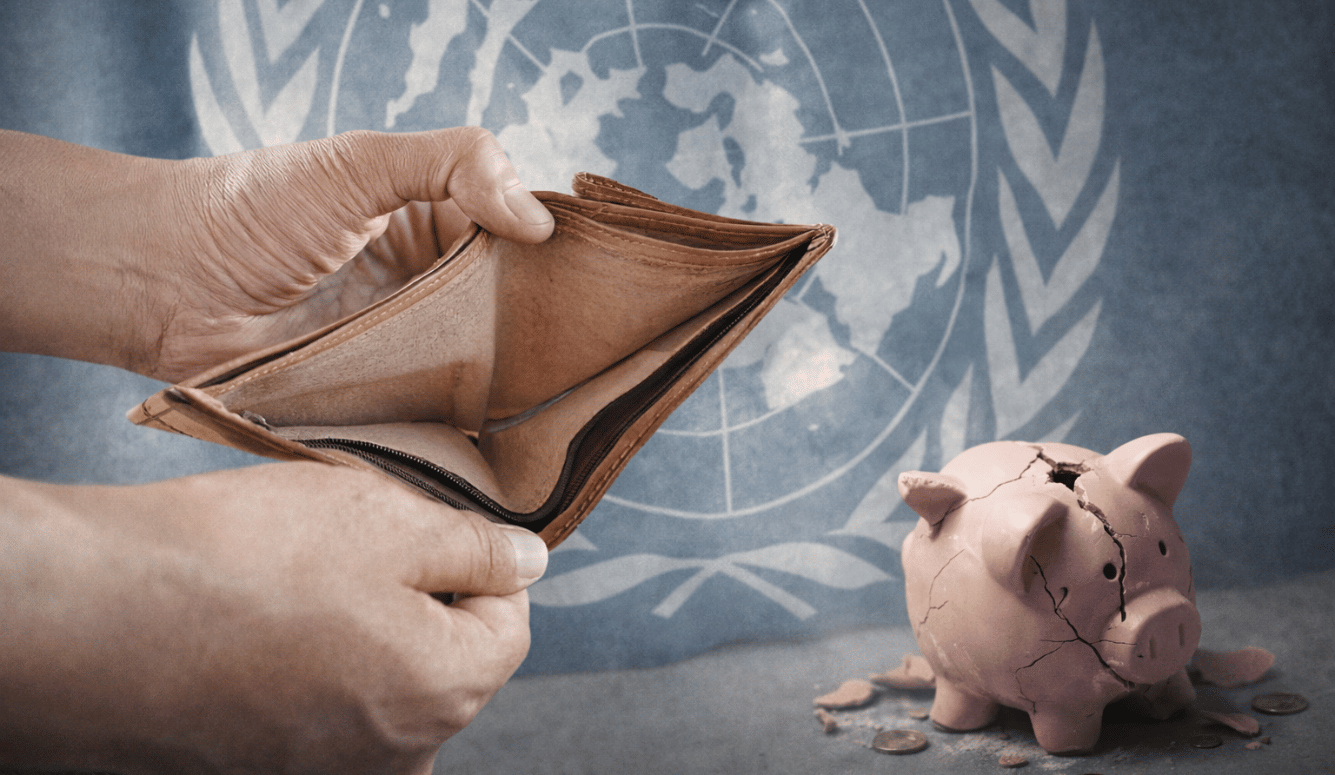
But the United Nations now faces a crisis that threatens to impair its global work. On 30 January, UN Secretary-General António Guterres warned that the body is on the brink of “imminent financial collapse,” citing record-high unpaid dues totalling nearly $1.6 billion (all figures US) and outdated budget rules. He cautioned that the UN could run out of cash by mid-2026, and urged member states to pay their assessed contributions in full and on time, or agree to fundamental financial reforms.

NATO Is an Alliance, Not a Protection Racket
Even if unsuccessful, Donald Trump’s aggressive campaign to acquire Greenland threatens to undermine America’s reputation as a champion of western security, freedom, and co-operation.

The core UN Secretariat budget for 2026 is $3.45 billion, an amount that covers the cost of running UN offices around the world (including the headquarters in New York), and staff salaries. The figure represents a seven percent reduction from the 2025 budget, which came in at $3.72 billion. In the interim, the UN was forced to trim its gargantuan bureaucracy. A press release noted that “as of 1 January 2026… 2,900 positions will be abolished, while more than 1,000 staff separations have already been finalized.”

National financial contributions to the UN are calculated according to a formula based on each country’s share of global gross national income. (A separate formula is used to calculate peacekeeping assessments, which can be offset by troop contributions.) The United States’ assessment tops the list, at 22 percent of the global total; followed by China at 20 percent, and Japan at 7 percent. For many countries, the assessment is so small as to be essentially symbolic. Africa as a whole, for instance, pays almost nothing.

UN Assessment Rates per country for 2026 budget | Created with Datawrapper
The UN is funded by its members. The amount of each member contributes is determined by the size of their economy and capacity to pay. In 2026, the United States was assessed at the maximum rate of 22%, followed by China at 20%.

But this UN “regular budget” represents just a small fraction of the outlay for the entire UN system, which is nearly $70 billion. That includes about $30 billion for humanitarian assistance, $20 billion for development assistance, and $9 billion for peace operations. Much of this is funded by voluntary national contributions made on an issue-by-issue basis. Because such commitments must be renewed regularly, they can fluctuate with national election cycles—which is one of the reasons why the UN now finds itself strapped for cash.

The Human Rights Council (HRC), located in Geneva, has a budget of $439 million, which is small compared to the above-listed amounts. But the HRC punches above its fiscal weight when it comes to media attention—to the detriment of the UN’s overall brand. HRC deliberations often feature dictatorial member states presuming to pass moral judgment on advanced democracies (while ignoring their own infractions), episodes that go viral thanks to watchdog groups such as UN Watch.

A prominent part of the HRC’s work is done by Special Rapporteurs, who are appointed to examine the general human rights situation of a specific country or to study a specific category of human rights at the international level. All are nominated pursuant to resolutions adopted by the Human Rights Council. As of last January, there were 60 such Rapporteurs, 46 with thematic mandates and 14 others relating to specific countries or territories. In addition, the UN has created and mandated a welter of international commissions of inquiry and fact-finding missions to investigate potential violations of international law.

Many such UN bodies have been captured by parochial diplomatic constituencies that have little connection to the real world, and which have become punch lines for the UN’s critics. Last year, for example, Saudi Arabia, of all nations, was made the chair of the UN commission mandated to promote “gender equality and the empowerment of women.” These farcical episodes may do little harm to the UN’s bottom line, but they do provide plenty of fodder to critics who see the body as (at best) a social club for cynical, globe-trotting grandees.

The United States has long been the single biggest contributor to the UN’s regular budget and peacekeeping operations. That role has granted Washington outsized influence within international circles, but has also fuelled persistent domestic resentment among critics who ask why American taxpayers should underwrite an institution that often seems hostile to western interests.

As one might expect, Donald Trump is sympathetic to this constituency, and his administration (both during its first and second terms) has imposed sweeping cuts on payments to UN bodies, including the World Health Organization and the Human Rights Council. It also permanently halted funding to the UN agency for Palestinian refugees (UNRWA), which has been accused of serving the interests of Hamas. Last year, the Trump administration announced its withdrawal from the UN Educational, Scientific and Cultural Organization (UNESCO), on the basis that the agency promotes “woke” and “divisive” cultural postures. This is actually the second time that Trump has ordered this move: He withdrew from UNESCO in 2019, but the United States rejoined in 2023 under Joe Biden’s watch.

A year ago, the tally of unpaid assessments to the UN’s regular budget stood at roughly $2.4 billion. Since then, the figure has swelled to nearly $4 billion—$1.5 billion of which is owed by the United States. Other major debtors include China, Mexico, Russia, Saudi Arabia, and Venezuela.

As noted above, a complicating factor is the growing importance of voluntary contributions to the UN budget. While assessed dues cover the UN’s basic administrative and political machinery, much of its real work takes place in troubled regions, where the bills are paid by earmarked donations. This shift has transformed the organisation’s character. While assessments to a central fund encourage the ideal of the UN as a coherent collective entity, voluntary funding allows wealthy donor nations (and sometimes private individuals and NGOs) to influence the agenda, budget cycle by budget cycle, according to their own priorities.

As a result, UN humanitarian agencies must constantly fundraise to maintain operations, just like any other NGO—even if they happen to be operating under the UN’s brand umbrella. These development projects expand in times of generosity and collapse during periods of donor fatigue. And so long-term planning becomes difficult.

Nowhere is this fiscal fragility more visible than in regard to peacekeeping operations, whereby thousands of personnel are deployed to some of the world’s most volatile regions, tasked with preventing renewed conflict, protecting civilians, and supporting fragile political settlements. There are currently eleven such missions underway, spanning the Western Sahara, Congo, Sudan, the Central African Republic, Cyprus, the Balkans, Syria, Lebanon, and Kashmir (where the United Nations Military Observer Group in India and Pakistan has been in operation since 1949).

A map of all UN field missions. Special Political Missions are indicated in purple. Peacekeeping operations are indicated in blue.

These missions are expensive, logistically complex, and politically constrained. When they succeed, few notice outside the affected regions. When they fail, the whole planet knows about it. Delayed payments from member states can disrupt operations, undermine morale, and expose peacekeepers to heightened risk.

Humanitarian operations, meanwhile, have expanded dramatically, as conflict, climate change, and migrations have produced regional crises beyond the capability of any one nation to manage. The UN feeds millions, shelters refugees, co-ordinates disaster response, and provides medical aid in places where states have collapsed or withdrawn. Again, the successes are quiet, and the failures are loud.

It’s a pity that all of this substantive work often gets overshadowed by the performative political theatre that grabs headlines. But to some extent, UN officials only have themselves to blame. The UN chief recently congratulated Iran’s mullahs on the anniversary of the 1979 Islamic Revolution—which, in case anyone needs reminding, ushered in the ruthless theocracy that just slaughtered tens of thousands of protesters.

This kind of misjudgment contaminates the whole UN brand, not just the organisation’s top administrator. And it isn’t surprising that politicians in many parts of the world are getting tired of paying his invoices.

Quillette invites thoughtful responses to its essays.
Selected responses are published once per week as part of a curated Letters to the Editor feature. If selected, letters appear under the contributor’s real name and may be edited for clarity and length.

To submit a letter for consideration, please email [email protected].