interview
Dan Schueftan on Gaza, Iran & the Future of Israel
Israel faces not a solvable conflict but a permanent condition—one requiring deterrence, “violent maintenance,” and historic patience—while confronting both regional enemies and a cultural battle in the West.
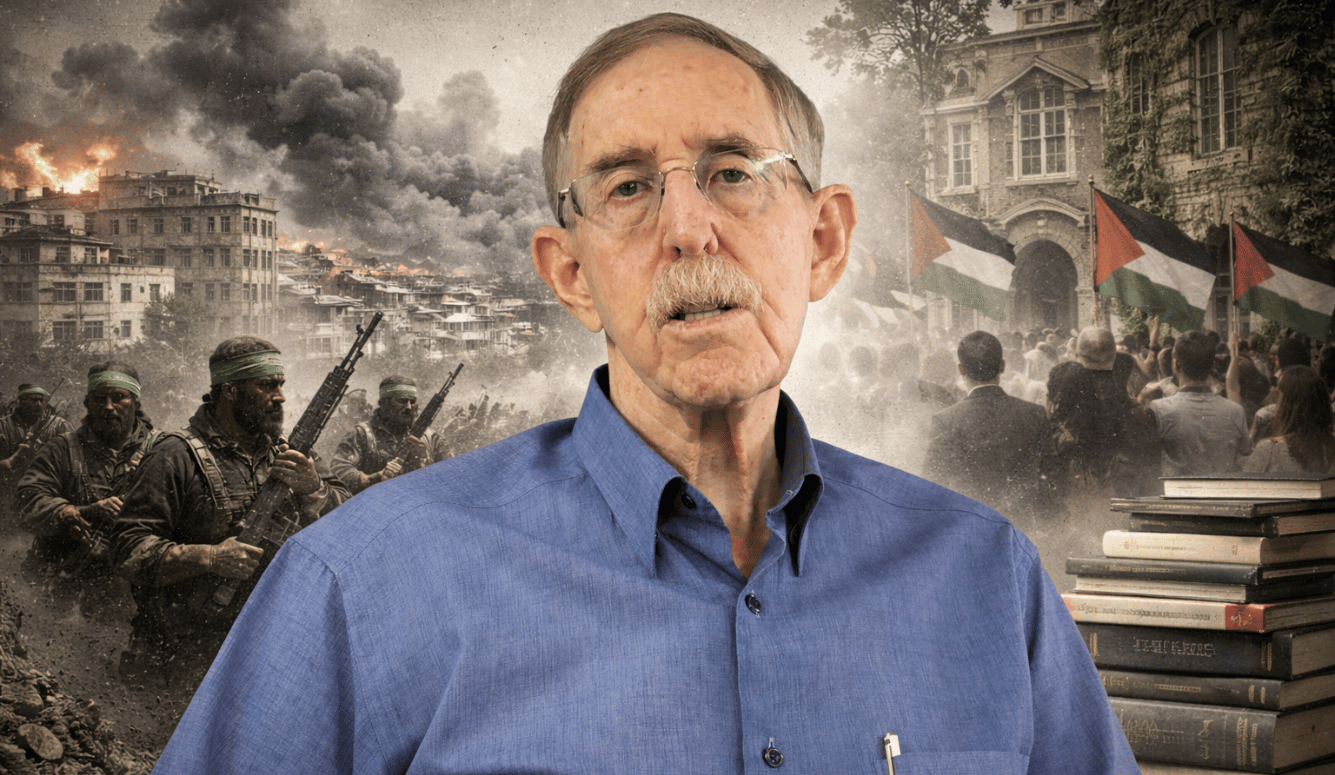

Israel’s recent military victories in Gaza, Lebanon, Syria and against Iran have reshaped the regional balance of power. But according to Professor Dan Schueftan, battlefield success is only the beginning. In this wide-ranging conversation with Pamela Paresky, Schueftan argues that Israel faces not a solvable conflict but a permanent condition — one requiring what he calls “violent maintenance” to prevent enemies from rebuilding.
He also contends that Israel is losing Western public opinion amid a broader cultural shift within academia, media and law. Israel, he says, must be “Sparta towards its enemies and Athens at home” — strong externally, liberal internally, and prepared for a long struggle.
Dan Schueftan: On one hand, we won the war in a very dramatic way—in Gaza, in Lebanon, in Syria, in Iran—and we changed the Middle East, because to a very large extent we have demolished most of the power of the radical axis. Not only those radicals who were intent on fighting Israel indefinitely, but also those who had been terrorising the more moderate elements in the Arab world, are now much weaker than they were before.
In Gaza, Hamas is in a very difficult position, and Gaza is in ruins. In Lebanon, Hezbollah has lost most of its power and is now struggling against a Lebanese government that is trying to re-establish its sovereignty. In Syria, the Assad regime is gone, and the arms it had accumulated over decades were destroyed by Israel. In Iran, we struck very hard both the missile project and the nuclear project, and we worked together with the Americans. The Americans participated in a war that Israel started, and Iran was demoted from a first-rate regional power to a third-rate one.
So the achievements are great. We failed in one category, which I will address later—Western public opinion. And now we are in the next stage of the war: namely, how can we institutionalise the successes of the war? Because striking Gaza is something we have done many times before, and will have to do again in the future. It’s not over. The question is how we can institutionalise the situation in Gaza in a way that will be more convenient for a civilised people defending itself against barbarians who are trying to kill Jews.
In Lebanon, we don’t yet know whether the government will be strong enough to genuinely undermine Hezbollah—particularly if Iran becomes strong and rich again and can finance Hezbollah at a level that will undermine Lebanon again. In Syria, we don’t know what al-Sharaa is, and there is a danger that he will work with the Turks and present Israel with a very serious problem. And in Iran, with an American armada threatening Iran, the question is whether America will accept the existing situation with some modifications, or whether Iran will change in a direction that might one day bring down this regime.
That is what we are struggling with. Let me take each of these fronts in turn and be more specific.
In Gaza, the problem is not a terrorist organisation existing alongside two million innocent civilians. What is wrong in Gaza is the society. It is the Muslim Brotherhood. The Muslim Brotherhood is not just a danger to Israel; it is not only an antisemitic and barbaric organisation. What you have there is a way of life, a philosophy, an ideology that is the number one impediment to the Arab world meeting the challenges of the twentieth century, let alone the twenty-first.
Some parts of the Arab world are successful—the UAE being the best example—but most of the Arab world is so frightened by, or dominated by, those close to Hezbollah that they cannot break out of the vicious circle that traps Arab societies. And these societies are resilient in the sense that you cannot destroy them entirely, because this is what the society is about. We have killed tens of thousands of terrorists. There are tens of thousands of new terrorists because there is something profoundly wrong with the society in Gaza. So it is not over. And it will not be over. And what we are struggling with is: can we prevent the Turks and the Qataris—who are essentially the backers of the Muslim Brotherhood, and not just in Gaza but of every radical force in the region that threatens other Arab countries and Israel—from helping Hamas re-establish itself in the Gaza Strip?
The problem is that Trump has very good relations with Erdoğan and the Qataris, so it’s very difficult to avoid them altogether if you want to work with the Americans. But, on the other hand, instead of the very simplistic approach we had with Biden: “simply stop the war, we want the war to be over”—and had we listened to the Biden administration, Israel would have faced a catastrophe. Nothing short of a catastrophe. Not because Biden wished Israel ill but because he did not understand what was happening in the Middle East. The entire approach of that administration was perhaps sympathetic to Israel, but profoundly misunderstood everything in the Middle East.
So we have the support of the Trump administration in Gaza, Lebanon, Syria, and with Iran, and that is very important. But we do have a problem with Trump’s attitude vis-a-vis Erdoğan and the Qataris, and with a vision that, unfortunately, almost all Americans are committed to: that there is no such thing as an unfixable situation. Americans believe in solutions. There is a problem; you look for a solution. In Gaza, there is no solution. In Gaza, we are fighting them today, we will be fighting them in the next generation and the generation after that. This is what they are. Not what they do, but what they are. You cannot deradicalise them, because that’s what they are.
Is it possible that things will change one day? Yes. But we will know decades before it becomes significant, when we see a different kind of education, a different culture, and people understanding that there is something profoundly wrong with everything they have always had… which is very difficult. I don’t think we are about to see it in the foreseeable future.
So the question is whether we can ensure that Gaza is not rebuilt in a way that benefits Hamas—in a way that allows Hamas to say: we caused this enormous upheaval in the Middle East and got away with it, and now we have a better life than before, and we can still prepare for the next confrontation with Israel.
If people believe—and I don’t—that anyone can persuade Hezbollah to disarm; go ahead, try it. It will inevitably fail. What Hamas is trying to do is exactly what Hezbollah did in Lebanon. Namely, you will have a government in Gaza, that government will get billions of dollars to address economic problems, and Hamas will get a large share of it to build its military infrastructure, exactly as Hezbollah did in Lebanon. Preventing this can only be done by force. You cannot prevent it once and for all; you must constantly use violent maintenance to prevent it. And Israel should prevent the rebuilding of Gaza as long as we don’t get something working in this direction. If it is not bad for Hamas, and if it is not bad for the Muslim Brotherhood, and if the Turks are happy—then we shouldn’t accept it.
The very simple-minded people in America believe you can have a Riviera in Gaza—build a Riviera. But underneath the Riviera, there will be a war—because that is what radical Arabs do, that is what they did in the Gaza Strip, that is what they did in Lebanon, that is what they are doing everywhere they can. So this challenge will not go away. We will not meet in a year or two and say there is a solution. There will be no solution in Gaza. As an Israeli, I don’t think anyone is more sorry about that than Israelis are. But anyone who thinks that anything else is possible has no clue what is happening in the Middle East in general and in Gaza in particular.
Pamela Paresky: What is going on with the Board of Peace that Trump is trying to assemble?
DS: This is a mechanism. In this mechanism, people can meet, they can have coffee, and unfortunately they can send billions of dollars to Gaza—but it will go to the military infrastructure. You cannot change a society through a mechanism. It does not work. When it comes to the Muslim Brotherhood and Hamas, the only thing you can do is violent maintenance. There is no other way. And no solution.
Keep reading
Doomscrolling into Adulthood

Podcast #331: The Ayatollahs’ Assassins

The Disgrace of Tariq Ramadan
Apocalypse ’92