Politics
Progressive Moral Reasoning and Iran’s Revolt
Progressive discourse has become highly adept at identifying oppression, exclusion, and harm. But it is far less capable of understanding the basic conditions of political order.

I.
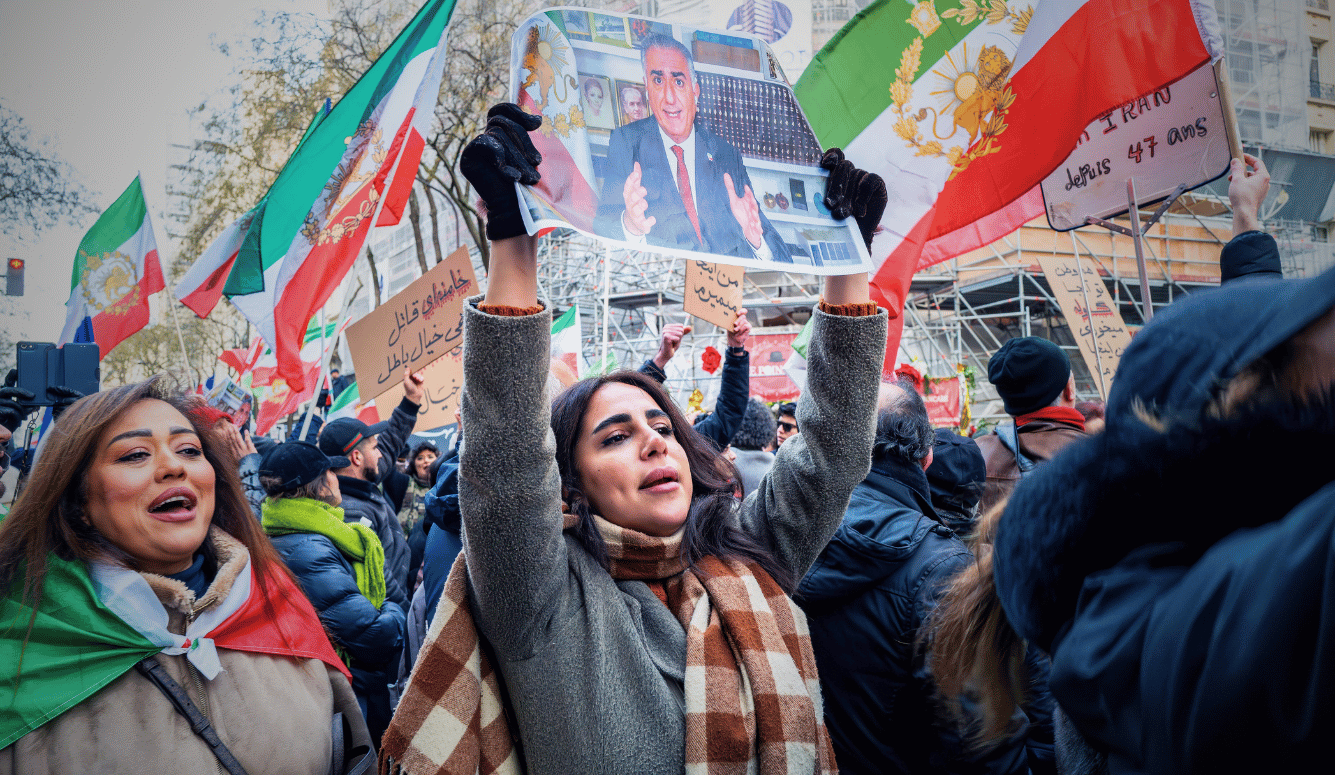
The Iranian revolt of 2026 has exposed a profound flaw in Western progressive thinking. While people in Tehran and Mashhad and dozens of other Iranian cities risk their lives in the name of secular nationalism and constitutional law, progressive activists in the West seem to have nothing to say. If a movement isn’t checking the usual boxes of Western identity politics, they tend to view it as confusing, suspicious, or even reactionary.
Consequently, the Iranian people are showing us, mostly by accident, just how narrow the Western moral imagination has become. Many observers have attempted to interpret the uprising through familiar human-rights and liberationist frameworks, recasting it as another episode of identity-based politics. Others, finding no comfortable place for themselves within it, have chosen silence instead. The result has been a striking absence of sustained global attention.
This absence cannot be explained by material constraints alone, although those constraints are real and severe. Prolonged internet shutdowns have made reporting from inside Iran extraordinarily difficult. Information about mass shootings, arrests, executions, and street-level violence has emerged in fragments, often weeks after the fact—an ominous sign of the situation’s gravity. Even so, an inability or unwillingness to properly acknowledge what is happening in Iran has ensured that the revolt there has received nothing like the sustained attention granted to the Gaza War.
This is a direct result of the moral lens through which the West now filters every political conflict. Even within the Left itself, you’ll hear the occasional grumble that Western leftists are blind to Iranian demands because they only recognise “power” when it looks like Western imperialism. In their eyes, if an oppressor isn’t a Western power, the Left doesn’t have the vocabulary to criticise them. But this critique doesn’t go far enough. It assumes the issue is just a double standard, and that progressives are simply choosing not to condemn certain regimes. The reality is more fundamental: their moral framework is structurally incapable of seeing the Iranian revolt for what it is.
The Left’s moral grammar can recognise injustice with impressive sophistication. Progressive discourse has become highly adept at identifying oppression, exclusion, and harm. But it is far less capable of understanding the basic conditions of political order. When it is confronted with a movement that does not present itself as a struggle for recognition, inclusion, or moral emancipation, the Left’s moral and analytical frameworks fail. This isn’t merely a failure to acknowledge oppression in Iran; it’s a failure to grasp that Iranians are rejecting an entire ideological system of rule. The revolt is misread not because its suffering is illegible, but because its political orientation falls outside the categories through which contemporary moral reasoning assigns meaning.
II.
Unlike earlier waves of protest in the Islamic Republic, the 2026 revolt is not a demand for reform nor an appeal to be governed more gently within the prevailing ideological system. It is a rejection of a state that defines itself as the custodian of metaphysical truth rather than as a provider of ordinary governance. Decades of ideological rule have hollowed out the state, leaving a crumbling economy and a corrupt political system unable to fulfil the most basic functions of government. Iranians are exhausted by constant moral mobilisation, and the most consistent demand on the streets is for a political order capable of governing predictably, lawfully, and without theological theatre.
As economic breakdown has deepened in recent years, a growing number of Iranians have converged on calls for a constitutional monarchy to replace the Islamic regime, not because this prospect is universally idealised, but because it is thought to have the best chance of working in the near term. It is less an expression of romantic attachment than of political resignation shaped by bitter experience. Western commentary often treats restoration as evidence of nostalgia or ideological confusion. But on the ground, it reflects a dearth of alternatives after decades of failed reformism, aborted moderation, and cyclical repression. Iranians believe that restoration offers the best hope of escaping a closed system in which every internal adjustment has already been tried in vain.
It is this pragmatism that makes the revolt especially difficult for Western progressives to understand. Contemporary progressive moral reasoning is orientated towards critique rather than construction. It is preoccupied with naming injustice and exposing domination, but it is suspicious of movements that seek authority and power. Politics, within this worldview, is imagined primarily as a process of moral analysis rather than as the raising of a stable and legitimate order. As a result, much Western coverage of Iran relies on interpretive shortcuts. The uprising is translated into familiar idioms: an intersectional struggle, a women’s rights movement, a generational revolt. These descriptions are not exactly false, but they are incomplete in ways that matter. They make the revolt intelligible to Western audiences but they obscure its defining feature: the decisive collective rejection of ideological governance.
This misapprehension is most apparent in reactions to the revolt’s least fashionable elements. Slogans invoking secular nationalism, constitutional order, or monarchical restoration are routinely dismissed as incoherent, reactionary, or symptomatic of false consciousness. Within progressive discourse, nationalism is treated as a moral pathology and restorationist language as an authoritarian impulse. But responses like these say less about the revolt than they do about the limits of the Western progressive framework.
In recent years, Western leftist, liberal, and progressive media have consistently portrayed the growing consensus around constitutional monarchy—and around Crown Prince Reza Pahlavi, in particular—in negative terms. Rather than treating this convergence as the product of political experience and pragmatic calculation, it is often framed as regression or a failure of political imagination. For participants in the revolt, however, appeals to restoration are not an attempt to resurrect the past wholesale, they are attempts to locate a unifying authority outside the collapsing moral claims of the Islamic Republic. After decades of permanent revolution and ideological absolutism, historical continuity offers a way to imagine political authority without metaphysics.
The same logic applies to the resurgence of nationalism. In the Iranian context, nationalism is not an exclusionary or romantic ideology, it offers patriotic solidarity after decades of imposed theocracy. It expresses the desire to be governed as citizens rather than mobilised as believers. In a society fractured by ideological overreach, nationalism is less a moral statement than a practical one. Seen in these terms, the Iranian revolt is best understood as a refusal of ideological rule and a search for political normalcy. That orientation—descriptive rather than aspirational, pragmatic rather than heroic—is precisely what makes the events in Iran hard for the contemporary Western progressive to understand.
III.
Western progressives’ struggle to make sense of Iran isn’t just a matter of insufficient information or an absence of compassion, it’s built into the way they’ve been taught to see politics. Their moral frameworks were forged in free societies where the central political task is scrutinising power. They’ve focused on expanding rights, tearing down hierarchies, and generally keeping the powerful under a moralistic microscope. These frameworks are not equipped to understand why large populations might seek legitimacy, authority, and order as political goods in their own right.
Keep reading
Made in Moscow
Letters to the Editor
A Paradoxical War
Hearts of Darkness
A New World Order in the Making

Podcast #328: The Extraordinary Exploits of Agent Zo