Skip to content

Politics

The Supreme Leader’s Reckoning

The brutality the security forces are unleashing in Iran is not an improvisation. It is doctrine.
· 6 min read
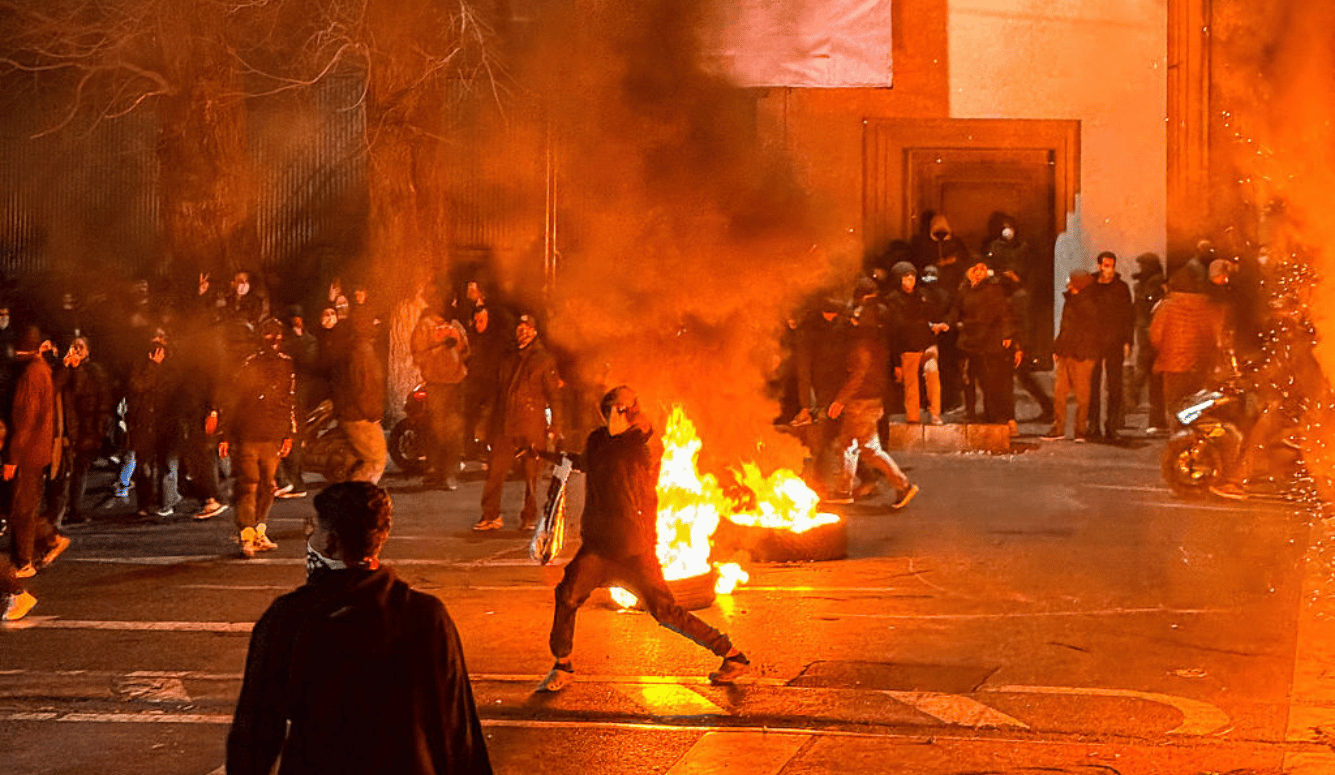
Crowd gathered on a city street at night as a person throws an object towards a burning tyre during a street protest.
Iranians on a blocked street during protests in Tehran. Photograph: MAHSA/Middle East Images/AFP/Getty Images

As fragmentary reports of mass killings trickle out of Iran, it is difficult to absorb the alleged scale and speed of the violence being committed there. A crime of this magnitude—thousands killed, by most estimates—has unfolded in a matter of just two or three days. At a special session of the United Nations Human Rights Council in Geneva last week, Payam Akhavan, an Iranian-Canadian lawyer and former prosecutor for the Milošević trials at The Hague, compared the killings to those committed by the Serbian military at Srebrenica, with one chilling distinction. “It took the Serbs weeks to carry out massacres of that scale,” Akhavan observed. “In Iran, it has taken days.”

According to CBS, “at least 12,000, and possibly as many as 20,000 people have been killed” during the January protests. These figures may turn out to be too high or too low; the Islamic Republic’s near-total internet blackout makes verification impossible. But the uncertainty cannot mitigate the horror. Indeed, it should sharpen it. Every time the regime has cut off all means of communication while prisons overflow and hospitals are overwhelmed, the absence of information has been a prelude to even greater atrocities.

The question the world must confront now is not simply how many people have been killed, but more urgently, how to prevent further crimes from being committed. The threat to tens of thousands of detainees, children among them, has never been greater. This is because the Supreme Leader, who believes himself to be the guide to Shi’ites everywhere, has arrived at the apocalypse he has been preparing for all his life. That, in part, explains why the recent massacre that occurred did not come as a result of panic, miscalculation, or a sudden loss of control. The brutality the security forces are unleashing is not an improvisation, it is doctrine.

The Islamic Republic has faced profound moments of vulnerability before, the most formative of which arrived in the summer of 1988, as Iran’s eight-year war with Iraq drew to a close. The war ended not in the victory that Ayatollah Khomeini had promised, but in exhaustion, humiliation, and defeat. Hundreds of thousands had been slain. The economy was shattered. A population that had endured years of sacrifice was left with nothing to show for it.

Inside Iran’s prisons sat thousands of political detainees—leftists, dissidents, members of banned opposition groups—many of whom had already served their sentences or were nearing release. To a regime facing its first major reckoning, these men and women represented threats: they were witnesses to failure, and once they regained their freedom, they were potential fomenters of dissent.

What followed was one of the late 20th century’s least-acknowledged atrocities. Over the course of several months, the Islamic Republic carried out a coordinated, nationwide massacre in its jails. Death commissions were convened. Prisoners were asked a few questions assessing their beliefs: Do you believe in the Koran? Do you believe in the Prophet? Do you pray? etc. If they answered no to any of these questions, they were sent to the gallows. The prison officials refused to return the remains of the prisoners to many of the families, lest they stage funerals that would lead the grieving crowds into protests. Most of the bodies were instead buried in mass graves. 

The massacre of 1988 obliterated a generation of the nation’s political class and became a key legacy for the regime, which learned to use mass murder as a tool of survival. This terrible event also changed the course of history in Iran. In 1988, the designated successor to Ayatollah Khomeini was a senior cleric named Ayatollah Hossein Ali Montazeri. When Montazeri learned what was happening inside the prisons, he vehemently objected. He wrote to Khomeini and told him that the killings violated Islamic principles, stained the revolution, and weighed on his conscience, and he insisted that he could not, in good faith, inherit power purchased with the blood of others.

Iran’s Weekend of Blood
How internet blackouts, morgue data, and medical testimony point to a five-digit death toll.

Montazeri’s refusal is essential to remember, because it demonstrates that another path was available. The regime was not compelled by theology or circumstance to slaughter its prisoners. It chose to do so. And that choice had monumental consequences. Montazeri was removed as successor, marginalised, and eventually placed under house arrest where he died years later. In his place, Ayatollah Khomeini appointed Ali Khamenei, who had raised no objections to the slaughter and voiced no dissent. He was selected for the job of Supreme Leader because he did not flinch.

The lesson Khamenei absorbed in 1988 was not merely that violence works. It was that violence is how to save the regime. Faced with the end of a disastrous war and the prospect of internal dissent, the Islamic Republic chose massacre—and it survived by doing so. Today, Iran again stands at a moment of acute vulnerability. The regime is economically strangled, regionally exposed, and domestically detested. Protests have spread across cities and classes. The regime has lost what little legitimacy it had. So it is no surprise that it has turned, once again, to the cure it knows best. 

This is why the language of diplomacy and hopes that the Supreme Leader and his regime may change course, as Steve Witkoff has suggested in the last few days, are grotesquely misplaced. Diplomacy assumes that leaders seek survival through compromise, that they fear consequences more than isolation, and that there exists a moral or political threshold that they will not cross. But Khamenei acknowledges no such threshold. For nearly fifty years—first as one of Ayatollah Khomeini’s close confidants, then as Iran’s president, then as Tehran’s Friday prayer imam, and now as the Supreme Leader—he has been a chief architect of the regime’s “origin story.” This is a narrative of victimisation by oppressive US imperialism, followed by lonely but valiant resistance while other quisling states appeased the Great and Little Satans and betrayed the Muslim world. For decades, his every sermon has begun and ended with the chants of “Death to America and Israel,” and the promise that “America can’t do a damn thing.”

And for decades, the chants went on, and America did not do a damn thing. Now, suddenly, the apocalyptic encounter for which Khamenei has been preparing the nation—the grand face-off that could hasten the arrival of the Hidden Imam—has finally arrived. To imagine that such a man intends to negotiate is to misunderstand the system that produced him. In his worldview, violence against the population is not a betrayal of Shi’ism but its fulfilment: a cleansing act carried out by those chosen to rule. Haviv Retig Gur put it best, “In such an ideological frame, high losses are very easily recast as evidence of righteousness, not as a policy failure; as showing a willingness and capacity to sacrifice, rather than a sign of incompetence and extremism; and as proof of how faithful you are to the sacred religious vision.”

It is impossible to overstate the urgency of this moment. Iran is largely offline. Journalists are barred from the country. Prisons and morgues are overflowing, respectively, with detainees and the dead. According to one leaked report, the judiciary is advising Iran’s prosecutors and justices to shred all documents relating to victims of the recent protests and to leave no evidence or paper trail behind.

With every passing day, the regime evades scrutiny and does what it can to thwart the pursuit of justice, even as it tortures activists and murders others in its official prisons and the shadow gulags it operates outside of the official legal system. This is precisely the scenario in which international intervention is not only justified but required. Because if the global community fails to act now, it will not be because the warning signs were absent. It will be because they were ignored. And history will record that failure not as ignorance, but as complicity.