Books
Stormclouds Over the Capitol
Mary Clare Jalonick’s oral history of the 6 January riot is an important corrective to the second Trump administration’s vandalism of the historical record.

A review of Storm at the Capitol: An Oral History of January 6th by Mary Clare Jalonick, 336 pages, PublicAffairs (January 2026)
When I was a callow graduate student majoring in history, I was told by a crusty old empiricist that what is left out of a historical account determines whether a chronicler is trustworthy or biased. By and large, Mary Clare Jalonick is not an ideological axe-grinder—politically, it is obvious that she was never a Trump voter, but she acknowledges the validity of his presidential election victories in 2016 and 2024. And in this excellent oral history of the 6 January 2021 riots, she includes evidence that complicates the orthodox anti-Trump position that the invaders were a mob activated solely by the outgoing president’s incendiary rhetoric.
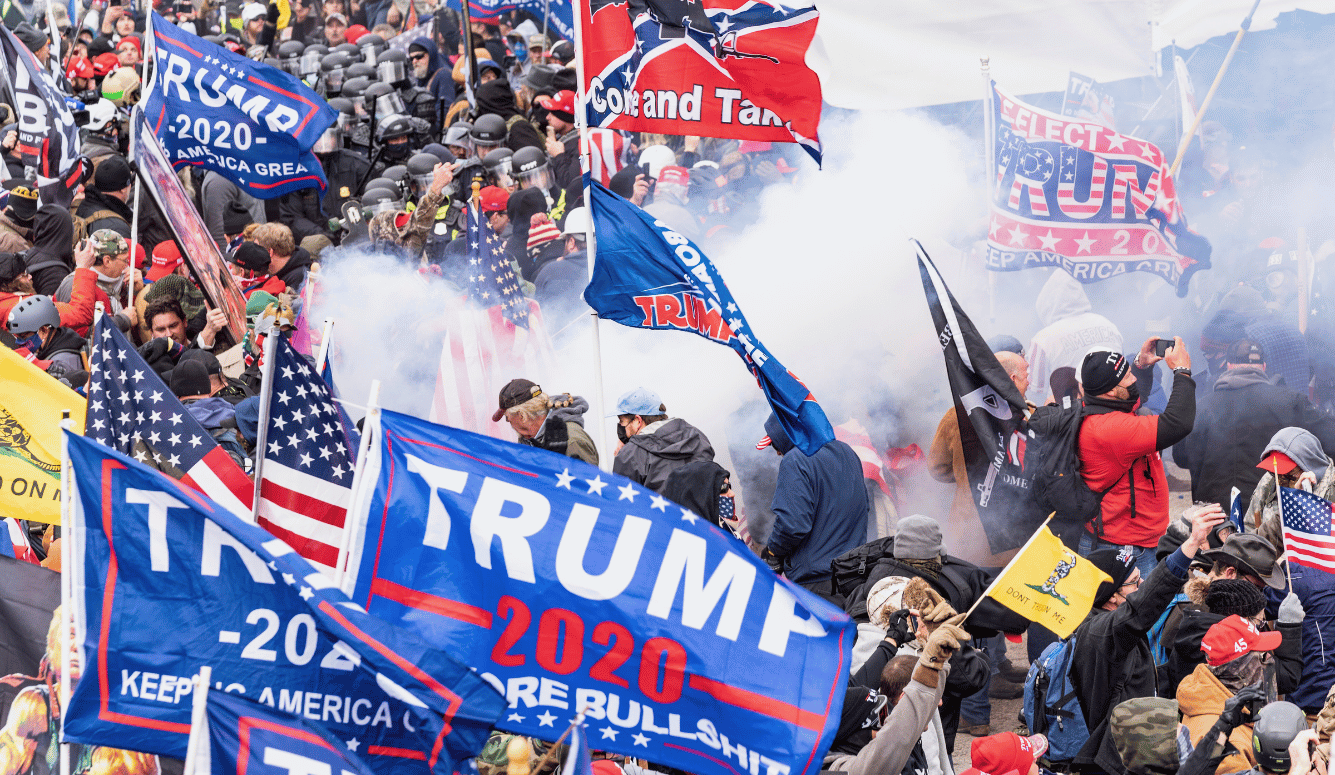
On 5 and 6 January 2021, thousands of Donald Trump’s supporters travelled to Washington, DC, in support of the president’s false claim that the 2020 election had been “stolen by emboldened radical-left Democrats.” Trump demanded that his vice president Mike Pence and Congress refuse to certify Joe Biden’s victory on account of alleged election irregularities for which no evidence has yet been produced. There is no way that Trump can have been unaware of an armed faction in the audience of the rally he addressed at noon on 6 January, some of whom were wearing tactical gear, bearing guns, and carrying holstered bear spray designed to stop a 500–1,000-pound (around 226–450-kilo) animal. As Congress began the solemn work of certifying the presidential election results, Trump was bellowing from the podium and beseeching his disciples to “fight like hell” or “you’re not going to have a country anymore.”
Jalonick dispenses with MAGA’s claims of a stolen election, pointing out that Biden’s legitimate victory was “certified by election officials from both parties in all 50 states.” Trump’s own attorney general, she adds, “said there was no evidence of widespread voter fraud that could have altered results in the states Biden won.” Nevertheless, Americans from all walks of life believed the election was corrupt and heeded Trump’s call to prevent Pence from completing the electoral count. Relying on interviews, FBI reports, and court transcripts, Jalonick acknowledges that “multiple people will have different memories of the day.” Some of those in attendance regarded the riot as nothing more serious than “a picnic” outside the Capitol. Others stormed the building and saw violence within it. Pamela Hemphill, a retired drug-and-alcohol counsellor from Idaho thinks what happened that day was “just a protest. No big deal … a love in.” Joe Munchillo, a photographer, describes the crowd as “very militaristic.”
Jalonick challenges her own prior belief that Trump incited peaceful protesters to participate in violence by showing that two MAGA militias calling themselves the Proud Boys and the Oath Keepers arrived in Washington hoping for an insurrection. According to Stewart Rhodes, the founder of Oath Keepers, the group was already stocking weapons in Virginia and preparing for war two days after the November 2020 election: “We aren’t getting through this without a civil war,” he declared in an encrypted group chat on 5 November. “Too late for that. Prepare your mind, body, spirit.” In two open letters to Trump posted in December 2020, Rhodes also urged him to “invoke the Insurrection Act and call up the military to block a Biden presidency.”
On the Oath Keepers’ discussion board, meanwhile, a writer made the group’s violent intentions plain: “Be ready to fight. Congress needs to hear glass breaking, doors being kicked in. … Get violent. Stop calling this a march, or a rally or a protest. Go there ready for war. We get our president or we die. NOTHING else will achieve this goal.” Another post read: “Get into the Capitol building, stand outside Congress. Be in the room next to them. They won’t have time [to] run if they play dumb. Bring your guns.” Trump’s own digital strategy advisor Dan Scavino posted a less explicit but equally ominous message on social media, “Wait for the Storm. The Storm is coming.”
Inside the Capitol, police and journalists noticed that the Proud Boys and the Oath Keepers seemed to know their way around the building. John Bresnahan, a reporter for Punchbowl News stated: “[They] made a beeline to the House floor. And you could see groups of guys inside the crowd. They were moving with a purpose. They looked like they were on a mission.” Inspector Robert Glover of the Metropolitan Police believes the attack was “well planned.” Crouched behind a chair on the House floor and “protected” by a door hastily barricaded with furniture, Rep. Jim McGovern, D-MA, told a colleague: “These people aren’t here to make a political statement. They’re not here to hand me a leaflet. I think they are here to hurt us.”
 Ron Capshaw
There were, of course, some heroes in this episode, most notably Mike Pence, who was determined to discharge his constitutional duty as vice president and complete the electoral vote certification over the objections of his boss. Pence’s refusal to send the votes back to the states caused Trump to question his courage in a now-deleted tweet: “Mike Pence didn’t have the courage to do what should have been done to protect our Country and our Constitution, giving States a chance to certify a corrected set of facts, not the fraudulent or inaccurate ones which they were asked to previously certify. USA demands the truth!”
Pence refused to comply and he refused to bend before the mob. Nor did he get into a police caravan to leave the Capitol (“I’m not leaving! I’m not giving these people the sight of a sixteen-car motorcade speeding away from the Capitol.”). Meanwhile, protesters in other parts of the building were chanting, “Hang Mike Pence!” and hitting the police with baseball bats.
Senate Republican leader Mitch McConnell, who blamed the ex-president directly for the mob violence during Trump’s subsequent impeachment trial, also acknowledged the validity of the election and seemed to understand just how dangerous the situation could become if certification of the result was not allowed to proceed. “The courts, the voters have all spoken. If we overrule them, it would damage our Republic forever. This election was not unusually close. If this election was overturned by mere allegation from the losing side, our democracy would enter a death spiral.” Congress—with the exception of MAGA partisans—also did their constitutional duty once the Capitol was secure, and certified Joe Biden as president. But the most courageous of the lot were the Capitol police officers who held off the mob during a two-hour brawl in a narrow tunnel. The National Guard wouldn’t arrive until after the police had already cleared the building of protesters. Jalonick skilfully uses quotations to recreate the nightmarish close-quarter combat required of the badly outnumbered police officers that day, as they were pepper-sprayed and crushed against the wall by the insurrectionists.
If there was one thing about which the protesters and members of Congress agreed that day, it was that something revolutionary was happening. By and large, members of Congress (with notable exceptions like Matt Gaetz) felt the invasion of the Capitol was a uniquely treasonous event, the threat of which was comparable only to the British attack on the White House on 24 August 1814, during the War of 1812. The protesters, on the other hand, took the Leninist line that history was with them. One member of the mob yelled at a policeman: “You should be with us. You’re on the wrong side of history.” Jason Riddle, a former correctional officer turned insurrectionist, saw the riot as not only patriotic but “apocalyptic.” Proud Boys member Dominic Pezzola, the first person to breach the Capitol when he broke a window with a policeman’s riot shield, stated: “American citizens are taking back the Capitol right now. Oh my God, this is such history.”
As rioters were spitting pepper spray back into the faces of the police and another group was trying to find that “bitch” Nancy Pelosi, Donald Trump finally addressed the protesters in a video message, after hours of pressure by aides, and told them to desist. He was, however, clearly sympathetic to the insurrectionists and their aims:
I know your pain. I know you’re hurt. We had an election that was stolen from us. It was a landslide election, and everyone knows it, especially the other side, but you have to go home now. We have to have peace. We have to have law and order. We have to respect our great people in law and order. We don’t want anybody hurt. It’s a very tough period of time. There’s never been a time like this where such a thing happened, where they could take it away from all of us, from me, from you, from our country. This was a fraudulent election, but we can’t play into the hands of these people. We have to have peace. So go home. We love you. You’re very special. You’ve seen what happens. You see the way others are treated that are so bad and so evil. I know how you feel. But go home and go home at peace.
It was hardly a surprise then, that one of Trump’s first acts after he assumed office for the second time in January 2025 was to pardon all those convicted for their part in the violence of that infamous day.
The term “fascism” is often irresponsibly applied in contemporary political discourse. But the Capitol invasion on 6 January 2021 was a fascist attempt to overturn a free and fair election and to capture—if not kill—members of Congress who were attempting to do their Constitutional duty. It is important that we do not forget this, now that Trump is using the authority of the presidency to rewrite history. On the fifth anniversary of the riot, the White House posted a memorial page that redescribed the events of that day in terms entirely favourable to the president. The timeline of events in this looking-glass reality includes this entry at 8pm, in which up is down and black is white:
Vice President Mike Pence, who had the opportunity to return disputed electoral slates to state legislatures for review and decertification under the United States Constitution, chooses not to exercise that power in an act of cowardice and sabotage. Instead, Pence presides over the certification of contested electors, undermining President Trump’s efforts to address documented fraud and ending any chance to correct the election steal.
America’s institutions successfully resisted a coup in 2020 only for the country’s voters to invite the chief insurrectionist back into power just four years later. And by electing Donald Trump a second time in 2024, the American public permitted the loser on 6 January to vandalise the historical record. It’s an irony that would surely have dismayed Orwell.
Keep reading
Trump, Tehran, and the China Calculus
Parallel Kingdom
Meanwhile, in Sudan

The Australian Way of Life
What Makes the West Western?
The State of Grace