Politics
Weimar Vibes
The fate of the Weimar Republic stands as a warning of what happens when societies and their citizens indulge extremism.
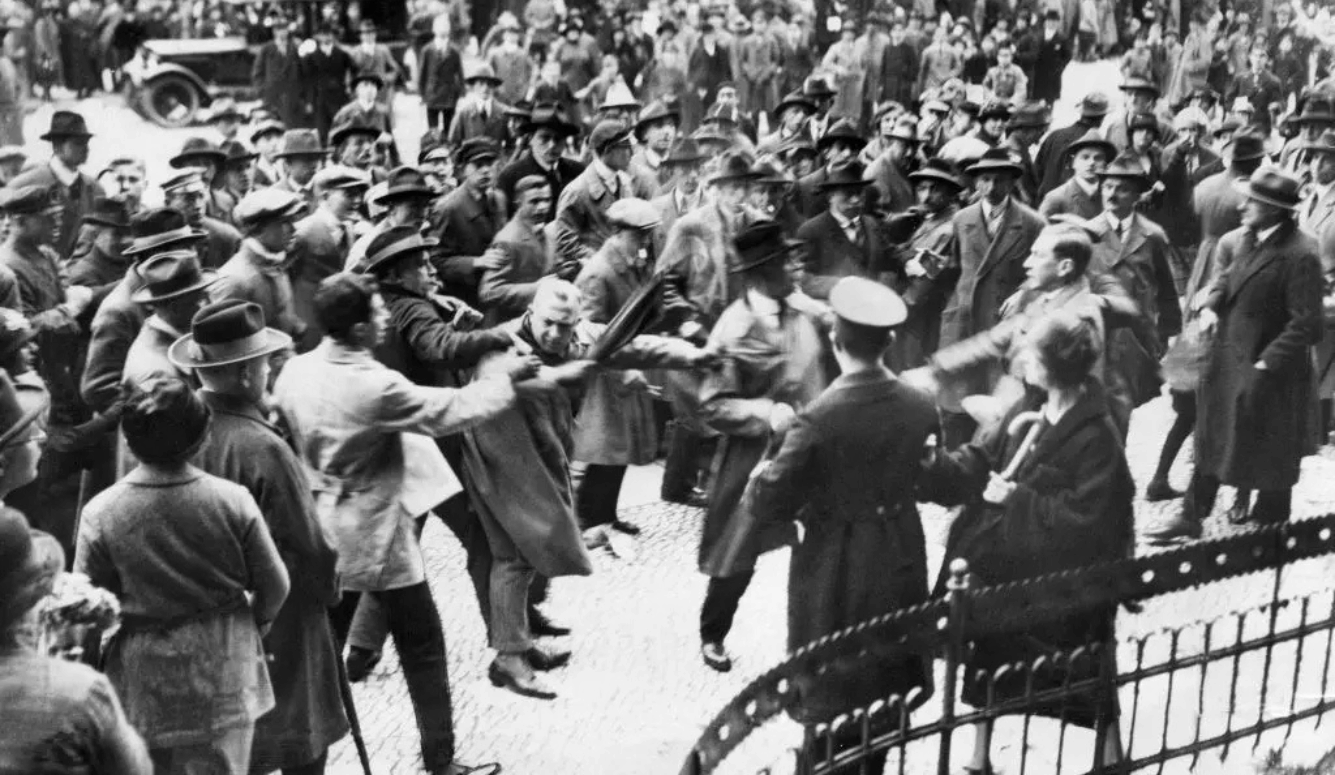

Although history never repeats itself, it is a useful teacher and we ignore its instruction at our peril. To understand the nature of Western democracy’s current crisis, we must look for historical parallels that can help to illuminate the instability that we are experiencing.
The Weimar Republic (1918–33) is often taken as the paradigm of a failed democratic experiment. Forged in the immediate aftermath of Imperial Germany’s defeat in the First World War, it was designed to be a constitutional liberal democracy that opened the way to a new progressive future for the country. Instead, it suffered from chronic political instability, which was deliberately aggravated by strongly anti-Republican forces on the far-right and far-left, both of which launched uprisings and coup attempts in the initial five years of the Republic. Weimar was also rocked by two major economic crises that undermined its viability, and beset by difficult relations with the Western allies that had defeated Germany in the war. Following widespread political violence and constant civil turmoil throughout its fifteen year tenure, it finally collapsed with the Nazi rise to power in 1933.
It is not uncommon to use the Weimar Republic as a standard of evaluation when assessing the relative health of democracies under pressure. The British historian Richard Evans did so in his annual Provost Lecture at Gresham College on 18 June 2019 titled “The Weimar Republic: Germany’s First Democracy.” While acknowledging the recent rise of authoritarian regimes and anti-democratic movements throughout the world, Evans focussed on significant differences between Weimar and the current situation in the West.
Specifically, Evans noted the comparatively low level of political violence in Europe and North America today compared to the first German republic. He pointed out that the legislatures in Western countries remain effective centres of government power. Germany’s then-president, Paul von Hindenburg, invoked article 48 of the German constitution to justify direct presidential rule by decree in March 1930, rendering the Reichstag largely irrelevant. This enabled his appointment of Hitler to the chancellorship after the election of 1933. Evans remarked that the far-right and far-left oppositions in Weimar both sought to destroy the Republic, but that contemporary right and left populist movements are, for the most part, operating within their respective constitutional frameworks. He also observed that there was growing danger of global conflict in the period that followed the fall of the Republic, which he regarded as largely absent at the time of his lecture.
However, in the six and a half years since Evans presented his talk, we have experienced the COVID pandemic, the 6 January 2021 assault on the US Capitol, the Russian invasion of Ukraine, the Gaza War, a sharp increase in openly expressed antisemitism, Trump’s election to a second term, the unravelling of international trade agreements due to Trump’s erratic tariff campaign, increasingly extreme measures against immigration, and a range of related developments. It is therefore worth revisiting the comparison between the current state of the West and the Weimar Republic in light of these events.
Keep reading
Robert Lynch on Status, Humour and the Apes We Pretend Not to Be | Quillette Cetera Episode 74

The Radicalisation of Tucker Carlson
A Pop Fiction Master and Monster

Australia’s Coming Censorship Machine

Anatomy of a Book Promotion