Skip to content

film

Alfred Hitchcock’s Christmas Movie

‘Psycho’ deserves recognition as a classic film for the festive season.
· 8 min read
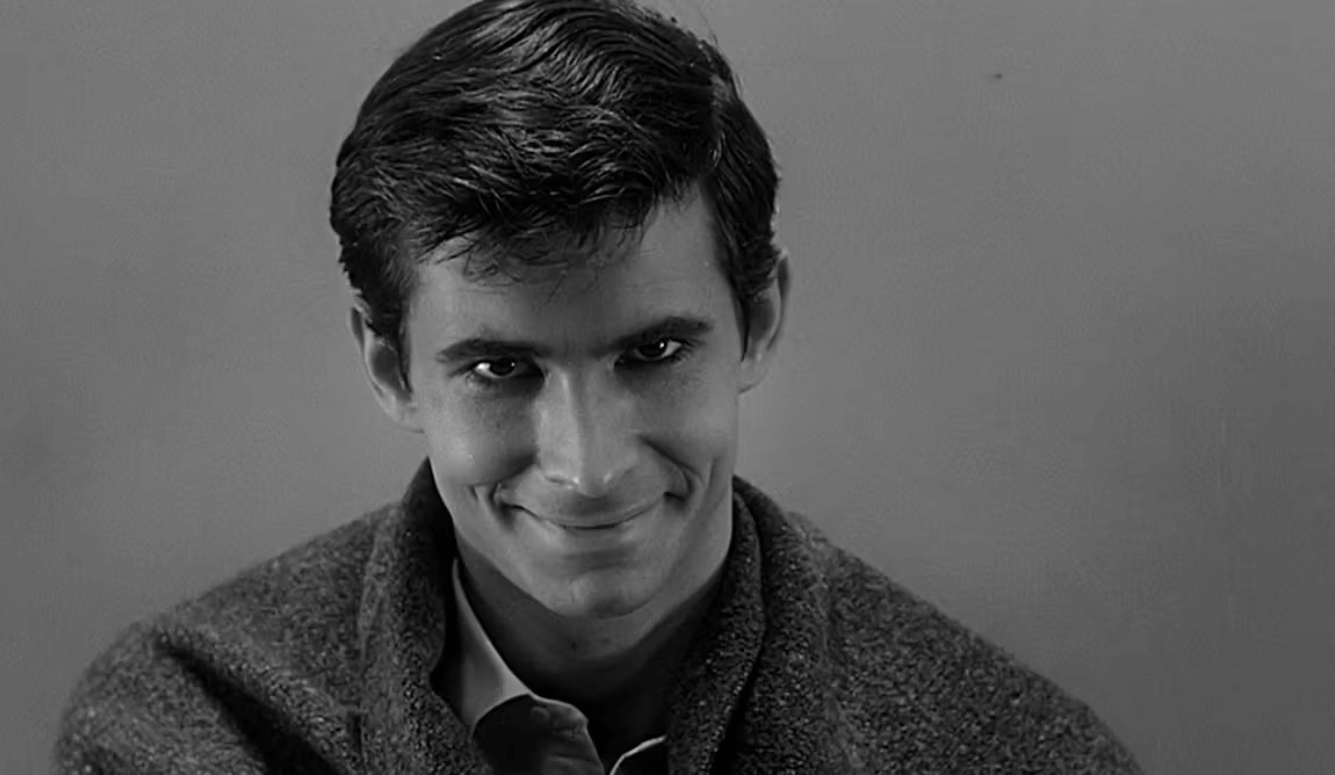
Black-and-white close-up portrait of a young man with short dark hair, wearing a jacket and shirt, facing the camera with a slight smile.
Anthony Perkins as his iconic character, Norman Bates, from the 1960 film Psycho

Christmas is a time for watching movies. Every year, television schedules are packed with holiday classics, and the internet is awash with lists of the greatest festive features—from It’s a Wonderful Life to The Muppet Christmas Carol. Occasionally, some unconventional choices slip through, like Terry Gilliam’s dystopian comedy Brazil (which features a memorable cameo from Santa Claus) and Stanley Kubrick’s erotic thriller Eyes Wide Shut (which includes Christmas trees and fairy lights in almost every scene). But one classic film is never mentioned in the Christmas movie conversation: Psycho.

Alfred Hitchcock’s 1960 masterpiece is one of the most closely studied movies in film history. More than a dozen books have been written about it—from actress Janet Leigh’s memoir of her time working on the film, to Stephen Rebello’s definitive account of its making (which was itself turned into a movie). There is even a feature-length documentary dedicated solely to the famous shower scene. A handful of these studies have referenced the fact that Psycho is technically a Christmas movie, taking place during the advent season. But none have examined what significance this has for the film’s meaning.

We know Psycho is set during the holidays from the opening scene. Over an establishing shot of a city skyline, Hitchcock superimposes three title cards, giving us a precise location, date, and time:

PHOENIX, ARIZONA
FRIDAY, DECEMBER THE ELEVENTH
TWO FORTY-THREE P.M.

From there, the camera slips through a hotel window to spy on a sinful lunchtime tryst between Marion Crane and her lover Sam. We learn that this is how they always meet. Sam lives 500 miles away in California, so the only moments they have are these stolen lunch hours when Sam can make the journey to Arizona for business. They could get married. But the divorced Sam makes excuses about his alimony debts to deflect the suggestion.

On returning to the office from her lunch break, Marion makes an impulsive decision: she steals $40,000 from a client, hoping it can buy her a new, more respectable life with Sam. On the way to California, she sleeps one night by the side of the road in her car. On the second, she finds shelter in the Bates Motel, a secluded establishment run by the charming but emotionally stunted Norman Bates. By now, it is Saturday 12 December. And this is the night Marion meets a grisly end—stabbed to death in her motel shower.

From there, the narrative skips forward one week to Saturday 19 December. Hitchcock signposts this clearly with a close-up of Sam writing a letter to the missing Marion dated “Saturday.” When Marion’s sister and a private investigator arrive, they confirm the date by explaining that Marion disappeared a week ago. The private investigator heads out to the Bates Motel, to become the film’s second murder victim. The action draws to a close the following day, when Sam and Marion’s sister finally apprehend Norman as the culprit.

As this synopsis shows, the film’s timeline can be precisely traced from 11 December to 20 December—right in the heart of the advent season. But Psycho is rarely acknowledged as a Christmas film because these dates are never specifically stated after that opening title card. Nor do any characters ever reference the holiday season. The closest we get is an offhand comment from Marion, which could be an allusion to the upcoming new year. “Headaches are like resolutions,” she says. “You forget them as soon as they stop hurting.”

The only overt sign that it is Christmas is a brief shot while Marion is driving away with the cash, which shows festive decorations strung over the streets of Phoenix. Indeed, this shot is supposedly the sole reason why Hitchcock added the titles to the film’s opening. As Stephen Rebello explains in Alfred Hitchcock and the Making of Psycho, that street scene was filmed by a second unit crew. “When [Hitchcock] saw what they’d shot, he noticed that Christmas decorations were hung over the street,” Rebello quotes set designer Robert Clatworthy as saying. “So he added the date in the titles at the beginning and hoped some wiseacre wouldn’t wonder why there was no other reference to the holidays anywhere else in the picture.”

Thus, Psycho’s yuletide setting has often been explained as a quirky accident, with no bearing on the film’s meaning. But maybe some aspect of the Christmas spirit was imbued in the movie during its production. After all, it was shot during the holiday season and there was a festive feeling on set. According to Rebello, Hitchcock even bestowed gifts on some of his colleagues. And Janet Leigh (who played Marion) was certainly conscious of the strange contrast between the film’s blood-spattered subject and the season of peace and goodwill during which it was shot. “During the day I was in the throes of being stabbed to death, and at night I was wrapping presents from Santa Claus for the children,” she writes in her memoir.


Once we start looking for that Christmas spirit in Psycho, a strange parallel does become apparent between Marion’s plot and the Nativity story. The most obvious link is in the name Marion, which derives from the name of Mary, mother of Jesus. Indeed, in Robert Bloch’s novel (which the film is based on) the character is called Mary. She was even named Mary in the original script. According to Janet Leigh, the name was only changed after the film’s legal team “found an actual Mary Crane in the Phoenix telephone directory.”

The basic narrative of Marion’s story also parallels the Biblical account of the Nativity: both are stories about women named Mary who travel through the desert and seek refuge in a guest house. But once we get into the granular details, everything in Psycho is a twisted reversal of this holy narrative.

The Amityville Horror—A 50-Year Old Lie That Won’t Die
Jay Anson’s haunted-house yarn was a highly lucrative hoax, but it struck a popular chord amid the financial precarity of 1970s America.

Firstly, unlike Mary, Marion is no virgin. The film’s opening establishes that. And not only is she sexually active, she is also unmarried. Though we aren’t given Marion’s exact age in the film, we can assume she is around thirty. (We know she has been working the same job for ten years, suggesting she must be at least in her late-twenties, and actress Janet Leigh was thirty-two during filming.) When the film came out in 1960, the median age for a woman’s first marriage in the United States was twenty. So, Marion’s position as a thirty-year-old woman carrying on an unmarried affair would have been seen as highly disrespectable for the time. It also sets her up in contrast to her namesake, the Biblical Mary, who scholars estimate was anywhere from her mid-teens to early-twenties during the Annunciation, and did not consummate her marriage until after the birth of Jesus.

Marion’s story contrasts with the Nativity in other details too. When Mary travels to Bethlehem, she finds “there was no guest room available” (Luke 2:7 NIV)—hence those famous images of Jesus being born in a stable, surrounded by animals. Conversely, when Marion arrives at the Bates Motel, she finds that every room is open. “Twelve cabins, twelve vacancies,” Norman tells her. Here, the animals are not segregated in a barn—they are in the hotel itself. But rather than living witnesses to a holy moment, these creatures are all dead-eyed sentinels in sinister poses—products of Norman’s creepy hobby of taxidermy. 

However, the most important reversal is that the Nativity story is about a mother giving life to a son, while Psycho is about a son taking life from a mother. At the film’s conclusion, we learn that Norman killed his mother some ten years earlier in a jealous rage after she took a lover. Norman escaped punishment by framing the crime to look like a murder-suicide committed by his mother. The two lovers, we are told, were found in bed, paralleling Marion and Sam at the start of the film, and implying a perverse Oedipal confusion in the mind of Norman between mothers and lovers. Norman’s killing of Marion is another kind of matricide. We are told he is attracted to her. But the mother side of him (which he inhabits as an alternate personality) is also threatened by her. Thus, for Norman, she represents both lover and mother, which is why she must die. 

So, Psycho is a grotesque reversal of the Nativity story. And its depiction of mothers is also an unholy mirroring. In Christianity, Mary is depicted as a nurturing and loving mother. But in Psycho, the mothers are overbearing and manipulative. Norman’s is the most obvious example. We are told she was “a clinging, demanding woman”. But it’s implied that Marion’s mother has a controlling influence too—Marion wants her sordid lunchtime meetings with Sam to end, so she can host him “respectably” at home “with my mother’s picture on the mantel.” At the office, Marion’s co-worker also seems to be living under the influence of an overbearing matriarch—she tells us that her mother plied her with tranquilisers on the day of her wedding.

These mothers are indicative of a society less interested in nurturing true spiritual salvation, and more concerned with the surface-level appearance of “respectability”. It’s a theme that Rebello highlights too. He argues that Psycho is a film “not only [about] man’s fathomless capacity for the barbaric, but also the ability of an entire community to deny its very existence.” After all, by the film’s conclusion we learn that Norman has committed six murders, all of which have escaped the attention of the local community. They have been living next to a psychotic maniac for over a decade, but so strong is their denial and desire for respectability that no one has noticed.

As Rebello continues, in the 1950s “most Americans preferred to perceive themselves as God-fearing, clean-living men in gray flannel suits, or perfectly perfect Doris Day wives.” In other words, they chose to live under the delusion of respectability. And what could be more Christmassy than that? Because like the respectability of 1950s American society, Christmas is also a shared illusion. It’s the one day of the year when we pretend peace and goodwill exist among all mankind. We dress up and decorate our houses and wrap everything in coloured paper, keeping our troubles hidden away. In Psycho, Hitchcock sought to take that wrapping off. He showed Marion and Sam’s lurid affair with a frankness that was unprecedented for the period. He gave us the most violent murder that had ever been seen on screen. He even shocked audiences with the first depiction of a flushing toilet in American cinema. By showing these less respectable aspects of society in a yuletide setting, Hitchcock created a kind of anti-Christmas story. It’s not so much a critique of the religious holiday itself. Rather, it’s a comment on the society around it, which wears the exterior trappings of Christian respectability, but lacks the true spiritual values within. Indeed, there is just one appearance of a church in the film, seen only from the outside—providing us again with an exterior image, but no inner substance.

The Exorcist: To Save Us All From Satan’s Power
William Friedkin’s horror classic is 50 years old.

And there’s another reason why the December timeframe is appropriate to Psycho. By setting his film between the bright afternoon of 11 December and the late evening of 20 December, Hitchcock literally leads us into darkness, taking us to the cusp of the winter solstice, the longest night of the year. At Christmas, we usually brighten this cold and gloomy moment with roaring fires and glittering baubles. But Hitchcock’s journey into the darkness offers no such comforts. The Nativity story he tells is a gruesome parallel, reflected in a black mirror, without salvation or festive adornment. No wonder the film never became a staple of Yuletide TV scheduling. But, this Christmas, for those who tire of tinsel and fairy lights and the illusion of respectability, it might provide a fitting alternative. 

Featured in Sections

headshot

Christian Kriticos

Christian Kriticos is a journalist and author based in London. He has written for The Guardian, The Telegraph, the BBC, The i Paper and many more publications.