Videos
Bondi Was Not a Surprise: How Antisemitism Was Normalised in Australia
Why the Bondi attack was not an aberration, but the consequence of years of tolerated antisemitism across Australian public life.
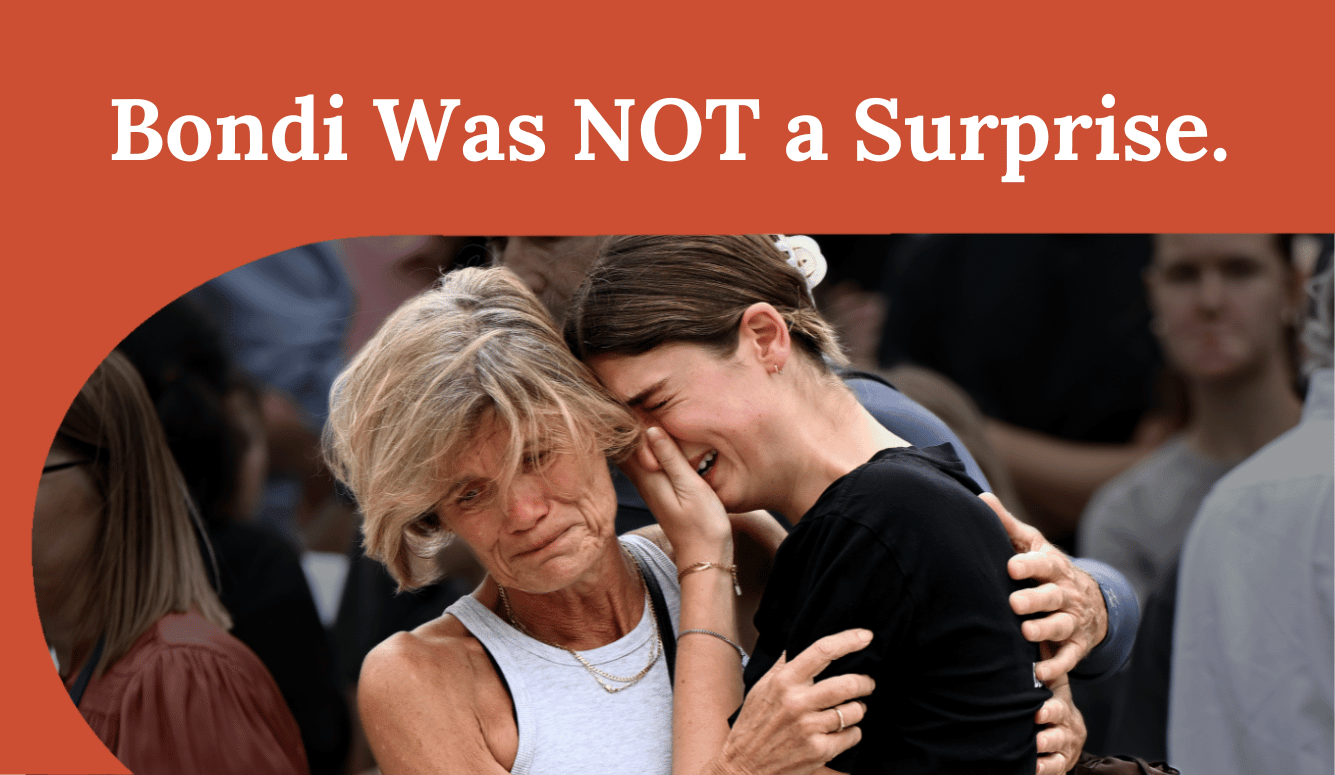

Written and read by Jack Pinczewski.
In the aftermath of the Bondi Beach terror attack, Jack Pinczewski examines why the massacre shocked much of Australia while leaving many in the Jewish community grimly unsurprised. Drawing on his proximity to Bondi and his experience in politics and Jewish civic advocacy, Pinczewski argues that the attack was not an aberration but the foreseeable outcome of a long period of moral and institutional failure.
The video traces how anti-Jewish rhetoric was normalised across political discourse, media, universities, and civil society, while existing laws and norms designed to curb hatred were inconsistently enforced or quietly abandoned. Rather than focusing on security logistics or firearms policy, Pinczewski situates the violence within a broader failure of leadership and accountability. The result, he argues, was an environment in which antisemitism could flourish with minimal consequence—until it became lethal.
Chapters
00:00 — Introduction and setting the scene
00:42 — Personal account and initial reactions
01:40 — Community response and perception
02:22 — Media and public discourse on antisemitism
03:17 — Failures across politics and civil society
04:31 — Education, institutions, and social media
05:28 — Inadequate responses and political implications
06:22 — Call for change and conclusion
View full transcript
It was a shock, but it was not a surprise. Two men driven by their pathological hatred of Jews have barbarically murdered innocents in Australia on its most iconic beach. In 2025, men with high-calibre weapons hunted Jews for sport. I live in Bondi. My home is two hundred metres from the Lewis Continental Kitchen—the target of Iranian terrorists in 2024—and a little over seven hundred metres from the golden sands of Bondi Beach. In this small area are a half-dozen synagogues. Chabad of Bondi were the ones who organised Chanukah-by-the-Sea. The shocking messages came to me minutes after the attack began, with people across the world asking if I was OK. We were driving to my parents’ house for a pre-planned Chanukah event of our own, watching a cavalcade of police and ambulance vehicles stream in the opposite direction towards Bondi. The entire evening was spent watching 24-hour news channels, answering messages from friends asking if we were OK, and trying to eat the traditional sufganiot and latkes which, like all Jewish mothers’ cooking, were delicious—but I was hardly in the mood to eat. As the stories of heroism emerged, we fell silent. The man who wrestled a gun away from the terrorist deserves the Cross of Valour, as do the police who drove the ambulances so that paramedics could treat more victims. All of them are the absolute best of Australia. Just like the surf lifesavers who run towards danger, so many Australians did the same when confronted with terrorism. No one in the Jewish community I spoke to felt like this was a surprise. Many felt like this was an inevitability. Ever since 7 October, the Jewish community in Australia has been drinking from a firehose of antisemitism. Daily occurrences of hate—an inexorable tide of evil we felt rising around us. The worst feeling was seeing those who we thought might be sympathetic to our plight dismiss our fears as a “hoax” or a “moral panic.” Elites in our media threw these deliberate fictions and red herrings into the national debate, making the warning signs almost impossible to see for the average Australian. The worst were the egregious and uncalled-for accusations that Jews were “weaponising” antisemitism to shut down debate on Israeli policy, and the obscene navel-gazing debate over whether pro-Hamas rioters at the Sydney Opera House were chanting “Where’s the Jews?” or “Gas the Jews”—as if the difference between the two actually matters. Australian civil society has failed. This attack is the result of a series of failures of leadership across our country. From politicians to business leaders, academics and commentators, there has been too much equivocation and misdirection on antisemitism. Feckless politicians have caved to constituencies that laud violence, refusing to repudiate the hatred that comes from their supporters—some even went so far as to indulge in it themselves. Courts have allowed marches in the streets calling for “resistance” and a globalised intifada. State-funded media have provided inflammatory coverage of the Israel–Gaza conflict. Public commentators have tied Jews in Australia to the policies of Israel, deliberately conflating the two into what they call the “Israel Jewish Lobby.” Business leaders declined to investigate credible accusations of antisemitism in the workplace, afraid of the potential consequences. University administrators allowed exclusionary and deeply antisemitic encampments on their campuses for months at a time while their Jewish staff and students were attacked. Mendacious academics worked hard to redefine Zionism away from its definition as a form of Jewish civil rights—specifically the right to self-determination—towards a completely unhinged definition suggesting Jewish supremacy. Arts bodies drove their Jewish stakeholders out unless they complied with political tests. Artists painted murals on walls in Sydney depicting Jews as parasites, while Jewish creatives were doxxed by their peers. Government bureaucrats provided support and funds to websites that published apologia for terror groups. Police failed to enforce laws against the public display of terrorist or Nazi symbols. Schools allowed the politicisation of their classrooms by staff asserting a genocide by Israel to their students during school hours. Through all this, social media platforms let angry people marinate in their own echo chambers, with algorithms encouraging Jewish hatred. Australian society failed Jews at every level. The responses since the attack have been predictably milquetoast, with multiple persistently online commentators registering their shock at an event which they implicitly encouraged through their consistent dehumanisation of Jews. Many of these same commentators are now complaining that the tragedy is being “politicised,” while ignoring that the clearly political nature of the act necessitates a political reaction. The offers of more security funding are beyond parody. There is no wall high enough to protect Jews in Australia, for the true barriers to the outrage at Bondi are those built in the human mind. They are built through an understanding that there are consequences for anti-Jewish hatred. The offer of higher physical walls feels like a means of segregating Jewish Australians further in their own country—a modern-day ghetto being built for the Jews of Australia. For this to be reduced to a question of gun control, in a state where access to firearms requires permission from the Commissioner of Police, is to conflate the means with the ends. These vile creatures had bombs as well as bullets—they wanted dead Jews by any method. Australia must change course. It cannot allow this form of stochastic terrorism to take root. There must be consequences for Jewish hatred—at all levels of our society—and this should be just the start. The government must implement the recommendations of the Special Envoy’s Plan to Combat Antisemitism. More broadly, Australians must reject the laissez-faire attitude towards antisemitism, and there must be political consequences for our leaders letting their supporters engage in this sort of behaviour. The monotonous drone of our leaders saying that “antisemitism has no place in Australia” has been shown to be a hollow lie. It is clear that there is antisemitism in Australia, and it is spreading. These are the ashen wages of permissive antisemitism.Further Reading
If you found this video essay useful, subscribe to the Quillette YouTube channel and browse our video archive.
Keep reading
AI Is Not About To Become Sentient

The Innovation Trap

Treating Myths as Science

The Edifice Complex
Letters to the Editor
Criminal Research