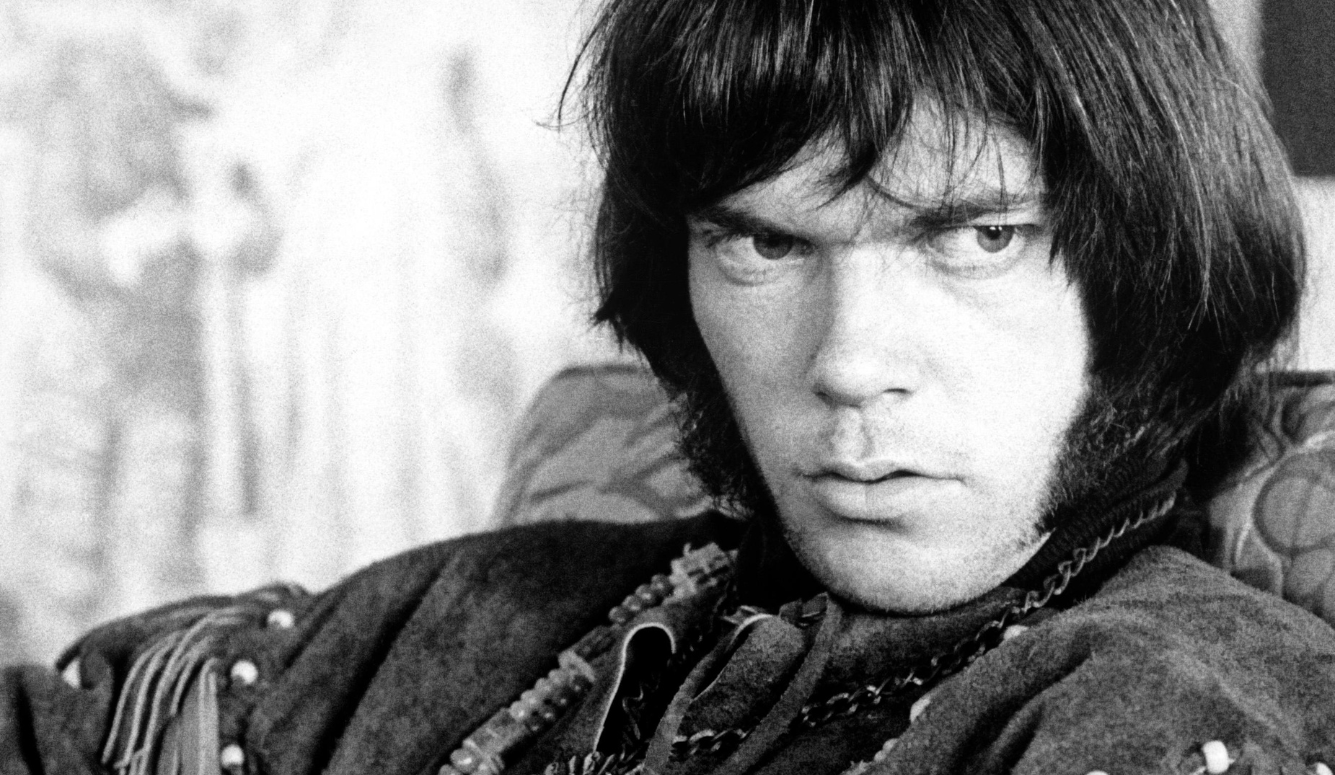

“Listen to your own voice,” Neil Young once remarked. “Don’t listen to someone else’s. To me the way to live is to always move forward—to keep searching for whatever it is that interests you.” At eighty, Young is still a defiantly idiosyncratic songwriter and a singer and instrumentalist so raw and ragged that his music feels like a protest against polish. One of rock’s mad masters of excess, he has always moved too fast, and overdone more or less everything he has turned his gnarled hand to. “It’s better to burn out than to fade away,” he famously declared in a lyric that would find its way into Kurt Cobain’s parting thoughts. And after nearly fifty studio albums and countless live performances, Canada’s spikiest artist is still at it.
That’s good news for anyone who has followed him since he first displayed his tremendous songwriting talent in the mid-1960s. His thin vocal might be a little rustier these days, but it never sleeps. Nor does his willingness to pick fights with high-profile targets. Most recently, he threatened to remove all of his songs—more than a thousand of them—from Amazon Music because Jeff Bezos is too cozy with the Trump administration. “Forget Amazon,” Young instructed his fans in a post on the Neil Young Archives site. “Buy local. Buy direct. Bezos supports this government. It does not support you or me.” In August, he quit Facebook over its “unconscionable” use of chatbots with minors. He has also declared that he is done with X and Elon Musk, whom he has accused of promoting antisemitism in a retweeted message.
Perhaps the biggest spat of all occurred in 2022 after Young yanked all of his records from Spotify, ostensibly as a stand against the platform’s lucrative relationship with podcaster Joe Rogan. Young accused Spotify of propagating COVID “misinformation” through Rogan’s show, which the music streamer had earlier bought in a deal reportedly worth at least US$100 million. Financially, Young never stood to lose much from that decision. He had just sold fifty percent of the publishing rights to his own back catalogue to the investment firm Hipgnosis Songs Fund for an estimated US$150 million. Still, his reputation probably ended up taking a bit of a hit, and the only other notable star to follow his lead was his old friend Joni Mitchell.
A couple of years ago, Young returned his music to Spotify (as did Mitchell). Since plenty of others were still serving “the same disinformation podcast features,” he explained, he felt his protest gesture had run its course. But the questions it raised remained. Young’s sporadic temper tantrums seem to be consistent with his idea of ethical living, but some of his fans have begun to wonder what they actually achieve. Streaming services and social media have made music more accessible than ever, the argument goes. By stepping away from these platforms, isn’t Young just making it harder for fans—and younger fans, in particular—to find and enjoy his work?
Young’s behaviour raises broader questions, as well. Should consumers choose services based on political beliefs? Can we separate an artist’s message from the medium through which it’s delivered? “Freedom of choice is meaningless without knowledge. That’s why it’s crucial we all get engaged and get informed,” Young has said, in defence of his belief in the importance of awareness and action. That’s debatable, I suppose, but as with so many other artists, Young’s politics and activism are not as interesting as the shimmering back-catalogue he has produced during a career of furious intensity.
The younger of two sons born to Scott and Edna “Rassy” Young, Neil entered the world in Toronto on 12 November 1945. Neither parent was a musician, though his father—a sports journalist and novelist—would occasionally play a ukulele for fun. That simple instrument became Neil’s first. His father also had a reputation for extramarital affairs, a habit that led to domestic turbulence, and eventually a separation when Neil was twelve.
His mother moved the two boys nearly 2,000 kilometres west to Winnipeg, Manitoba, which was where the younger son first picked up an electric guitar and began honing his musical skills at community clubs and high-school dances. Starting out as an instrumentalist, he drew inspiration from Hank Marvin of the Shadows and Canada’s own Randy Bachman (who later had a hit with “You Ain’t Seen Nothing Yet”). The first song the young Neil ever performed was a cover of Berry Gordy and Janie Bradford’s “Money (That’s What I Want)”—a fitting choice given his wobbly finances.
That lack of money followed him south when he moved to the United States. Before he was able to secure a green card, Young worked under the table as a jobbing musician in California, eventually forming Buffalo Springfield in 1966 with fellow guitarists Stephen Stills and Richie Furay, bassist Bruce Palmer, and drummer Dewey Martin. The band initially occupied the same alt-country-rock space as The Byrds before veering into psychedelia—a shift accompanied by drug busts that hastened the band’s breakup a couple of years later after just three albums.
Young’s solo career began in 1968 with an enigmatic self-titled debut—half of which was acoustic, and half of which was lushly arranged. A year later, he followed it with Everybody Knows This Is Nowhere, a less polished offering that featured “Cinnamon Girl” and “Cowgirl in the Sand” (still two of his best-loved songs), as well as the nine-and-a-half-minute murder ballad “Down by the River.” This album also marked his first collaboration with Crazy Horse, the feedback-and-distortion-heavy California bar band with whom Young would go on to record fifteen studio albums. Guitarist Danny Whitten would succumb to a drug overdose in 1972 at the age of just 29, but his contributions on Everybody Knows This Is Nowhere would set the template for the heavier side of Young’s remaining output and influence the West Coast grunge scene of the 1990s.
However, it wasn’t until the decade turned that Neil Young finally established himself as a creative force by appearing on two of the most important records of the 1970s. In late 1969, he had been invited to tour with the folk-rock supergroup Crosby (ex-Byrds), Stills (ex-Buffalo Springfield), and Nash (ex-Hollies), and the foursome released Déja Vu as Crosby, Stills, Nash, and Young (or CSNY) in March 1970. The band’s sound was altogether sweeter than the darker and heavier sound Young had cultivated with Crazy Horse on his second solo effort. But this seemed to suit Young’s developing skills as a songwriter, and his two contributions to the CSNY record—“Country Girl” and, especially, the lovely autobiographical ballad “Helpless”—blended gorgeously with the group’s soaring harmonies.
Five months later, in August, Young released After the Gold Rush, a critical hit, a dazzling stoner classic, and arguably still his finest album. A dreamy mix of rough-hewn country lyricism and breathtaking rockers, it announced the arrival of one of the era’s great singer-songwriters. The peculiar mood Young captured was somehow at once bleak and optimistic, hopeful and foreboding, as when he sang on the haunting title track:
I was lyin’ in a burned-out basement,
With a full moon in my eyes,
I was hopin’ for replacement,
When the sun burst through the sky,
There was a band playin’ in my head,
And I felt like getting high,
I was thinkin’ about what a friend had said,
I was hopin’ it was a lie.
One of the earliest critics to champion Young was Albert Goldman, the music biographer notorious for his scalding takes on Elvis Presley and John Lennon. In Neil Young, however, Goldman found an artist worth admiring, and he hailed him in the pages of Rolling Stone as a significant artistic voice in the burgeoning folk-rock scene. This was high praise from Goldman, a Columbia University literature professor, unapologetic jazz purist, and cultural conservative who despised most white rock artists. Shortly before his death in 1994, Goldman told me that he still stood by his early assessment of Young, whom he ranked alongside The Doors’ Jim Morrison as one of contemporary music’s few enduring figures. And he liked Young’s occasional way with a lyric, such as this reference to Charles Manson in Young’s 1974 song “Revolution Blues”:
Well, I hear Laurel Canyon,
Is full of famous stars,
But I hate them worse than lepers,
And I’ll kill them in their cars ....
On the other hand, Goldman may have been drawn to the singer’s early aversion to political grandstanding. That may sound hard to believe now that Young seems to be grandstanding about a political cause every other week, but in the 1960s and ’70s, he showed little interest in protest music. There were a couple of exceptions—the irritatingly catchy rocker “Ohio,” which Young wrote for CSNY after the Kent State shootings on 4 May 1970, and “Southern Man,” Young’s self-explanatory track about racism in the Deep South. But for the most part, Young’s battles were personal and inter-personal. He wrote about drugs and falling in and out of love, struggled with alcohol, and feuded with Lynyrd Skynryd (who took exception to “Southern Man” and name-checked Young in their rejoinder “Sweet Home Alabama.”)
During this period, Young was also coping with ill-health. He had suffered from polio as a child, and between After the Gold Rush and its follow-up Harvest two years later, he was frequently hospitalised by slipped discs that left him unable to tour or even hold a guitar. He was also enduring periodic epileptic seizures. “Epilepsy is just part of me,” he told Rolling Stone’s Cameron Crowe at the time. “Part of my head. Part of what’s happening in there.” He likened the seizures to psychedelic experiences: “You slip into some other world. Your body’s flapping around and you’re biting your tongue and batting your head on the ground, but your mind is somewhere else.”
Concertgoers may have missed Young’s presence, but record buyers in the early 1970s were still able to savour his creative fruits. Harvest, recorded in Nashville while Young wore a back brace, yielded the irresistibly melodic hit singles “Heart of Gold” and “Old Man.” The b-side of the latter introduced fans to one of his most beloved live staples, “The Needle and the Damage Done,” written after Whitten’s death earlier that year. With On the Beach in 1974, and Tonight’s the Night in 1975, Young revisited the themes of loss and addiction with even greater intensity.
Much of Tonight’s the Night was influenced by the death of Young’s roadie Bruce Berry, another drug casualty, and Young’s band play through the record’s gloomy material as if they expect to follow suit. American critic Robert Christgau called it “a howling facedown with heroin and death,” and Young himself described Tonight’s the Night as “the most liquid album I’ve ever made,” a fitting phrase for sessions fuelled by grief, drink, and narcotics. It’s widely considered one of Young’s greatest works by critics and fans alike, but I’ve never been able to understand why. Most of the album’s dirges were cranked out after afternoons spent “getting high, drinking tequila, and playing pool,” as Young told Crowe, and they are toxically out-of-key.
 Christopher J. Snowdon
Much the same can be said of the booze-soaked album that appeared a couple of years later, American Stars ’n Bars, and its punning title and sleeve artwork are a suitably witty introduction to the patchwork quilt of rural ballads and quavery rockers that populate the record. It’s not entirely satisfactory, but it did yield another of Young’s live standouts, the intense and anthemic “Like A Hurricane,” initially recorded as an instrumental but later redubbed with vocals in Los Angeles. “We were all really high, fucked up,” Young later groaned. “Been out partying. Wrote it sitting up at Vista Point on Skyline. Supposed to be the highest point in San Mateo County, which was appropriate. I wrote it when I couldn’t sing. I was on voice rest. It was nuts—I was whistling it. I wrote a lot of songs when I couldn’t talk.”
As well as charting his sobriety levels, Young’s albums from the 1970s defined his restless artistic approach, ricocheting between the country-pop stylings of Harvest and Comes a Time (1978), and more the experimental, theatrical works. Fans also became familiar with his lifelong signature, evident in his live shows as well as in the studio recordings, of opening quietly and ending with raucous rock. This approach dated back to the concert days of CSNY when sets began with acoustic “wooden music” before the electric gear was hauled out from behind the curtain.
Probably the best example of this formula remains the magnificent Rust Never Sleeps record, the relentless “concept album” recorded live and later overdubbed, with which Young closed out the decade. The album begins with a darkly acoustic mood piece, “My My, Hey Hey (Out of the Blue),” and continues in a pastoral vein for much of side one before Young and Crazy Horse plug in for side two and power the second half of the album towards the climax of “Hey Hey, My My (Into the Black),” a grungy reworking of the record’s opener.
Both versions of this track benefit from luminous performances, but I’ve never been entirely sure what the point of these bookends was. Perhaps this is just the problem with concept albums in general. As the Guardian’s Michael Hann pointed out a few years ago when he was writing about Linda Ortega’s Liberty, the trouble with “song cycles” and “concept” packages is that they don’t “really make a lot of sense unless someone’s explaining it to you.” In the case of Rust Never Sleeps, the only message really worth taking away is that the apocalypse is nigh and it’s time to break out the black t-shirts.
While Rust Never Sleeps flirted with punk tributes (“The king is gone but he’s not forgotten / This is the story of Johnny Rotten”) and at least one stupid singalong chorus (“Welfare mothers / Make better lovers!”), the hard-driving Re•ac•tor album he recorded with Crazy Horse in 1981 finally bridged the musical gap between Young’s earlier guitar-rock and music’s new primitivism. That move was a lot less surprising, however, than Young’s gear-shift the following year, when he released one of his most reviled and criminally underrated records, best described as an attempt to turn folk-rock into a cryptic conversation with machines.
Recorded with Devo, the stubbornly eccentric New Wave outfit from Ohio whom Young first encountered around the time of Rust Never Sleeps, Trans sounded nothing like anything else Young had ever produced. The guitars had been replaced by synthesisers, the drum kit had been replaced by a sampler, and the murky vocals were frequently filtered through a vocoder that made them sound as if they’d been recorded underwater (fortunately the record came with a lyric sheet since the words were often hard to understand). The album baffled even Young’s most sympathetic fans and listeners when they first heard it, not least those at Geffen Records, who had just paid Young a small fortune to sign a multi-album deal. Presumably, they were expecting an album of pastoral folk music or grinding guitar rock or some combination of the two.
But while Trans was sonically dissimilar to Young’s previous work, it was also one of his most deeply felt and personal albums. The son he had conceived with actress Carrie Snodgress had been born with cerebral palsy and Young communicated with him using electronic devices. Not only did the record he was recording at the time anticipate the electronica era by a couple of decades, but the use of vocoder technology was also a bonding exercise. At least one track from the sessions, “Transformer Man,” has since become a Young live standard, and it remains one of his most touching and emotionally rewarding efforts.
Although Trans is by no means universally loved today (at allmusic.com, William Ruhlmann grumbles that “it was an idea that just didn’t work”), it has undergone something of a reevaluation in recent years. As Sam Sodomsky observed in an essay for Pitchfork in 2017:
Keep reading
Jerry Kaplan on AI Doomers
Payback Time for Steven Galloway
War Stories

Life in The Grim Old Days
In Defence of Academic Standards