Thomas Sowell
One ‘Maverick’ Documents Another—Jason Riley’s Biography of Thomas Sowell
The collective wisdom of the tax-paying citizenry—literally the sense of the commons—is very often correct.


A review of Maverick: A Biography of Thomas Sowell, by Jason Riley. Basic Books, 240 pages (May, 2021).
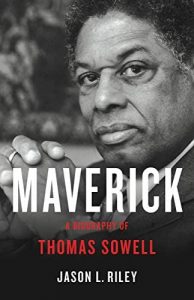
Thomas Sowell is an icon. And, now, he has a biographer. While Sowell himself has written, by my count, 43 books, Jason Riley’s 2021 Maverick seems remarkably to be the first-ever major press biography of the heterodox African-American giant. Riley’s book sums up most of the key themes of Sowell’s thought, including the Anointed and Constrained visions of human behavior, the fact that the plain existence of racism does not explain most differences in group performance, and the idea of quantitative culturalism as an alternative to both “critical race theory” and genetic determinism.
Sowell’s biographer also sums up two factual story-lines critical to an understanding of the man: how growing up outside the national elite allowed Sowell to become a truly innovative thinker, and how he (no doubt aided by revenues from all those books) remained a genuinely independent voice throughout his career—a conservative who never ran for office, rarely endorsed mainstream GOP candidates, and openly detested both Barack Obama and Donald Trump. All of the points just mentioned are well worth summarizing here, and Riley’s book is well worth reading.
Perhaps Sowell’s most famous idea, a massive influence on my own thought, was the idea of the “conflict of visions.” One of the defining features of upper-middle class life in the modern era has been the idea that a degreed elite, often trained in such novel new fields as Post-Colonial Studies and Feminist Psychology, has a moral duty to guide society forward. This manifests itself all the time, from the necessity of wearing COVID-19 masks outdoors to the importance of allowing puberty-blocking drugs for young teenagers: trust the in-field experts, they always know best.
Against this, Sowell famously proposed the alternative idea of trusting in common sense, or the shared wisdom of the intelligent crowd—what Psychology professor Gad Saad calls “nomological networks of cumulative evidence.” While the very occasional lambent genius might indeed know more than any other single person in close proximity to her, even such a Mozart or Al-Jabir would almost never have access to more knowledge that all of the farmers, general practice doctors, National Guard officers, and local pharmacists contained within even a very small town. And honesty compels us to admit that perhaps not every single human being with a PhD is such a lambent genius. The collective wisdom of the tax-paying citizenry—literally the sense of the commons—is very often correct.
It is fashionable to scoff at this point, but, particularly in The Vision of the Anointed, Sowell defends it empirically and in detail. Using three distinct time-series-style case studies—of explicit sex education, criminal justice policy, and welfare policy during the American cultural revolution of 1960–1980—Sowell points out that common-sense traditionalist arguments about why liberal policies might fail were made almost immediately in each case, were then widely disparaged by the intelligentsia, and were eventually proved correct.
While American upper-bureaucrats disdained such truisms as “Where there are fewer cops, there will be more crime”—Sowell and Riley provide multiple darkly hilarious examples of this genre—the plain unfunny fact is that US murders rose from 8,640 in 1963 to 24,530 30 years later, just before big-city mayors such as New York City’s Rudy Giuliani reinstated tough traditional policing.
In addition to noting Sowell’s focus on the importance of common sense and honest data analysis—logic is not a discipline-specific skill, as I tell every first-year Methods student—Riley highlights a critical point Sowell’s books make about race: the fact that some racism exists does not explain all performance differences among groups. Residual racial bias obviously DOES exist in, for example, American entry level job markets, something Sowell never denies: Maverick (p. 217–218) includes a solid summary of his debate with Georgia Tech economist Thomas Boston around this issue. However, an awkward fact is that such bias exists at similar levels against many groups. Pew data about the impact of prejudice on political contests indicates that a disturbing eight percent of Americans would not vote for a qualified same-party black candidate—but also that seven percent would not vote for a Catholic, eight percent would not vote for any woman, and nine percent apiece would not vote for a Jew or Hispanic. Sociological audit studies, originally designed basically to measure racism against African Americans, now yield similar results in the case of Asian Americans.
If this even needs to be re-iterated here, Jewish and East Asian Americans are on average the richest people, of any color, in the United States. Riley notes that this sort of minority success is very far from uncommon: a key conclusion of Sowell’s research is that: “One of the strongest explanations against the injustice explanation of intergroup differences is that, in many countries around the world, minorities … have been far more successful—economically, educationally, or otherwise—than those who constitute the bulk of the nation’s people.” One such country is the modern United States of America, where no less than eight (counting South Africans) of the nation’s top 10 income-earning groups are people of color as usually defined.
Sowell’s body of work, and Riley’s summary of it, segues from discussing the inadequacy of “CRT” as an explanation for group outcomes to providing a more accurate alternative theory. As one of the founding fathers of quantitative culturalism, which is my own interpretative paradigm for the human world (because it is accurate), Sowell famously rebukes both “crits” and the “hereditarian” advocates of equally univariate genetic explanations for group performance discrepancies. Against the second of these two groups, which I refer to respectively as “Sharptonites” and “Jensenites” in my recent book Taboo, Sowell makes several rarely-heard points worth reiterating.
 Jason L. Riley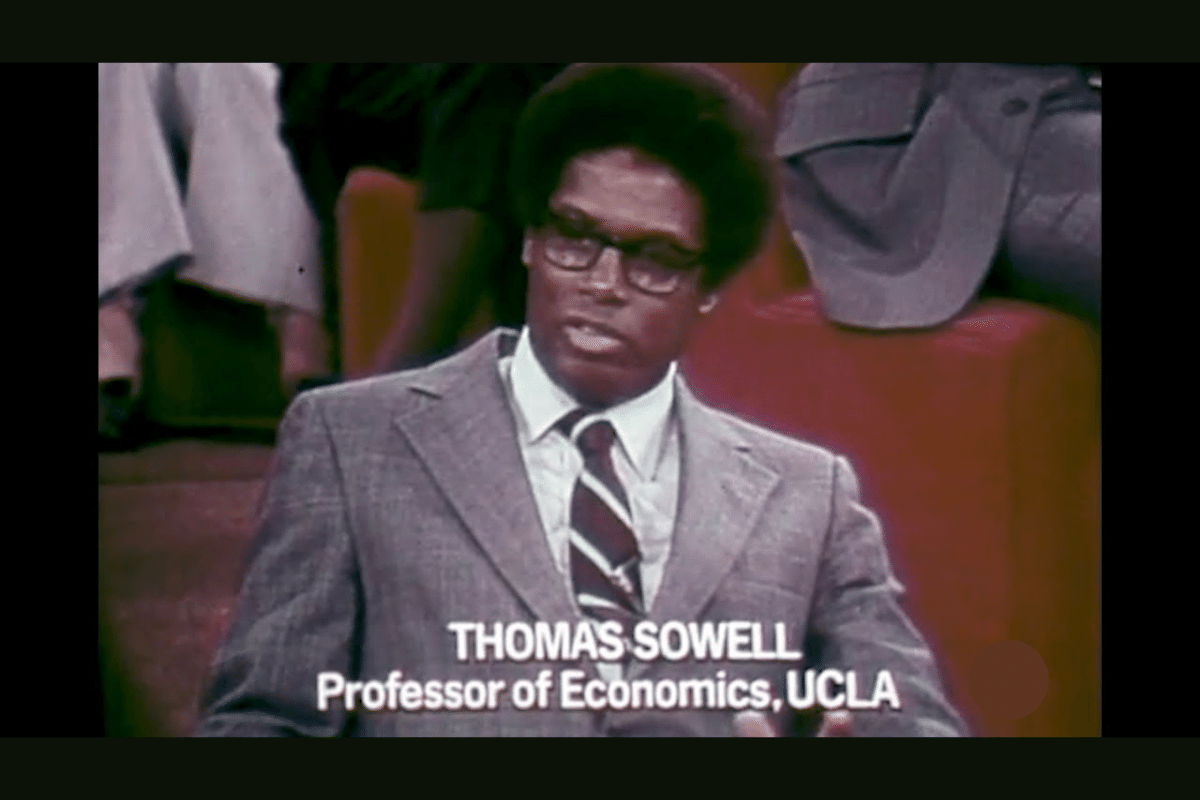
As he points out, the IQ scores of once-oppressed American white groups such as Irishmen and Italians have risen more than 15 points since World War One, black scores seem to be up as much as seven points since the early 1970s, there are many white groups globally with scores similar to the American black average, and (notably) the “pre-Flynn Effect” IQ scores for ALL white Americans in the very recent past would be roughly identical to those for black Americans today. To quote Sowell in full on this point, as Riley does on page 118: “If race A differs from race B in IQ, and two generations of race A differ from each other by the same amount, where is the logic in suggesting that the IQ differences are racial, even partially?”
Against both Sharptonites and Jensenites, Sowell proposes an alternative theory of group performance: that peoples hailing from different continents, with different histories and religions, which have experienced different levels of past bias and settled in different regions, will probably differ in terms of a whole range of cultural and situational variables. A short list of these, from page 199 of Maverick and my own research, might include: study culture and attitudes toward education (which hugely impacts the test scores we use to measure IQ), median age, family structure, region of residence, level of isolation, religious faith, attitudes toward alcohol and drugs, and degree of trust in and respect for “the system.”
Since Sowell first wrote on this issue, many economists have concluded that standard quantitative adjustment for factors of this kind does close most group gaps: the black/white income gap shrinks to roughly one percent after a fairly small group of variables including age, region, years of education, and aptitude test score is adjusted for. As Riley puts it, Sowell’s research undermines not only “the notion that racial and ethnic disparities could be laid to genetics” but also “claims that past hostility or discrimination visited on minorities … sufficiently explained why some groups trailed others.”
Riley’s book does more than sum up Sowell’s corpus of research (something Sowell himself has done on a few occasions), it also provides some real insights into the man himself. One of Riley’s most meaningful points, to me, was the reminder that Sowell grew up outside the American mainstream, and so truly learned to think for himself. Riley notes on page 123 that Sowell came of age in the 1930s and 1940s, but did so “with no fear” or hatred of whites, growing up in New York City rather than in the racially conflicted deep South where most blacks then lived. At the same time, however, he was a child of famously scrappy Harlem rather than the upper-middle class—and held down fairly long-term jobs as a blue-collar worker and telegraph messenger “boy.” Sowell largely educated himself via public libraries, and joined the Marines before—finally—pursuing one of the finest imaginable educations at Howard University and then Harvard University. He was, in order, a combat troop, a Marxist, an Ivy League student, and a classically trained professional economist.
I identify strongly, if a personal note can be permitted. My own black mom was an aspiring writer and urban (often substitute) teacher, and I grew up in the big-city neighborhoods where she lived and taught—first in center-city Chicago and later on the tough East Side of nearby Aurora in the 1990s. I didn’t “teach myself”: I went to working-class but quite functional schools. However, I was very definitely exposed to ideas as I was to athletics: as a kid on my own trying to pick up useful things. I read books from every source from Third World Press to Pat Buchanan at an early age, on my apartment balcony, and was able to judge for myself what I found logical and nonsensical about both—with no one yapping at me about how certain facts and arguments are simply forbidden.
Keep reading

Payback Time for Steven Galloway

War Stories

Life in The Grim Old Days
In Defence of Academic Standards