Books
Beating Up Boomer

Reviews of A Generation of Sociopaths: How the Baby Boomers Betrayed America by Bruce Cannon Gibney, Hachette, 465 pages (March 2018)
OK Boomer, Let’s Talk: How My Generation Got Left Behind by Jill Filipovic, Atria/One Signal, 336 pages (August 2020)
Boomers: The Men and Women Who Promised Freedom and Delivered Disaster by Helen Andrews, Sentinel, 256 pages (January 2021).
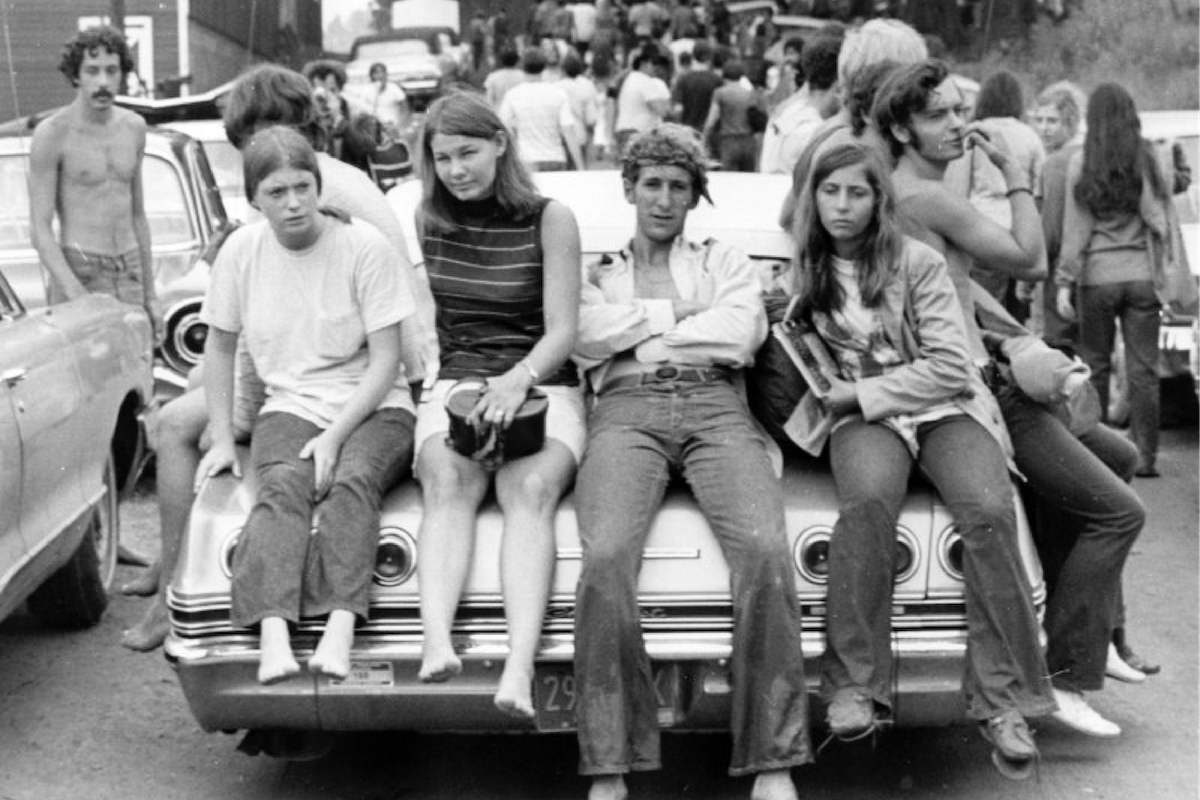
Beating up on Baby Boomers is rapidly becoming the favorite sport of Gen-Xers and Millennials eager to deflect attention from their own privilege. Whether they are leftwing BLM sympathizers, card-carrying libertarians, or rightwing NRA members, there is one thing about which every American under 56 seems to agree: the Boomers are horrible. This month brings us the latest anti-Boomer manifesto, Boomers: The Men and Women Who Promised Freedom and Delivered Disaster by Helen Andrews, a senior editor at the American Conservative. Her book is among the smartest and most intelligent of the lot, but before we delve into its contents let’s take a look at some of the previous highlights of the genre.
In 2017 Bruce Cannon Gibney, a fabulously wealthy Gen-X venture capitalist who helped found, among other things, the ride-sharing service Lyft, published a book called A Generation of Sociopaths: How the Baby Boomers Betrayed America, in which he tries to blame most of America’s societal ills on people like me. Unfortunately, he begins with a mistake on page one when he defines the Boomers as “that vast and strange generation born between 1940 and 1964,” a definition that virtually no other legitimate commentator on my generation has ever used. Boomers have usually been described as American children conceived after the American GIs came marching home from World War II. On the European front, the Second World War ended on May 8th, 1945. So, Boomers couldn’t have been born any earlier than 1946.
Throughout his book, Gibney waxes nostalgic for the great politicians of previous generations and argues that, beginning in the late 1960s, “The future slipped away and the timing was not coincidental. By the late 1960s, the earnest and industrious old regime was fading. The future would soon be reposed in the hands of a group altogether less competent and well-meaning.” The Boomers, he writes, began accumulating political power in the 1970s and, by the dawn of the 1990s, had “achieved full institutional power.” The facts say otherwise. The 100th US Congress, which convened from January 3rd, 1987 to January 3rd, 1989, contained, like all Congresses since 1959, 100 senators. Of those senators, a grand total of seven were actual Boomers, and most of them were fairly inconsequential ones at that. The 100th Congress actually contained more senators born before 1920 (eight) than after 1945 (seven). These included such paragons of statesmanship as Strom Thurmond (born 1902), a racist, segregationist, and begetter of illegitimate children; as well as Robert Byrd (1917), who once founded a chapter of the Ku Klux Klan and convinced 150 of his racist friends to join it. Among the other elder statesmen was John Stennis (1901), about whom Wikipedia says: “Stennis was a zealous supporter of racial segregation. He signed the Southern Manifesto, which called for massive resistance to the Supreme Court ruling in Brown v. Board of Education. He also voted against the Civil Rights Act of 1964, the Voting Rights Act of 1965, and the Civil Rights Act of 1968… [and] the establishment of Martin Luther King, Jr. Day as a national holiday.” Such a shame to see such an “earnest and industrious old regime” fade from the national scene.

Probably because he’s a Silicon Valley multi-millionaire and doesn’t want to be confused with a reactionary, Gibney announces upfront that, “For this book, I treat the Boomers as generally white and always native born.” Again and again, he insists that it is Boomers who are to blame for all the financial difficulties of the Millennials. It’s easy to understand why he might be anxious to point the finger. If the Millennial tumbrels should ever start to roll, they will no doubt be headed in the direction of those who helped build the gig economy, the venture capitalists like Gibney who gave rise to companies that spent over $200 million dollars in the last election cycle to ensure their California drivers didn’t have to be treated like real employees and given things like health benefits, sick leave, and a minimum wage.
Anti-Boomers like to point out that tax policy since the Reagan era has changed again and again to favor the Boomers. This isn’t true. It has changed again and again to favor the rich. Boomers as a demographic group are far richer than the others because: a) they are a huge group and have had more time to accumulate wealth than Gen-X or the Millennials, and b) they count among their number some insanely rich individuals such as Jeff Bezos, Bill Gates, and Steve Jobs. In the aggregate, Boomers are richer than Gen-Xers and Millennials, but the vast majority of Boomers are not rich. Put me in a room with Bill Gates and Jeff Bezos and in the aggregate you’ll have a room occupied by Boomers worth a total of more than $300 billion. But that doesn’t make me rich.
Distinctions like these are lost on Gibney, who blithely notes that low-cost university educations began to vanish in the 1980s because “Boomers had their cost-free diplomas in hand, so meaningful reform and costly subsidies were no longer relevant.” But only a third of Boomers have a college diploma. Already, a higher percentage of Millennials has graduated from college than any previous generation. In California, at least, low-cost university educations began to vanish after the passage of the Jarvis-Gann initiative (better known as Prop 13) in 1978. It was the brainchild of Howard Jarvis (born 1903) and Paul Gann (1912), two longtime Republican operatives who hated paying property taxes. In 1978, the youngest Boomers were 14 years old. The anti-property-tax revolution that eliminated free postsecondary education in the state, was led by the “earnest and industrious old regime” of which Gibney speaks so highly.
Gibney’s college roommate co-founded PayPal and allowed Gibney to buy in early at a friends and family discount. He was also allowed to buy stock in Facebook earlier than other investors. “Sharing a dorm with the next Mark Zuckerberg,” he explains, “is a boon not to be denied, but in the luck department it really should be enough to be born American. And so it was, before the Boomers took over. Most Americans with moderate talent and ambition could find a good job, buy a home, and invest their savings in the Standard & Poor’s 500, and in doing so, accumulate enough for a comfortable retirement.” His ignorance of history is appalling. Like most Boomer-bashers, Gibney thinks the generation grew up in a prelapsarian America:
Boomers were happy from the start and this conditioned them to believe effortless, affluent contentment was their due, and they behaved accordingly… They were, after all, the human instantiations of American optimism… Thanks to the competent stewardship of prior generations—a mix of the Greatest Generation, the earlier Silents, and a few nineteenth-century fossils—the optimism that led to the Boom in the first place found seemingly endless confirmation in American success.
This is a glib and rose-colored depiction of mid-20th-century America (to which I’ll return in a moment).

Then last August, Millennial Jill Filipovic, a lawyer and a member of the New York Times’s editorial board, weighed in on the matter with her book OK Boomer, Let’s Talk: How My Generation Got Left Behind. Unlike Gibney, who blames all Boomers, left and right (provided they aren’t black or foreign-born) for America’s current financial woes, Filipovic mostly blames Republican Boomers. As a polemicist, Filipovic is a lightweight and rarely discloses her sources of information. Her book contains no footnotes and no index, and some of her assertions either make no sense or are self-contradictory. For example:
Let’s dispel the myth that a college education makes you wealthier. It is true that having a college degree will get you higher wages than if you had only graduated from high school (or if you had not made it that far). But that’s largely because the wages of Americans without college degrees have collapsed, making college graduates better paid by comparison.
Huh? Nonetheless, her overall thesis (to the extent that she has one) makes a lot more sense than Gibney’s: greedy, rightwing Boomers have made life harder for members of subsequent generations. Filipovic’s book is so recent that it includes commentary on how the COVID-19 pandemic and the recession it triggered are affecting her generational cohort (disastrously). It also delves into the Great Recession that lasted from December 2007 to June 2009. She seems to think that being hit with the double whammy of two major recessions before the age of 40 makes Millennials unique among Americans. And like Gibney, she seems to think that Boomer childhoods and young-adulthoods were trouble-free.
But Boomers were born and raised in the shadow of nuclear annihilation. As small children we were taught how to curl up into a ball under our school desks should a nuclear weapon be detonated over our city. Filipovic notes that, “By the time the average Boomer was sixteen, he had watched more than 12,000 hours, or 500 days, of television.” She doesn’t provide a source for this statistic, but I have no trouble believing it. What she doesn’t say is that many of those hours were interrupted by tests of the Emergency Broadcast System, which, according to the United States Defense Civil Preparedness Agency in 1978, existed to alert Americans to the outbreak or threat of war and other national security crises.
Thousands of Boomers were killed in a war in Vietnam that was started and escalated by Greatest Generation luminaries such as Dwight Eisenhower, John F. Kennedy, Lyndon Baines Johnson, Robert McNamara, Richard Nixon, and Henry Kissinger. As for recessions, there have been eight of them since the first Boomers reached adulthood in 1964, and I have been buffeted by seven of them. The recessions that lasted from November 1973 to March 1975 and from early 1980 to early 1983 were different from the most recent two because, in addition to high unemployment, they brought with them high inflation (a combination referred to as “stagflation”), something that no American born after 1970 has ever had to deal with. When I left high school in 1976 I had to compete in the low end of the job market with all of those far-more-experienced workers who had been laid off in ’73, ’74, and ’75 and hadn’t yet found new jobs.
What’s more, although unemployment began to fall in 1975, inflation didn’t. Which meant that even if you could find a job, you’d have a hard time finding an apartment or buying a car. I tried to join the Peace Corps, but it turned out that you needed a college degree if you wanted to go off and build mud-walled huts in Malawi—just one more way that the elites look after their own. I got married in late 1980, about the time another American recession was settling in. The house my wife and I bought shortly after getting married was lost in foreclosure (along with our down payment) by the end of 1981. And we still had five more recessions to get through. Filipovic writes that, in the years after the Great Recession of 2008, Gen-Xers and Boomers “fully recovered” but “Millennials didn’t.” Again, this is true only if you consider Xers and Boomers in the aggregate (a concept that Gibney and Filipovic, both of whom have law degrees, either don’t understand or refuse to acknowledge). The Boomer cohort recovered fully because the richest Boomers got even richer. But plenty of non-wealthy, non-college-educated Boomers never recovered, which is why my 71-year-old wife is still working four days a week at the fringes of the escrow business and I am a 62-year-old part-time warehouse worker.
The most curious omission in Filipovic’s book is that when she recounts the major events of the Boomer era she makes no mention of the AIDS epidemic. It’s hard to overstate just how immensely this crisis affected Boomer lives, whether or not they were infected by the disease. The sexual revolution was promoted to Boomers mainly by older Americans such as Alfred Kinsey, Hugh Hefner, Helen Gurley Brown, and others of that ilk. Likewise, recreational drug use was promoted by Timothy Leary (born 1920), Alan Ginsberg (1926), William S. Burroughs (1914), and many others. For better or worse (mostly the latter), many Boomers heeded the words of these older Americans and embraced free love and recreational drug use in the 1960s and 1970s. Then came the 1980s, and a disease that disproportionately affected intravenous drug users and the sexually promiscuous. Needless to say, this took some of the shine off of free love and drug use.
AIDS scared the hell out of everyone, but Boomers, being in or near their sexual prime at the time, were probably more frightened than most. Suddenly all the old hipsters of previous generations didn’t look quite so cool anymore. If Boomers took a conservative turn in the 1980s, it wasn’t because they suddenly fell in love with trickle-down economics. It was because reality intruded and revealed much of what they were told in the 1960s and 1970s to be a lie.
Fast-forward 30 years and once again a plague has arrived with a particular appetite for Baby Boomers. To be sure, people in their 80s and 90s (who are, by definition, not Boomers to anyone but Gibney) have more to fear from COVID-19 than people in their 60s and 70s (almost all of whom are Boomers). But Boomers are at much higher risk of dying from COVID-19 than Gen-Xers or Millennials. The argument that Gibney and Filipovic forward in their books—that Boomers have cruelly screwed over younger generations for decades—may be fueling some of the anti-elderly prejudice that has surfaced during the current pandemic. In March of 2020, the Atlantic ran an essay by Rabbi Shai Held called “The Staggering, Heartless Cruelty Toward the Elderly,” in which Held paraphrased a conversation he overheard between two 20-something New Yorkers, one of whom said to the other: “It’s not a big deal because the elderly are gonna die anyway.” He also reported receiving a tweet from someone who wrote: “To be perfectly honest, and this is awful, but to the young, watching as the elderly over and over and over choose their own interests ahead of climate policy kind of feels like they’re wishing us to a death they won’t have to experience. It’s a sad bit of fair play.”
A tiny minority of my co-generationists—mostly wealthy, white people with elite educations and right-of-center politics—have indeed blighted American life by exacerbating inequality, despoiling the environment, fraying the social safety net, driving up the cost of college, and making home-ownership and health-insurance less affordable. They did this not because they listened to too much Beatles music in the ’60s or disco music in the ’70s but because that’s what wealthy, white right-wingers have always done.
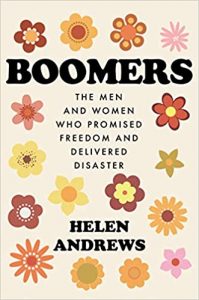
Which brings us to the latest installment in Beating Up Boomer. Helen Andrews’s new book, Boomers: The Men and Women Who Promised Freedom and Delivered Disaster sounds, at first, as though it will be another all-out attack on everyone born between 1946 and 1964. But that’s not quite what Andrews is up to. Instead, she focuses her fire on six Boomers (unlike Gibney and Filipovic, Andrews eschews capitalizing the “B”) who, if not exactly exemplary, are certainly eminent: Steve Jobs, Aaron Sorkin, Jeffrey Sachs, Camille Paglia, Al Sharpton, and Sonia Sotomayor. As you can see from her choice of targets, Andrews is the anti-Filipovic, aiming her attack at Boomers who are generally left of center in the partisan divide.
Andrews’s book is easily the most entertaining of the three under discussion here, consisting as it does of six short (25–30 pages each) bios of iconic Boomers. It is also the smartest and the most well-written. Filipovic frequently criticizes right-wing Boomers but she rarely mentions any by name. Andrews not only names names, she gives you their biographies as well. Her chapter on Sonia Sotomayor convinced me that the Supreme Court Justice is a bully. An anecdote about how Sotomayor made Justice Ruth Bader Ginsburg get up and salsa dance in front of her colleagues three days after the funeral of Ginsberg’s husband is especially galling. Her chapter on Camille Paglia is highly entertaining even though its conclusion—“Paglia’s work, taken as a whole, seems less profound than it should be”—strikes me as less than earth-shaking. Likewise, her chapter on Steve Jobs breaks no new ground. But even though her portraits aren’t always full of new details, they are without exception filled with scathing cultural commentary. Here’s a critique of the leftwing mania for higher education from her Paglia portrait:
Keep reading
A Clockwork Filmmaker

The Insight Trap
Cornell and Consent
Robert Lynch on Status, Humour and the Apes We Pretend Not to Be | Quillette Cetera Episode 74