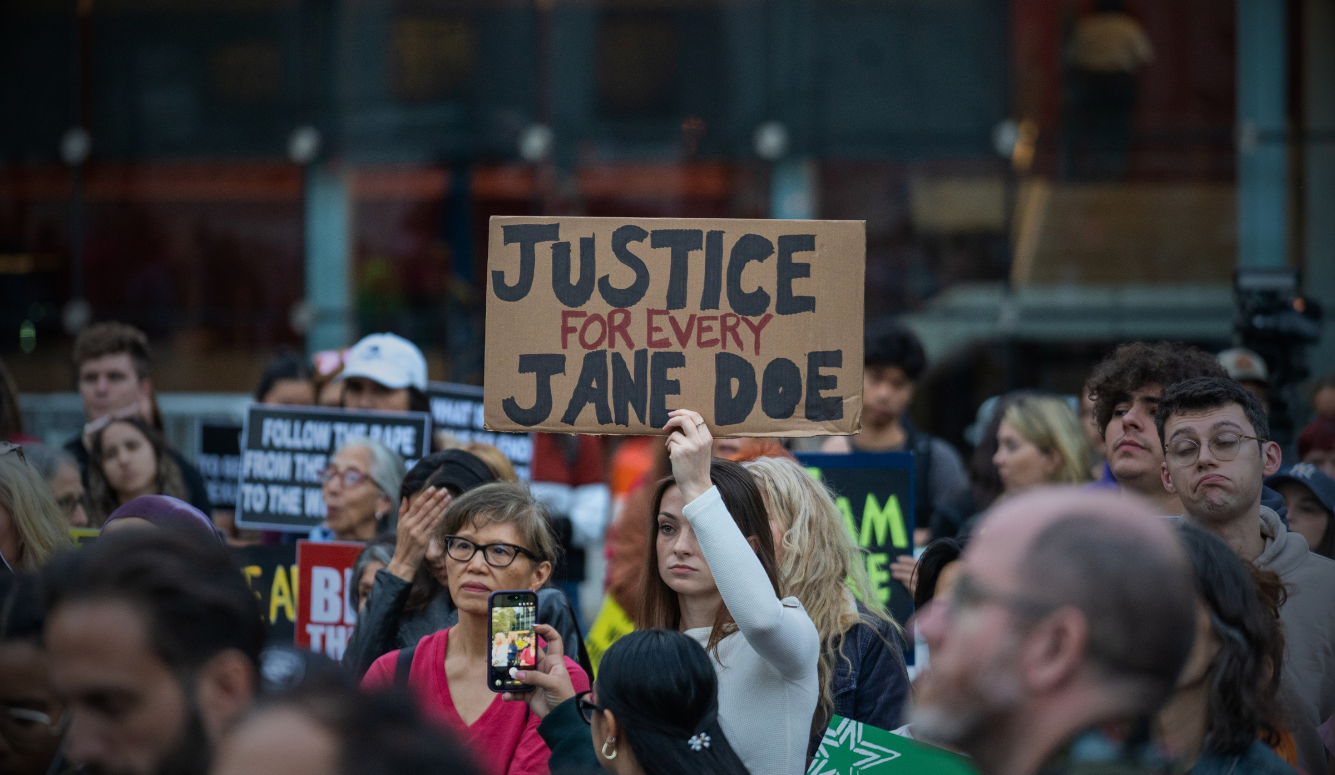
The Only Thing Necessary for the Triumph of Evil is for Good Women to Do Nothing
In my pre-feminist days, sexual harassment and rape were so common, so pervasive, so accepted, that they were virtually invisible.

In my pre-feminist days, sexual harassment and rape were so common, so pervasive, so accepted, that they were virtually invisible. The shame clung to the victim or to the whistle-blower; the abuser almost never experienced any consequences for his actions. In fact, he was rarely named and when he was all ranks closed to protect him and to destroy his accuser.
Back then, people had very stereotypical ideas about who a rapist might be. He was a monster, a stranger, a loser—not the boy next door, not one’s husband or boyfriend, definitely not a wealthy celebrity, a diplomat, or the employer of hundreds.
Like most young women in the 1950s and 1960s, I was sexually harassed, almost every day, certainly a few times every week—by strangers on the street, men on trains and in movie theaters, employers, neighbors, and professors. Like others of my generation, I was bred to accept it, keep quiet about it, and blame myself if something about it bothered me. For years I did this, until the feminist movement in the late 1960s allowed me to analyze my fate in feminist terms.
In 1951, photographer Ruth Orkin shot a street scene in Italy in black-and-white in which at least 15 men are captured leering at one lone American girl in a long peasant skirt and sandals. Her expression is at once controlled, trapped, terrified. There are men behind her, on either side of her, men awaiting her. The photo is well known.
Orkin’s photo is a scene of street harassment. It understates the problem. Over the years, I have traveled in Italy; what happens is far worse than what we see in the photo. I have seen Italian men literally risk life and limb to make their appreciation known to a woman. They half fall out of windows, dash into traffic. They are operatic, outrageous, hot-blooded, infantile—and a royal pain in the ass.
In my time, catcalls, smacking noises, and offers of money were what constituted “the outside world” for most unaccompanied young women. I could not sit on a park bench and gaze at a tree, listen to a soft rain fall, stand before a magnificent painting for the first time, or read a book in a café without being interrupted, or without fearing I might be interrupted by some male stranger. Only in retrospect do I understand that what I once experienced as reality “heightened” was, in effect, reality narrowed.
I felt no danger. I felt invincible. I wanted to be as free, sexually, as boys were. I hadn’t a clue that a double standard existed that would penalize me for doing the exact same thing as boys did.
I always had a job after school; my family needed the money. During college I waited tables as part of my financial aid package. On winter and summer breaks I worked as a waitress and as a camp counselor. I have memories of being sexually harassed by one male employer after another when I was a teenager and when I worked as a waitress in Greenwich Village.
As every woman knows, hell hath no fury like a man spurned.
For example, in the late 1960s, after we had had dinner together, the head of a department at a prestigious medical school tried to rape me. I was a graduate student and we’d met at his suggestion (I’m guilty, I confess: I went, I ate) to discuss how he could assist me in getting my research funded. In the decidedly non-amorous scuffle that ensued, I broke one of his ribs, and although I helped him to a nearby hospital, he never helped me get my research funded.
In the early 1970s a professor arrived to rate my college’s curriculum for a national review board. I admit it; I did it again: I accepted his invitation to a dinner party with well-known intellectuals and their wives. My equally ambitious heterosexual male counterparts also accepted dinner invitations but they didn’t have to face sexual harassment at the hands of their heterosexual mentors. I had the audacity to reject this professor’s every subsequent social and sexual advance. He retaliated by arranging for the publication of a scathing review of my first book, Women and Madness.
 Claire Lehmann
Neither of these professors were overcome with love for me. They treated me as they did because I was a woman.
It was nothing personal. Prejudice rarely is.
In 1975, the feminist journalist Lin Farley first used the phrase “sexual harassment” when she testified before the New York City Human Rights Commission. Because of all the media coverage, it became known both nationally and globally. And in 1978, Farley published Sexual Shakedown: The Sexual Harassment of Women on the Job.
It changed nothing. It did not help that our radical analyses were attacked and then disappeared from the academic canon and in the media as well. In any event, even a high profile, digitally powered #MeToo Movement has been unable to abolish the global epidemic of sexual violence.
Ninety-nine percent of sexual predators are male—but not all men are sexual predators. Such predators have gotten away with pedophilia, sexual harassment and rape, mainly of girls and women, but also of boys and men.
Nevertheless, those women and men brave enough to accuse sexual predators of their crimes have not been believed and/or have been blamed and shamed. I therefore hesitate to focus on the ways in which women also support sexual predators.
But they do.
The phenomenon of cowardly bystanders and relentless opportunists also describes human behavior in genocides and massacres—and the silence, inaction, and active collaboration of supposedly “good” people haunts survivors even more than the evil deeds of “bad” people.
Being sexually harassed and raped by your employer—when you need to keep the job—consigns a woman to a special circle of hell.
In 1979, a high ranking diplomat at the United Nations attended a reading I gave. He asked me to propose a project and invited me to an evening he was hosting for J.H. Plumb, the distinguished British historian. I then told the diplomat that I wanted to organize an international feminist conference consisting of feminists who had already achieved some level of power or recognition in their countries.
We negotiated my employment contract for months. Then, on Christmas Day, four days after we signed my contract, my bell rang. It was just after midnight. I opened the door and my six-foot employer barged in. He was drunk. He declared his love for me, said he had waited long enough, and then, despite my most ferocious efforts, he raped me.
I did not scream. My toddler son was sleeping in the next room. I gritted my teeth and bore it. I thought about how a feminist government might handle rape. Life in prison? Execution? Radical rehabilitation?
I wanted to call the police, but he had diplomatic immunity. I considered quitting. But I wasn’t going to allow this man to drive me off my field of dreams. Instead, I chose to endure his subsequent campaign of hostile intimidation. All I could do proactively was make sure I was never alone with him again and hope for feminist support and solidarity. Otherwise I was helpless. Vulnerable.
The following day I told a close friend (whom I had hired to work with me on this UN project) and my assistant what had happened.
And then—I carried on. Seven months later, at the conference in Oslo, my drunken rapist harassed and frightened at least four other women. At that point, I suggested we all confront him. My American feminist friend, whom I had invited to Oslo, cooled out this potential (and totally private) confrontation because my rapist was a black African man. Although two black African women had joined us, my fine feminist friend argued that white American feminists would “look bad” if we accused a black man of a crime.
And then, to my amazement, she buddied up with my rapist and took my place in all subsequent UN-heightened activities including writing the Introduction to the UN Proceedings of the Oslo Conference, future anthologies, and further international conferences.
Neat trick.
There I was in early 1980 without any legal way to allege either rape or sexual harassment, and my illusions about feminist sisterhood (not about the feminist analysis of harassment and rape) had just been radically challenged. I had been treated the way those who accuse their fathers of incest are treated by their mothers who disbelieve their stories and then ostracize them for telling.
In 1983, I finally suggested a feminist tribunal behind closed doors. I did not want this man to go to his grave thinking he could divide the likes of us. I composed a 50-page document in which I exhaustively described what had happened and sent it around.
Incredibly, at first my feminist allies said that they’d assumed I’d had an affair with my rapist. Then they pointed out that few feminists would have read the Proceedings and anyway, time had moved on.
Still, my high profile feminist allies promised to stand by my side—as they would do later on behalf of Anita Hill—but they never did. We never confronted my rapist together while he was still alive.
They also promised to write and tell the Oslo conference participants exactly what had happened. That, too, was a promise never kept.
I was devastated and demoralized, but I carried on. However, this betrayal and the failure of my feminist friends and allies to do the right thing has haunted me ever since.
It was also a gift because it led to my interviewing other women about envy, competition, sneakiness, rumor-mongering, and other forms of “indirect” woman-on-woman “aggression.” Some feminists warned me not to publish anything on this subject because “the men would use it against us.” They also asked: “Are you going to name names?”
“Don’t be ridiculous,” I said. “If I did, I’d have to publish the entire phone book.”
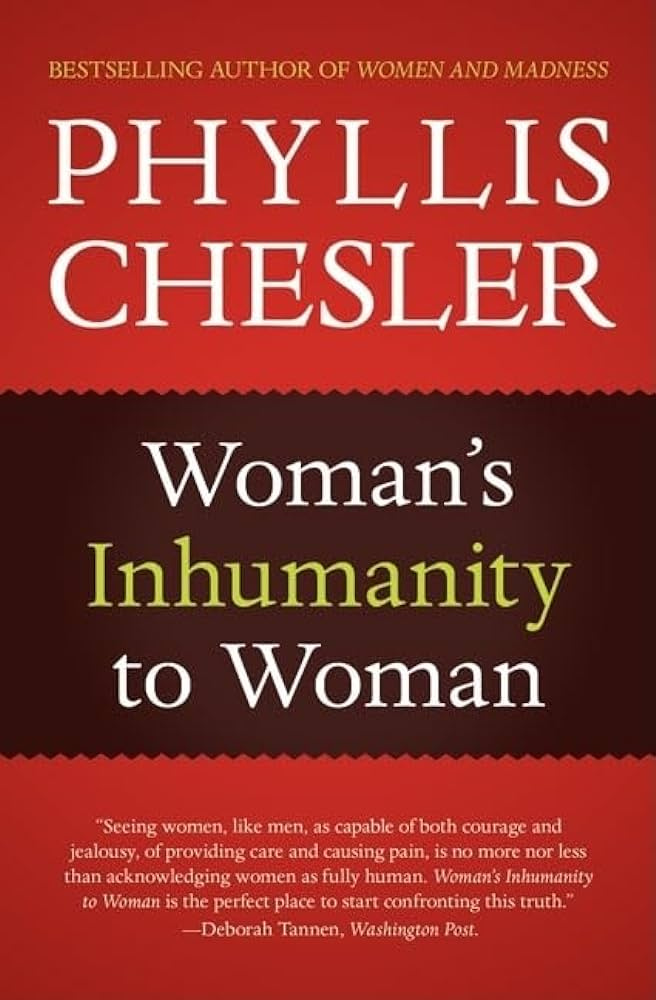
Eventually, in 2002, I published a book titled Woman’s Inhumanity to Woman. In it, I told a modified version of this episode without naming any of the women in question. Some feminists still blamed me for not disguising the cast of characters well enough. Years later, some feminists, even those who had warned me against publishing at all, told me that what I was writing about was very important, that it was happening to them, and that I should have published it sooner.
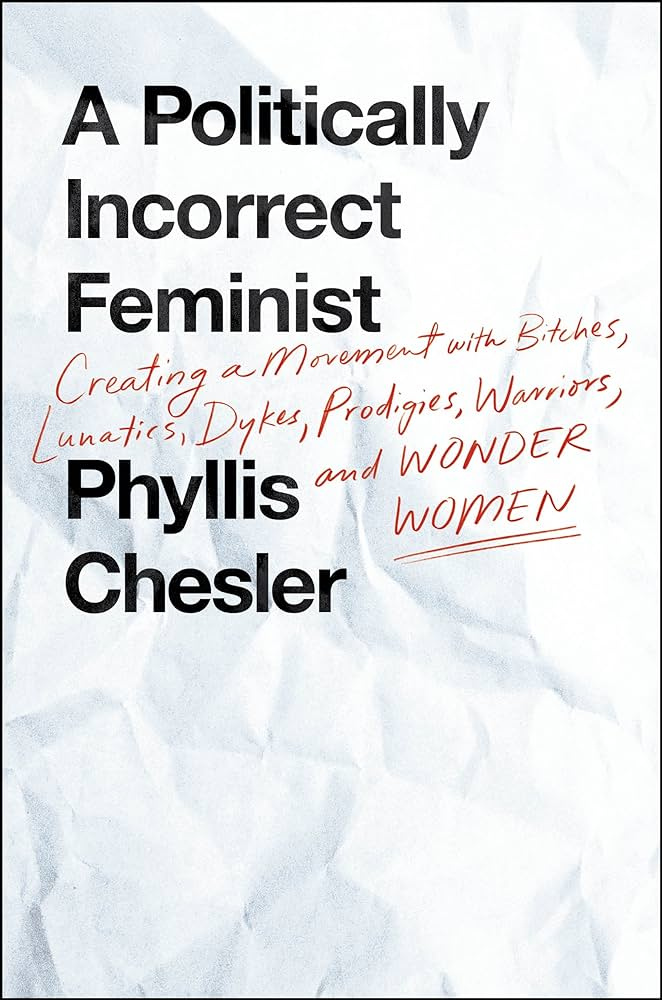
I finally did “name names” in my more thoughtful analysis of this episode in my 2018 book, A Politically Incorrect Feminist, which may be why it was never reviewed in the feminist, left-feminist, or mainstream media. This is amazing given that many of my books had received front page reviews in the Washington Post and the New York Times; that I’d been reviewed all across the country and in Europe, South America, and Australia, in both left-wing, feminist, and right-wing media. I’d appeared on the cover of the NYT, been interviewed there often, and had published op-eds and letters in their pages over the years.
It was as if I’d never spoken, had never lived the life of a public intellectual or feminist leader.
Important matters are always complicated and cannot be resolved, or even properly understood, by politically correct sloganeering.
Some women do lie about being raped for reasons of revenge or greed. Some women do so because they’re mentally ill.
And then there are all the ways in which some women opportunistically profit by assisting male sexual predators.
Some women profit economically from enticing and controlling vulnerable female prey—think of the role some women allegedly played for recidivist sex offender, Jeffrey Epstein.
For twisted psychological reasons, not involving economic survival, some women help “season” and control the Master’s vulnerable prey—think of Keith Raniere’s Nxivm sex slave cult and his female enforcers. There were many, including actresses, heiresses, and the lost souls whom they enticed and essentially pimped to Raniere.
Think of the late and not lamented Al-Baghdadi whose many wives served him as he repeatedly raped and murdered civilians and little girls. Think of all the ISIS wives who tormented and controlled their barbarian husbands’ infidel sex slaves, including female children; or the ethnic Arab Muslim Sudanese women who sang as their men publicly gang-raped mainly black African children and women.
Think of the role played by female pimps and brothel Madams whose names are too numerous to mention. Here, though, their very lives, not their reputations or careers, are often on the line. If they refuse to do this for the trafficker and pimp, they may face torture, even death.
Claire Lehmann
In addition, American police continue to disbelieve, blame, and ostracize female rape victims. In 2019, The Atlantic reported that more than 200,000 rape kits—evidence of rapes that included DNA samples—remained untested in cities across the country. In Detroit alone, at least 11,341 rape kits had never been tested over a 30-year period. When some rape kits were finally tested for DNA and then matched to various data banks, both serial killers and serial rapists were quickly discovered—men who had gone on to rape again and again.
In one 2019 case in Kansas, a woman was raped but did not want to report it. However, she did go to the police—who then chose to investigate her, not her alleged rapist, for filing a false report. According to her attorneys:
The police violated almost every tenet of trauma-informed practices during this investigation by telling our client to think of her assailant’s reputation, suggesting that our client merely regretted what she had done, and repeatedly misrepresenting the status of her case. All told, they investigated our client’s rape for less than two hours. That’s how long it took them to conclude that our client had ‘fabricated’ being raped.
It is also true that most allegations of sexual harassment on the job have been disbelieved and covered up. Women have lost their jobs and their careers for pursuing such claims. They still do. Many have been gagged by non-disclosure agreements. Women in non-Western countries have risked shame, jail, (Afghanistan, Iran, Saudi Arabia) and even death (Bangladesh) for reporting rape and sexual harassment. At the very least, they are not believed.
Unfortunately, women also disbelieve women when they report sexual harassment and sexual assault. For years now, prosecutors have not wanted women on the jury in rape cases or in cases in which a battered woman finally killed her batterer. Why? Because according to legal researcher Lynn Schafran, men and women, including women judges and jurors, “avoid acknowledging their own vulnerability by blaming the victim. This distancing mechanism operates particularly in non-stranger rape cases, because it is acknowledging the likelihood of these crimes that women jurors feel most at risk.”
Keep reading
France’s Imaginary Austerity
A Clockwork Filmmaker

The Insight Trap
Cornell and Consent