Inquiry and Ideology — The Battle of Ideas
Rather scathingly, Frye notes that “in weak or insecure minds such a collision produces immediate panic, followed by elaborate defensive reactions.”


Two kinds of viewpoint inform our public debates today: those derived from values and those derived from facts and data. To simplify the battle of ideas by siding wholly with either values or disinterested inquiry leaves us with a choice of different values or different academic conclusions. But it also involves discounting an enormous amount of oppositional thought – value-driven arguments as a whole if you are a scientist, and much of what passes for science if you are an activist.
Are there any grounds for privileging value-driven viewpoints, on the one hand, or thoroughly academic attitudes, on the other? The notion that we should put our faith in science has a number of prominent advocates, such as Richard Dawkins, Sam Harris, and Steven Pinker. Similarly, a great many activists appear to have decided that prioritizing values is fully justified – in their view, science is a manifestation of power, and so everything conventionally thought of as epistemological is actually political. Perhaps the best answer is that there are no grounds for an a priori preference for either values or facts. But then how do we conceptualize instances where a values-driven movement becomes anti-social? The pages of our finest newspapers and magazines are replete with stories that testify to this creeping authoritarianism.
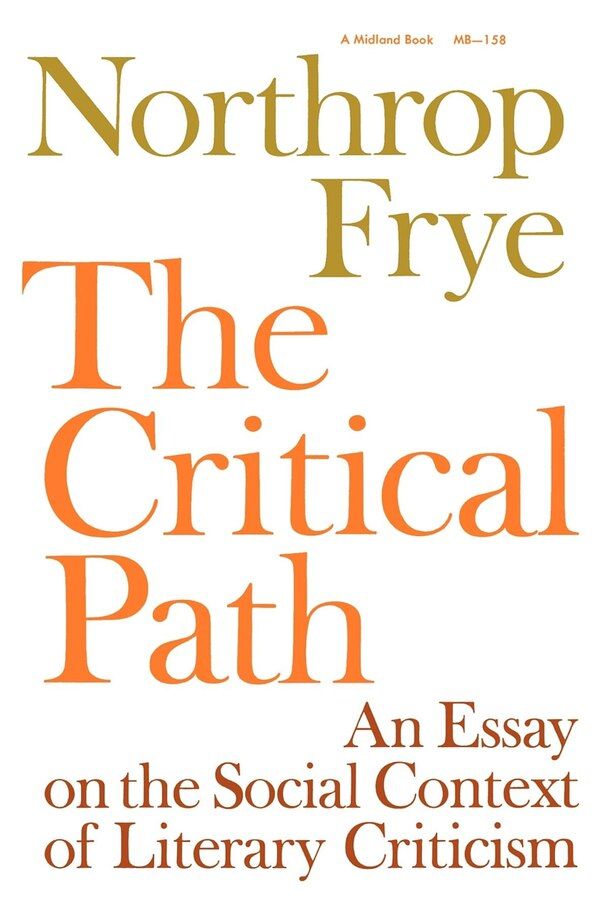
Written nearly half a century ago, Northrop Frye’s The Critical Path (1971) grapples with these questions, and sheds some light on the issues involved. Frye notes that most of us combine respect for the authority of university disciplines with a religious or political attitude. He conceptualizes the latter as “concern.” Concern, in his critical vocabulary, is distinct from the authority of the disciplines. (“Many of my readers,” Frye observes, “would call what I am calling […] concern an ideology, and […] those who prefer ideology may substitute it in most contexts.” In this piece, I will retain his term ‘concern.’)
Importantly, ‘truth’ and ‘reality’ mean different things to these divergent ways of approaching and understanding the world. For the disciplines, truth and reality are provided by nature, and our understanding of truth and reality depends on reasoning and evidence. For concern, “truth and reality are not directly connected with reasoning or evidence, but are socially established … its truth or reality is connected with human desire.” Concern is bound up with “truth of vision,” while the disciplines are dedicated to “truth of correspondence.” When Frye first speaks of concern, he emphasizes its mythical nature, and tries to explain how, in the Western world, distinct “myths of concern” jostle with one another. We have inherited the “Judeo-Christian myth as set out in the Bible,” but other myths are also of great consequence, such as “the myth of democracy and the revolutionary working-class myth.”
As a university professor, Frye had a keen sense of the towering importance of disinterested inquiry. Indeed, he thinks of those who defend the spirit of inquiry as a minority in society, and, over the course of his lifetime, he obviously saw himself as a part of that minority. But in this theory of society, he insists that inquiry must learn to live with concern. He expresses his support for a synthesis of concern and inquiry by rejecting the notion that either should ever become hegemonic. On the one hand, we have what I call the “Don’t bother me with ‘facts’” approach which Frye, as a researcher, unsurprisingly rejects out of hand. Inquiry, he tells us, justifiably, challenges concern:
[A]stronomy had to accept a heliocentric view of the solar system even though social anxieties demanded a geocentric one; sooner or later British history had to give up on King Arthur even though the British imagination clung to him. That is, historians and scientists found that they had not only a social function, but a discipline of their own that demanded loyalty to its principles.
Rather scathingly, Frye notes that “in weak or insecure minds such a collision produces immediate panic, followed by elaborate defensive reactions.” Since nobody can entirely escape the prejudices of their socio-cultural environment, many in the humanities prefer to claim that disinterested inquiry doesn’t exist at all, a lesson absorbed from Critical Theory. For Frye, this amounts to an attempt to collapse disinterested inquiry into concern, and truth of correspondence into truth of vision. The origin of this idea, he argues, is Marxist:
Many Marxist theologians […] insist that, as everybody exists in a specific social context, there is no such thing as complete detachment from a social attitude which must be either revolutionary, and so in agreement with them, or counter-revolutionary.
This, Frye argues, is simply bad logic. From the notion that “complete objectivity is impossible” one cannot safely infer that “differences in degree of objectivity are not significant.” So, the “Don’t bother me with facts” attitude does not get us very far. But nor does its counterpart.
 Jeffrey Herf
The counter viewpoint argues that as society progresses, it undergoes a process of demythologization, which can lead to the conclusion that all we need is science. Frye makes light work of this outlook, too. Just as it is unwise to assume that everything can be collapsed into ‘concern,’ it is wrong to conclude that only science possesses authority. “Some, of course, meet the collision of concern and freedom from the opposite side,” observes Frye, “with a naïve rationalism which expects that before long all myths of concern will be outgrown and only appeal to reason and evidence and experiment will be taken seriously.” David Hume, Frye would no doubt say, was correct to say that an ‘ought’ cannot be derived from an ‘is.’ Rather, concern must supplement science: “The growth of knowledge cannot in itself provide us with the social vision which will suggest what we should do with our knowledge.” [emphasis added]
Frye does not adopt an “anything goes” attitude to concern. Ideological zealotry provided the backdrop to his entire career, and, unsurprisingly, he does not fail to incorporate considerations about the worst myths of concern into his framework. He candidly states that “Some myths of concern obviously make a fuller life possible than others do”, before identifying charity and intellectual honesty as two values which inhere in the better myths of concern. And those considerations segue to a damning assessment of Nazism (a “myth of concern” in this framework, though a diabolical one). But he is clearly of the view that a great many myths of concern are benevolent in their effects and that, generally, they must be accommodated by society.
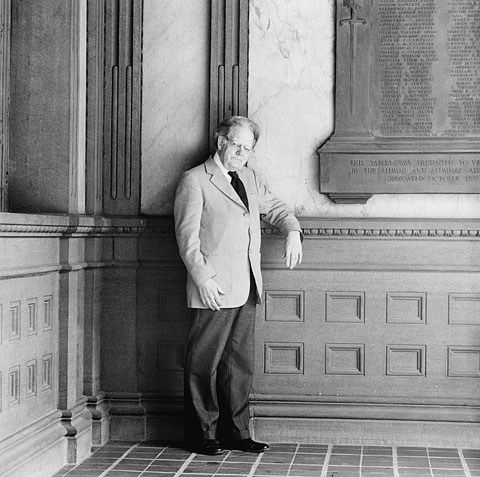
Northrop Frye in 1984
Frye suggests, then, that an intellectual who denies the value of concern and a “true believer” who denies facts are something of a pair – both hope to simplify public debates using an a priori emphasis on one viewpoint. A public intellectual like Steven Pinker, who takes a dim view of myths of concern, is in this sense the bedfellow of creationists who deny science. And so we are stuck with our squabbling, feuding society, in which concern and inquiry must inevitably clash over and over again.
Keep reading
The Genetics of Crime and Punishment
Jerry Kaplan on AI Doomers

Payback Time for Steven Galloway