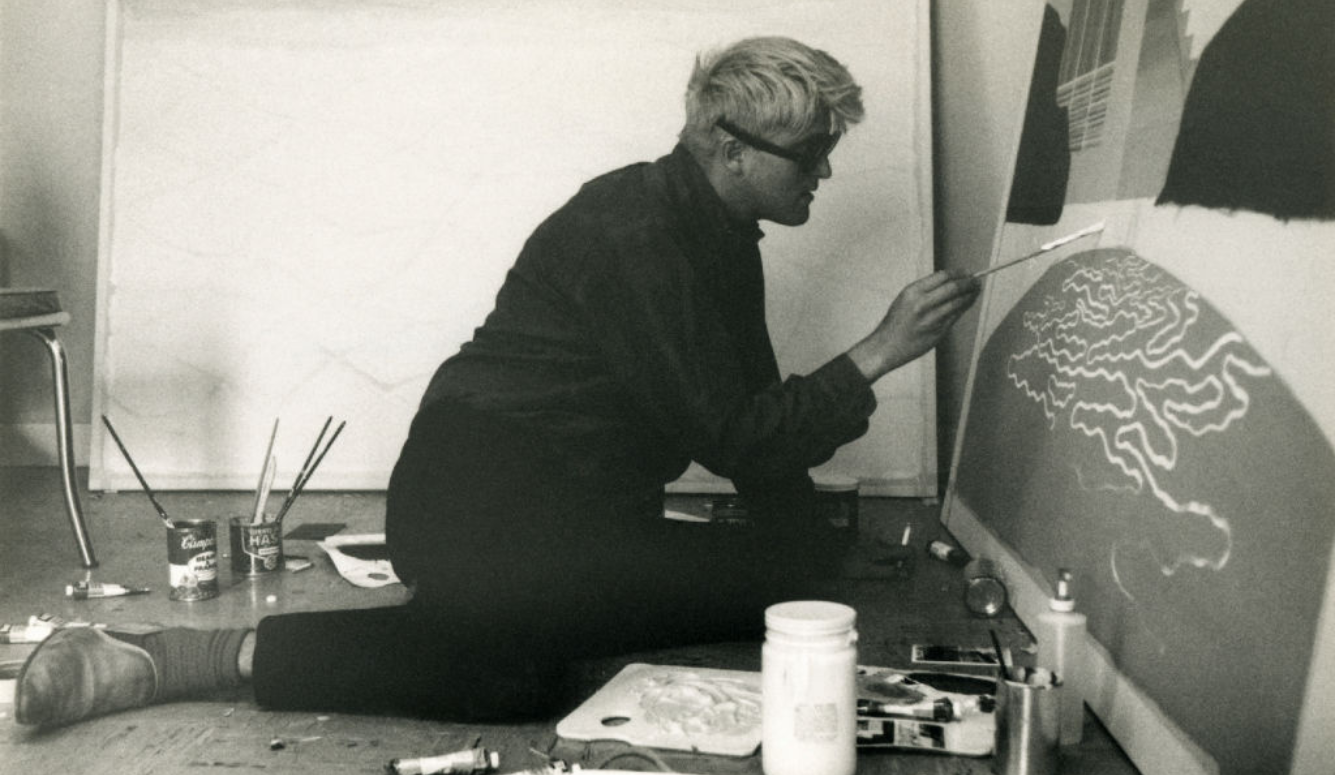

One of David Hockney’s favourite stories concerned a ceramic owl made by Picasso. Standing before it in contemplation, he would point out that a stuffed owl contains infinitely more information than Picasso’s sculpture. A stuffed bird preserves the details of plumage, coloration, and anatomy with scientific accuracy, while Picasso’s owl has none of those things. But in Hockney’s view, the artist’s rendition possessed something the stuffed bird lacked—the experience of the human gaze.
Hockney, who died last week at the age of 88, spent over seven decades making pictures. During that time he became one of the most recognisable artists in the world. His iconic images of swimming pools became emblems of California. His psychologically penetrating double portraits held their own against those of Freud and Bacon—the most unsparing figurative painters of the postwar period—but he brought a lightness of touch to his work that neither of those artists managed. His Yorkshire landscapes transformed an unfashionable genre into one of the most ambitious artistic projects of recent decades. He designed opera sets, experimented with photography and film, investigated the optical techniques of the Old Masters, and in his seventies, embraced the iPad with the enthusiasm of a schoolboy. Whatever he was working on, Hockney pursued the same question: what can a picture reveal about the world that ordinary looking leaves unseen?
David Hockney
— Wild at Heart (@emmanu_elle_) June 21, 2026
Beach umbrella
1971 pic.twitter.com/UfvWNjfrwV
Many television and print tributes to the late master have ignored this question, preferring to dwell on the deceptively objective measure of the art market. They mention the record-breaking 2018 auction sale, in which Hockney’s Portrait of an Artist (Pool with Two Figures) (1972) sold for over US$90 million, making him the world’s most expensive living artist. That distinction was short-lived—Jeff Koons reclaimed the title within months with his fabricated sculpture. Mike Winkelmann, aka Beeple, entered the value conversation with his algorithmically assembled NFT, which sold for nearly US$70 million in 2021—proving that the only thing to be learned from auction-price rankings is how the market flattens widely disparate phenomena in financial terms.
Keep reading
Claire's Weekly Letter: A Dish in the Sink
Banning the Horseless Carriage

Myths and Illusions of the Digital Age

Zineb Riboua on Islamism, Israel and the West’s New Culture War | Quillette Cetera Episode 72

Citizen Sane

‘This Country Is But One Scene of Massacre’