Art & Culture
A Clockwork Filmmaker
A look back at the cinema of Stanley Kubrick on the eve of a massive new Criterion retrospective.

I.
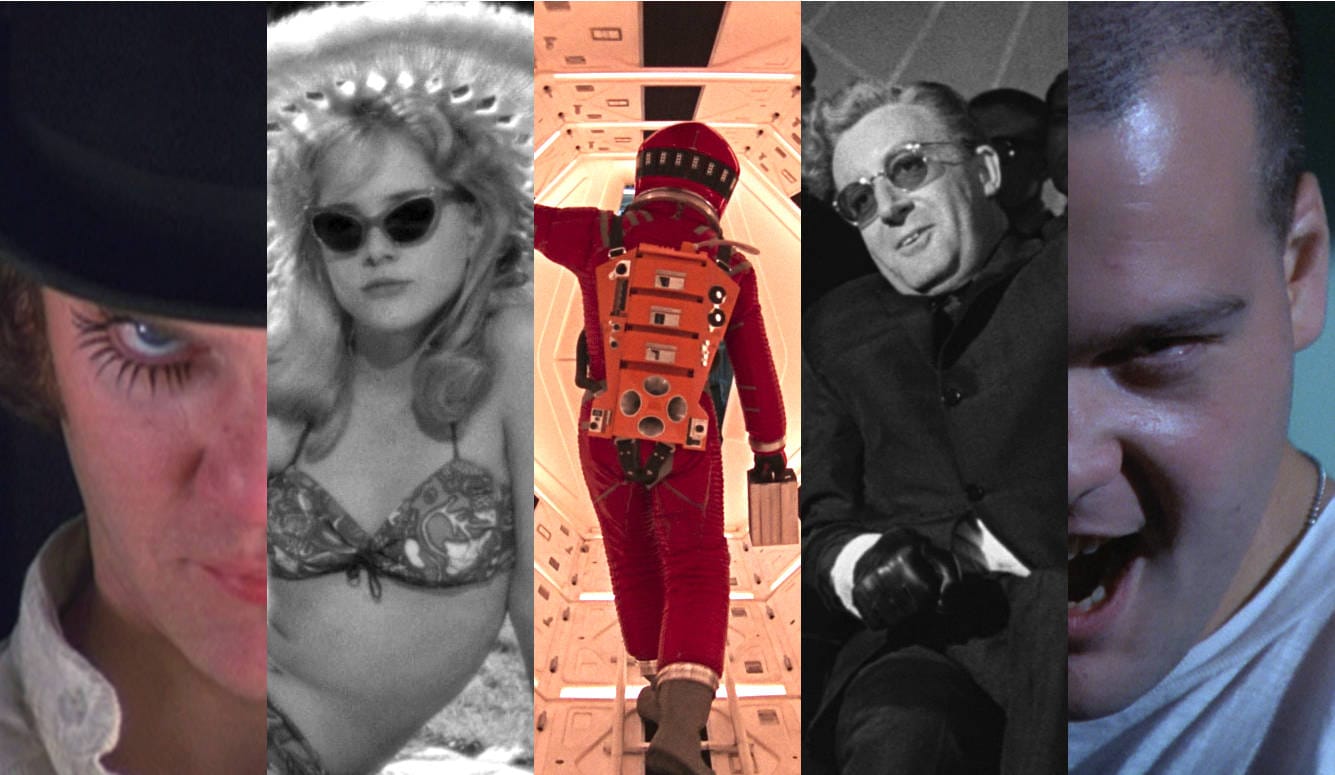
This month, the Criterion Collection is releasing an extravagant boxset containing Stanley Kubrick’s entire back-catalogue, from his self-funded documentary short Day of the Fight (1951), which he made when he was 22 years old, to his final film, Eyes Wide Shut (1999), which he completed days before his death. I wonder what the director would have made of this collection, had he lived to see it. Kubrick was a notorious fusspot. After he hit it big in Hollywood, he tried to destroy the prints of his first feature, Fear and Desire (1952), because he felt it no longer met his standards. He would personally phone theatres to make sure they were projecting his films at the correct luminosity. During the making of The Shining (1980), he shot so many takes of one scene involving Scatman Crothers that the 68-year-old actor broke down and cried, “What do you want from me, Mr. Kubrick?!” The technicians who worked with him on 2001: A Space Odyssey (1968) used to say: “In six days, God created the heavens and the earth. On the seventh day, Stanley sent everything back for modifications.” If Kubrick were alive today, he’d undoubtedly have insisted on supervising the digital transfers frame-by-frame, and we might never have got the boxset at all.
At US$479, The Complete Kubrick is too rich for my blood. It tells you something, though, that the folks at Criterion are comfortable charging such an eye-watering price for thirteen feature films that are already available in multiple formats for far less. Nearly thirty years after his death, and nearly eighty years after he began making movies, Kubrick remains one of the most important and influential figures of 20th-century American cinema. In the past decade, half a dozen books have been published about his life and work, including a biography by Robert P. Kolker and Nathan Abrams; a collection of Kubrick’s photographs, from the period when he worked as a staff photographer for Look magazine; and a massive, 800-page volume on his uncompleted Napoleon biopic.
The people who buy these books aren’t just drawn to Kubrick’s films; they’re drawn to Kubrick himself. He looked more like a Russian monk than an American movie director, with dark, hooded eyes, wild hair, and an unruly beard. He was so reclusive that Anthony Lane called him “the Howard Hughes of Hertfordshire.” Though he was born and raised in New York City, Kubrick spent nearly forty years tucked away in the English countryside. Even when he made Full Metal Jacket (1987), his grunts’-eye-view of the Vietnam War, he refused to leave the UK, importing 200 palm trees, 100,000 plastic plants, and 5,000 Vietnamese extras to help recreate the city of Huế at the disused Beckton Gas Works in Newham. He was leery of infections, terrified of flying, and apparently carried a hunting knife in his briefcase during the making of 2001: A Space Odyssey. Yet, these quirks only added to his mystique, creating the impression that he was some kind of mad genius, like Friedrich Nietzsche or Bobby Fischer.
Kubrick might have liked the latter comparison. He was an avid chess player all his life, and he earned extra money as a young man by hustling games in Washington Square. “Chess,” he once explained, “is a series of steps that you take one at a time and it’s balancing resources against the problem, which in chess is time and in movies is time and money.” His films often feel like giant games of chess. The rows of raw recruits in Full Metal Jacket resemble sacrificial pawns with their stiff posture and smooth heads. The metaphor is even more explicit in Paths of Glory (1957), where Kubrick stages the film’s pivotal trial scene on a checkerboard floor, revealed in chess-player’s-eye-view from above. Kubrick loved arranging men in tidy rows, then making them fight to the death. That’s what drew him to films like Spartacus (1960) and Barry Lyndon (1975) and why he yearned to make a movie about Napoleon. In an interview with reporter Joseph Gelmis in 1970, he reflected:
Napoleonic battles are so beautiful, like vast lethal ballets. ... They have an aesthetic brilliance that doesn’t require a military mind to appreciate. There’s an aesthetic involved; it’s almost like a great piece of music, or the purity of a mathematical formula. ... There’s a weird disparity between the sheer visual and organisational beauty of the historical battles sufficiently far in the past, and their human consequences. It’s rather like watching two golden eagles soaring through the sky from a distance; they may be tearing a dove to pieces, but if you are far enough away the scene is still beautiful.
II.
Stanley Kubrick was born on 26 July 1928, to Jacques Kubrick, a 26-year-old physician fresh out of medical school, and his 24-year-old bride, Gertrude, whom he’d wed nine months before. Kubrick liked to say that he wasn’t really a Jew; he just happened to have two Jewish parents. Unlike the other boys in his Bronx neighbourhood, he didn’t learn to speak Hebrew or Yiddish, and he didn’t receive a bar-mitzvah. (This may explain why there’s only one obviously Jewish character in all his films—Victor Ziegler, the wealthy New York businessman played by Sydney Pollack in Eyes Wide Shut.) Jacques hoped that, one day, his son would follow in his footsteps and go into medicine, but it wasn’t to be. Kubrick’s grades, from elementary school onward, were abysmal. Between June 1938 and June 1940, he was given “unsatisfactory” marks in Personality, Works and Plays Well with Others, Completes Work, Is Generally Careful, Respects Rights of Others, and Speaks Clearly. Of the 509 students in his high-school class, he was ranked 414. “It wasn’t as if he were stupid,” a classmate recalled. “He was simply not interested.”
Only two things held the lad’s attention: chess and photography. He picked up the latter hobby after his father gave him a professional Graflex camera for his thirteenth birthday. “From the start I loved cameras,” he explained. “There is something almost sensuous about a beautiful piece of equipment.” Over time, his interest in cameras would extend to a wide variety of gadgets, from cars and computers to assault rifles and atomic weapons. “Eventually,” he told an interviewer in 1968, “we will have to share this planet with machines whose intelligence and abilities far surpass our own. But the interrelationship—if intelligently managed by man—could have an immeasurably enriching effect on society.” Some critics complained that Kubrick’s films felt mechanical; technically impressive but empty of human feeling. “There is something majestically unbreathable in his conception of cinema,” the New Yorker’s Anthony Lane wrote at the time of Kubrick’s death, describing his films as misanthropic and antiseptic.
Anyone who has sat through 2001: A Space Odyssey will have at least an inkling of what Lane is talking about. The only character in the film with any personality is the HAL 9000, a disembodied supercomputer. The humans, on the other hand, all sound like robots:
HAL: Forgive me for being so inquisitive, but during the past few weeks I’ve wondered whether you might be having some second thoughts about the mission.
Dave: How do you mean?
HAL: Well, it’s rather difficult to define. Perhaps I’m just projecting my own concern about it. I know I’ve never completely freed myself of the suspicion that there are some extremely odd things about this mission. I’m sure you’ll agree there’s some truth in what I say.
Dave: Well, I don’t know. That’s a rather difficult question to answer.
HAL: You don’t mind talking about it, do you, Dave?
Dave: No, not at all.
Kubrick denied the charge that he was a misanthrope. “I mean, the world is not as it’s presented in Frank Capra films,” he explained during a 1987 interview with Rolling Stone. “People love those films—which are beautifully made—but I wouldn’t describe them as a true picture of life.” One of the reasons Kubrick’s pictures still feel fresh today is that they don’t offer viewers what Lane called “the warm fuzz of Hollywood.” At the time of its release in 1987, Full Metal Jacket was inevitably compared to another Vietnam movie that had taken home Oscars for Best Picture and Best Director earlier that year. “It's one of the best-looking war movies ever made on sets and stages,” Roger Ebert wrote of Full Metal Jacket, “but that's not good enough when compared to the awesome reality of Platoon, Apocalypse Now and The Deer Hunter.” Four decades on, however, Platoon (1986) looks sentimental and childishly pretentious, while Full Metal Jacket remains as tart as it always was.
By Kubrick’s senior year of high school, photography had become an all-consuming passion. He took photographs for the yearbook and the school paper, and in his free time, he took them for fun. In April 1945, the sixteen-year-old was walking along the Grand Concourse in the Bronx when he spotted an old man inside a newsstand surrounded by the day’s headlines: “F.D.R. DEAD,” “TRUMAN TAKES OFFICE.” Kubrick framed the vendor between the papers and snapped his shutter. The New York Daily News offered to buy the shot for US$15. He sold it to Look for US$25.
A newsstand with papers announcing President Roosevelt’s death, April 1945.
— @QuirkyBird (@quirkiebird) April 27, 2022
📷 Stanley Kubrick [via MCNY] pic.twitter.com/4bIfipVuNX
So began Kubrick’s brief career as a photojournalist. Between 1945 and 1950, he took around 26,000 photographs for Look, including man-on-the-street pictures, posed portraits, gimmicky photos (“How People Look to a Monkey”), and celebrity features. In May 1948, he photographed former Allied commander Dwight Eisenhower, who was then serving as president of Columbia University. Two weeks later, he shot a series on the father of motivational speaking, Dale Carnegie. The following summer, he profiled actor Montgomery Clift, photographing the handsome young star answering phone calls, smoking cigarettes in bed, and giving a toddler a ride on his shoulders. While some of these pictures are clichéd, they nevertheless demonstrate Kubrick’s obvious gifts for composition and for using the camera to tell stories. One photo shows a shoeshine boy named Mickey plying his trade beside a dance parlour. Although Mickey is just twelve years old, he radiates confidence and experience. He’s got one hand in his pocket, while the other’s cocked like a pistol and resting on his knee. With the tilt of the head and the knowing look on his face, he looks as if he is auditioning to be the next Dan Duryea.
Years later, Kubrick acknowledged that his tenure at Look served him well: “To make a film entirely by yourself, which initially I did, you may not have to know very much about anything else, but you must know about photography.” Even Kubrick’s sternest critics acknowledge that he had a magnificent eye. For the sake of historical accuracy, he decided to shoot the night-time interiors for his 1975 film Barry Lyndon without the aid of electric light, illuminating those scenes entirely with candles. To do this, he bought fast lenses that were normally manufactured for NASA for taking photographs in space, and had them custom-fitted to a modified Mitchell camera. Some scenes required so many candles that oxygen became scarce. Ken Adam, the unfortunate production designer—who had to keep the candles alight and make sure they remained at a consistent height from take to take—suffered a nervous breakdown. But the results are spectacular. Nearly every shot in that film looks as if it ought to be hung in the Tate Britain. “Kubrick,” the critic Richard Schickel wrote shortly before the film’s US release, “has assembled perhaps the most ravishing set of images ever printed on a single strip of celluloid.”
After five years, though, Kubrick was anxious to move on from Look. “My ultimate ambition,” he later told journalist Michel Ciment, “had always been to make movies.” A friend informed him that The March of Time spent up to US$40,000 on short documentaries. Kubrick figured he could shoot one for a fraction of that, then pocket the difference. Groping for a subject, he decided to repeat one of his assignments for Look, following middleweight boxer Walter Cartier on the day of a fight, showing everything Cartier did from the time he got up in the morning till the moment the fight was over. However, when Kubrick tried to cash in, he discovered that he’d overestimated the value of documentaries. The March of Time was going out of business, and Kubrick was forced to sell to RKO-Pathé instead, which agreed to buy the picture for US$4,000, netting the young director a measly US$100 profit.
III.
Kubrick liked to give the impression that he was solely responsible for all the creative decisions in his films. When 2001: A Space Odyssey won the Academy Award for Best Special Visual Effects, it was Kubrick—not effects supervisor Douglas Trumbull, who created the film’s stargate sequence, nor production designer Tony Masters, who designed the giant centrifuge that made it possible for Gary Lockwood to jog around the circumference of the ship—who took home the trophy. According to Kirk Douglas, Kubrick even tried to get himself a screenwriting credit on Spartacus, even though he had no involvement in the screenplay. “I don’t mean to minimize the contributions of the others involved,” he told a New York Times reporter, “but the director is the only one who can authentically impose his personality onto a picture, and the result is his responsibility.” While this credit-hogging was unbecoming, it wasn’t always unwarranted. Kubrick really did exert an extraordinary amount of control over his films, especially the early ones. On his first two features, Fear and Desire and Killer’s Kiss (1955), he did pretty much everything there was to do, besides playing the characters himself. He was the cameraman, editor, assistant editor, sound-effects man, property master, and grip. “It was invaluable experience,” he explained, “because being forced to do everything myself I gained a sound and comprehensive grasp of all the technical aspects of filmmaking.”
The trouble is the films weren’t any good. The first, a war story about four soldiers caught behind enemy lines, was, as Kubrick later admitted, “little more than a thirty-five-millimeter version of what a class of film students would do in sixteen millimeter.” Kubrick made the mistake of post-dubbing the dialogue, which grew the budget from US$9,000 to around US$40,000 by Kubrick’s account, and made the already stilted dialogue sound even more stilted. Killer’s Kiss has a little more polish. Kubrick created some lovely images by illuminating the villain (Frank Silvera) through Venetian blinds. Yet the film still feels amateurish, especially the exterior scenes, which were shot guerrilla-style, without permits. Kubrick would later be renowned for the elegance of his tracking shots, which he retook again and again, until they were silky smooth. In this case, though, he simply had to do the best he could, bumps, bad lighting, and all.
Things improved considerably after Kubrick began working with James B. Harris in 1955. A millionaire’s son, eight days younger than Kubrick, Harris dreamed of becoming a movie producer. He already had some experience under his belt, having co-founded his own film and television distribution company, but he wanted to make films, not just sell them, and he was impressed by how much Kubrick had been able to accomplish with so little money. In conversation with Vincent LoBrutto, author of Stanley Kubrick: A Biography, Harris recalled:
So I said ... “What do you think about maybe we could team up. You direct and I produce. Possibly I could bring to you a lot of things you didn’t have the advantages of when you were doing these other two [films], like maybe acquiring a story from a book so you have something more substantial to work with—and sort of run interference for you so you would not have to do everything for yourself. So he said, “It sounds great to me!”
They decided to make their first film about a racetrack robbery. The Killing (1956) has a lot in common with another heist movie, John Huston’s 1950 film, The Asphalt Jungle. In each case, the thieves pull off the caper only to discover that divvying up the loot isn’t as easy as they’d first imagined. Kubrick and Harris even managed to convince Sterling Hayden, the star of The Asphalt Jungle, to play the lead. In most respects, The Asphalt Jungle is the superior picture. The cinematography is more sumptuous, the characters are better developed, and, unlike The Killing, the film isn’t laden with a windy voiceover. (“Four days later,” the narrator of The Killing declares, “at seven-thirty a.m., Sherry Peatty was wide awake.”)
Nonetheless, Kubrick handled the ticktock of the crime quite well—how it’s planned, how it’s executed, and how it all goes to hell—and his film has the better ending. In The Asphalt Jungle, the doomed antihero, bleeding profusely from a gunshot wound, makes a futile attempt to return to his home in Kentucky, only to drop dead as soon as he arrives. In The Killing, Kubrick teases viewers with the possibility that the protagonist might escape. Just as Hayden and his girlfriend are about to board the plane at the airport, a dog dashes across the tarmac, the baggage cart swerves to avoid it, and Hayden’s suitcase falls off, spilling the cash he’s stolen into the prop wash, which sweeps it away like powdered sugar. “Run!” his girlfriend beseeches him as the police advance. “Ah, what’s the difference,” Hayden mutters.
Kubrick’s next film is considered by many to be his first masterpiece. “Paths of Glory,” Roger Ebert wrote, “was the film by which Stanley Kubrick entered the ranks of great directors, never to leave them.” A story of official mendacity and dishonour set during World War I, the picture has much to recommend it. I adore the shot of Kirk Douglas striding through the trench before the film’s central battle, head bowed, with the dust from artillery shells raining down around him. The battle itself is superbly staged (Winston Churchill reportedly said it was the only film that truly caught the look and feel of combat in the First World War). And it benefits from a poignant ending comparable to nothing else in its director’s back-catalogue. As Colonel Dax (Douglas) prepares to return to the front, he looks into a café, where his men are heckling a young German woman they’ve captured, and demanding that she sing them a song. Her voice trembling, her cheeks wet with tears, the young woman begins to sing. At first, the men hoot and whistle, but as she sings, they subside. Moved by her voice, they start to hum along. For a few moments, they are no longer battle-hardened soldiers; just lonely and frightened men who want to go home.
Unfortunately, the rest of the film is not so subtle. Dax is not only brave, handsome, and highly principled; he’s also said to be “perhaps the foremost criminal lawyer in all of France.” This is convenient, because he’s forced to defend three of his men after they’re unjustly charged with the capital crime of cowardice. Dax’s eloquence, however, is no match for the machinations of General Mireau (George Macready), who has stage-managed the whole thing to draw attention from his own blundering. Despite Dax’s efforts, the defendants are all shot by firing squad.
Fans of the Australian New Wave will notice that the story has a lot in common with Breaker Morant, Bruce Beresford’s riveting 1980 picture about a court martial during the Boer War. One of the interesting things about Beresford’s film is its moral complexity—some of the defendants really are guilty and the prosecutors have intelligible reasons for rigging the trial in their favour. In Paths of Glory, on the other hand, the defendants are entirely innocent. One was chosen by lot; another was picked because he has dirt on his lieutenant; the third because he’s “a social undesirable.” The French generals, meanwhile, are irredeemable monsters, particularly Mireau, a hissing hypocrite who sips cognac in his palatial chateau while his men sleep in filthy trenches. “The life of one of those soldiers means more to me than all the stars and decorations and honours in France,” he declares before he approves an attack that he knows will be a senseless slaughter.
Paths of Glory didn’t make much of a profit, but it did make an impression on critics. “Mr. Kubrick has made it look terrific,” Bosley Crowther enthused in the New York Times. “The execution scene is one of the most craftily directed and emotionally lacerating that we have ever seen.” Hollywood also began to take notice. Marlon Brando asked Kubrick to direct him in a western set in Monterey, California, and Kirk Douglas employed him to direct a gladiatorial epic. Kubrick and Harris now had offices on Canon Drive in Beverly Hills, and things were looking up in Kubrick’s personal life, too. In 1958, he wed Christiane Harlan, the actress who’d played the German girl at the end of Paths of Glory. He’d been married twice before, first to his high-school sweetheart, Toba Metz, and then to dancer Ruth Sobotka. Neither marriage lasted more than a few years. His relationship with Christiane was different. The couple remained together until the day Kubrick died.
 Charlotte Allen
IV.
Keep reading
A Clockwork Filmmaker

The Insight Trap

Cornell and Consent
Robert Lynch on Status, Humour and the Apes We Pretend Not to Be | Quillette Cetera Episode 74