Politics
The Radicalisation of Tucker Carlson
The most parsimonious explanation for Carlson’s political project in recent years is that he has developed a hatred of Western liberal democracy.

I.
During a 2025 interview, Tucker Carlson asked Texas senator Ted Cruz how many people live in Iran. When Cruz replied that he didn’t know, Carlson made a show of incredulity: “You don’t know the population of the country you seek to topple?” He continued: “Okay, what’s the ethnic mix of Iran?” Cruz mumbled something about Persians and Shia, and Carlson pounced: “You don’t know anything about Iran! You’re a senator who’s calling for the overthrow of the government and you don’t know anything about the country!”
In light of this exchange, it is fair to ask how well Tucker Carlson understands Russia and Ukraine. After all, Carlson has spoken a lot about both countries over the last four years or so, and he hasn’t been shy about his sympathies. “Why shouldn’t I root for Russia?” he asked in 2019, before adding, “Which I am.” A few weeks before the invasion, he asked: “Why is it disloyal to side with Russia but loyal to side with Ukraine?” After the war began, he repeatedly demanded an end to American support for Kyiv in his nightly monologues at Fox News. He described Ukrainian president Volodymyr Zelensky as a “dictator” and mocked the idea that the defence of Ukraine is a defence of democracy. And he routinely repeated Russian propaganda—claiming, for example, that NATO launched a “coup” in Ukraine in 2013–14, when in fact the Revolution of Dignity was an organic pro-Europe uprising that led Ukraine’s parliament to vote overwhelmingly to remove the Russian-backed president Viktor Yanukovych from office.
After he was fired by Fox News, Carlson’s support for Russia only seemed to intensify. In February 2024, he conducted a morbidly embarrassing interview with Vladimir Putin accompanied by a propaganda tour of Moscow. Carlson told the World Governments Summit in Dubai that the cleanliness, affordability, and high-quality infrastructure of the Russian capital city had “radicalised” him against the leaders of the United States. “How does Russia,” he asked, “a country we’re told is a gas station with nuclear weapons, have a subway station that normal people use to get to work and home every single day that’s nicer than anything in our country?”
TC Shorts: The Moscow Subway Station pic.twitter.com/xX8qRrda3X
— Tucker Carlson (@TuckerCarlson) February 14, 2024
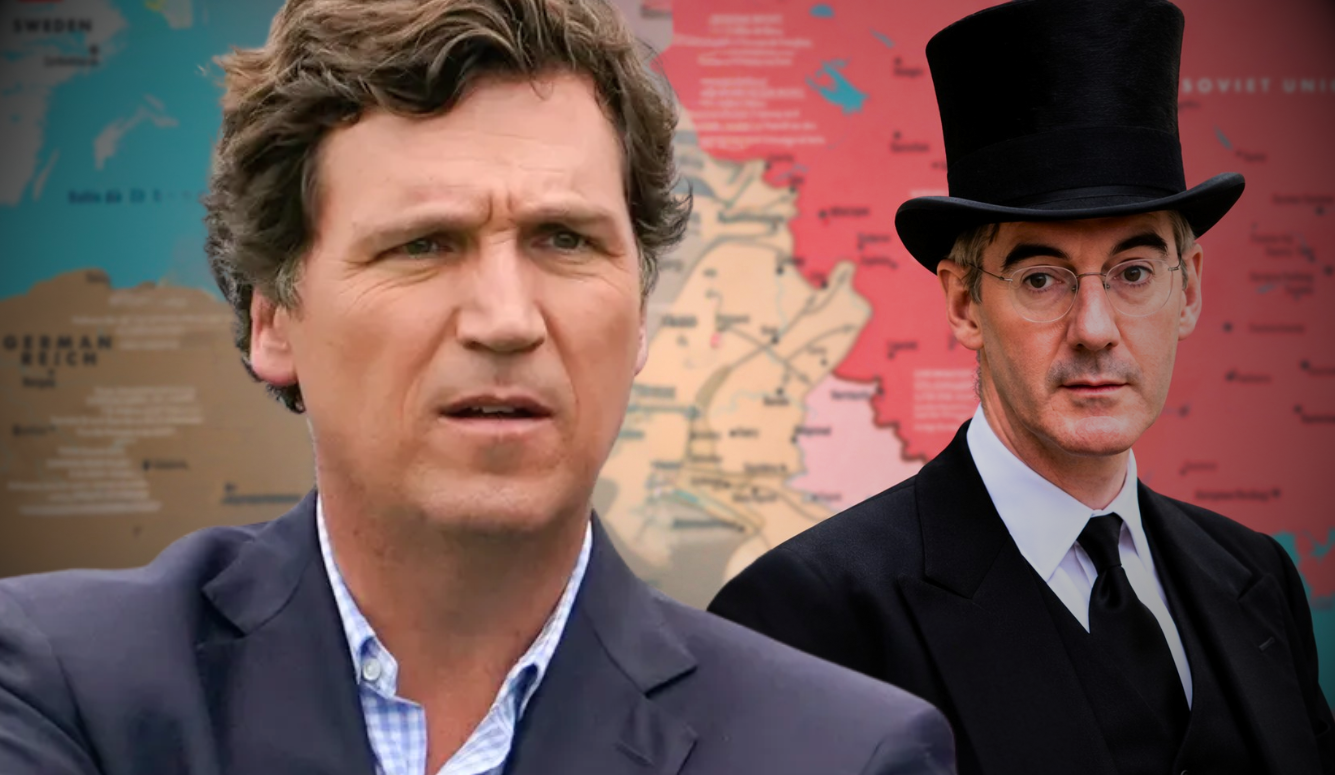
As an independent-media operator unburdened by editorial oversight, Carlson has become accustomed to using his platform to retail dubious claims and information about the conflict to a credulous audience. Most of the time, he can get away with this by employing a combination of scorn and bluster. However, a recent interview conducted with Jacob Rees-Mogg didn’t go according to the usual plan. Rees-Mogg is a 57-year-old British traditionalist and former Conservative Party parliamentarian of a particularly old-fashioned sort, his plummy accent balanced by an unfailingly civil temperament. He is a free-marketeer sceptical of the statist populism that Carlson has tended to embrace of late, and he has firmly advocated greater Western support for Ukraine on the basis that state sovereignty must remain inviolable in the interests of global stability.
The interview did not start well for Carlson, who began by wondering “why Russia would want to pick a fight with Britain. It’s got a much larger economy than Britain’s.” Rees-Mogg politely corrected him: “No no no, it hasn’t got a larger economy than Britain’s. It’s got a smaller economy than Britain’s.” When Rees-Mogg pointed out that Russia’s GDP is about two-thirds of the UK’s, Carlson objected that “GDP is not the only measure of an economy!” Again, Rees-Mogg patiently contradicted him:
Rees-Mogg: It’s an important measure of an economy. ... Russia is an economic failure. But it could have a huge economy. But it’s got a small economy because it’s deeply corrupt and it hasn’t managed to use its resources effectively. And so, although the population of Russia is bigger than that of the United Kingdom, very significantly, its total GDP per capita is so much lower that the total GDP of Russia is smaller than that of the United Kingdom.
Carlson: Right. Its inherent wealth dwarfs that of the UK. It’s the largest country in the world. But leaving aside that, I’m not in charge of—
Rees-Mogg: Yes, but inherent wealth isn’t very useful, is it? There are lots of African countries that have huge resources that have never been able to use them.
Carlson: It depends what your timeline is.
Rees-Mogg: Well, if you go for hundreds of years, they haven’t used them.
Carlson: Yuh, I—
Rees-Mogg: Russia has consistently been a poor country in spite of its resources.
Carlson: Well, I don’t agree but I’ll grant you that.
For a pundit who has complained for years about Western misconceptions of Russia, this was a humiliating display of ignorance and ineptitude. Carlson, it turns out, hasn’t bothered to learn even the most rudimentary facts about the country he insists his political opponents are so clueless about.
Discussion then moved on to the Budapest Memorandum, which was signed by the United States, Russia, Ukraine, and the United Kingdom in 1994, and which provided assurances that Ukraine’s independence and territorial integrity would be respected if it agreed to relinquish its nuclear weapons. “There have been many subsequent agreements since,” Carlson announced, “including a verbal agreement which has been testified to by people who were present, that the United States would not expand NATO to Russia’s borders.” This is actually a reference to an earlier meeting in 1990 between US secretary of state James Baker and Soviet general secretary Mikhail Gorbachev, during which Baker suggested that NATO could pledge to “not shift one inch eastward” after bringing a unified Germany into the alliance. But Gorbachev stated that any assurances at the time were in reference to NATO forces in East Germany, and that there was no official agreement about limits on NATO’s eastward expansion in the rest of Europe. (Baker lacked the authority to make such a promise on NATO’s behalf in any case.)
Were Carlson’s errors haphazard, they could be written off as mere sloppiness. But they always point in the same direction, lending support to his conviction that Russia is somehow both more vulnerable and more powerful than it actually is. “Everyone thought,” Rees-Mogg observed, “the Russian military was sufficiently powerful that it could roll up Ukraine in a fortnight and it failed.” Carlson: “They could send hypersonic missiles into Kyiv today and end the war. We’re relying on Putin’s restraint not to do that. They could also nuke Ukraine if they wanted.” Russia has, in fact, fired hypersonic missiles into cities like Kyiv and Dnipro, and Ukraine is still standing. Carlson is correct that Russia has the capacity to level Ukraine with nuclear weapons, but Putin does not deserve credit for “restraint” for failing to take that particular step in a war that is otherwise being fought with unrelenting savagery.
If Putin used nuclear weapons in Ukraine, it would create an existential crisis for his regime. NATO states that “any use of chemical, biological, radiological or nuclear weapons by Russia would be met with severe consequences.” Even the use of tactical nuclear weapons would likely produce a major NATO military response, such as the destruction of Russia’s Black Sea fleet and massive strikes on its already-strained conventional forces in Ukraine. China would almost certainly slash its economic and security cooperation with Russia, which would push Russia to the edge of economic collapse. Russia’s efforts to build an anti-Western political and economic coalition (through BRICS, for instance) would be destroyed overnight. Major neutral countries like India and Gulf nations would face immense pressure to abandon Moscow.
It’s no surprise that motivated reasoning and ideological bias cause Carlson to misrepresent basic economics and strategic logic. The more interesting question is why he reflexively defends Russia and condemns Western democracies in the first place. When Carlson said he was radicalised by what he saw in Moscow, he was describing a transformation that began long before he set foot in Russia—and even before he set out on his own to start one of the most popular political podcasts in the country.
II.
“Has Putin ever called me a racist?” Carlson asked on Fox News immediately before the invasion of Ukraine. “Has he threatened to get me fired for disagreeing with him?” Carlson is one of many right-wing pundits in the United States who began to examine every issue through the lens of the American culture wars in the late 2010s and early 2020s. This was a time when the political establishment on the American Left was in thrall to an authoritarian strain of identity politics, which was aggravated by Trump’s first term. Even some progressive Democrats who were swept up in this phenomenon now admit that it was an overcorrection to Trumpism: “Woke one was crazy,” as congresswoman Alexandria Ocasio-Cortez recently put it.
Carlson has long viewed Putin’s Russia as a civilisational counterweight to the depravity of Western secularism and wokeness. According to Carlson, Western leaders “hate Russia because it’s Christian.” He argues that Putin is trying to “re-Christianise Russia,” and that this is “extremely offensive” to Western elites. “I honestly think,” Carlson continued, “if Putin had just left the oligarchs in place—okay, you get to secretly run the government like they do in the United States—and not tried to reintroduce Russian Orthodoxy into the life of the country, this war wouldn’t have happened. Because I know the people who are pushing it, and what they hate most is Christianity.” In Carlson’s telling, the people responsible for the war in Ukraine aren’t the people who actually launched it, and who are now prosecuting it by rocketing civilian neighbourhoods and critical infrastructure (Ukrainians are currently preparing for what will likely be their most brutal winter since the start of the war).
Carlson also conducts interviews about “Zelensky’s Torture of Ukrainian Christians,” an accusation that distorts the Ukrainian government’s investigations of members of the Ukrainian Orthodox Church, whom the government accuses of retaining ties to its Russian Orthodox equivalent and covertly supporting the Russian war effort. But when he interviewed Putin, Carlson had nothing to say about the persecution of Protestants in Russia or the arrest, torture, and murder of Evangelical church leaders in occupied Ukraine. He preferred to ask questions like: “You are a Christian leader. … What effect does that have on you?” Beyond Carlson’s selective concern for Christians in Ukraine, his celebration of Russian piety is misplaced. While 16 percent of Russians attend religious services at least once a month, this proportion is 39 percent in the allegedly godless United States.
During his conversation with Rees-Mogg, Carlson argued that a Christian could never justify the deaths of noncombatants inflicted by the Allies at Hiroshima, Nagasaki, and Tokyo, which Rees-Mogg defended: “I’m asking you a theological question, which is: is it ever allowed, under the precepts of, say, Christianity, to kill people who did nothing wrong? To kill women and children?” Carlson repeated the question many times over the course of several minutes. But he never found the courage to ask the same question of Putin, whose forces regularly launch drones and cruise missiles into apartment buildings. Like his concern with the suffering of Christians, Carlson only adopts this position when he thinks it will give him some kind of rhetorical advantage. “I don’t think killing the innocent is ever justified under any circumstances,” Carlson said. “It’s always wrong to kill people who did nothing wrong.”
This would, of course, make it impossible to fight any war. As Rees-Mogg observed, it would have been “very difficult to have fought the Second World War without innocent people being killed.” Carlson: “No one tried. I’ve never understood: why fight the Second World War in the first place?” After Rees-Mogg pointed out that “Hitler would have taken as much as he could have done,” Carlson retorted: “Hitler said that fifteen percent of Poland was once Germany and it was given to Poland at the Treaty of Versailles—that was German territory with Germans in it. That was his case. And by the way, that was true. … I'm not here defending Hitler! I’m just saying that the idea that Hitler just randomly rolled into Poland is a lie, and everyone believes it because they know nothing about the actual facts.”
Keep reading
The Radicalisation of Tucker Carlson
A Pop Fiction Master and Monster
Australia’s Coming Censorship Machine
Anatomy of a Book Promotion

They Walked in Line