Art & Culture
The $64 Question, Again
Anna D. Shapiro’s recent revival of Eric Bentley’s 1972 play about the HUAC hearings offered entertainment along with the pleasures of moral certainty and ideological reinforcement.
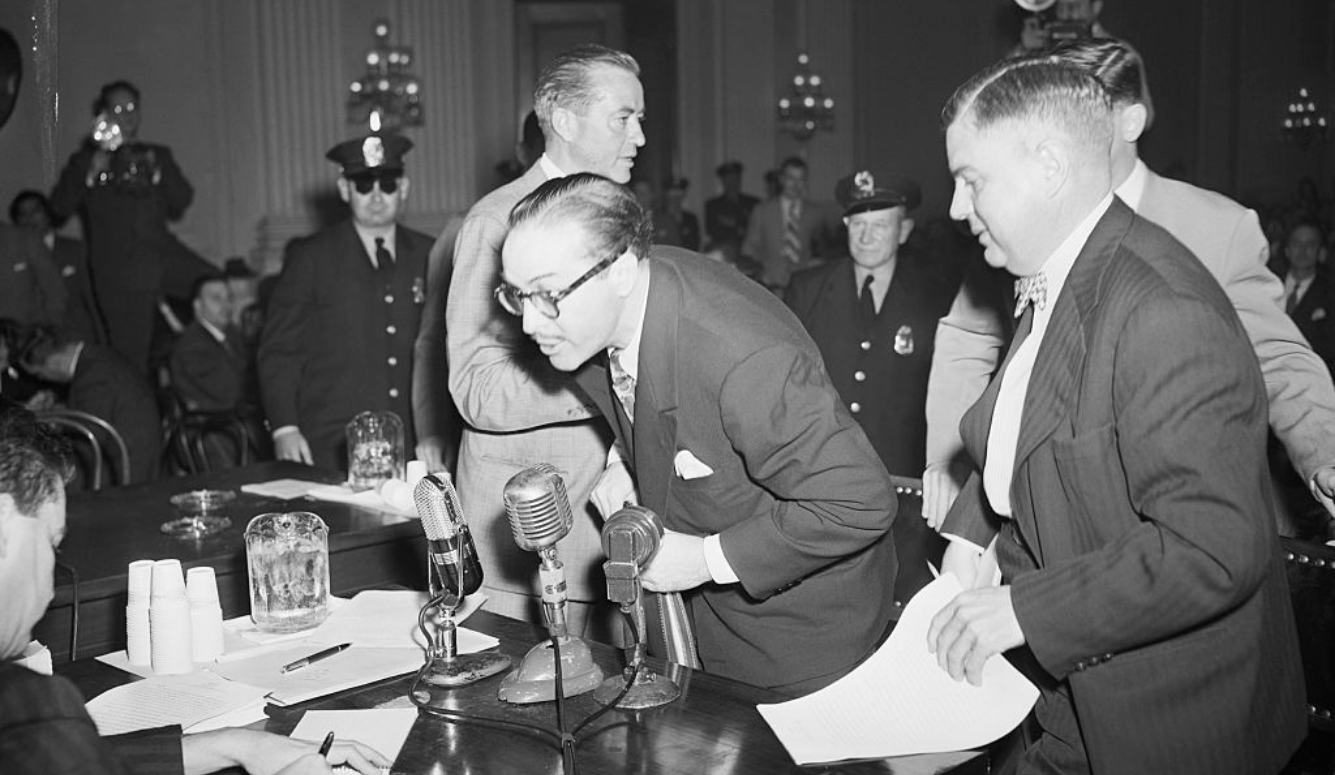

Billed as “an American docudrama,” Are You Now or Have You Ever Been, directed by Anna D. Shapiro and written by Eric Bentley, recently ended a two-month run at the New York City Center. For New York theatre-goers, the hook was pre-sold and high concept: a period drama about the investigations by the House Committee on Un-American Activities (HUAC) into alleged communist subversion in the entertainment industry with dialogue drawn verbatim from the Congressional Record. For the core demo, besides being educational, the play offers the pleasures of moral certainty and ideological reinforcement.
The title of the play, posed without a question mark, is taken from the trademark interrogative HUAC committeemen barked at witnesses in the dock and under subpoena. The full phrasing, with the key predicate, was “Are you now—or have you ever been—a member of the Communist Party?” The past tense add-on was the tripwire for a series of incriminating follow-ups: you say you are not a communist now, but were you one back in the day—and who did you see at the meetings?
This was known as “the $64 question,” in reference to the radio quiz show Take It or Leave It, in which the top prize for correctly answering the most difficult question was the princely sum of $64. In 1955, television upped the ante exponentially with The $64,000 Question, the increase being a fair metric of the difference between Depression-era austerity and Cold War prosperity. The competitions in The $64,000 Question and its quiz show companions were rigged, but then so, in a sense, were the face-offs in the HUAC hearings: the question was a set-up because both sides of the table already knew the answer.
Keep reading
They Walked in Line

Anti-Catholic Social Panics, Then and Now
A Dishonest (and Dangerous) Nobel Laureate

Common People
How Genetics Rewrote History