Art & Culture
Billy Bunter and the Man from Animal Farm
A look back at the 20th century’s most entertaining literary spat—one of the few such encounters that Orwell emphatically lost.
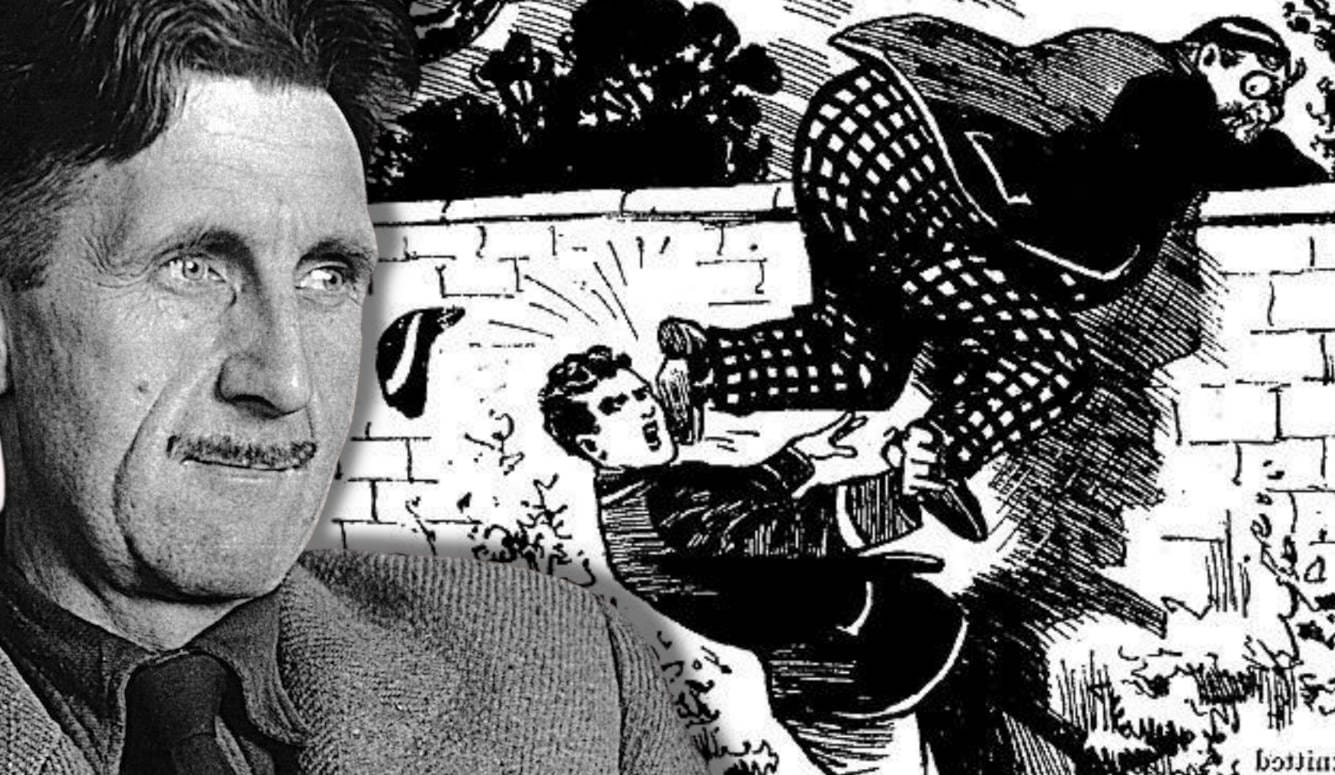

In 1940, one of the great literary showdowns of the last century took place between one of Britain’s great men of letters and a writer whose name most readers of this essay will never have heard. From one corner of the literary ring strode George Orwell, the ancient-jacketed patron saint of plain speaking, cigarette adroop. Facing him was another assiduous smoker—a pipe man, in this case—and writer of popular children’s stories. This mismatched fight did not go as expected.
The morbidly private Charles Hamilton was the undisputed world champion of that peculiarly British genre, the English school story, and over the previous four decades, he had cranked out his yarns under at least two dozen pseudonyms. For each new setting, he used a different name, populating his schools with their own casts of pupils, spivs, gimlet-eyed form-masters, sadistic prefects, local tradespeople, and ridiculous foreigners. Joining them was a small galaxy of muggers (what Hamilton called “footpads”), would-be kidnappers, and local grifters. Over the course of an uncommonly productive career, Hamilton is reckoned to have created more than a hundred fictional schools in something like 5,000 stories. Understandably—but, as it turned out, incorrectly—Orwell assumed that all this industry could not possibly have been the work of one author. In this, and in much else, Orwell was mistaken.
The best-known of Hamilton’s noms de plume, Frank Richards, appeared most famously on the hundreds of book-length yarns set within the fictional cloisters of Greyfriars School, located somewhere in Kent, for the Magnet. A fabulously popular weekly boys’ story paper in its time, the Magnet was first published by Amalgamated Press in 1908 and was still going strong by the time Orwell weighed in on the matter in the pages of the now long-defunct Horizon, a cultural magazine edited by Cyril Connolly. During the same period, Hamilton also produced—this time writing as Martin Clifford—another series of stories for the Magnet’s companion paper, the Gem. This, too, ran to 20,000 words a week over the same period, but it was set in a different school, St Jim’s, with an almost entirely different cast of characters inhabiting the same sort of stiff-upper-lipped world.
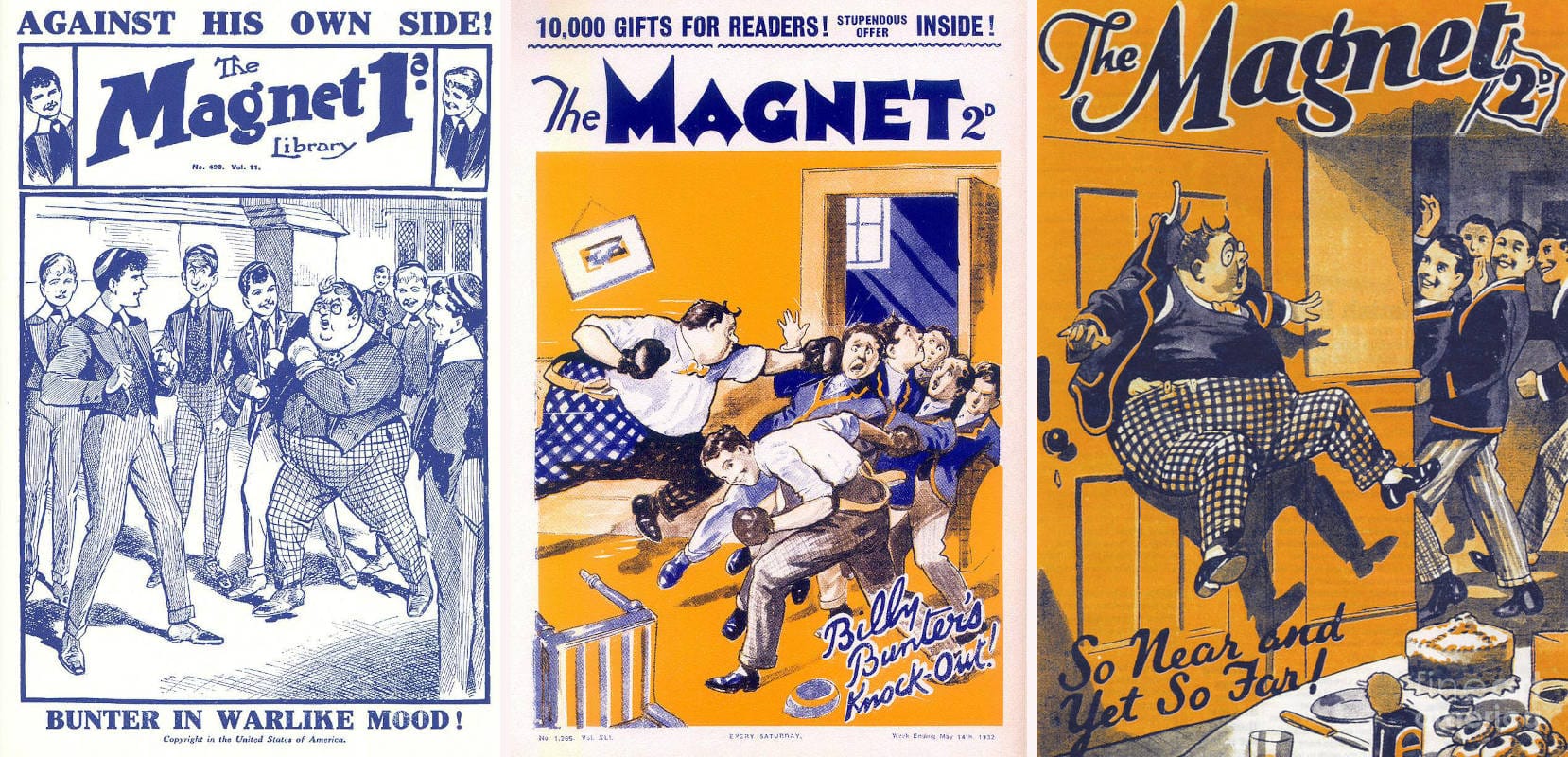
The Magnet series was the better known of the two, however, largely thanks to the popular presence of Billy Bunter, a mischievous schoolboy nicknamed “the fat Owl” for his large round spectacles and rotund figure, who was always getting into comic scrapes and was forever on the brink of getting expelled. Bunter ought to have been an unpleasant chap, but he was a real card. Here he is in the classroom getting grilled by his long-suffering form master, Mr Quelch, about pranking another pupil with a pin:
“No, sir! Nothing of the kind,” stuttered the confused fat Owl. “I never had a pin, sir. Besides, fellows are allowed to have a pin, sir. I—I—I was going to pin a page into my Latin grammar, sir. Not that I had a pin, sir,” added Bunter cautiously. “You can ask Skinner, he knows—he gave it to me.”
Even Orwell was happy to concede that Bunter was a “really first-rate character.” The fat boy’s “tight trousers against which boots and canes are constantly thudding, his astuteness in search of food, his postal orders which never turn up,” he marvelled, “have made him famous wherever the Union Jack waves.” Bunter’s creator, on the other hand, was hardly known at all. Even many of the people who had worked at Amalgamated Press since 1908 knew little about the person behind the byline, or if he even existed. In The Road to Greyfriars, a rosy memoir about his years spent working on the Magnet as a subeditor, George Richmond Samways referred to Hamilton as “an almost mythical personage, much talked of indeed—but nobody working in the general office had the faintest conception of what the man was like.” Stories in “immaculate typescript” addressed to the editor with the briefest of covering notes would arrive, and that was basically that.
Samways eventually discovered that the author was a scrunchy little character, monkish in appearance, with a thing for wearing skullcaps. Born in London in 1876, Hamilton began writing at the age of seventeen and possessed an appetite for words as prodigious as his best-known character’s appetite for snaffled tuck. But while lazy Bunter seized any opportunity to take a badly needed nap, his creator hardly seems to have slept a wink. He tapped out his stories for the Magnet and the Gem at about fifty words a minute, by his own hunt-and-peck count. Somehow, he also found time to write occasional girls’ stories under the pen name Hilda Richards.
By the time Hamilton died in Kent at the age of 85, he is reckoned to have produced the equivalent of 1,200 full-length novels. The Guinness World Records lists him as the most prolific author of all time in the English-speaking world, and one of the Bunter stories was written entirely in the classical Greek that he taught himself when he was Bunter’s age.
Keep reading
The Genetics of Crime and Punishment
Jerry Kaplan on AI Doomers


Payback Time for Steven Galloway