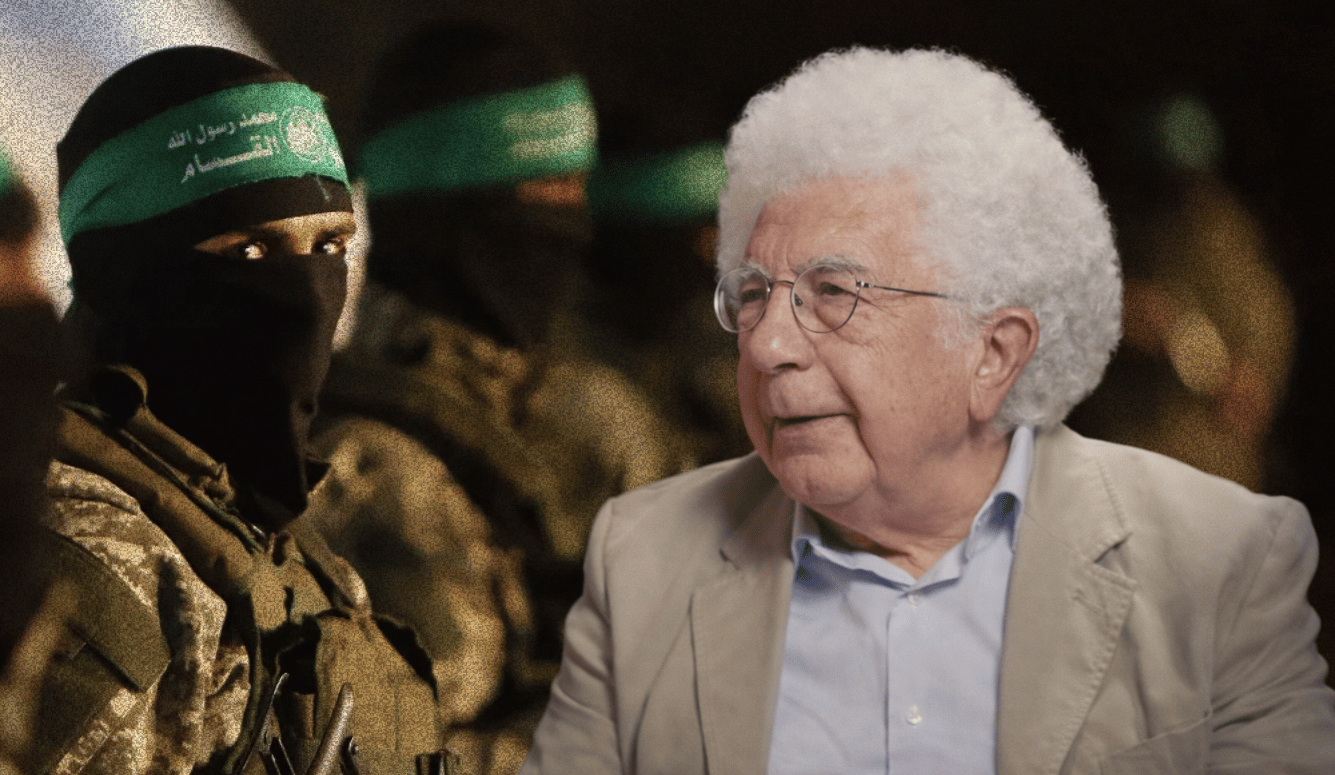
The past two years have seen vilifications of Israel galore, by both traditional anti-Zionists and antisemites and by those minted since 7 October 2023. But few in the West have come out with full-throated, public support for Hamas, which has been designated a terrorist organisation by the EU and most Western democracies.
Avi Shlaim has been an exception to the rule. Once a professed Zionist, Shlaim has now completed a perverse trajectory in the course of which he seems to have lost his moral compass. And Shlaim is not some ignorant, fashionably keffiyeh-draped American or European sophomore who chants “from the River to the Sea” without knowing which river and which sea. Shlaim is a respected Oxford University historian who is supposed to know something about the Middle East, who knows that Hamas slaughtered some 850 Israeli civilians on 7 October 2023 and that it frankly espouses antisemitic, misogynistic, homophobic, anti-Western, and anti-democratic values and policies.
I can personally testify to Shlaim’s past Zionism and not only because I have read his writings closely over the past four to five decades. I lunched with him some twenty years ago in the dining hall of St Antony’s College, where my wife Leah asked him bluntly: “Would you call yourself a Zionist?”
He responded with a simple “yes.”
What did his assent mean? Well, the Earth is parcelled into nation-states, in most of which one people are sovereign. The Dutch have a state, the French have a state, the Czechs have a state, and so on—in fact, the Arabs, by the latest count, have 22 states as the result of a campaign of imperial conquest and proselytising that started in the seventh century. The Jews, dispersed among the nations, suffered oppression and massacre at the hands of Christians and Muslims for two millennia until, at the end of the nineteenth century, they finally woke up and, like so many others, demanded a state of their own. These were the first Zionists. A Zionist is someone who supported the return of the Jews to Zion and the establishment of a Jewish state—as came to pass in 1948—and who sees that state’s continued existence as a moral and political imperative, especially in the light of the Holocaust. The Zionists established their state in “Zion”—one of the Bible’s names for the Land of Israel, which first the Romans, then the Christians and later the Arabs renamed “Palestine”—because it was the land where the Jews lived and exercised sovereignty for much of the time between 1200 BC and the second century AD. The return of an exiled people to their land and the re-establishment of sovereignty was a unique event in human history.
Shlaim understood all this and was a Zionist. In 1964, when he was inducted into the Israeli army as a young conscript and pledged loyalty to the Jewish state, he writes in his 2023 autobiography, Three Worlds, Memoirs of an Arab-Jew, that he “felt nationalism in my bones.” In his latest book, Genocide in Gaza, Israel’s Long War on Palestine, a compilation of essays and papers written between 2009 and 2024, he explains, “I write as someone who served loyally in the Israeli army in the mid-1960s and who has never questioned the legitimacy of the state of Israel within its pre-1967 borders.”
But the “has” in this sentence is misleading and Shlaim, whose grammar is usually faultless, should have deleted the word. For over time, his views changed.
The first breakpoint was the 1967 Six Day War, when Israel conquered and then occupied the West Bank, East Jerusalem, and the Gaza Strip. “Disenchantment” set in, Shlaim tells us: “Israel became a colonial power” and the IDF changed from a defender of a legitimate realm to “a brutal police force of a brutal colonial power.”
Many Israelis, incidentally, myself included, would agree with him that 1967 and its aftermath steadily changed their country for the worse. But Shlaim’s disaffection progressed apace, transforming his views on Zionism’s past as well as on Israel’s present. He came to realise, he tells us, that Zionism had always been
a settler-colonial movement that [had] proceeded ruthlessly towards its goal of building a Jewish state in Palestine even if it involved, as it was bound to, the dispossession of the native population … The origins of Israel’s moral decadence … [predated] 1967. Israel has always been a settler-colonial state. The logic of settler colonialism is the elimination of the native.
I don’t remember Shlaim branding Zionism a “settler-colonial” project before it became the slogan of Zionism’s current detractors. (And in fact, settler-colonialism would be a far better descriptor for the Muslim empires that have straddled North Africa and the Middle East over the past fourteen centuries.)
With Shlaim, the issue also had a personal aspect. He has come to believe that he and his family—and, indeed, all the 800,000 Sephardi Jews who washed up on Israel’s shores after 1948—were also victims of the Zionist project, stampeding to the Holy Land in response to the pull of Zionist propaganda and the push of pan-Arab intimidation generated by the 1948 War when the Arab world came to believe—or pretended to believed—that their Jews were a potentially subversive minority. Shlaim fails to acknowledge that the masses of Sephardi refugees who settled in Israel were, in reality, saved from the potential horrors of life as a persecuted third-class minority in Muslim Arab lands.
But Shlaim went one further than this. By 2024, he had evolved into an outspoken advocate of Hamas, even helping Islamist Qatar, Hamas’s main backer in the Arab world, assail Israel in the International Court of Justice (as he details in Genocide in Gaza). Shlaim has since become Hamas’s foremost cheerleader in the West, dethroning the renegade Israeli academic Ilan Pappe. But while Pappe has never been taken seriously as a scholar, Shlaim was. And while Genocide in Gaza will no doubt earn him brownie points in British academe, it will likely chip away at his stature as a historian.

So how does Shlaim assess Hamas? It “is a set of ideas,” he tells us, “including the idea of freedom and self-determination for the Palestinian people.” It is not “identical to ISIS, as Netanyahu [claims] …. ISIS is a jihadist organization with a nihilist global agenda. Hamas … is a regional organization with a limited and legitimate political agenda … Israel sees Hamas as a terrorist organization, [but] Hamas regards itself as a national liberation movement similar to the one that led the Algerian struggle for independence from France.” (This last comparison is perhaps not as flattering as Shlaim intends, given the history of postcolonial Algeria—hardly a liberal democracy success story.)
One obvious problem with this is that Hamas’s “limited and legitimate political agenda” prominently includes the destruction of the Jewish state, as we can see from the organisation’s founding Charter of 1988, which it has never revoked and which remains its constitutional bedrock. True, in 2017 Hamas issued a non-binding statement entitled “A Document of General Principles and Policies” designed to take in Western naifs with its pragmatic, non-theocratic language. But, as any Hamas foot-soldier or sheikh will tell you, the Charter, penned by the founding father Sheikh Ahmed Yassin and his disciples, is what counts. It was the teachings of the Charter that Hamas inculcated in its kindergarten and school systems and universities in the Gaza Strip before their premises were largely levelled by Israeli jets in 2023–25; and it was the Charter’s principles that were put into action by the Hamas fighters who invaded southern Israel on 7 October 2023. Hamas recently issued a 36-page summary of its recent activities and policies in which it stated that “the Zionist project … failed to understand that its fate will be the same as the fate of all waves of invaders throughout history … Either it will be expelled from [our blessed land] or it will be buried in it.”
But the Charter remains the key document and it tells us simply that Islam—meaning Hamas in this case—will destroy Israel and replace it with theocratic Islamic government from the river to the sea: it will “raise the banner of Allah over every inch of Palestine.” These are Hamas’s plans for the immediate future. But beyond that, Hamas is the Palestinian branch of the “universal” Muslim Brotherhood, whose aspirations extend to “the depth of the earth” and “to the heavens.” Israel is not its only target. The brotherhood—like Bin Laden’s Al-Qaeda—aims at Islamic rule over the Earth: the planet’s billions of infidels must either submit or be put to the sword. Westerners may dismiss this as a fantasy. But this is what the Islamists and their many supporters in the Muslim world look forward to.
And of course—Shlaim’s fantasy-world aside—as with ISIS, in the Hamas Charter jihad is exalted as a core belief: “Allah is [Hamas’s] target, the Prophet is its model, the Koran its constitution, Jihad is its path, and death for the sake of Allah is the loftiest of its wishes.” Anyone dismissing this as mere verbiage need only look to 7 October for an illustration of what this means. Hamas differs from ISIS only in its calculus that publishing its atrocities would cause more loss than gain as they would not go down well among Western liberals. In October 2023, the Israeli government foolishly decided to keep the footage of Hamas’s GoPro cameras and the records of its own corpse-gathering units out of the public domain. But at this point, many journalists and members of the public have seen the footage of murder and carnage from that day.
The Hamas Document of 2017 differs in one important respect from the 1988 Charter—it excised the Charter’s antisemitic effusions. The Charter accuses the Jews of causing the French and Russian Revolutions and the First and Second World Wars; the 2017 Document omits these accusations. And the Charter is explicit about what should happen to the Jews. Quoting a popular hadith, it states: “The Day of Judgment will not come until Muslims fight the Jews (and kill them), when the Jew will hide behind stones and trees. The stones and trees will say O Muslims, O Abdullah [i.e., servant of Allah], there is a Jew behind me, come and kill him.” On 7 October 2023, this verse came gruesomely to life as many of the hundreds of the victims at the Nova music festival attempted to hide behind rocks and trees and were slaughtered.
Shlaim cannot, of course, completely avoid mention of the events of 7 October 2023. So he offers a partial justification for the atrocities. Hamas, he writes, is “an Islamic resistance movement,” and its invasion of southern Israel “was in part a response to the Israeli infringements of Muslim prerogatives in the Old City of Jerusalem.” Shlaim fails to detail these “infringements,” which are in the main a figment of Islamist propaganda. In fact, since conquering East Jerusalem in 1967, the Israeli government has left the religious status quo intact and refrained from touching the two historic mosques on the Temple Mount, the Dome of the Rock and Al-Aqsa, built atop the ruins of the Jewish First and Second Temples, and, contrary to the wishes of many Israelis, left the management of the sacred compound in the hands of Muslim priests, administrators, and security personnel. This remains the status quo even though, in truth, Israel’s police minister, Itamar Ben-Gvir, is constantly trying to subvert it. The 7 October assault on Israel that Hamas dubbed The Al-Aqsa Flood, had nothing to do with specific holy site prerogatives or infringements—and everything to do with Hamas’s over-riding goal, the destruction of the infidel Jewish state.
Like many in the West, Shlaim fails to understand that Hamas’s goal has remained constant; he fails to understand the Islamist mindset. Ironically, in this he resembles Israel’s prime minister, Benjamin Netanyahu, who channelled Qatari funds to the terrorists for many years, as if they could be bought off with trinkets. Hamas may bob and weave tactically, pretend to momentary moderation, and periodically float hints of conciliation, but its endgame never changes.
Shlaim doesn’t understand this. In Genocide in Gaza, he tells us that,
Like other radical movements, [after 2007] Hamas began to moderate its political programme following its rise to power … From the ideological rejectionism of its Charter and its call for an Islamic state over the whole of mandatory Palestine, it moved step by step towards pragmatic accommodation to a two-state solution.
Shlaim’s language recalls Western liberal pronouncements in the 1930s that Hitler’s accession to power would lead to moderation and responsibility. According to Shlaim, Hamas “tacitly accepted Israel’s existence and lowered its sights to an independent Palestinian state along the 1967 lines.”
But Shlaim is no fool, and he takes care to cover his flanks: “Hamas,” he tells us, “did not agree to sign a formal peace treaty with Israel and … insisted on the right of return of the 1948 refugees, widely seen as a codeword for dismantling Israel as a Jewish state.” The problem, of course, is that if Israel accedes to the Palestinian demand of a “right of return,” millions of Palestinian “refugees” will flood the Jewish state—there are more than six million according to the UN, which grants the descendants of the 1948 refugees refugee status in perpetuity—and this would lead almost instantly to Israel’s demise. There are currently some five million Palestinians living in the West Bank and the Gaza Strip and some two million Israeli Arab citizens, most of whom today call themselves “Palestinians.” The Jews between the river and the sea number 7–8 million. A mass influx of Arab “refugees” would overwhelm them demographically and politically.

We can see one stark indication of Shlaim’s incomprehension of the Islamist mindset when he writes that it is possible that Hamas realised “that the suicide bombings it carried out during the Second Intifada were both morally wrong and politically counter-productive.” He seems to be seriously arguing that Hamas terrorists may have realised that their suicide bombings were “morally wrong.” Perhaps Shlaim also believes that Usama Bin Laden’s protégés, had they lived long enough, would have come to regard their demolition of New York’s Twin Towers as “morally wrong.” This is both ideologically and psychologically illiterate.
Shlaim claims that Hamas “moderated” after the unilateral Israeli withdrawal from the Gaza Strip in 2005, but eventually reverted to a fundamentalist mindset because of Israel’s subsequent behaviour; this is his explanation for Hamas’s atrocities on 7 October. Israel, he says, rejected Hamas’s outstretched hand for peace and tightened the screws on Gaza, turning it into a vast “open-air prison.” So, left with no choice, Hamas reverted to barbarism. “The Hamas that committed the massacre of 7th October,” he writes, “is far more extreme than the Hamas that won the 2006 [Palestinian] elections … By blocking the path to peaceful political change, Israel and its Western supporters are largely responsible for this regression to fundamentalist positions.”
This twisted logic also informs the core thesis of Shlaim’s 2001 book The Iron Wall, Israel and the Arab World: that the Arabs have always sought peace with Israel but the Jews keep resorting to the sword. But is this really an accurate representation of Zionist–Arab relations between 1882 and the 2000s? Throughout both Genocide in Gaza and the Iron Wall, Shlaim ignores or belittles Zionist two-state compromise proposals and neglects to mention the Palestinians’ persistent rejectionism: their rejection of the partition proposal of the British Peel Commission in July 1937 and of the UN General Assembly’s partition proposal in November 1947; their rejection of the two-state compromise offered by Israeli Prime Minister Ehud Barak and US President Bill Clinton in 2000–01; and of the similar two-state solution proposed by Prime Minister Ehud Olmert in 2007–08. From Muhammad Haj Amin al-Husseini and Yasser Arafat to Mahmoud Abbas, the current head of the Palestinian National Authority, the Palestinian leaders have all been rejectionists, whatever they occasionally said to western interlocutors.
Shlaim disagrees. All the Palestinians aspire to, he tells us, “is to live in freedom and dignity on roughly a fifth of Mandate Palestine” (i.e., the West Bank, the Gaza Strip, and East Jerusalem). And Shlaim offers specific reasons for each of their rejections of two-state proposals. Arafat said “no” in the hope of extracting better terms down the road—the Israeli offer “was not good enough,” rules Shlaim; and Abbas failed to respond to Olmert’s proposal in 2007–08 because the Israeli prime minister was on his way out of office. (Shlaim never really explains why the Palestinians rejected the Peel Commission proposal of 1937 and the UN General Assembly proposal of 1947.)
But in The Iron Wall, Shlaim at least makes a stab at balance and nuance; in Genocide in Gaza, historical scrupulousness has been thrown to the wind. The picture that emerges is black and white, and Israel is always the bad guy. Even when Israel agrees in 1979 to return all of the Sinai Peninsula in exchange for peace with Egypt and to hand over hundreds of square miles in the Arava as part of the peace agreement with Jordan, the Jews get no credit. As for the recent Abraham Accords—which have led to the normalisation of relations between Israel and United Arab Emirates, Bahrain, Morocco, and Sudan—the Arab parties are simply maligned for abandoning their Palestinian brothers.
Shlaim is right to argue that Israel’s post-1967 settlement enterprise in the West Bank has been a major obstacle to Israeli–Palestinian peace-making and that the continued expansion of the settlements, even in the Yitzhak Rabin and Barak years, when Israelis and Palestinians were busy negotiating a deal, appeared in Palestinian eyes to demonstrate that the Israelis were not serious about peace-making.
But was this really the major obstacle to peace, as Shlaim argues? In my view, the main bar to peace has been the Palestinian stance, consistent from the 1880s onwards, that Zionism and Israel are illegitimate and have no right to sovereignty over any part of Palestine. True, the Israeli Right, which has largely controlled Israeli policy since Menachem Begin swept to power in 1977, has never been willing to share the country with a Palestinian state. But this does not explain Palestinian rejectionism before 1977 or when peace and Palestinian sovereignty were on offer during the Rabin, Barak, and Olmert years.
Shlaim also takes the successive governments of his adopted country Britain to task. Britain should never have issued the November 1917 Balfour Declaration supporting the establishment in Palestine of a Jewish “national home,” he argues. He attributes the declaration solely to malign imperial interests and ignores Balfour’s main or at least additional altruistic motives. As for the establishment of Israel in1948, according to Shlaim, it “involved a monumental injustice to the Palestinians.” It would be more accurate to say that the Palestinians brought catastrophe upon themselves by rejecting the UN’s compromise proposal and instead electing to go to war—a war that they lost. At one point Shlaim approvingly quotes the antisemitic British Foreign Office official John Troutbeck, who wrote in mid-1948, “that the Americans were responsible for the creation of a gangster state headed by ‘an utterly unscrupulous set of leaders.’” In condemning British foreign policy during the Mandate years, Shlaim reaches deep into the Thesaurus: “An unbroken thread of duplicity, mendacity, chicanery and skullduggery connects British foreign policy from the beginning of its mandate to the [1948] Nakba.”
This is an emotive but inaccurate description of British policy. The British may have supported Zionism—with reservations and within limits —between 1917 and 1937 but in the course of the Palestine Arab Revolt (1936–39) they turned anti-Zionist: vide the White Paper of 1939, which severely curbed Jewish immigration to Palestine just as the Nazis were closing in on European Jewry. Britain abstained from the partition vote of November 1947 and assisted the Arab states in various ways during the 1948 War.
The Shorter Oxford English Dictionary defines genocide as the “annihilation of a race”; the Merriam-Webster New Collegiate Dictionary defines it as “the deliberate and systematic destruction of a racial, political or cultural group.” Both definitions accurately describe the actions of the Germans and their helpers in Europe during World War II, when some six million Jews were murdered, and of the Muslim Turks in 1894–1924, when some two million Armenians, Greeks, and Assyrians were butchered.
Nothing like this happened in Gaza in 2023–25. There was widespread destruction of infrastructure and habitation, and around 70,000 Palestinians were killed (the figure includes 15,000-20,000 Hamas combatants). But there was no genocide, no systematic destruction of the population. Indeed, the Gaza Strip’s population seems to have slightly increased over the two-three years in question, when births outstripped deaths. Genocides, of course, result in major reductions of population—after the Holocaust, there were six million fewer Jews; after the Turkish genocide, there were two million fewer Christians.
Genocide is also characterised by governmental intent and policy. No such intent was displayed and no such policy was decided upon by the Israeli government or IDF command in 2023–25. Had such a decision actually been taken by the government or the IDF General Staff, it would have been leaked—such is the nature of the Israeli polity. Yes, in the vengeful atmosphere immediately following 7 October, several cabinet ministers and Knesset members employed genocidal language and spoke of “wiping Gaza off the face of the earth” or “flattening” Gaza, as Shlaim meticulously documents. But these politicians were not enunciating the government’s intent or policy and were mostly uninvolved in the actual decision- and war-making.
Yes, Netanyahu, following President Donald Trump’s lead, endorsed the idea of a “voluntary” transfer of some or all of Gaza’s population out of the Strip, a proposal backed by the Israeli cabinet. But no mass transfer of population occurred—if only because no country was willing to absorb hundreds of thousands of Gazans and because Hamas, which controlled the population, would have prevented their expatriation. And uprooting a population and transferring it—even against its will—may involve a great deal of suffering but is a far cry from the act of mass murder that is usually understood by the word genocide. Neither the Cabinet nor the IDF General Staff decided to kill Gaza’s inhabitants.
Rather, the orders down the chains of command—and Israeli society is such that these orders were fairly quickly leaked to the public and press via soldiers’ testimonies and recollections—clearly demonstrate that genocide was never contemplated. Although many soldiers were highly critical of the government, none, to my knowledge, have testified that they were ordered to “kill the Arabs” or to “kill as many Arabs as you can.”
The non-genocidal nature of IDF actions in Gaza emerges clearly from the Israel Air Force (IAF)’s operations. The bombardments in the Strip were directed at what the IAF and Israeli intelligence believed to be—and generally were—Hamas arms depots, military positions, bases, and hideouts. Each strike was approved by intelligence and legal officers. No doubt mistakes occurred and without doubt many strikes—perhaps most—resulted in the deaths of civilians alongside the targeted Hamasniks, who were embedded among the civilians. But there was no deliberate targeting of civilians. One can accuse the Air Force pilots of having been partly impelled by vengefulness and having been not overly sensitive to causing collateral casualties. But this is not tantamount to the deliberate killing of civilians.
At each stage of the IDF offensive in Gaza, the inhabitants of the targeted areas were given advance notice to leave their homes and shelters. We know that, on average, Gazan families ended up moving 5–6 times during the war. Indeed, residents of specific large urban buildings were often warned by Israel—sometimes by telephone call—to evacuate before IAF strikes.
The offensives by IDF ground forces resulted in civilian deaths and injuries when innocents were hit alongside Hamasniks. But according to testimony by many veterans of the fight in Gaza, most soldiers took care not to harm civilians. And to the best of my knowledge, no massacres of groups of civilians or detainees occurred anywhere in the Strip over the two years of battle (and none was reported by Gazans), though doubtless here and there smaller-scale war crimes occurred such as the execution of individual detainees or civilians. And, to the best of my knowledge, IDF troops raped no one in the Strip during those two years—and rape is a constant feature in genocides—though there have been accusations that IDF personnel or prison guards have raped one or a number of detainees and prisoners inside Israel.
Comparing what happened in Gaza with the actual genocides of the twentieth century reveals stark differences. During the real genocides, inhabitants were not warned of impending assaults; in Gaza, this was the norm. In the Holocaust and in the Turkish genocide, the intended victims were simply rounded up, driven to designated sites, and murdered.
During much of the war, Israel supplied the Gazan population—the majority of whom supported Hamas, sometimes proactively, both before and during the war—with electricity and water and allowed foodstuffs and other provisions to enter the Strip. True, Israel often restricted the entry of foodstuffs in the hope of turning the population against Hamas or of depriving Hamas of the goods that they routinely confiscated and sold to the civilian population, and that this led to malnutrition and even limited pockets of hunger and starvation. And it is true that the IDF’s eventual effort to feed the population itself through the Israeli-American Gaza Humanitarian Foundation (GHF) or to regulate international air drops was largely a failure. Nonetheless, at no stage in the war did the government adopt or implement a policy designed to starve the Gazan population into submission, though a number of former Israeli generals did recommend such a policy.
In fairness, I must add that the Israeli public and soldiery exhibited little sympathy for the suffering Gazan civilian population. In some measure, this was due to the belief that most Gazans supported Hamas, at least in the initial months after 7 October, and to reports that Gazan civilians had crossed into Israel that day in the wake of the Hamas fighters to loot and perhaps kill and rape. Nor were Israeli sympathies improved by TV footage showing crowds of Gazan civilians beating Israeli hostages as they were led through the streets of Gaza City and Khan Younis by their Hamas captors on 7 October.
It is also true that IDF operations disrupted the functioning of most of the Strip’s medical facilities. The IDF raided hospitals and medical clinics believing that they were being used by Palestinian combatants and that Red Crescent ambulances regularly transported or hid Hamas fighters. Here and there medical staff, including hospital directors, were detained. The raiding units generally avoided harming medical staff and patients but, in some cases, patients were forcibly removed from hospitals. Almost all of Gaza’s hospitals continued to function throughout the two years, contrary to Hamas propaganda, but often this functioning was severely impaired by lack of medical supplies and by the death, injury, or detention of medical staff and by Israeli raiding and by bombing near hospitals.
It should, however, be noted that in the decades during which Hamas spent constructing hundreds of solid, elaborate underground tunnels to serve their fighters, the organisation built no shelters for Gaza’s civilian population and that civilians were barred by the Hamas from taking refuge in the tunnel system.
In sum, during the war in Gaza a large number of Palestinian civilians were killed but there was no genocide, though Hamas and its supporters in the Arab world and in the West ran a very effective propaganda campaign that portrayed Israelis as genocidaires.
Shlaim declares, “Israel crossed the red line that separates common, all-too-common war crimes from genocide.” Genocide, he argues, is what “colonial-settler” states like the United States and Australia do and Israel is a colonial-settler state; therefore, what happened in Gaza was genocide.
But the premise of Shlaim’s paradigm is incorrect. In the typical settler-colonial scenario, an imperial mother country conquers a Third World land and sends its sons to settle it, exploiting its natural and human resources and eventually destroying its native population. The mother country derives strategic and economic benefits from the resulting colony. The Zionist experience between 1882 and 1948 was radically different. Yes, Zionists from Eastern Europe emigrated to the Land of Israel and established settlements there. But the country had no natural resources to speak of and while some of the settlers used cheap Arab labour, many others declined to do so. Before 1948, the Zionists did not conquer but bought the lands on which they established their settlements from very willing Arab sellers. And the Zionists were not agents of an imperial power but saw themselves as the vanguard of the much-persecuted Jewish people, who needed a sovereign state in which they could achieve security. They saw Zion as the land in which this should occur. The Zionist leaders solicited the help of the great powers and eventually received patronage and assistance from the British Empire—but they were never that empire’s servants or agents. Indeed, in the mid-1940s, Palestine’s Jews rebelled against the British Mandate government. The Zionists regarded the country’s Arab inhabitants as usurpers, descendants of invaders from the Arabian peninsula with no rightful title to the land and saw themselves as returnees to their ancient homeland, not “settler-colonists.”
In addition to the genocide lie, the book is peppered with fragments of misinformation unworthy of a serious historian. At one point, Shlaim tells us that Israel is pursuing a policy of ethnic cleansing in East Jerusalem. What then explains the fact that East Jerusalem’s Arab population, which numbered 68,000 in 1967, now stands at around 400,000—a sevenfold increase?
Toward the end of Genocide in Gaza, Shlaim offers his readers a glimmer of hope: The two-state solution may well be dead, he writes (in this, I agree with him), but a bi-national one-state “solution” is definitely possible—“one democratic state from the river to the sea with equal rights for all its citizens.” I am not so hopeful. The idea may seem realistic to liberals in Paris cafés or Oxford common rooms. But most Palestinians want all of Palestine for the Arabs and a growing number of Israelis want the whole Land of Israel for the Jews. And the two peoples have been at each other’s throats for more than a century, creating vast reservoirs of hatred and mistrust. The events of 2023–25 have only driven home the stark realities of mutual enmity and irreconcilable divide. A one-state solution, if ever tried, is likely to end in anarchy and mutual massacre. Sadly, there is as yet no solution and no peace to be found.
Quillette invites thoughtful responses to its essays.
Selected responses are published once per week as part of a curated Letters to the Editor feature. If selected, letters appear under the contributor’s real name and may be edited for clarity and length.
To submit a letter for consideration, please email [email protected].