Soviet Union
Chernobyl Forty Years On
How fear, misinformation, and myth came to define the world’s worst nuclear accident.
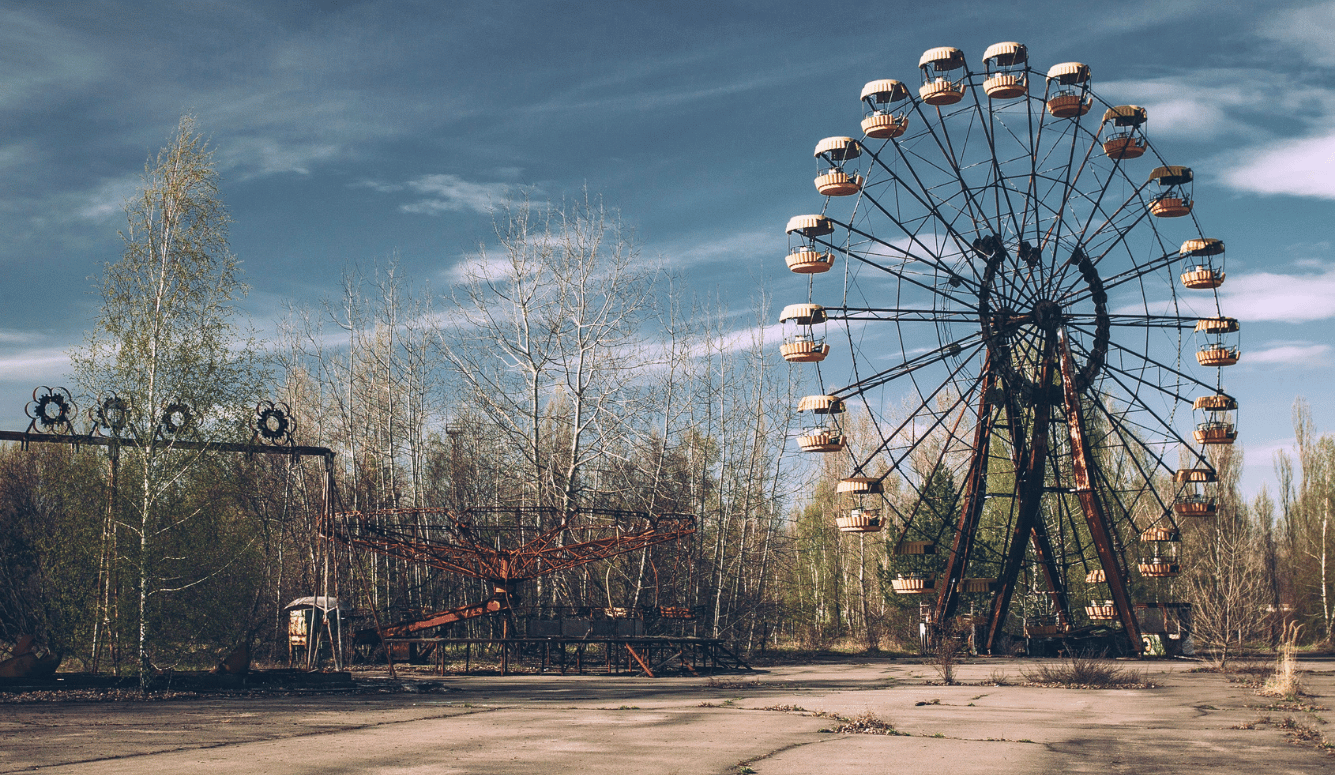

On Saturday 26 April 1986, at 1:23 a.m., a safety test at Chernobyl’s nuclear power plant spiralled out of control. Within seconds, reactor 4 exploded with a deafening roar. The heavy concrete roof was blown open and burning graphite and fragments of nuclear fuel were hurled out into the night air.
Inside the plant, chaos ensued. Debris fell from the ceiling, pipelines jumped, and lights went out. Some thought the Americans had attacked. Inside the control room, operators struggled to understand what was happening, while outside, the firefighters who had arrived within minutes were unaware that this was no ordinary fire. Within hours, many of them were to suffer from dizziness, nausea, and vomiting.
A catastrophic accident had taken place. But almost no one yet was aware of its scale. To understand how it unfolded—and how it has come to be understood, forty years on—we need to look more closely at what was happening not just inside the control room and the reactor, but also in the way information was controlled, withheld, and interpreted.
The safety test was simple in principle. Engineers wanted to know whether, in the event of a power cut, the turbine could keep spinning long enough to generate electricity until the backup generators kicked in. The test should have been completed when reactor 4 began operating in 1983, but earlier attempts had either failed or been cancelled.
On Friday 25 April 1986, the test was delayed for hours. By the time it finally began, the night shift had just started and the arriving workers had not been briefed. When Leonid Toptunov, the senior reactor control engineer, arrived for his shift, he was simply handed a stack of instructions that he had never seen before. Toptunov was 25 years old and had only two months’ experience operating the reactor.
During the test, power unexpectedly dropped far lower than intended—almost to zero. The sensible response would have been to shut the reactor down, abandon the test, and try again later. But deputy chief engineer, Anatoly Dyatlov, who was in charge of the operation, was determined to see it completed. He was known for prowling the plant at all hours, berating staff, and brooking no dissent. He ordered Toptunov to withdraw the control rods and increase the power again. When Toptunov objected that this would cause the reactor to enter a dangerously unstable state, Dyatlov threatened to get someone else to do the job for him. Under the Soviet system, refusing an order could mean the end of a man’s career, so Toptunov complied.
The reactor at Chernobyl was an RBMK—a uniquely Soviet design that used graphite as a moderator and water as a coolant. It was cheap, powerful, and relatively easy to build, but it had major flaws: it was unstable at low power and not only behaved unpredictably when operators tried to shut it down but did not naturally stabilise as it heated back up. In the reactors commonly used in the West, rising temperatures tended to dampen the nuclear reaction. In the RBMK, the system could actually become more reactive as it grew hotter. In addition, there was no robust containment structure to prevent large releases of radioactive material in the event of a serious accident.
The valves and flow metres in the reactor’s control room had already proved unreliable, so engineers had learned to make adjustments by intuition. The control panel, with its hundreds of switches, dials, and warning lights, also malfunctioned frequently, producing a confusing stream of signals that operators found difficult to interpret. Nevertheless, Soviet nuclear specialists maintained that their reactors were “perfectly safe.” In February 1986, a glossy English-language Soviet magazine boasted that the Chernobyl plant featured “safe and reliable controls that are protected from any breakdown” and that the odds of a serious accident were “one in 10,000 years.”
But the reactor’s design flaws had already become noticeable: inspections had revealed cracks in the concrete, as well as the fact that the emergency stop could take as long as eighteen seconds to take effect. There had been accidents in other RBMK reactors, too. In 1975, a concrete tank containing radioactive gases exploded at the Leningrad nuclear plant and in a separate incident that same year, radioactive water leaked out and killed three workers, after the cooling circuit broke down. Russian operators were not told about such events.
The accident at Chernobyl, then, was not caused simply by human error, nor by a flaw inherent to nuclear technology. It was made possible because of a political system that punished criticism, concealed prior failures, and valued propaganda over safety.
According to the dosimeters, radiation levels did not seem especially high following the explosion. But those instruments had only a limited range; when radiation exceeded that range, they were ineffective—yet their readings were passed on as if they were accurate. Officials were reluctant to acknowledge that the reactor had been destroyed; someone even called the new Communist Party leader Mikhail Gorbachev to reassure him that the operation would soon be restarted.
Meanwhile, the fire outside continued to rage. Firefighters climbed onto roofs littered with highly radioactive material. Their faces quickly became swollen and their skin turned bright red. Soon, ambulances were arriving to take them to the local hospital, where the doctor on duty instantly recognised their symptoms as those of acute radiation sickness. A day later, more than 200 patients were flown to a hospital in Moscow. In addition to the firefighters, the sick and wounded included technicians, guards, and construction workers who had been standing at a bus stop a bit further down the road, oblivious to the trail of radioactivity sweeping past them.
Nobody was told the full truth about what had happened. This all took place towards the end of the Cold War. The Soviet system was built on secrecy, and nuclear technology was among its most guarded domains. Any official who admitted that a major nuclear accident had occurred would have been committing political suicide.
The glasnost promised by Gorbachev was briefly suspended. Instead, officials decreed that no one was allowed to leave town without permission. No TV or radio stations reported on the event. People blithely continued to go about their normal business and children played outside, while radioactive particles drifted through the air.
The silence was not broken until Sunday afternoon, when a local radio station reported that there had been an accident at the plant and that “an unfavourable radiation situation is developing,” though thankfully, “the necessary measures are being taken.” That same day, buses began evacuating nearly 50,000 local residents, who were taken to nearby towns and villages, having been told to pack lightly as they would only be away from home for a short period. Most would never return.
Then, on the morning of Monday 28 April, when Swedish workers arrived at the Forsmark nuclear plant north of Stockholm, the rainwater on the coats they were wearing triggered the plant’s radiation detectors. Air samples and wind patterns suggested that the contamination was coming from the southeast. When Swedish authorities contacted the Soviet Union, they were initially told that there was nothing to worry about—but all the while a cloud of radiation was drifting slowly across the European continent, through Mongolia towards Japan, and on to the US west coast. Wherever rain fell, it was radioactive.
It was not until Monday evening that Moscow finally acknowledged that an accident had occurred at a nuclear facility, in a twenty-second announcement on the TV news programme Vremya. Gorbachev himself did not deign to comment until eighteen days after the accident, when he made a speech on national television, denouncing reports of the disaster as “a veritable mountain of lies—most dishonest and malicious lies,” designed to denigrate the Soviet Union.
Western governments issued contradictory public messaging. Citizens were reassured that the situation was under control, yet instructed to avoid fresh milk and leafy vegetables and keep children indoors. Deprived of access to reliable information, journalists were forced to speculate as to the scope of the accident. “2,000 Die in Nukemare,” the New York Post announced on 29 April. Days later, the number was revised: “15,000 Buried in Nuke Disposal Site,” stated the Post, as rumours circulated about mass graves.
Experts warned that the radiation exposure would have lasting impacts. Damage would accumulate unnoticed in people’s bodies, leading to a huge increase in cancer cases, birth defects, spontaneous abortions, and infertility. Within months of the accident, a report by American physicist Ernest Sternglass claimed that up to 600,000 additional cancer cases could be expected, along with increased damage to foetuses, including “retarded physical and mental development.” In September 1986, radiobiologist John Gofman told the Los Angeles Times that more than a million people “will develop cancer, and about half will die.”
Such beliefs die hard. In the early 1990s, British radiation expert Christopher Busby argued that this number “may be still an underestimate,” while Australian physician Helen Caldicott wrote that the accident “will linger in the genetic material of future generations for the rest of time.” An award-winning British TV documentary described the disaster as leaving a horrific genetic legacy leading to“a million deformed children.”
In 2019, a new generation was introduced to the events through the HBO miniseries Chernobyl, which portrays the disaster in apocalyptic terms. We see firefighters collapsing by the dozen. A young father is first shown wheeling a healthy baby in a pushchair; in a later scene, we encounter them in hospital, their faces bright red, as the father begs for help. We hear from scientists who talk of radiation spreading like a poison, rendering large parts of Europe uninhabitable.
One leading expert, Valery Legasov, played by Jared Harris, compares the burning reactor to an atomic bomb, going off “hour after hour.” He warns, “And it will not stop. Not in a week. Not in a month. It will burn and spread its poison until the entire continent is dead.”
In one scene, the miniseries shows onlookers, including families with young children, watching the fire at the nuclear plant from a bridge after which, according to the end credits, they all died of radiation exposure. This so-called “bridge of death” incident has been thoroughly debunked. In another scene, a helicopter approaches the burning reactor to drop sand onto the core. Suddenly it tilts forward, as if pulled by an invisible force, loses control, and crashes. This never happened. There was a helicopter crash at the site, but it happened months later, after the fire had long been extinguished, when a rotor blade struck a cable hanging from a construction crane.
Chernobyl was watched by millions and was one of the highest-rated television shows ever, winning ten Emmy Awards and two Golden Globes.
To correctly assess the impact of Chernobyl, we first need to realise the ubiquity of radiation. Radiation is a constant presence in our environment. It comes from cosmic rays in the atmosphere, from naturally occurring radioactive elements in the soil, such as radon gas, and even from everyday building materials like bricks and concrete. Radioactivity increases at higher altitudes, for instance when flying, and can differ significantly between different regions of the same country.
Some of that radiation enters our bodies in small quantities when we ingest it along with our food and drink. And while a small portion is the result of human activity, including atomic tests and reactor accidents, a much larger share reaches us with our consent, for example, when we submit to medical imaging or radiotherapy.
Ionising radiation may be invisible, but it is easily measured. Doses are usually expressed in millisieverts (mSv). In the UK, people receive on average about 2.7 mSv of radiation each year, though in parts of Cornwall the dose can be up to 7 mSv. A return flight between London and Sydney exposes passengers to roughly 0.1 mSv. A CT scan of the abdomen delivers about 10 mSv, while a dental X-ray involves around 0.003 mSv.
High doses of radiation can, of course, be extremely dangerous. The firefighters who tried to extinguish the burning debris from the Chernobyl reactor and the plant workers who came into close proximity with it often received doses of well over 1,000 mSv. Some of them were diagnosed with acute radiation sickness that night:within weeks, their skin had blistered or peeled away, their hair had fallen out, and the walls of their intestines had been eaten away, and excreted in the form of bloody diarrhoea. But most people associated with Chernobyl were not exposed to anything like those doses.
In a 2011 report, UNSCEAR (the United Nations Scientific Committee on the Effects of Atomic Radiation) estimated that residents of the most affected areas in Belarus, Russia, and Ukraine received an average dose of between 10 and 30 mSv—not annually, but cumulatively over the twenty years up to 2005. By comparison, in a 2014 study, the organisation showed that, over a period of twenty years, “sizeable population groups” in countries ranging from Belgium to Brazil, Finland, and India, are exposed to well over 100 or even 200 mSv from natural background radiation alone.
Keep reading
Dangerous Liaisons and the #MeToo Wars
The Crisis in the Humanities Is Not About Money

How Brexit Made Britain European

Agency and Adaptation

State of Failure