Comedy
Can Blackface Be Anti-Racist?
In her early comedy career, Sarah Silverman mocked bigots by impersonating them. What could possibly go wrong?
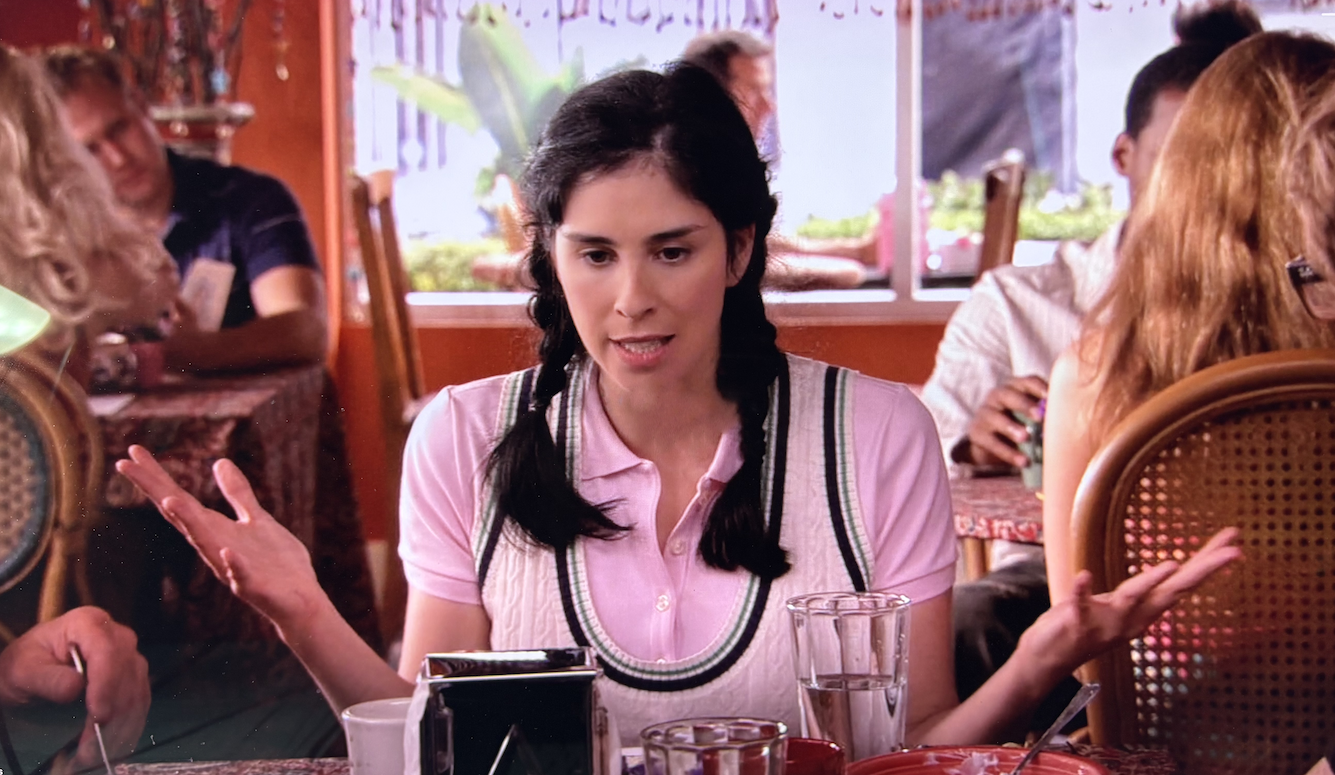

During an appearance on NBC’s Late Night with Conan O’Brien in 2001, Sarah Silverman expounded on her unique strategy for avoiding jury duty. While munching on grapefruit wedges (provided courtesy of guests Penn and Teller), she sighed that the only fun part of jury duty is “the doody.” Getting into her groove, she then pondered various plans for avoiding selection.
A friend had counselled her to write something really inappropriate on her questionnaire for the judge—something like “I hate chinks.” Fearful that the court might think she was racist, Silverman eventually settled on the opposite: “I love chinks.”
“And who doesn’t?” she asked with a smile. The audience ate it up.
The President of the Media Action Network for Asian Americans, Guy Aoki, did not eat it up. He demanded an apology from the edgy young comedian the next day. Years later, Silverman related that she was essentially cancelled by NBC following the controversy. (The show Fear Factor didn’t cast her. This upset her, she said, even though she never wanted to be on the show in the first place.)
Looking back on the whole episode, Silverman would reflect that “there is nothing more pointless, and nothing less funny, than defending your own material.” She learned this lesson on Bill Maher’s Politically Incorrect, where she, Aoki, and other guests debated the use of slurs in comedy. The segment was tense and unpleasant. It made the white comedians who participated appear thoughtless and entitled, rather than the free-speech activists they insisted they were. Maher affirmed his universal right to use the N-word. David Spade remained mostly quiet until he chimed in about his dislike of black comics making jokes about white people.
In his comments, Aoki drew a connection between racial epithets and the real acts of violence directed against minority communities. Silverman categorically refused to accept that the two might be linked. She ended the debate with an unfortunate joke: “There are only two Asian people I know that I don’t like. One is you [Aoki] and the other is my friend Steve who actually went pee-pee in my coke.”
A few years later, in 2005, Silverman revisited the controversy: “What kind of world do we live in where a totally cute white girl can’t say chink on network television?” Aoki, though, got the last, bittersweet laugh during a completely different comedic controversy: In 2017, he reflected on that encounter with Silverman after a chastened Maher finally apologised for using the N-word.
Silverman viewed the controversy as a misunderstanding on the part of Aoki and his media watchdog group. What they failed to comprehend, she argued, were the complexities of the technique she uses to perform her art. This technique, she averred, was deployed in the name of anti-racism.
It involves toggling between her person and her persona, or between Sarah Silverman and “Sarah Silverman.” Born in 1970, the Sarah Silverman of flesh and blood grew up in New Hampshire. She is a comedian. She loves dogs, smokes substantial quantities of marijuana, freely discusses her fondness for pornography, owns a home in Los Angeles, and so on.
Silverman’s persona is a character named “Sarah Silverman” who inhabits Sarah Silverman’s body during performances. The views she expresses may or may not be shared by the real person named Sarah Silverman. Person and persona overlap in some Venn Diagram-y sort of space, but they are not identical. This requires an understanding from a comedian’s audience that the comedian’s jokes are, in fact, jokes, and that these jokes are separate from what the comedian may actually believe.
One of Silverman’s core personae is what I call the “Demeaning Ditz.” This character is a self-absorbed, clueless racist. Beaming a thousand-watt smile as she offends, she is too dumb to understand the inherent stupidity of her words and the anger they foment. Silverman describes her as “a persona at once ignorant and arrogant.” Playing this character allows her “to say what I didn’t mean, even preach the opposite of what I believed.” All of this is done, of course, with the best of intentions, to highlight problems the real Sarah Silverman sees. The comedian’s intent is to expose prejudicial attitudes and behaviours.
Silverman’s persona is a character named “Sarah Silverman” who inhabits her body during performances. The expressed views may not be shared by the real Sarah Silverman. Person and persona overlap in some Venn Diagram-y sort of space, but they are not identical.
This, needless to say, is a morally complicated artistic operation under the best of circumstances. The troubles begin when audiences either cannot, or refuse to, distinguish person from persona, Silverman from “Silverman.”
A week after her appearance on Late Night, Silverman tried to explain the “I love chinks” punchline to Aoki in an email: “The joke is satirical,” she wrote, “and the intended point of view is to underline the ignorance people demonstrate when they employ racial epithets.” Silverman believes that she was right there with Aoki and other Asian Americans; her intent was to shine a light on irrational hatred. The Demeaning Ditz, then, is a comedic false flag—a tool meant to educate us about racism. Aoki only heard a racial slur.
There are, of course, a few problems with the way she flits between person and persona. For starters, it’s confusing. When Silverman (who in real life is a progressive liberal) mauls targets on the right, person and persona are essentially two perfectly overlapping circles. When she attacks targets on the left (often in the same comedy set), person and persona are pried apart and there is no overlap whatsoever.
One critic referred to Silverman’s act as “meta-bigotry,” a phrase that nicely captures the complexity of this operation in which a comic self-consciously, winkingly pretends to be a mean-spirited, hateful individual. The person is an anti-racist. It’s the persona that’s racist. The latter sits atop the former’s lap like a hateful ventriloquist dummy. This can induce cognitive whiplash in audiences. It also accounts for an oft-made criticism of Silverman’s art: audiences can’t tell if “she’s exploiting stereotypes or puncturing them.”
Let’s also recall that some—likely most—audience members might simply not care about the subtle distinction between person and persona. They don’t read comedy on a rarefied analytical level. They are not impressed by the craft involved in using screens and masks. They just love to laugh. The slurs, as voiced by The Ditz, give them pleasure.
Here we encounter a major and underappreciated problem with a racially insensitive persona deployed by an anti-racist artist. It’s one thing to use your persona to joke about a minority group at the Fort Wayne Comedy Club. It’s another thing entirely to make similar jokes in 2001 before a national television audience. And it’s exponentially more dangerous to do so today, on a streaming platform in the digital era.
Among those multitudes in the audience will be sub-multitudes who harbour irrational hatred toward said minority group. They care less about the joke and its mechanics than about the cruel sentiment it conveys, one that they espouse.
Read charitably, Silverman’s Ditz does raise interesting points about culture, politics, and comedy itself. Stimulating thought in her audience is likely what she always aspires to. Her success rate, however, is uneven.
Consider the musical number, German Cars, which appeared in the 2005 special Jesus Is Magic. The song features Silverman in full 1960s regalia: Pucci dress, white go-go boots, and mod-coif à la vintage Priscilla Presley. As she walks through a Hollywood studio lot, she strums a guitar, singing about her love for an unknown person (“I love you more than bears love honey, I love you more than Jews love money… I love you more than Asians are good at math”). The melody continues with pokes at blacks, Puerto Ricans, gays (whom she calls “faggots”), and lesbians.
The song then shifts to a completely different problem—an incoherent shift rendered explicable only by footage of the comedian taking a “monster bong hit.” Silverman suddenly croons about her unease at Jews driving German cars. She reasons that a Jew driving a Mercedes is like “Patti Hearst siding with her kidnappers” or “South African miners killing diamond-bearing gangster rappers.”
Maybe, Silverman sings as she wanders across the set, Jews’ love of German engineering is “like when black guys call each other niggers.”
At this point, the audience (and Silverman) realise she has belted out this racial slur, “hard r” and all, in front of two black men whom she did not notice standing there. The music stops. The men glare at her in silence, contemplating the insult. Suddenly, they start to laugh, leading a relieved Silverman—who a few seconds earlier had looked incredibly uncomfortable and quite dumb—to join in their laughter. They get the joke! The laughter bonds the three of them, as laughter often does.

The laughter bonds the three of them until the men suddenly retract their smiles. Now they stare at Silverman with a combination of hurt, anger, and contempt. Silverman tries to recapture the moment and laughs again, but the men will not join her. Left hanging, laughing alone at her own joke, Silverman turns to the screen, smiles her blinding smile, and ends her song with the outro, CHA-CHA-CHA.
The scene is offensive, but it does make a point. First, Silverman, who has spent the song (and her career) unloading cruelly on all sorts of identity groups, must reckon with the incontrovertible fact that her jokes are heard by people who have every reason not to appreciate them or to understand why she is making them.
Second, Silverman subtly relinquishes interpretive control of the scene; the two offended men force the audience to think not of Silverman’s joke, but of how her joke demeans others.
Finally, she concedes that there is no comfortable resolution to the dilemma that her jokes raise. This is evidenced by her self-consciously shallow effort to break the tension created by the silence.
The Ditz persona got Silverman into even greater trouble a few years later. If you wish to watch Season 2, Episode 3 of The Sarah Silverman Program, you’re going to need to hunt around. Silverman claimed in 2022 that it had been removed by every streaming service. And indeed, it does seem to have been de-listed from the digital archives of Comedy Central (where it initially aired in 2007)—though it can still be found on Apple TV, at least in some markets. It is remembered primarily for an outrageous skit called Face Wars, in which Silverman appears in blackface.
The aforementioned sub-multitudes have taken note: screengrabs of this shocking sketch tend to appear in the social-media posts of hard right-wing activists performing “what about” mode (as in, “My last tweet was racist? What about the time liberal Sarah Silverman wore blackface?”).
It’s not clear to me when “Face Wars,” as the episode was called, was tagged by Comedy Central as problematic. But in any event, the case study helps us identify a crucial distinction in regard to the study of “cancellation.” When contemplating the suppression of art, we must be cognisant of who is doing the suppressing. It appears that executives over at Comedy Central (and maybe even Team Silverman) didn’t want this material to circulate and proceeded to make it unavailable. (Silverman, for her part, has been coy on the subject, remarking that the episode had been de-listed because of “the Jews.”)
In this instance, no coalition of the incensed suppressed Face Wars. The episode was censored not because of an uproar in the African American community and beyond, but because those who created it were concerned about the uproar it might create. It was, in other words, an act of preemptive self-cancellation, and one likely made with considerations of the artist’s commercial longevity in mind. (Since then, she has apologised for appearing in blackface, and for various other offensive skits and jokes.)
Artistic censorship, I believe, may in some extreme cases be legitimate and necessary. But there is always a downside. The downside here may be the loss of an intriguing set of questions raised by the art itself.
Keep reading
Gemma Tognini on Australia’s Political Revolt
Rubio in Athens

How France Lost Control of Its Streets
How to Suppress Men’s Writing
Back to the Dark Ages