Deeply Problematic
Canada’s 215 Imaginary Martyrs
How will Canadian journalists cover the five-year anniversary of the 2021 ‘unmarked-graves’ social panic without admitting their complicity in promoting a fake story?


On April 9, Canadian Prime Minister Mark Carney and the rest of his caucus gathered in Montreal to kick off their three-day 2026 National Liberal Party Convention. In keeping with recent tradition, the proceedings began with an Indigenous elder performing a land acknowledgement and other sacraments of reconciliation.
In this case, the elder was Kan’ahsohon Kevin Deer, a well-known expert in Haudenosaunee culture, who delivered a brief oration in Mohawk, which he followed by a religious ritual involving a rattle made from the shell of a snapping turtle, a deerskin water drum, and a series of subdued ululations.
Mohawk is an Iroquoian language spoken by only about 1,600 Canadians. And so it seems unlikely that anyone in the room could understand Deer’s recited “creation story” (as he later described it). On the CPAC television network, roughly the Canadian version of C-SPAN, befuddled producers captioned Deer as “SPEAKING INDIGENOUS,” the equivalent of identifying a Korean diplomat as “SPEAKING ASIAN.”
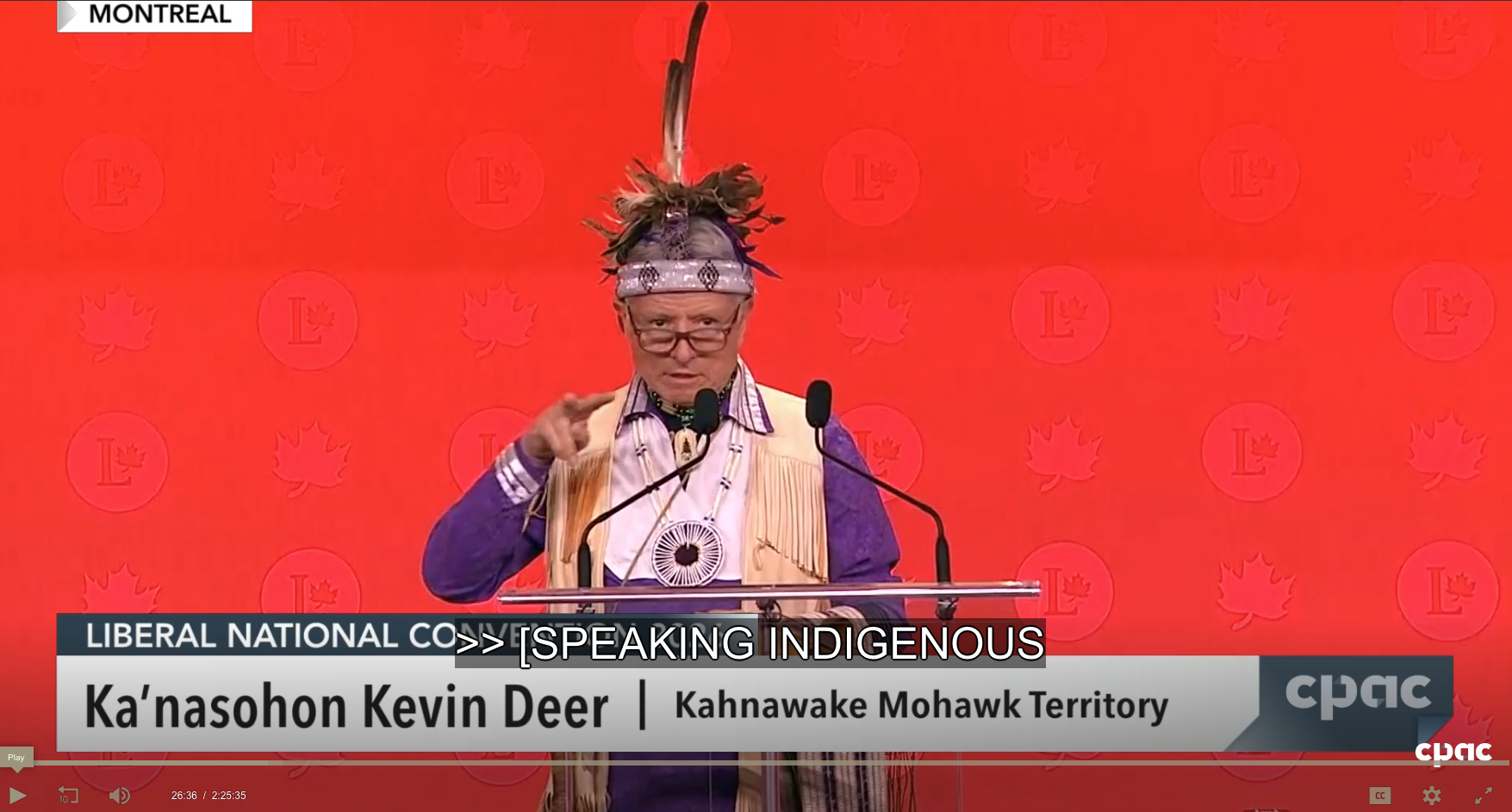
But for crowds such as this, the unintelligible nature of Indigenous religious rituals is a feature, not a bug. As with a Catholic priest conducting a traditional Latin mass, it is not the words that matter, but the air of solemnity and sacredness they evoke. Being secularized upper-middle-class Canadian knowledge workers, these Liberal Party politicians and apparatchiks have plenty of time for religion—on strict condition that it’s not the one they were taught at home.
In fact, it was only after switching to English that things got awkward for Deer. This is when he began explaining his personal religious creed—a syncretic mash-up of Christian theology and traditional Haudenosaunee animism. After instructing the audience that we are all “sacred beings” engaged in a “sacred dance” with moose, caribou, fish, and birds, he said: “We talk about what happened in Kamloops, British Columbia—215 kids’ spirits resurrected up from the dead…” Like these poor children, he added, we would all one day return to the womb of “our first mother—mother earth,” and then ascend to the heavens, “resurrected in spirit, not in flesh.”
As just about every Liberal in the Palais des congrès audience would have known (or at the very least, should have known), those “215 kids” risen from the dead in Kamloops are fictional characters. They never existed “in flesh,” even if their “spirit” once felt very real to Canadians, thanks to a nationwide social panic that spread in mid-2021 following false claims that 215 “unmarked graves” had been found on the grounds of a former Indigenous residential school in the aforementioned city of Kamloops.
The original 27 May 2021 announcement convulsed Canadian society for many weeks. The Canadian Press called it the “Story of the Year.” Justin Trudeau lowered flags on federal buildings for almost six months, and had himself photographed bowing his head and taking a knee, BLM-style. He also authorized hundreds of millions of dollars in payments to Indigenous groups—including $12.1-million to the Kamloops First Nation alone—so they could find, exhume, and identify the children whose bodies (we were told) had been tossed anonymously into the earth by murderous white teachers and administrators.
In the four years and eleven months that have passed since then, not a single actual grave (let alone human remains) have been found at any of the identified sites. It turns out that back in 2021, no one—not the Kamloops band leadership, not Canadian journalists, not Justin Trudeau—had bothered to educate themselves about the limits of the ground-penetrating radar (GPR) technology that had been the basis of the unmarked-graves claims.
Keep reading
Jerry Kaplan on AI Doomers
Payback Time for Steven Galloway
War Stories
Life in The Grim Old Days
In Defence of Academic Standards