United Nations
The UN’s Historically Selective Denunciation of Human Bondage
The transatlantic slave trade was a monstrous crime against humanity. Yet it represented just one example of an ancient evil that spanned many civilisations.
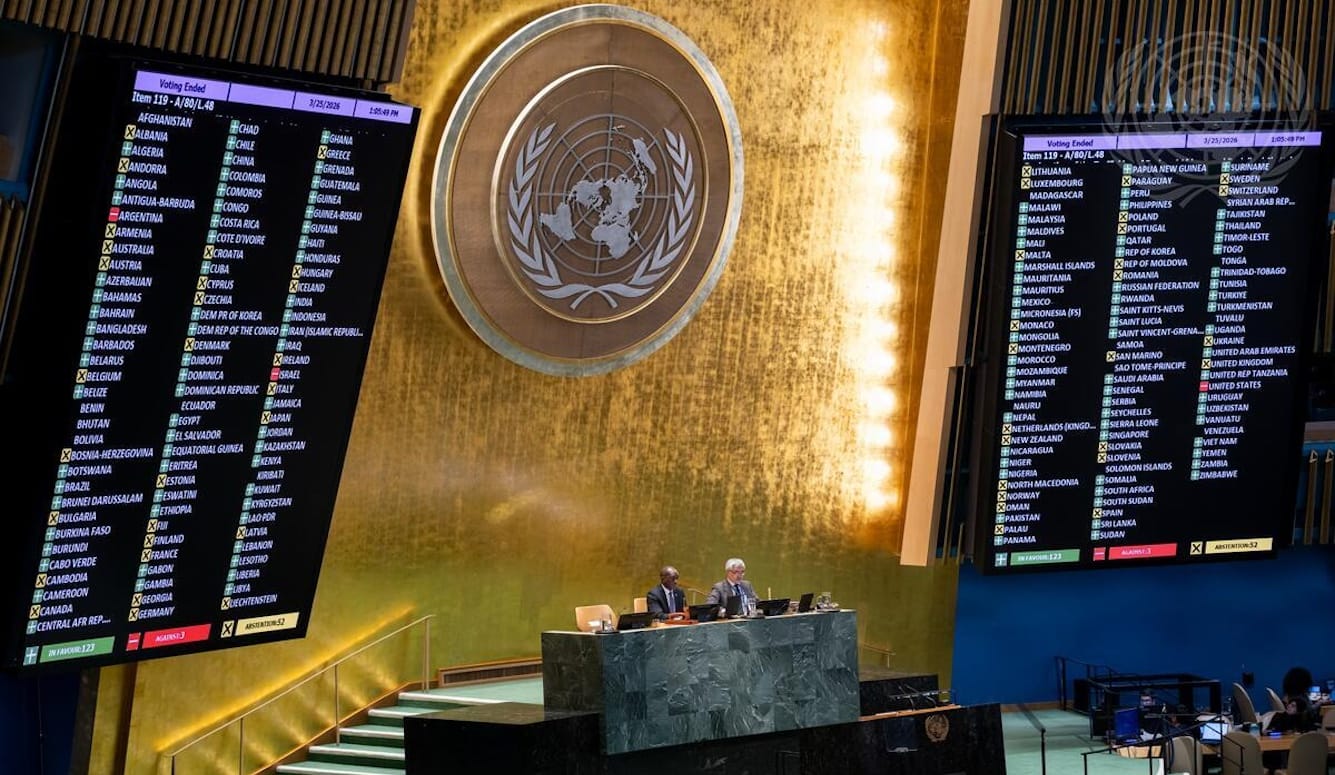

From my press-gallery vantage point on 25 March, the United Nations General Assembly didn’t seem like a body wrestling with history so much as one re-enacting it. Delegates rose in turn to condemn the trans-Atlantic slave trade in solemn tones, much as generations of abolitionists had done two centuries ago in the parliaments of Europe. None but a small handful grappled with the larger sweep of history in which this depravity unfolded. And serious analysis of modern calls to compensate the victims’ ancestors was absent altogether.
The occasion was a resolution sponsored by Ghana that proclaims the transatlantic slave trade to be “the gravest crime against humanity.” It passed by a lopsided margin of 123 votes in favour versus three against (the United States, Israel, and Argentina). The 52 abstentions included the UK and the members of the European Union.
No reasonable person would contest the claim that the transatlantic slave trade was a grave historical crime. During the sixteenth, seventeenth, and eighteenth centuries, more than twelve million Africans were shipped to the Americas as cargo. Those who survived the journey were typically worked to death in plantations, or assigned to other menial and dangerous tasks, sometimes chained or yoked together like livestock. In the United States, the bondage of black men, women, and children didn’t end until 1865.
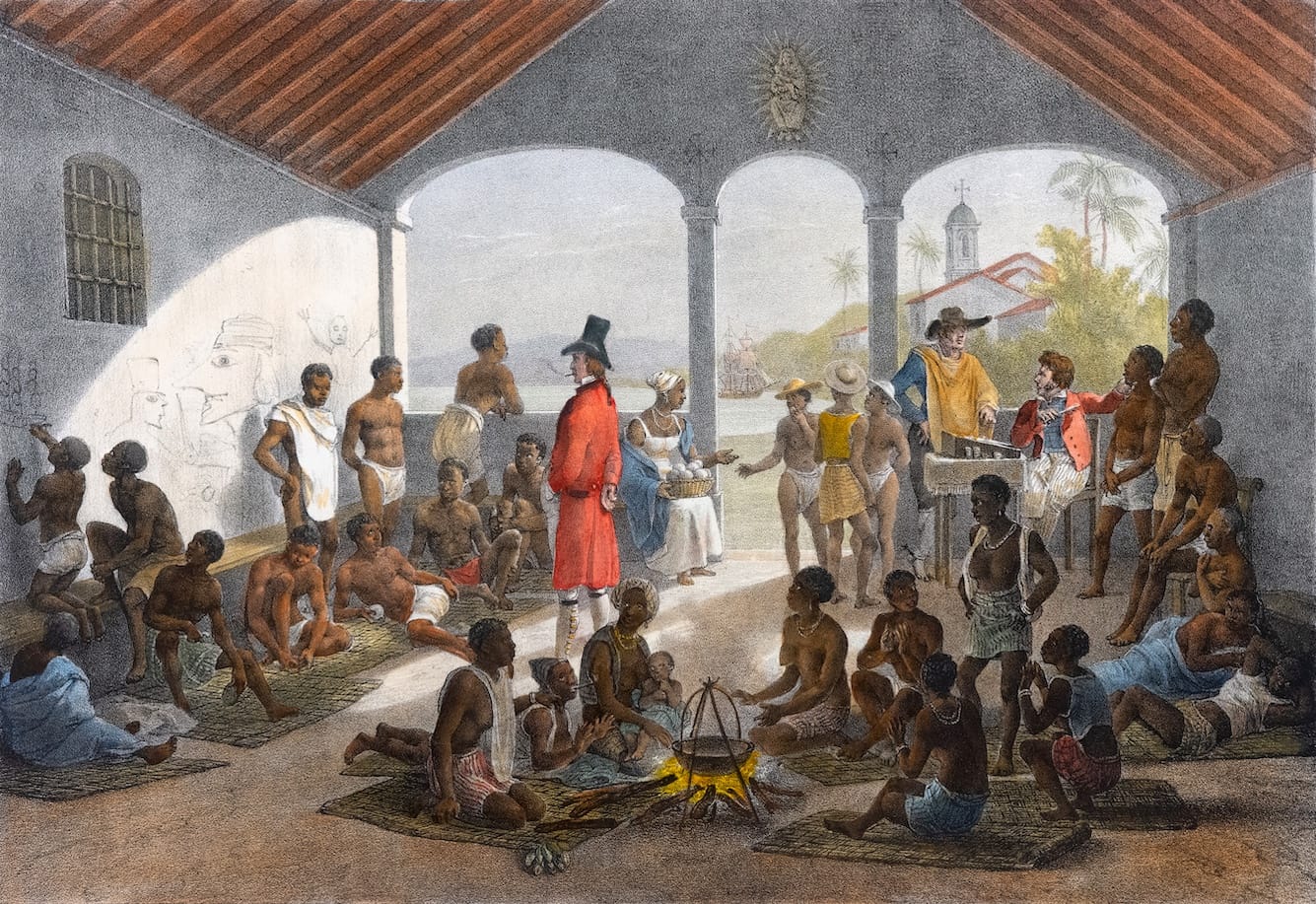
Yet the identity of the resolution’s main sponsor points to moral complications in the historical narrative. At the height of the slave trade, the country we now call Ghana was ruled by the Asante Empire—an expansionist military power that fought, conquered, and, yes, enslaved its west African neighbours. The abundant supply of captives in the area is one reason why the Europeans used Ghana’s coastal ports as depots for western-bound slaves.
Needless to say, none of this serves to excuse the role of European slavers and colonialists, who compounded both the scale and horror of this ancient abomination. Yet ritualised denunciations of slavery, such as those I observed at the UN, often provide a highly selective take on history. Centuries before the transatlantic slave trade had even begun, untold millions of slaves were being carried off in the opposite direction—toward the Muslim empires of northeast Africa and the Middle East, where local slave markets remained a common sight well into the nineteenth century. From the seventh century onward, enslaved people were transported across the Sahara, the Red Sea, and the Indian Ocean, often under conditions that rivalled those of the Atlantic Middle Passage in brutality, and surpassed the European slave trade in volume and duration.
The arithmetic of the United Nations General Assembly argues against any kind of holistic perspective, however. The African Union (AU), which supported Ghana’s resolution, contains 55 states. The Organization of Islamic Cooperation accounts for 56 UN member states (of which almost half are also AU members). For somewhat obvious geopolitical and economic reasons, most or all of these nations are just fine with equating the slave trade with European racism.
Thus, speaker after speaker at the General Assembly returned to that single formulation, enshrined in the resolution’s title, that the transatlantic slave trade was “the gravest crime against humanity.”
And to reiterate, the transatlantic slave trade surely has a prominent place in what Winston Churchill once called the “dark, lamentable catalogue of human crime.” But to demand that it be placed foremost in that catalogue, ahead of every other genocidal horror, is to invite a pointless (and ultimately unresolvable) argument that none of us should really want to have.
Is the Nazi Holocaust history’s “gravest crime” because its six million victims were killed within such a compressed time frame (and with such explicitly genocidal intentions)? Or is it the horrors of Soviet and Chinese communism, on the basis of casualty totals? These arguments belong in barrooms and lecture halls, not the United Nations Assembly Hall.
The meeting aroused particular interest because it was brought to order by none other than the UN Secretary-General himself. António Guterres took the podium to condemn the “elites and empires” that conceived and sustained the trans-Atlantic slave trade. He inveighed against the Western powers—including his native Portugal—for their “deep betrayal of human dignity.” And he pledged to help turn “memory into progress”—even if, beyond rote denunciations of “systemic racism,” he left the question of how this should be done for audience members to work out.
As noted, the resolution passed by a comfortable margin, the only murmurs of dissent coming from the aforementioned trio of the United States, Israel, and Argentina, whose representatives pointed out that the motion elided the fact that chattel slavery was once a universal practice; and that demands for financial compensation were, in the words of the US ambassador to the UN, “an attempt to reallocate modern resources to people and nations who are distantly related to the historical victims.”
Representatives of sub-Saharan states, who typically appear at the UN in standard office attire, instead opted for traditional African robes and dresses. This made for a colourful spectacle, but also imbued the day’s proceedings with an air of what was once called third-worldism (or, if one prefers, tiers-mondisme), an early Cold War-vintage ideology that exhorted solidarity among members of what is now called the Global South.
The term now has an old-fashioned—even impolite—ring to it. But the underlying conceit that all countries with a colonial past have shared interests and values, no matter whether they are located in Africa, Latin America, or Asia, dovetails seamlessly with the modern ideological fixation on organising humanity into categories of oppressor and oppressed. Selective denunciations of bygone slave traders provide this movement with a useful set piece, as they metaphorically present the planet as being divided between colonial slavers and colonised slaves.
But human history is too complicated to be captured by such Manichaean binaries. Slaving was central to not only many African kingdoms, but also to the Vikings who sailed south down Eurasia’s rivers and competed with Byzantine Christians and the Arab Muslims for human loot in what is now Russia, Ukraine, and the Balkans. (This is how the word became connected with the ethnic designation “Slav,” albeit by route of Medieval Latin.) Serfdom (which isn’t quite slavery, but also not quite not slavery) survived in Russia until the age of rail. Many North American Indigenous groups practised slavery, and some continued to do so well into the colonial era. The great Mohawk leader Thayendanegea (1743–1807)—also known as Joseph Brant, after whom the Ontario city of Brantford is named—owned as many as forty slaves at one point.
That said, it should be conceded that the transatlantic slave trade was a “special” kind of evil in at least one respect: Its practice coincided with the stirrings of mass-market capitalism and the discovery (from the European perspective) of distant lands that provided fertile ground for cash crops. The transportation of millions of black people thousands of miles across an ocean to harvest these crops for white masters cannot be fully analogised in type or scale to, say, the slaves (or war captives—the two categories blend into one another) captured episodically by small bands of Indigenous warriors raiding one another’s territory.
It should also be conceded that the legacy of the transatlantic slave trade does continue to shape today’s world. It seems doubtful that your average Serbian or Bulgarian would seriously contend that his people’s modern troubles may be laid at the feet of Justinian I. But anyone familiar with the utterly horrifying details of France’s sugar plantations in Haiti, then known as Saint-Domingue, wouldn’t find it difficult to trace at least a dotted line from those horrors to the state’s current dysfunctionality. In the United States, likewise, the dark moral echo of slavery continued in de jure fashion well into the twentieth century. Laws against interracial marriage weren’t struck down as unconstitutional in that country until 1967, within the lifetimes of many of the delegates I saw rise to speak.
A good-faith and objective effort to take stock of the harms associated with slavery would include all this—but also the many other forms that slavery has taken over the centuries. And it was predictable that this didn’t happen at the UN General Assembly. As the late John Hunwick, a pioneering British scholar of Islam in sub-Saharan Africa, observed with characteristic bluntness, “for every gallon of ink that has been spilt on the transatlantic slave trade and its consequences, one very small drop has been spilt on the study of the forced migration of black Africans into the Mediterranean world of Islam and the broader question of slavery within Muslim societies.”
Yet recent scholarship has made it increasingly difficult to ignore this history. In his newly published book, Captives and Companions: A History of Slavery and the Slave Trade in the Islamic World, English journalist and historian Justin Marozzi notes that slaving was economically central to many Muslim civilisations. Although it predates the rise of Islam in the seventh century, the practice subsequently flourished in part because of the theological sanction that Islam provided. The Old Testament treated slavery as an accepted fact of life. But the Koran and its follow-on jurisprudential commentaries arguably went further by treating the inequality between master and slave as divinely ordained (though it should be said that some verses also indicate that freeing one’s slaves is a virtuous act that can serve to atone for one’s sins).
 Rosie Milne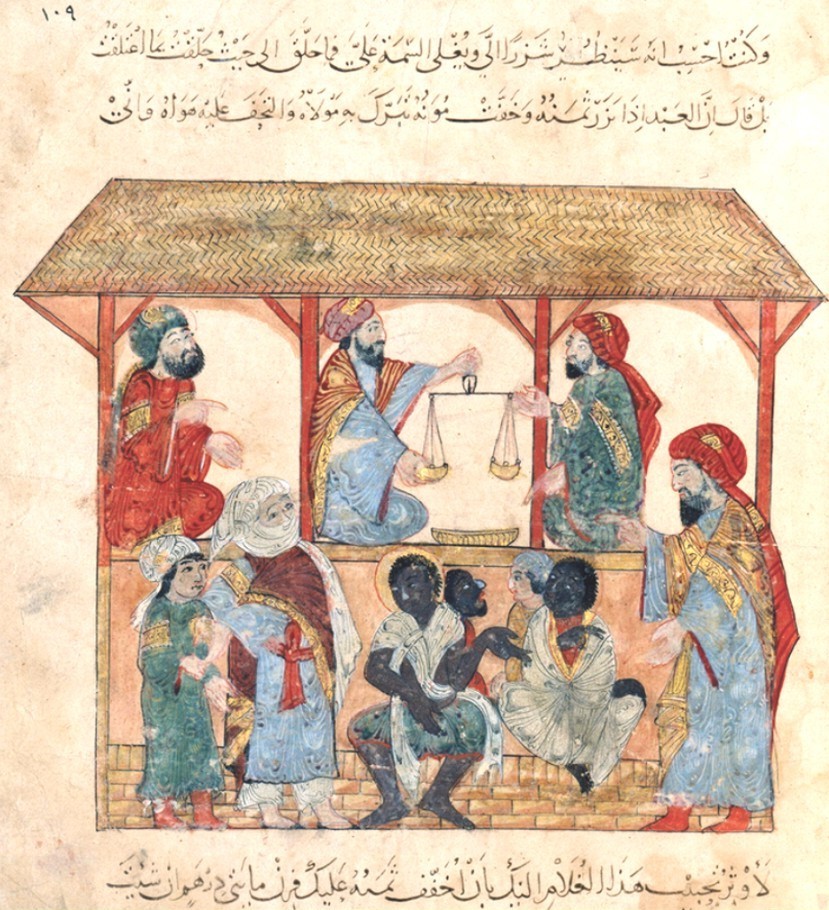
All of this sits uneasily with the simple moral hierarchy sketched out by the General Assembly’s resolution—or, indeed, by any moral template that serves to reduce history to a morality play pitting evil European colonialists against the rest of humanity. It’s an intellectual mode that the French thinker Pascal Bruckner has described as a “tyranny of guilt,” a condition in which the acknowledgement of past wrongdoing becomes an end in itself—a kind of moral capital to be accumulated for future consideration.
In some cases, this means cash—though the language in Ghana’s resolution, formally titled Declaration of the Trafficking of Enslaved Africans and Racialized Chattel Enslavement of Africans as the Gravest Crime against Humanity—gets at this theme with less direct language. Specifically, it calls upon UN member states to provide, among many other things, “measures of restitution, compensation, [and] rehabilitation.”
Bruckner, one of the nouveaux philosophes who came of age during the Cold War, did not argue that Western societies should ignore or deny their past crimes. On the contrary, he took it for granted that historical reckoning is both necessary and unavoidable. But in works such as La Tyrannie de la pénitence: Essai sur le masochisme Occidental (The Tyranny of Guilt: An Essay on Western Masochism), he expresses concern about the process by which guilt is transmuting into a form of identity. Individuals and societies are much more than the sum of their past transgressions, he argues.
Keep reading

What the Navigators Knew
Gemma Tognini on Australia’s Political Revolt
Rubio in Athens
How France Lost Control of Its Streets