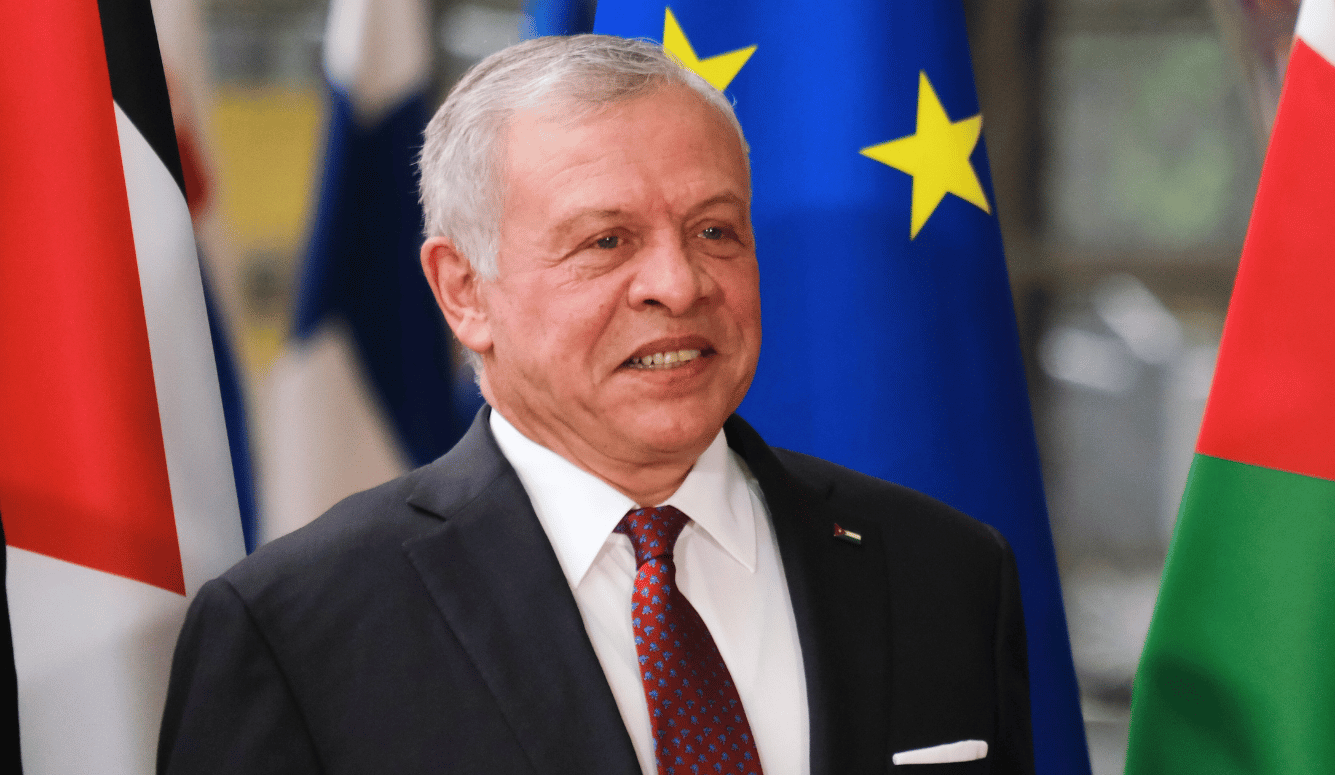

A review of The Most American King: Abdullah of Jordan by Aaron Magid, 243 pages, Universal Publishers (October 2025)
“We will not be intimidated into altering our position,” Jordan’s King Abdullah declared in November 2005, after three suicide bombers loyal to Al Qaeda in Iraq murdered sixty Jordanians in three hotels in Amman, “nor will we abandon our convictions or forfeit our role in the fight against terrorism in all its forms.”
During Abdullah’s 25-year-plus reign over his desert kingdom, he and his countrymen have faced numerous threats both caused and ameliorated by the king’s close ties to the West. The strategic importance of Jordan, its dependence on the United States, and the unique character of Abdullah represent the through-line of The Most American King, journalist Aaron Magid’s absorbing and evenhanded assessment of the Jordanian monarch’s tenure. The first full-length biography of Abdullah, Magid’s book is the product of more than 100 interviews with ordinary and high-ranking Jordanians, international diplomats, and the king’s confidantes.
Abdullah was born in 1962 to the beloved King Hussein—purportedly a descendant of Hashem, the great-grandfather of the prophet Muhammad—and an Englishwoman named Antoinette Gardner. (Reports conflict about how Hussein and Gardner met. According to one version of events, they met on the set of Lawrence of Arabia where Gardner was working as an assistant. Magid reports that they met at an Amman palace party when her father was posted there.) The Hashemite dynasty hailed from the Hejaz in Arabia, and it was awarded control over the land-locked, oil-free territory then known as Transjordan when the British Mandate expired in the late 1940s. Wedged between Israel, Syria, Iraq, and Saudi Arabia, Jordan’s population is largely divided between East Bankers, descendants of tribesmen who’ve lived in the territory for centuries, and West Bankers, Palestinians who fled the Arab wars against the Jewish state.
The young prince was fortunate to grow up relatively free of royal obligations, as Hussein had named his own brother Hassan as heir apparent. This liberated Abdullah to study abroad, and at the age of ten—in the wake of the Black September campaign, when his father killed thousands of militants and expelled the Palestine Liberation Organisation from the country—he decamped for the Eaglebrook School in western Massachusetts, where he became the first Arab student. He graduated high school from nearby Deerfield Academy with an undistinguished academic record, but he had forged ties with American classmates and absorbed the best—and worst—of Yankee culture. Former US Ambassador to Amman Wesley Egan knew the prince as an adolescent and later noted, “I don’t think the young Abdullah put great stock in academic credential or achievements.” Hollywood executive Jeri Taylor once remarked: “Take away the title and the trappings, and at the core, you have a Star Trek fan.” (Abdullah would later have a cameo in the series’ Voyager spinoff.)
Abdullah then began military service, first in Britain and then at a training course for foreign and US military personnel in Fort Knox, Kentucky. An American army officer who trained with the prince recalled that his colleague enjoyed visiting local watering holes and succumbed at times to other vices. “It was fairly obvious that there had been some ladies involved,” the officer told Magid. Abdullah also earned a certificate from Georgetown’s storied School of Foreign Service, after which he returned home, commanding various units in the Jordanian army until, in 1998, he ascended to the rank of major general. Around this time, his father named him crown prince, spurning Hassan, largely on the strength of Abdullah’s lengthy military service. When Hussein died of cancer in February 1999, his son ascended the throne, where he was confronted by 25 percent unemployment and found himself occupying an uncertain perch in a stormy region.
In what would become perhaps the central motif of his reign, Abdullah immediately turned to the United States for support. The day after he took power, he met with President Clinton and then travelled to Washington a few months later to cement an infusion of US$300 million in aid. He would also become the first Arab leader to meet with Presidents Obama, Trump, and Biden, and his personal charisma helped to ensure steadfast American support for his monarchy. In 2018, the Trump administration signed a five-year memorandum of understanding providing over a billion US dollars in annual transfer.
🎧 Listen to this article — available to paid subscribers.
Keep reading
Communism’s Obsolescence
To Meet a Chatbot

Searching for Structure
Strange Bedfellows
The Axis of Renewal