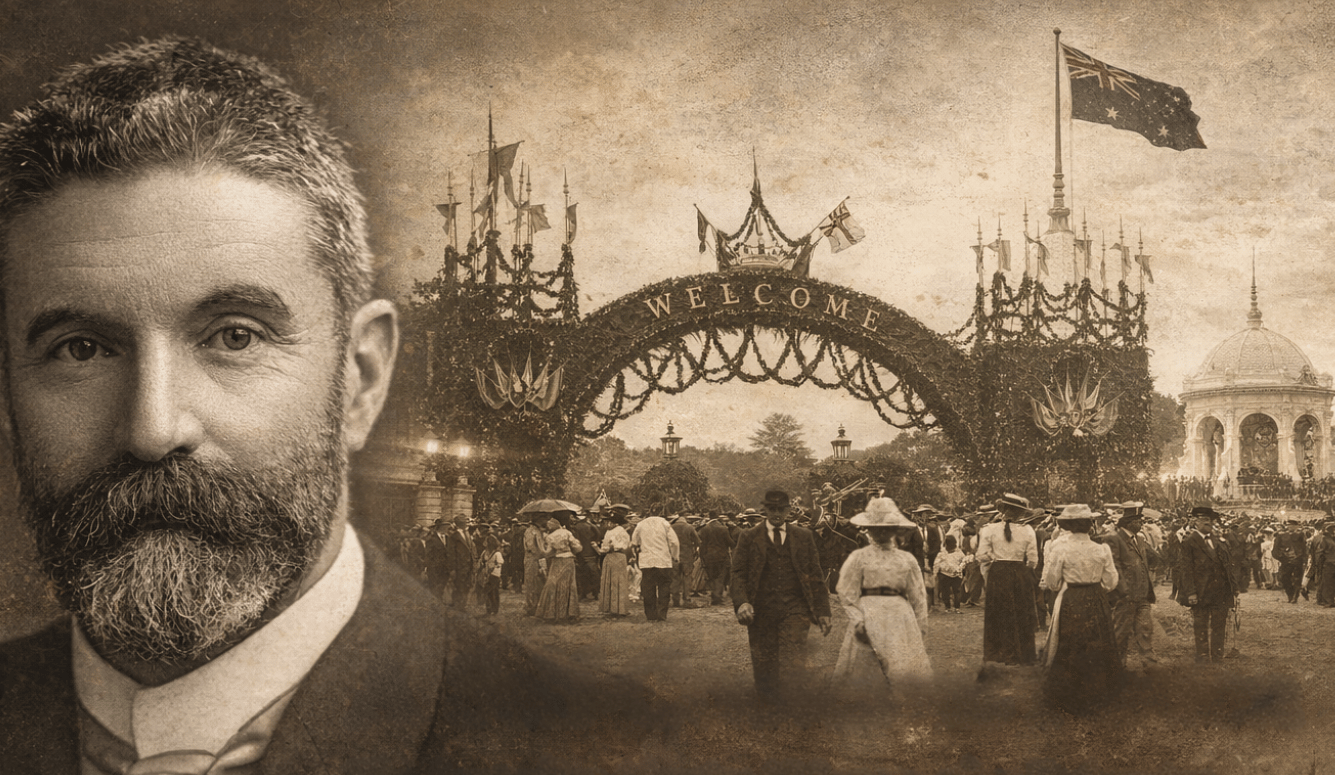

“It is certainly a very self-conscious nation that has just made its appearance in the centre of the Southern Seas,” writes Alfred Deakin, in his anonymous column for the London Morning Post of February 1901. “Platform orators and the Press have combined to instruct it as to its present importance and future potentialities.” The previous month, the Commonwealth of Australia had come into being at a ceremony held in Sydney’s Centennial Park on New Year’s Day. Deakin had been sworn in as the new nation’s first attorney-general.
Australia at its inception was prosperous, stable, and a democratic innovator. When the United Kingdom held its first election using a government-printed ballot paper and ballot boxes in 1872, it was following a precedent set in Victoria in 1856. Australians enjoyed one of the highest standards of living in the world. Classicists talked of the golden ages of Greece and Rome, but to Australians in 1901, the golden age was the present. But the country was, as Deakin points out, self-conscious. It was uneasy about its past, uncertain about its present, and while it had every reason to be optimistic, somewhat anxious about its future.
Australian nationhood did not come about through a single dramatic event. Unlike the Americans, Australians had not fought a war of independence. Unlike the French, they had not overthrown the old order in a revolution. Unlike the Canadians, they had not united to fend off a foreign invasion (in practice, the regular British Army and Navy had been more critical to repelling the American attack in the War of 1812 than the militia of Ontario and Quebec, but the militia nonetheless provided an excellent symbol of nationhood). Unlike the New Zealanders, they had not signed a groundbreaking treaty. The Federation ceremony, held in Centennial Park in Sydney on a stiflingly hot summer’s day, was the culmination of a bureaucratic process. A highly successful one, to be sure, but there will never be a dramatic HBO miniseries on the constitutional conventions of the 1890s, with their lengthy debates on trade policy and federal–state financial relations. Australians did not have a convenient hook to hang their national identity on.
There was, nonetheless, a clear Australian sense of nationhood at Federation. It arose in the chaotic transition from the convict era to self-government in the middle of the nineteenth century and remained more or less unchanged for over a hundred years. It was defined by a British cultural identity and by democracy, social unity, and egalitarianism. It manifested politically in the so-called Australian Settlement established in the decade after Federation—the White Australia Policy, high tariff barriers, and the centralised industrial system designed to quell strife and guarantee workers a fair share of the nation’s prosperity. After the social changes of the 1960s and 1970s and the economic reforms of the 1980s and 1990s, this settlement was dismantled and the idea of Australianness was transformed, though not completely. A century and a quarter after Deakin’s observation, we are still successful—and still self-conscious.
The Origins of Australianness
“Happy is a land with no history,” said Montesquieu—or perhaps Cesare Beccaria, since the attribution of this quotation is debated. Australia in 1901 was not a land with no history, but its history had wide gaps. Maintaining Australia’s sense of national identity depended on maintaining those gaps. Few people then talked about Indigenous Australians and their violent dispossession. The convict era was no more pleasant to think about but much harder to ignore. Penal transportation only ended in New South Wales in 1840, in Tasmania in 1853, and in Western Australia in 1868, by which time 160,000 men and women had been exiled from Britain and Ireland for crimes great and small. Penal transportation was very much a living memory at Federation, and the new nation had many residents who had first set foot on its shores shackled with leg irons. Even a member of the first House of Representatives, William Henry Groom, had been transported to Australia as a convict. This was the single most unique feature of Australian society.
In an era in which criminality was seen as a hereditary fault, having a founding population of felons was a serious problem. “We have poured down scum upon scum, and dregs upon dregs, of the offscourings of mankind, and, as these harden and become consistent together, we are building up with them a nation of crime,” lamented Roman Catholic bishop William Bernard Ullathorne in 1839, reflecting on his experience in the Australian colonies. Australia, he feared, was becoming the wickedest society to have existed since the one that God destroyed in the Flood. “Crime descends, as surely as physical properties and individual temperament,” New South Wales Judge Alfred Stephen remarked to prominent settler James Macarthur in the 1850s. The turn of the twentieth century was the golden age of eugenics, and Australians were naturally self-conscious about their antecedents. The infamous 1879 riot at the Sydney Cricket Ground was perhaps triggered by an English player hurling the forbidden c-word at a crowd of hecklers. In the Victorian era, it may as well have been a racial slur.
Penal transportation provided business owners and landholders with free labour, so, naturally, they wanted it to continue, while those who hoped to be paid for their work wanted it ended. The Anti-Transportation Movement was Australia’s first mass working-class political movement, and it was successful in the face of wealthy and powerful opposition. “The question is, shall the Colony be ruined or not?” asked James Macarthur in 1841, immediately after the end of penal transportation to New South Wales. “For ruined it must be, if cheap labour cannot be procured for the sheep farms.” Macarthur and others began to look overseas, towards indentured labour from Asia and the Pacific Islands. The Anti-Transportation Movement shifted seamlessly into a movement against non-white immigration. “No convicts, no coolies!” became the chant of working-class crowds at political rallies. They were successful in this goal, too.
The Gold Rushes of the 1850s brought a flood of new migrants and turned the dark continent of the lash and iron-gang into Australia Felix, the golden land where miracles were possible. Many of these migrants were regarded as little better than convicts—itinerant treasure-seekers, impoverished Irish, German and Italian revolutionaries, Californians, Chinese. But at least they weren’t actual criminals, so maybe something could be made of them. Except, of course, for the Chinese, who had to go.
Now prosperous, the Australian colonies were free to move towards self-government. This was not a smooth process, although by this point, Britain had learned some hard lessons from her experiences in America. Devolution and self-government had worked in Canada, although this was only granted after rebellions had swept through the Canadian colonies in 1837 and 1838. Nonetheless, Canada provided a blueprint for Australia, and the Australian colonies received their own parliaments and cabinets. The Eureka Rebellion of December 1854 had left 24 rebels and six soldiers lying dead or dying on a nondescript Ballarat hillside, not a high number of casualties by the standards of nineteenth-century warfare but still high enough to convince Australians to seek peaceful solutions to their political problems. Once they had self-government and the secret ballot, they would never take up arms against their government again.
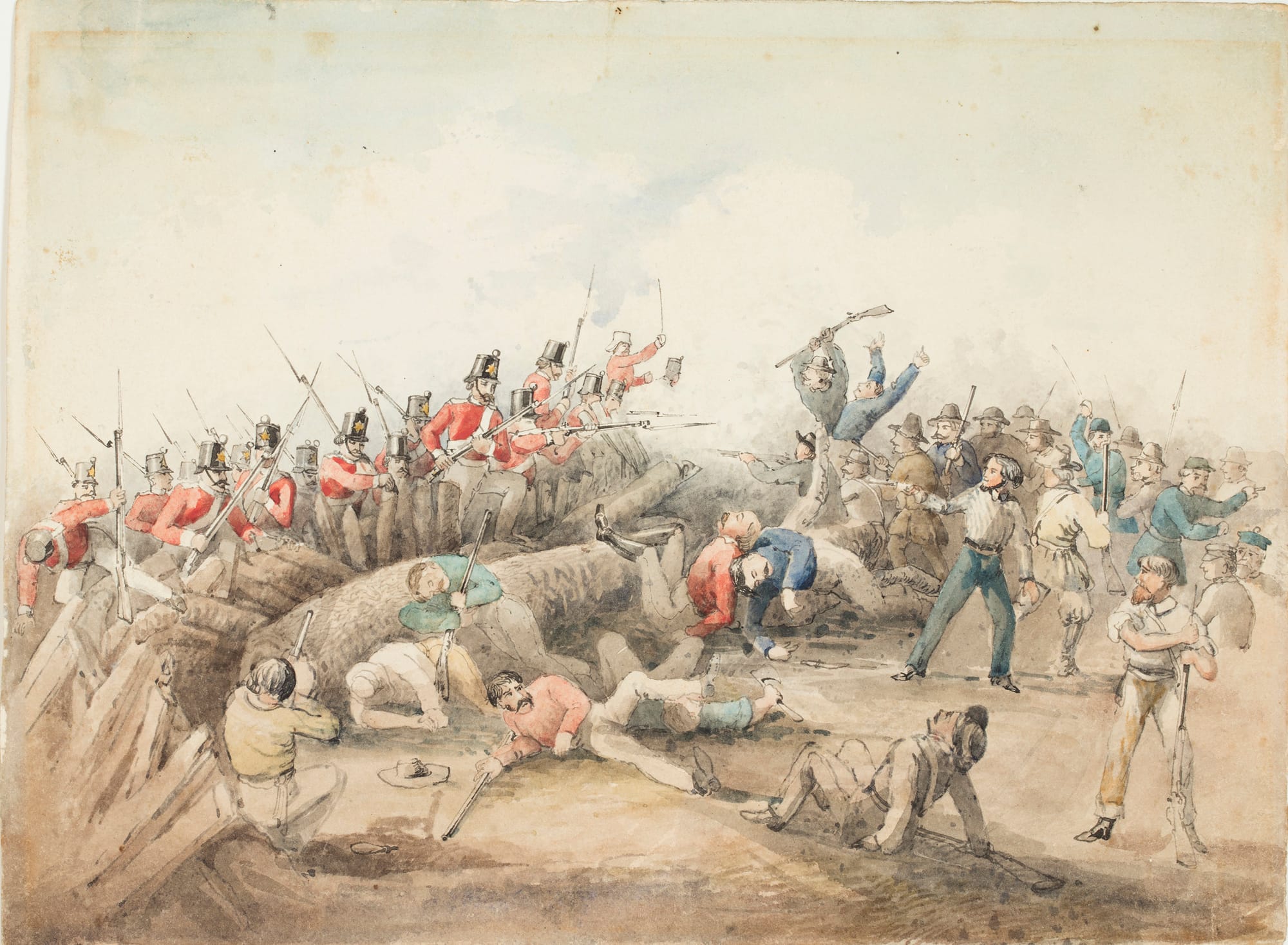
But the path to independence in Australia led mainly through offices and parliaments rather than battlefields. The changes came very quickly. Transportation to New South Wales ended in 1840, the colony held its first election under British-style rules in 1843, created a government with its own premier and cabinet in 1856, and held its first election with suffrage for all white men and the secret ballot in 1859. “It is an amazing record of statecraft,” writes historian John Hirst. “Liberal principles were applied to the [Australian] colonies well in advance of Britain, and sometimes by administrators who opposed them in Britain.” These trends continued. Women in Australia gained the vote state by state between 1894 and 1908, well in advance of not only Britain but almost every other country.
After the discovery of gold in 1851, the Australian colonies enjoyed four decades of prosperity. But the good times came to an end in spectacular fashion with the economic depression of the early 1890s. From 1892–93, real GDP fell by seventeen percent, the most severe contraction in Australia’s history. A house in the Melbourne suburb of Kew valued at £12,870 in 1892 was worth only £6,600 by 1894. Businesses failed, men were thrown out of work, governments ran out of money, workers went on strike, and for the first time in four decades, there was a threat of civil violence and disorder. Desperate colonial governments, unable to buy off their angry constituents as they had in the past, deployed troops with fixed bayonets. And then, in the late 1890s, just as the economy began to recover, the continent was gripped by drought. “Waltzing Matilda” is a jolly song, but it tells the story of an unemployed man who steals a sheep, runs from soldiers, and ends up drowning in a billabong—hardly an implausible tale in those troubled times. Federation represented not just the fulfilment of a long-running plan for a common, continent-wide immigration, trade, and defence policy, but a hope that the good times would return.
The Australian Settlement
The men of Australia’s first federal government had been tempered by the crisis of the 1890s. They envisioned a policy of national unity and defence. Australia would protect its economy with high tariffs. Behind these tariff walls, energetic governments would ensure that workers got their fair share of national prosperity. “Australia does not believe in allowing too much liberty to individuals, and tries to avoid the example of America, where excessive liberty threatens to subordinate the whole community to a few millionaires,” writes historian J.P. Bulkeley, in 1926. This reflects Australia’s egalitarianism, which has manifested itself over the years not just in trade and industrial policy but in the national commitment to “the fair go,” as well as in tall poppy syndrome and a certain ambivalence to entrepreneurialism. America’s influence on Federation, however, was huge and complex. At the time of the Confederation of Canada in 1867, the American system of government had been discredited by the Civil War. By 1901, however, the country was well on its way to becoming the most prosperous and powerful nation that had ever existed. Australia’s founding fathers looked far more to America than to their sister dominion, Canada, in designing the constitution and the institutions of the Commonwealth government. Australia’s federal government follows a “Washminster” model—Westminster with a fair bit of Washington mixed in. The most ambitious dreamed of a great and powerful United States of Australia, but they did not have America’s great rivers and well-watered plains. And they also wanted a more egalitarian society than America’s—without the trouble and strife that they believed were an inevitable concomitant of the presence of large racial minorities.
The White Australia policy was central to the Commonwealth’s economic, military, cultural, and racial security. It was not simply a manifestation of the racism of days gone by but a fundamental pillar of Australian ideology. The Australian colonies began passing anti-Chinese laws in the 1850s. By the 1890s, these had developed into comprehensive legislation restricting or banning non-white immigration. This had both economic and racist elements. The threat that big business would undercut Australian workers with cheap foreign labour was real. But in addition, racial anxiety—even panic—was widespread in Federation-era Australia. “As far as I am concerned, the objection I have to the mixing of these coloured people with the white people of Australia—although I admit it is to a large extent tinged with considerations of an industrial nature—lies in the main in the possibility and probability of racial contamination,” declared Labor leader Chris Watson in a debate on banning Pacific Islander workers from Australia. “The question is whether we would desire that our sisters or our brothers should be married into any of these races to which we object.”
In 1893, Anglo-Australian academic Charles Henry Pearson published National Life and Character: A Forecast. It made him by far the most famous public intellectual in Australia, the nineteenth-century antipodean equivalent of a Jordan Peterson or a Sam Harris, and even brought him worldwide fame. Pearson warned his readers that the white races had become complacent and were ignoring both the industry and the fecundity of the peoples of Asia and Africa at their peril. Australia stood alone as a bastion of the white race. Aboriginal people, he writes euphemistically, “died out as we approached,” and no non-white race had managed to gain a firm foothold on the continent. “We know that coloured and white labour cannot exist side by side; we are well aware that China can swamp us with a single year’s surplus of population; and we know that if national existence is sacrificed to the working of a few mines and sugar plantations, it is not the Englishman in Australia alone, but the whole civilized world that will be the losers,” he concludes. It is hard to overstate Pearson’s influence—Prime Minister Edmund Barton quoted him in his rambling second reading speech for the Immigration Restriction Bill in 1901.
Even so, the Australian government assured the peoples of Asia that there were no hard feelings. “It is not the bad qualities, but the good qualities of these alien races that make them dangerous to us,” Alfred Deakin told the House of Representatives in a now-famous speech calling for the passage of the Bill. “It is their inexhaustible energy, their power of applying themselves to new tasks, their endurance, and low standard of living that make them such competitors.” Stable, democratic, multiracial—Australia could be two, but not all three.
The White Australia policy remained central to Australian identity for decades. “I bid you go and fight for White Australia in France,” Prime Minister Billy Hughes told departing soldiers in 1916. At first glance, this seems incongruous, as they were being sent to fight Europeans in Europe. But Hughes was raising the spectre of a victorious and vengeful Germany forcing a defeated and prostrate Australia to accept a flood of non-white immigrants.
Australia was not just a white country; it was an explicitly British one. After the early squabbles over transportation and self-government, relations with Britain were good. Most Australians viewed the mother country as benevolent. C.E.W. Bean begins his multi-volume work on Australia in the First World War by stating that, “Great Britain, having on principle allowed enterprising sections of her population to create of themselves self-governing states in the outer fringes of the world, had also permitted them to organise themselves as they desired, free of restriction, but nevertheless enjoying her protection.” To describe the initial British population of the Australian colonies as “enterprising” might seem like poetic licence to us, given that so many of them were convicts, but it was a popular sentiment. “This country shall remain forever the home of the descendants of those people who came here in peace in order to establish in the South Seas an outpost of the British race,” are the words that Prime Minister John Curtin used to rally the country during the Second World War. Nationalism is strongest on the margins, and Australia’s distance from Britain intensified the sense of Britishness. Australians could be more British than the British, decorating their homes with quaint scenes of the Surrey countryside, eagerly learning the details of battles from Agincourt to Trafalgar, and showing more interest in the doings of the British Royal Family than Londoners did.
Unity of race and culture was considered critical to “social cohesion,” the term of the hour. Unity of religion would have been nice but was impossible. British authorities in the Australian colonies initially tried to suppress Catholicism. They realised—long before their masters in London did—that the large number of Irish convicts made this impossible. So they adopted a policy of state secularism. And while the colonial governments were flush with wealth from gold, they established systems of free, universal, secular public education. The prayers that preceded the Federation ceremony at Centennial Park were scrupulously non-denominational. The Commonwealth constitution called on the blessing of Almighty God without specifying whose god it was referring to. Sydney and Melbourne, people hoped, would not end up like Belfast.
Prayers were said for the governor-general, Lord Hopetoun, for the ailing Queen Victoria, and for the future success of the Commonwealth. Their effect was mixed. Lord Hopetoun spent his brief stint as governor-general complaining that his salary was too low to maintain his office in the appropriate style and dramatically quit the job and returned to Britain in 1902. “The people are all right and the leading statesmen are all right, but Sodom and Gomorrah in the zenith of their infamy could not have produced such a set as some of the inferior kind of politicians out here,” was his parting assessment of public life in Australia. Queen Victoria died on 22 January 1901, having been the Commonwealth of Australia’s sovereign for a total of three weeks out of her 64-year reign. But the new Commonwealth was undeniably successful.
Filling the Gaps
By the 1960s, the gaps in Australian history had become all too apparent. In 1968, anthropologist W.E.H. Stanner delivered his now-famous Boyer Lecture in which he coined the term the “great Australian silence.” Aboriginal people seemed to be invisible in popular history books. “Inattention on such a scale cannot possibly be explained by absent-mindedness,” he concluded. “It is a structural matter, a view from a window which has been carefully placed to exclude a whole quadrant of the landscape.” Stanner suggested that the deliberate exclusion was an attempt to maintain the fiction that Australia had been a waste land in 1788, and to ignore ongoing Aboriginal connections to the land. Over coming decades, popular historians took indigenous Australia more seriously. Geoffrey Blainey’s 1975 Triumph of the Nomads brought pre-colonisation Australia to life for general readers. “Aboriginals in most parts of Australia appear to have had an impressive standard of living at the time of the European invasion,” he concludes. Aboriginal people presented a challenge for the traditional conception of Australian identity. In one sense, they were not Australians, as they were not part of mainstream, white, British Australian society. On the other, they obviously didn’t belong anywhere else. And they remained a reminder that there had been a society in Australia before the British arrived.
At the same time, with the post-war waves of migration from southern and eastern Europe and then the fracturing of the White Australia Policy in the 1960s, Australia began to have visible minorities who were neither British nor Irish. There had been other European migrants before, such as the Germans and Danes in the nineteenth century, but they could pass themselves off as English. The Greeks and Italians, not to mention the Vietnamese, couldn’t simply change their names and pretend to be British. So we became a multicultural society. In 1949, Australian citizenship became a legal concept, and both at fact and at law, we were no longer just British subjects in an antipodean outpost. The White Australia Policy had been based on the assumption that Asians could not assimilate into Australian society and therefore posed a threat to it. The Vietnamese-Australians, the first large non-European, non-Christian immigrant group to become permanently established, proved these assumptions wrong. This highlights an interesting feature of the Australian character. Despite our conservatism, we have been willing to entertain radical ideas and make fundamental changes. The same society that gave emancipated convicts the vote decided, over a century later, to welcome the Vietnamese.
Still Successful, Still Self-Conscious
Australia remains a remarkably successful country, but also a self-conscious one. We no longer cringe at our convict past—if anything, it makes us cool and edgy—but we do shudder when we read our forebears’ missives on race. We say that we are no longer a British country, but still traipse down to the pub to eat fish and chips, drink ale, and watch cricket. We discuss what makes us Australian—the AFL, Akubra hats, saying “no worries, mate.” The Department of Home Affairs publishes a list of Australian values on its website, which are practical and serviceable, although fairly generic.
Debating our flag has become a long-running national hobby. In September 1901, the Commonwealth Government unveiled the new design, the winner of a competition. It was simple, striking, and won broad support, but it was far from universally liked. For one thing, the national flag is very similar to the Victorian flag, which led to muttering from other states that it suggested that Victoria enjoyed undeserved primacy in the Federation. And Melbourne, after all, was Australia’s first capital. The Sydney Bulletin, which was campaigning for an Australian republic, condemned the design as “a staled réchauffé of the British flag, with no artistic virtue, no national significance ... Minds move slowly: and Australia is still Britain’s little boy. What more natural than that he should accept his father’s cut-down garments,—lacking the power to protest, and only dimly realising his will. That bastard flag is a true symbol of the bastard state of Australian opinion.”
 Harry Lehmann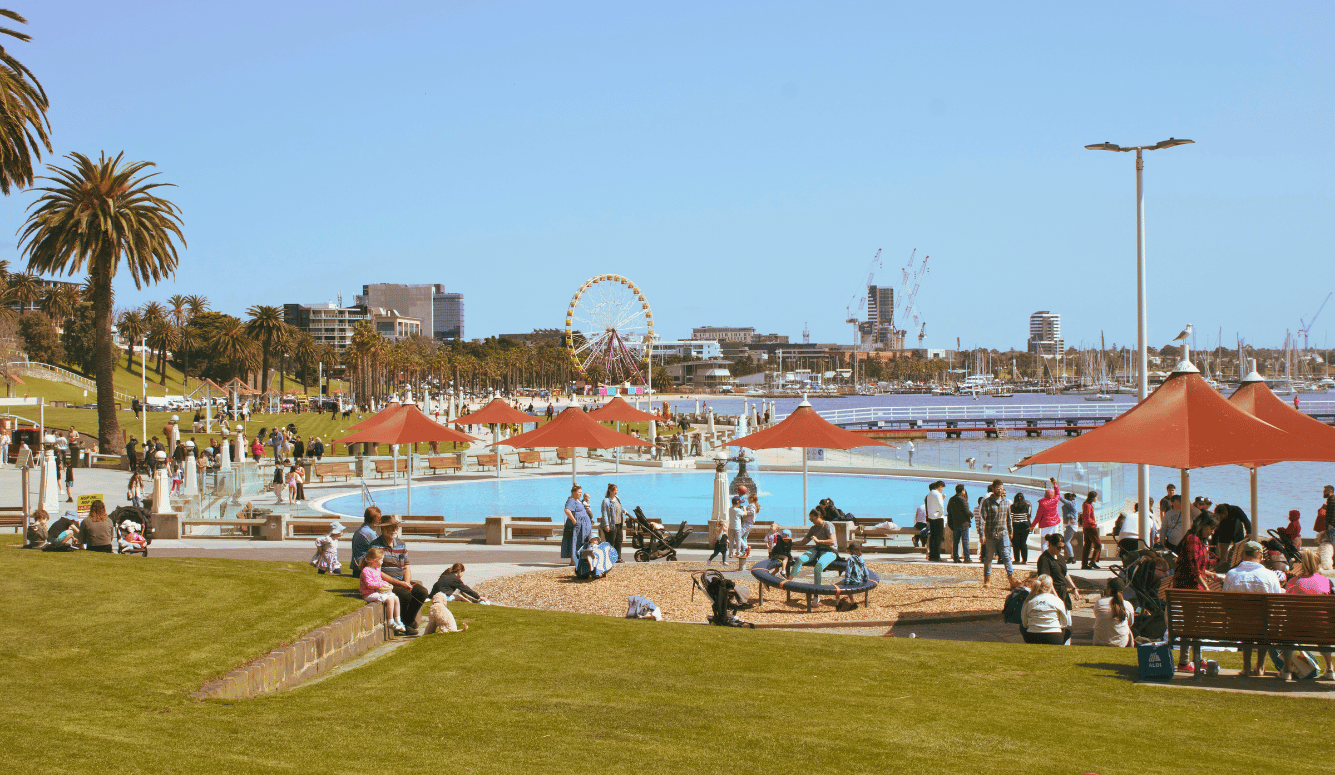
And, of course, in addition to debating the flag, we debate Australia Day.
Nations created through dramatic events have convenient days of national celebration: Independence Day, Bastille Day, Waitangi Day. New South Wales was the first state to commemorate the raising of the Union Jack beside Sydney Harbour on 26 January 1788. The practice caught on and the 26th was eventually adopted as the national day countrywide. Canadians celebrate the confederation of their country on 1 July, but Australia was federated on 1 January, and New Year’s Day would make for an awkward Australia Day. None of the other proposed dates have stuck—9 July, the date that the constitution was ratified; 9 May, the date of the first opening of Parliament; or 8 May, on the basis that “May eight” sounds like “mate.” Besides, celebrating Australia Day in one of the cooler months of the year feels wrong. It should be a day of beaches, BBQs, and yellow plastic cricket bats. Personally, I favour making Australia Day the last Monday in January, giving us a long weekend every year. It would be a purely pragmatic compromise to settle a long-running debate that shows no sign of going away—but then, we are a pragmatic people.
Ours is a remarkable country, not least because of its ability to change and re-invent itself. Nobody else has done such a 180 on their founding principles as we have. At the same time, though, we’ve been remarkably consistent in some ways. The commitment to egalitarianism and social unity and the rejection of extremism—these attitudes have not really changed since the 1850s. In these polarised times, settling on a single idea of Australianness is likely to be impossible. But we should at least be aware of our history. And there is no harm in being a little self-conscious about it, too.
Keep reading
Communism’s Obsolescence
To Meet a Chatbot

Searching for Structure

Strange Bedfellows

The Axis of Renewal