The current wave of mass demonstrations and unrest sweeping across Iran have been met with brutal crackdowns by the Islamic Republic’s police forces and paramilitary groups. Yet even as Iranians plead for foreign intervention, particularly from the United States, President Trump’s assurances that “help is on its way” remain empty rhetoric. While he congratulates Tehran for allegedly suspending hundreds of executions and public hangings, like his predecessors, Trump underestimates the suicidal fanaticism on which the Islamic Republic is built.
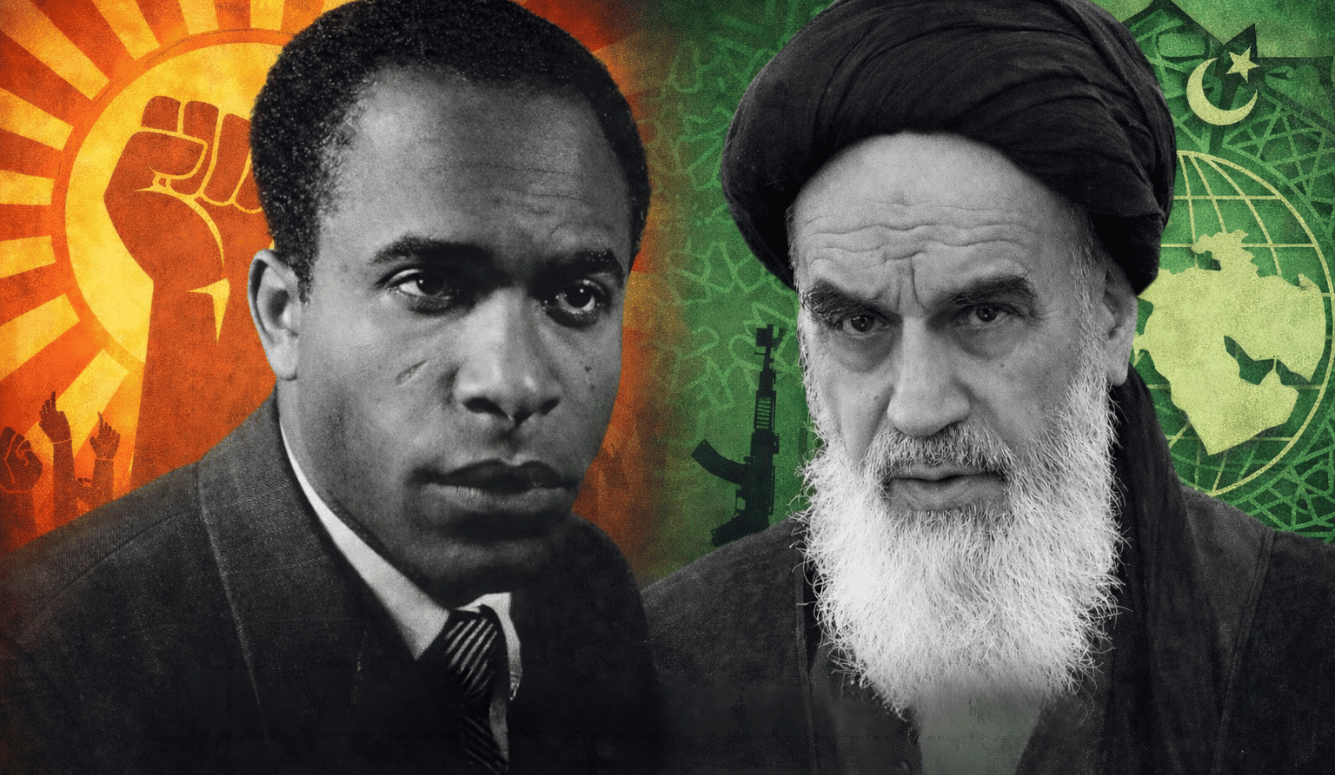
For decades, Ayatollah Ali Khamenei has presented himself as a critic of Western colonialism. This posture, however, is hardly new. In his 1970 lectures in Najaf, Ayatollah Ruhollah Khomeini railed against the “imperialist government of Britain,” dismissed constitutionalist movements as tools of foreign powers, and urged followers to conceal their true aims from those he claimed had “sold themselves to imperialism.” In a March 1980 radio address, he declared that Iranians must resist the “devourers led by America, Israel, and Zionism,” insisting that no foreign presence on Iranian soil would be tolerated and urging his followers to “export our revolution to the world.” In this, both Ayatollahs were parroting language and cynically hijacking an ideology most prominently articulated by Frantz Fanon.
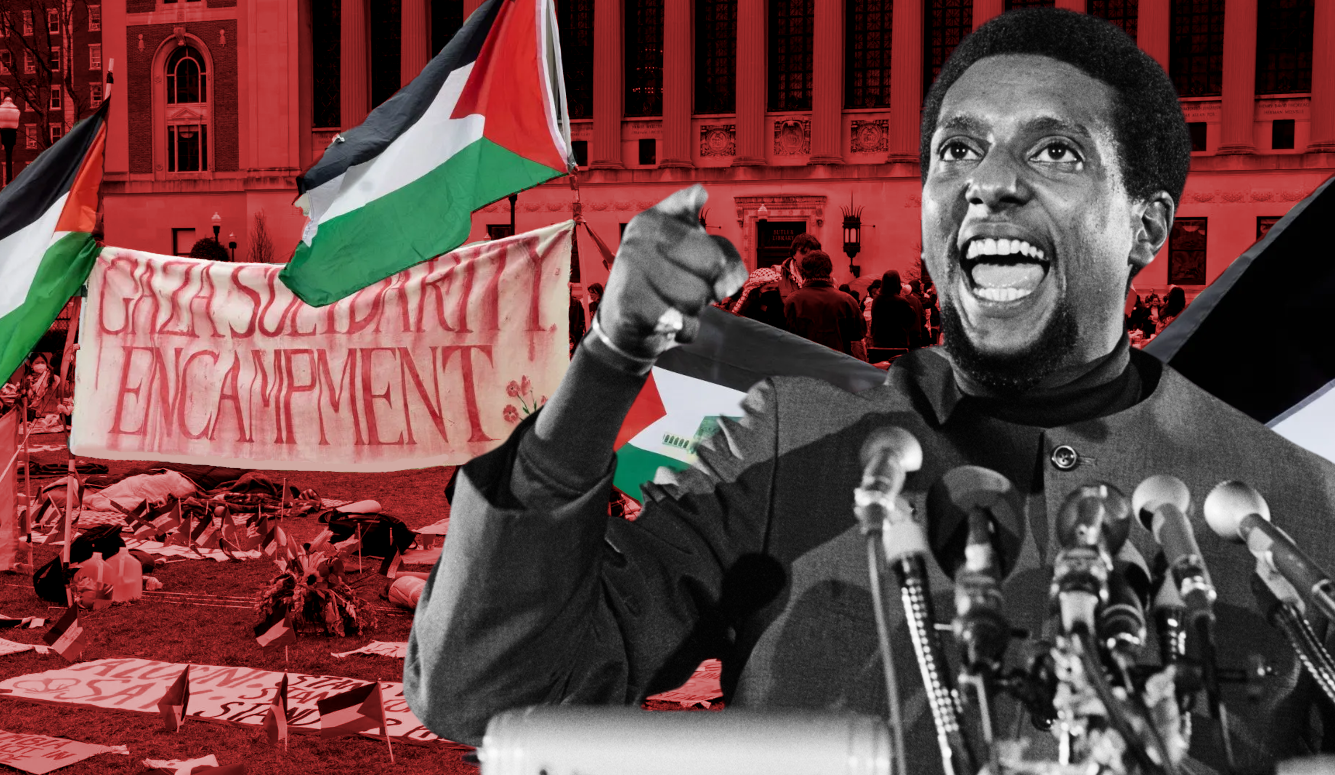
In his 1961 book Les Damnés de la Terre (The Wretched of the Earth), Fanon declares that “decolonisation is always a violent phenomenon.” Violence against the coloniser, he insists, is purifying, redemptive, and world-creating. It is a formulation whose resonance is starkly apparent in slogans like “Globalise the Intifada.” “The colonised man is one tormented,” writes Fanon, “who dreams every day of becoming the tormentor.” This is the kind of explanation that has led some to justify Hamas’s actions on 7 October.
Les Damnés de la Terre argues that violence is the only path to self-actualisation or, as Jean-Paul Sartre’s 1961 preface puts it, the sole cure for “colonial neurosis,” a pathology that supposedly renders its perpetrators incapable of moral agency and therefore exempt from moral responsibility. Therein lies the fundamental premise of Third-Worldism. “The Third World discovers and articulates itself in this manner,” according to Sartre—and only in this manner.
During the mid-1960s, Fanon’s work was translated into Persian by Abolhasan Banisadr, who served as Iran’s first president from January 1980 until his break with Khomeini led to his abrupt ousting in June 1981. Banisadr’s translation of Les Damnés de la Terre, published in 1966 under the title Duzakhiyān rūye zamīn, was circulated by Jalal Al-e Ahmad, the intellectual mentor for a generation of Shi’a ulama (clerics), including Khomeini and the young Khamenei.

Born in Tehran in 1923 to a devout but impoverished Shi’a family, Al-e Ahmad initially pursued religious study in Najaf before abandoning clerical life. Returning to Iran in the mid-1940s, he gravitated toward the Marxist Tudeh Party, only to break with it after recognising its subservience to Moscow. By the mid-1950s, Al-e Ahmad’s successive disappointments with anti-clerical socialist movements had driven him back to Islam, which he saw as the only viable foundation for a national Iranian identity. It is at this point that Al-e Ahmad began to formulate the Third-Worldist Islamism later adopted by the architects of the Islamic Republic.
Al-e Ahmad, who spoke fluent French, had almost certainly encountered Fanon’s works in the original long before Banisadr’s translations became available in Iran. In 1962, one year after the appearance of Fanon’s treatise on decolonisation, Al-e Ahmad published Gharbzadegi. The title is a neologism attributed to his contemporary, Ali Shariati, commonly rendered as “Occidentosis” in English. The essay is an anti-Shah polemic in which he indicts what he sees as the false consciousness of the colonised, for which Islam is the cure.
For Al-e Ahmad, Islam only attained its full form once it reached Iran and was no longer the sole province of the Arabs in what he calls their “primitiveness.” For him, the Western encounter with the Middle East was an assault on the region’s “Islamic totality.” Al-e Ahmad’s understanding of Islam’s place in the decolonial struggle is very different from that of Fanon, however. While Fanon acknowledges that in parts of the Arab world, “the national liberation struggle has been accompanied by a cultural phenomenon known as the awakening of Islam,” he also writes that, for an Algerian struggling for freedom for his country “no appeal to Islam or to the promised Paradise can account for [his] self-sacrifice.” For Fanon, the return to Islam was a consequence rather than a condition of collective revolt—a cultural resurgence produced by the struggle, but not its ideological engine. For Al-e Ahmad, Islam was the indispensable catalyst of liberation without which emancipation from Western domination would have been inconceivable. “If the Christian West, faced with overthrow and extinction at the hands of Islam, could suddenly awaken, dig in, and fight back—ultimately delivering itself—then is it not now our turn to awaken to the danger of extinction at the hands of the West, to rise, dig in, and fight back?” The question is, of course, rhetorical. The work was later censored in Pahlavi’s Iran, but by then it had already reached a wide audience.
Before the 1967 Arab–Israeli War, many anticolonial thinkers implicitly accepted Jews as part of the wider struggle against Western imperialism. Fanon, for instance, referenced the continued payment of German reparations to the State of Israel as a model for why the colonised should neither relent nor moderate their demands in the face of the colonial oppressor. Al-e Ahmad’s own vision of what Iran might become under renewed Islamic stewardship was shaped in part by a trip to Israel in 1963.
“Learn from Israel,” Al-e Ahmad urges in his book, The Israeli Republic: An Iranian Revolutionary’s Journey to the Jewish State (written in 1963, circulated initially in Persian, and posthumously published in English translation in 2017). “For me as an Easterner,” he writes, “Israel is the best of all exemplars of how to deal with the West, how with the spiritual force of martyrdom we can milk its industry, demand and take reparations from it and invest its capital in national development.” Al-e Ahmad understood Israel as a kind of velāyat, a polity led by clerical elites. He believed that what Zionism had accomplished for the Jewish people was precisely what an Islamic revolutionary movement ought to achieve for Iranians.
Of course, Al-e Ahmad’s reflections rested on the myth that the State of Israel was gifted to the Jews by European powers as atonement for the Holocaust. “Israel is a coarsely realised indemnity for the fascists’ sins,” writes Al-e Ahmad, “in Dachau, Buchenwald, and the other death camps during the war.” This is historically illiterate. And yet it is fascinating that, until he renounced Israel entirely after the 1967 War, Al-e Ahmad glimpsed in the Jewish state “a base of power, a first step, a herald of a future not too far off.”
We can see this same Zionism envy reflected in Khamenei’s repeated comparisons between Israel’s military prowess and Iran’s own revolutionary ambitions. Israel’s success is a constant slap in the face for the Islamic Republic. Hence, the incessant chants, at every gathering of the past four decades, of marg bar Esra’il (Death to Israel).
In 1941, Ayatollah Khomeini published his first book, Kashf-e Asrār (Secrets Revealed). In it, he advances the case for an Islamic system of government and castigates the Shah for what he portrays as systematic abuses against the ulama. Importantly, Khomeini urges the clerical establishment to involve itself more directly in political life—an injunction that goes against Shiʿa orthodoxy, which mandates that religious figures refrain from participation in political life.
Khomeini remained a relatively minor figure in national politics until his sermon of 3 June 1963 depicting the Shah as a “miserable wretch” and an enemy of Islam led to his arrest and ignited several days of brutally repressed rioting, later known as the Khordad Movement. In 1964, he was exiled on the Shah’s orders—first to Turkey and then to Iraq, where he would remain for the next thirteen years, after which he found refuge in France.
Khomeini’s meteoric rise to popularity in the 1960s was unusual. He was an ageing Shiʿa cleric who had spent much of the 1940s and ’50s on the margins of Iranian political life—wary of communism, alienated by the nationalist elite’s anticlericalism, and constrained by the pro-Shah inclinations of his spiritual mentor, Seyyed Hossein Borujerdi. His ascent coincided with the growing prominence of Third-Worldist doctrines among the Iranian intelligentsia. Absent the pervasive influence of Third-Worldism, Khomeinist ideology might have failed to ignite the revolutionary fervour necessary to forge the Islamic Republic.
Until the late 1960s, Khomeini had expressed no consistent opposition to Mohammad Reza Shah, nor had he advocated for an Islamic Republic. He writes in Kashf-e Asrār (1941), “We do not say that government must be in the hands of the faqih (jurists); rather, we say that government must be run in accordance with God’s law.” Khomeini spent much of the 1950s under the mentorship of Ayatollah Borujerdi, during which he composed Resaleh Towzih al-Masael (A Clarification of Questions), a treatise addressing the minutiae of Islamic daily life. Its rulings range from whether one may ogle Muslim women (as opposed to Jewish or Christian women, whom he regarded as barely human), to detailed prescriptions on ritual purity after acts such as bestiality—including guidance on how to dispose of the animal afterward.
It wasn’t until the death of his pro-Shah mentor in 1961 and the emergence of thinkers like Fanon and Al-e Ahmad that Khomeini began to leverage the language of decolonisation to launder his theocratic Islamism. Khomeini was heavily influenced by Al-e Ahmad. The two men met briefly following the June 1963 riots, which Khomeini incited by denouncing the “Occidentosis” of Iran’s ruling elite, quoting Al-e Ahmad. During this encounter, Al-e Ahmad is said to have observed a copy of his book beside Khomeini. Throughout the 1960s, Khomeini’s speeches framed Muslims’ lack of progress as the result of their dependence on Western culture and intellectual models. He urged his countrymen to return to Islamic principles of governance so that Iranians might “retrieve their original culture.” (Of course, Khomeini conveniently ignored pre-Islamic Persian traditions and the religion of Zoroastrianism.)
During his long exile in Najaf, Khomeini had constructed a “new theology of martyrdom.” Shiʿa Muslims, he argued, had a collective moral duty to rescue the entire Islamic Ummah—Sunnis included—from the corrosions of secularism and colonialism. Every Muslim, he urged, should follow the path of Husayn ibn ʿAli, whose refusal to submit to the corrupt Umayyad caliphate culminated in his brutal slaughter at the Battle of Karbala in 680 CE. In this militant vision, Islam must not be reduced to private worship; it is the rightful system of global governance, to be imposed by force if necessary, no matter how many generations it might take: “The imperialists began laying their plans three or four centuries ago; they started out with nothing, but see where they are now!”
This pivot proved decisive. Rather than continuing to condemn land reforms or women’s rights—topics that alienated many—Khomeini began targeting issues with broad revolutionary appeal: corruption, press censorship, foreign capitulations, election fraud, oil sales to Israel, and the Shah’s alignment with Western powers. Crucially, he avoided explicit calls for clerical rule in his cassettes from exile, understanding that such rhetoric would repel secular allies. In his analysis of Khomeini’s mobilisation strategy, Daniel Brumberg notes that Khomeini believed the Shah’s violent repression would eventually “persuade Iranians that they themselves were enduring the martyrdom of Imam Husayn.” It was this careful blending of Islamic symbolism with revolutionary populism that transformed Khomeini from a provincial moralist into a national revolutionary icon—and allowed even leftists and atheists to see him as the only credible anti-imperialist leader on offer.
Such is the vision that legitimised the clerical seizure of the nation and precipitated the nationalisation of its wealth. Those resources were then channelled into building and arming a global network of militarised proxies dedicated to eradicating Western influence, regardless of the cost in innocent lives. Its representatives recruit from the most marginalised communities, forging them into soldiers of the Revolution. Its ostensibly “charitable” fronts in Western nations operate youth camps designed to mould eight-year-olds into fervent Khomeinist zealots.

Like Fanon, Khomeini taught that oppression could only be answered through sacralised violence. Responding to the suicide bombing of Mohammad Hossein Fahmideh during the Iran–Iraq War, he declared: “Our leader is that twelve-year-old child [in fact, thirteen] ... who carried his bomb and threw himself under the enemy tank, blowing it up, savouring the drink of martyrdom.” Fahmideh’s face became an icon of Khomeinist propaganda. In Sartre’s preface to Les Damnés de la Terre, he writes that Europe branded its colonial subjects with the “red-hot iron” of Western culture. In the Islamic Republic, that iron has been replaced by the crimson headbands of the regime, binding the faithful, children included, to an eternal revenge cycle.
The ultimate tragedy of the Third-Worldist ideologues is that their insistence on anchoring decolonial solidarity in essentialised racial and religious identities—and their endorsement of violence as the preferred (or only) means to achieve it—can only result in the destruction of the peoples for whose freedoms they are supposedly fighting. Research suggests that over the past 120 years, approximately 51 percent of nonviolent movements achieved their stated objectives, compared to only 26 percent of violent campaigns. This 2-to-1 margin in favour of nonviolent resistance directly undermines the Fanonian premise that decolonisation is necessarily a violent process.
The utopian idealism of left-wing intellectuals has produced a long and ignoble record of blindness to the criminal despotism of the regimes and movements they insist on celebrating. That Michel Foucault, while in revolutionary Iran and exposed to the virulent antisemitism, misogyny, and xenophobia of Khomeinist ideology, could still write of the Islamic Republic as a radiant new “political spirituality” is a stark illustration of this fatal ignorance.
Khomeinist expansionism is now discernible even within the most prestigious Western elite institutions. On 13 November 2025, during a debate at the Oxford Union, an overwhelming majority of members (265–113) voted for the motion that “Israel is a greater threat to regional stability than Iran.” One of the speakers supporting the proposition was none other than Ataollah Mohajerani, an Iranian politician who presided over one of the most aggressive periods of press suppression in the Islamic Republic’s history. Such episodes reflect a deeper failure within Western education, where Third-Worldist narratives that equate violence with moral legitimacy have become disturbingly mainstream.
On 4 June 1989, The New York Times published an obituary of Ruhollah Khomeini, crediting him with transforming Iran into “the most hardline Islamic nation in the world.” It acknowledged his role in initiating a brutal war with Iraq, his rejection of democratic reform, and his calls for the assassination of Salman Rushdie. It detailed Khomeini’s methods of silencing dissent through mass executions, his orchestration of the US Embassy hostage crisis, and his frequent invocation of the “Great Satan” label for America. It acknowledged that his enmity was rooted not in politics, but in an eschatological worldview.
And yet, decades later, as Khomeinist atrocities unfold in plain view—protestors shot dead by rooftop snipers, women raped in detention, dissidents tortured in prison—Western policymakers remain paralysed. They continue to debate whether foreign intervention in Iran is “justified,” or whether the IRGC should finally be designated a terrorist organisation, despite overwhelming evidence of its support for groups like Hamas, Hezbollah, the Houthis, and al-Qaeda. If our leaders persist in this politics of immobilism, they will no longer be mere observers. They will be invariably complicit in the surrender of global freedom to a Third-Worldist death cult.