Politics
The New Speech Wars
At this year’s Global Free Speech Summit, there was a widespread sense that the US is at a perilous juncture.
During the free-speech skirmishes of the last decade, the battle lines were often drawn in a way that placed heterodox liberals and centrists on the same side as conservatives in opposing censorious progressivism. But those lines have been redrawn in recent months, after the Trump administration began aggressively targeting disfavoured expression, from overly negative museum exhibits on slavery to uncouth reactions to the murder of Charlie Kirk. Much of a triumphalist Right has now enthusiastically embraced the “cancel culture” it once condemned, embracing many of the same justifications once employed by the Left (censorship, we are told, is merely “accountability”). The heterodox community, defined by dissent from the progressive consensus on identity and social justice, has split into those whose defence of free speech extends to the Trump administration’s abuses and those who still prefer to fight various iterations of “wokeness.” Some leftists, meanwhile, have accused anti-Trump centrists of helping to “legitimise” him when they criticise the illiberal Left.
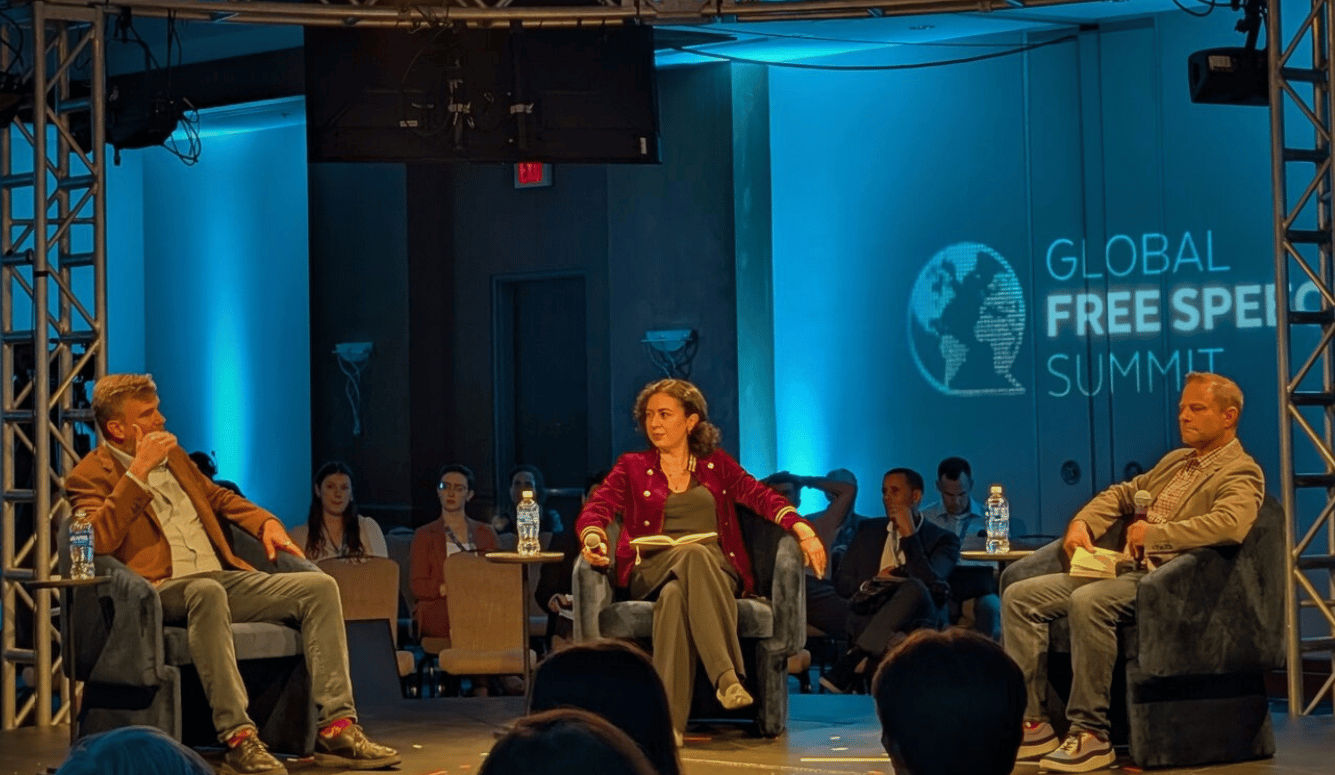
All these conflicts and realignments made it a particularly fitting moment to hold a “Global Free Speech Summit” at the start of October at Vanderbilt University in Nashville, Tennessee. This is the home of The Future of Free Speech, a think tank founded by Vanderbilt professor Jacob Mchangama, a Danish-born lawyer, scholar, and author.
The summit has been envisioned as an annual event. Now in its second year, it was co-sponsored by Heterodox Academy, the Foundation for Individual Rights and Expression, and the Freedom Forum and Knight Foundation, and it drew an impressive variety of speakers and perspectives. These included a satellite interview with an Afghan woman involved in the underground education of girls (the highlight of which, perhaps, was her disdainful huff when she was asked what she would like to say to the Taliban). There was also a talk by a Sri Lankan comedian who spent more than a month in jail after being charged with “words intended to wound religious feelings” for joking about religion.
The international experience certainly helps put America’s problems in perspective. And yet, there really was a widespread sense among American speakers that the US is at a perilous juncture. As Mchangama put it: “Unfortunately, as we see, cultural institutions, law firms, and media outlets voluntarily cave to the pressure of the Trump administration, even though they could rely on the strongest free speech protection in the world.” This acquiescence, he added, is “an affront to dissidents in Iran and Russia who cannot rely on that protection”—a compelling point, especially in the wake of earlier summit panels that examined the daunting challenges to dissent and to the free press under authoritarian or totalitarian regimes. (Panelists included Alsu Kurmasheva, a Russian-American journalist for Radio Free Europe/Radio Liberty who was arrested while working in Russia in October 2023 and later sentenced to six and a half years in a penal colony for “spreading false information about the Russian Army”; fortunately, she was released in a prisoner exchange in August 2024.)
Mchangama’s observation was made during a discussion about free-speech hypocrisies (also recorded as a Persuasion podcast) in which three of the four panelists had been strong critics of progressive illiberalism: Mchangama himself, Persuasion magazine founder and editor-in-chief Yascha Mounk, and Brookings Institution fellow Jonathan Rauch, whose critique of progressive speech-policing, Kindly Inquisitors, appeared in 1993. Now, he is adamant that speech-policing by the government is unequivocally worse: “I would argue it is an order of magnitude more concerning because government can yank your license, investigate you, try you, put you in jail.” We have seen, for instance, television networks being dragged into a Trump-friendly orbit through a combination of bogus lawsuits from Trump and strong-arming by the Federal Communications Commission via its power to regulate media-company mergers. Rauch expressed his dismay at “how quickly we are moving toward Hungary,” where Viktor Orbán’s ruling party has consolidated much of the media landscape in its hands through a combination of direct government control and ownership by Orbán cronies. Except that, Rauch said, America’s slide toward authoritarianism-lite has been happening “on a very fast time scale”—it is already perhaps halfway there after only eight months of Trump’s second term, compared to the fifteen years it took Orbán. It’s not creeping Orbánisation so much as galloping Orbánisation.
Other summit sessions also bore witness to the changed climate in America. The two panels dealing with higher education would once, no doubt, have focused solely on the speech-chilling effects of campus conduct codes or investigations based on student complaints over offensive language, or on the problem of left-skewed ideological uniformity. Now, the focus was also on the Trump administration’s efforts to wrestle universities into submission—including a “compact” offering expanded federal benefits contingent on the promotion of conservative viewpoints—and the danger of non-citizen students being targeted by the feds in retaliation for the expression of disfavoured opinions.
Is there room for a “both sides” argument here? In the session on challenges to academic freedom, some speakers pointed out that federal arm-twisting of academic institutions did not exactly start with Trump. Fourteen years ago, the Obama administration pressured schools to change their handling of Title IX sexual-misconduct cases in ways that weakened due process for accused students. And yet Rauch, who was also on this panel and who was also highly critical of the Title IX reform push under Obama, emphasised the difference: where the Obama administration conducted investigations and took legal action, arguably with “abuse of regulatory authority,” the Trump administration simply issues demands, makes threats, and cuts off or freezes federal funds, including money for vital medical research, to force compliance. It’s not just overreach, said Rauch; it’s “flatly illegal.”
Do universities need reform to promote more open debate and intellectual diversity? At the free-speech summit, the answer was a resounding yes. But there was an equally strong consensus that presidential bullying is not the way, and not just because of principle. Rikki Schlott, the self-described right-leaning libertarian journalist who co-authored The Canceling of the American Mind with FIRE’s Greg Lukianoff, pointed out that “grassroots organic change is the only way that’s actually a meaningful and lasting effect: what happens when the next administration has a different set of demands?” Rauch also disputed the notion that no such organic change was possible within academia until Trump rode to the rescue. In fact, he said, “campuses all over the country were adopting institutional neutrality and the Chicago principles,” which emphasise open discussion and free inquiry. And, if anything, the administration’s heavy-handed interventions “may lead to backlash in the other direction,” assuming that at some point the heavy hand will be gone.
While there is no need to pretend that past American administrations were devoted to free expression, both-sideism under Trump is unconvincing. The Biden administration’s sometimes tense and even heavy-handed interactions with social-media companies about moderating disinformation related to COVID-19 and to election integrity are a favourite “whatabout” response to criticism of the Trump administration’s aggressions against the media.
And yet, as Georgetown professor and social-media researcher Renée diResta argued on the summit’s free-speech hypocrisy panel, the comparison is entirely fallacious: it relies on uncritical acceptance of questionable GOP narratives as well as a bizarre “amnesia” that blames the “Biden censorship regime” for things that happened under the first Trump administration, such as the brief social-media blocking of links to the New York Post story on Hunter Biden’s laptop. (DiResta herself once became a target of right-wing attacks as a “government censor” because of her research on online disinformation and her past receipt of government grants. She says that while she used to support private tech-platform moderation to reduce the visibility of disinformation and extremism, she has since come to believe that giving users more control over their social-media algorithms is a far better and less antagonising solution.)

DiResta was particularly scathing about Ohio congressman Jim Jordan’s two-year investigation into alleged social-media censorship and his spin on the results. The statements Jordan got from tech executives did acknowledge requests and even pressure from Biden officials to restrict content that did not violate the platforms’ own rules. However, diResta pointed out, they also made it clear that they refused to comply and that there was no retaliation, or even threats of such. Meanwhile, even as Jordan was grandstanding about the Biden administration’s social-media tyranny, he also bragged about exercising some coercion of his own: namely, securing a commitment from Google not to fact-check posts and videos. As diResta put it, “The irony was several layers deep.”
It is certainly possible to argue, as Mchangama did, that mild pressure by government agents should still make us wary, even if the jawboning doesn’t become browbeating. (Prohibiting all communications between the government and social-media platforms regarding online content is simply not feasible. Surely, even the strongest opponents of censorship would agree that government agencies should be able to ask platforms to remove material that could endanger intelligence operations or a law-enforcement investigation, or a false claim of a terrorist attack that could set off a panic in a major city. FIRE’s proposal for full transparency about such contacts with a few narrow exceptions seems like a good approach.)
Yet the pitfalls of moral equivalency—and its easy slide into de facto Trump administration apologia—was amply demonstrated on the summit’s last panel by attorney and George Washington University law professor Jonathan Turley, who was adamant, in a debate with Harvard Law School’s Randall Kennedy, that nothing about the Trump administration’s threats to civil liberties or democracy was unprecedented or unique. Federal retaliation against law firms based on the president’s grudges? Sure, it’s bad but, Turley insisted, Republican lawyers who represented “Republican causes” (make that “assisted in attempted election subversion”) were also targeted by the Lincoln Project (which is a private organisation not the US government). Turley also accused the Biden administration of running “the largest censorship system in the history of this country.” As proof, he invoked the “Twitter Files” released by Elon Musk in 2022. But as I wrote at the time, while those disclosures exposed some arguably biased Twitter moderation of political content, it found no trail implicating the Biden administration. After the panel, diResta told me she had repeatedly reached out to Turley to correct his allegations about Biden-era censorship—to no avail.
Kennedy, on the other hand, was entirely willing to acknowledge errors and even “mischievous actions” by past Democratic administrations. “I hope that you’re correct in your suggestion that where we are now is actually not that much different than where we’ve been in the past, and that I’m being an alarmist,” he told Turley. “I fear that you are not correct.”
Yet, regardless of the administration’s authoritarian rampage through American institutions, it remains true that social and institutional pressures can also chill speech, debate, and intellectual life in less dramatic but still dangerous ways. Mchangama—who pointed out that John Stuart Mill, the foremost philosopher of free speech, was very clear about the harms of a non-governmental “tyranny of the majority”—stands by his view that free-speech advocates should continue to oppose “cultural repression” while acknowledging that government censorship is worse. Or as Rauch put it, “We do have to walk and chew gum.”
Free-speech defenders, particularly in the heterodox community, have long insisted that we need a “culture of free speech” that goes beyond the First Amendment: namely, cultural norms that support tolerance for opinions one dislikes and discourage even societal penalties—such as public shaming and/or loss of employment—for protected speech. Creating such a “culture of free speech” on college campuses was the focus of one of the summit panels, featuring FIRE’s Greg Lukianoff. Yet the concept is not uncontroversial; some observers believe that it’s dangerously muddled, equating criticism of speech with censorship, blurring the lines between private and government action, and even inviting a portrayal of the Trump administration’s coercive tactics as an understandable reaction to privately enforced “cancel culture.”
The problem, of course, is that “cancel culture,” as most people understand it, is not simply about criticism. At its worst, it’s about shutting down disfavoured speech through harassment, disruption, or even violence (which is obviously illegal). In less extreme cases, it’s about punishing speech by getting the speaker fired or blacklisted—and to that extent, Lukianoff wryly noted, “You have a First Amendment right to engage in cancel culture.” Want to mobilise people online to badger a pizza shop into getting a delivery guy fired for wearing a MAGA hat or a “white dudes for Kamala” shirt? “You have every right in the world to do that. However, I do think that if you consistently succeed, that’s bad for democracy,” said Lukianoff. “Take a deep breath, people: do you want to live in the kind of country where you can have a strong opinion and a job, but not both?”
Some people obviously do—and these days, such punitive zeal has largely migrated from the Left to the Right, a subject that was discussed in a thoughtful conversation on “cancel culture” between cultural critic Thomas Chatterton Williams and “political depolarisation” activist John Wood Jr. Williams’s book The Summer of Our Discontent raised some progressive hackles with its criticism of the 2020 racial justice protests, and his recent Atlantic essay about Charlie Kirk’s sanctification as the Right’s George Floyd angered both left-wing progressives and right-wing populists—making him well-positioned to comment on the issue as a bipartisan malady. As he put it with wry humour: “I united our society for a day, on X and on Bluesky.”
Williams, Wood, and moderator Michael Moynihan were all highly critical of the 2020 version of “antiracism,” which they saw as mainstreaming abstruse academic definitions of racism and white supremacy, stigmatising people for views and behaviours only recently regarded as innocuous, and enshrining a “moral certainty” that brooks no dissent. But they were also shocked, perhaps naively, by the speed with which the Right’s erstwhile free-speech warriors jumped at the chance to use their newfound power under Trump to assert dominance and seek revenge. “The people that were the free speech warriors, supposedly, are nowhere to be found now because they’re in charge and the tribe matters more,” lamented Moynihan. And some of them, like “anti-woke” activist Chris Rufo—who has played a major role in the Trump administration’s efforts to reshape higher education—are so candid about it is almost impressive.“You know,” marvelled Williams, “he just came right out and wrote an article in City Journal saying that, you know, I used to be against cancel culture when the Left was ascendant—but now that we’re in power, this actually is a good tool to use and we should use it, and we shouldn’t stand on principle. He just wrote that in an essay.”
Williams and Wood had an engaging discussion about the importance of civil discourse in which civility is not merely politesse but something rooted, in Wood’s words, “in a transcendent goodwill for humanity”—in which we can dislike and even despise the idea but not the person. Most of us will sympathise, and Wood certainly deserves applause for his efforts to promote such discourse through his organisation, Braver Angels. Williams made a strong case for more social-media moderation. It is worth noting that Elon Musk’s engagement-based monetisation of X, formerly Twitter, actually amplifies the incentives for inflammatory posting. But all that aside, what hope is there for civil discourse when the president of the United States and his administration lead the way in its debasement—and back up the insults by flaunting the raw exercise of power? Or, as Randall Kennedy asked on the closing panel: “How do we unspool this?”
Examining how we got into our current predicament, and the extent to which different brands and strands of illiberalism have played a role in it, is important. But obviously, where we go from here is the most important question.
Mchangama found hope in the American people’s history-tested dedication to free speech as an essential norm. Near the end of his roundtable with Rauch, Mounk, and diResta, he mentioned a conversation with an Uber driver, “a middle-aged white woman from Alabama,” who asked him what he did. When he told her about his Future of Free Speech foundation she replied, “If there is a future.” As it happens, the driver was a Trump voter but was very concerned about where things are going, specifically with regard to speech.
It’s an encouraging story, but how typical is it? As Mchangama acknowledged, many Trump voters are happy to gloat as Trump cracks down on the elite institutions they believe have been complicit in silencing them. We don’t know how far this crackdown has to go before a critical mass of normies becomes alarmed. Nor do we know whether the pushback will be a liberal one or a resurgence of the illiberal Left, currently battered but far from dead.
Perhaps, by the time the third Global Free Speech Summit rolls around, a combination of popular backlash and legal challenges will have pushed back the administration’s abuses and dramatically improved America’s free-speech landscape. Or perhaps we’ll be at a point where campuses may be skittish about hosting such an event—either because of further right-wing diktat or because of a “woke” revival. All we can do is remain grateful to the true free speech warriors who are doing their best to keep these dismal scenarios from coming true.