Politics
The Post-Kirk Clampdown
The current frenzy of right-wing cancel culture recalls the progressive lunacy that followed the murder of George Floyd. But the current iteration is more dangerous because it is backed by state power.

I.
America’s new cancel culture has arrived. Any remaining doubts about that were laid to rest on 17 September 2025, when a federal government official used the lingo of a mob boss to demand the removal of a comedian from the air for saying things that the US president didn’t like. Within hours, the private TV network responsible for broadcasting the offending show had complied, conscious that failure to do so would put its business interests at risk. This is not the way that free speech is supposed to work in the United States.
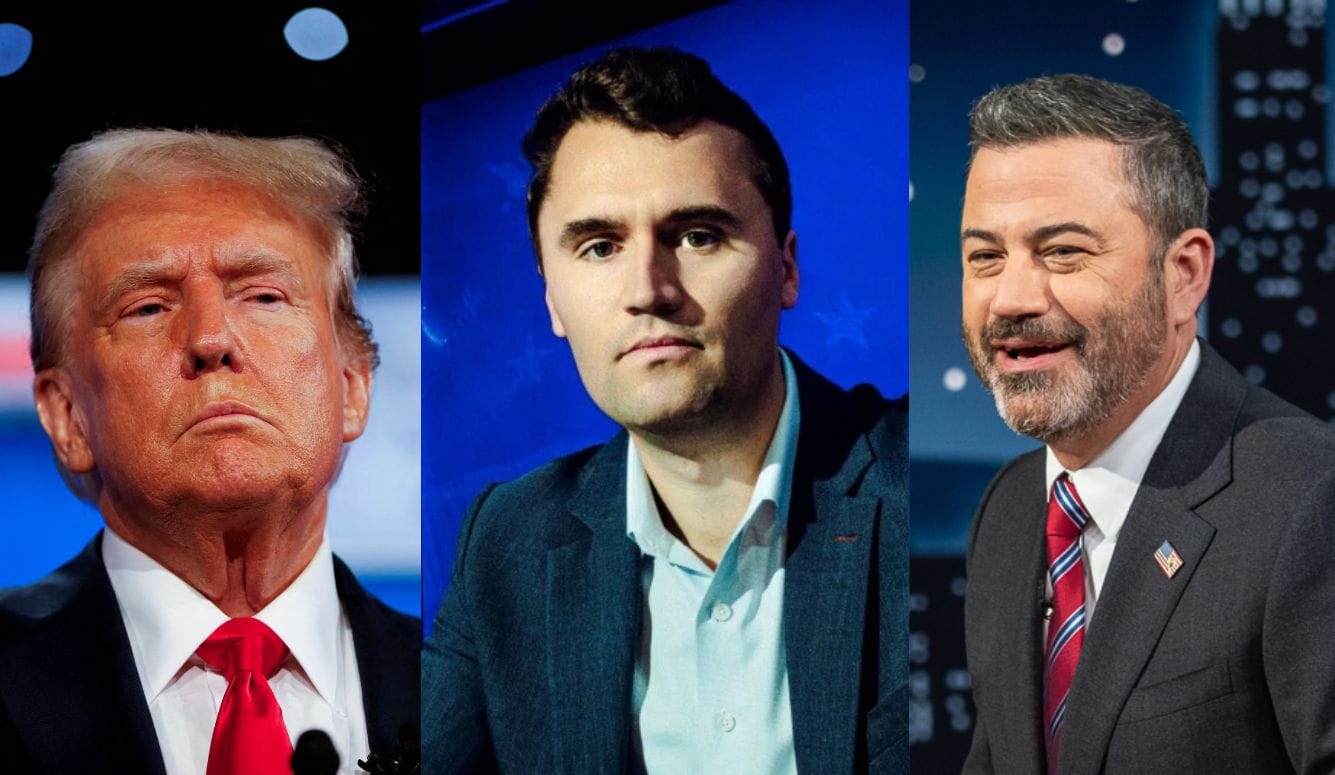
On 24 August, Donald Trump had demanded that the Federal Communications Commission (FCC)—America’s supposedly independent broadcast regulator—revoke the broadcast licenses of the country’s ABC and NBC networks. These companies, he complained in a Truth Social post, are nothing more than “AN ARM OF THE DEMOCRAT PARTY.” Two and a half weeks after Trump’s post and a few days after the shocking assassination of conservative activist Charlie Kirk, Jimmy Kimmel—host of ABC’s long-running late-night show Jimmy Kimmel Live!—made the following remarks:
We hit some new lows over the weekend with the MAGA gang desperately trying to characterise this kid who murdered Charlie Kirk as anything other than one of them and doing everything they can to score political points from it.
Kimmel went on to poke fun at Trump’s apparent callousness over the murder, playing a video clip of Trump being asked how he was dealing with his grief. Trump responded by yammering on about the new White House ballroom he was constructing. That last bit was funny. But Kimmel’s implication that Kirk’s murderer was part of the “MAGA gang” was neither funny nor true. So Trump administration officials—who are always sticklers for perfect accuracy—got to work trying to cancel Kimmel’s show.
On 17 September, FCC Chairman Brendan Carr appeared on Benny Johnson’s MAGA podcast and accused Kimmel of engaging in what “appears to be some of the sickest conduct possible. ... In some quarters, there’s a very concerted effort to try to lie to the American people about the nature ... of one of the most significant newsworthy public-interest acts that we’ve seen in a long time. And what appears to be an action by Jimmy Kimmel to play into that narrative that [Kirk’s assassin] was somehow a MAGA- or Republican-motivated person. If that is what happened here, that is really, really sick.”
BREAKING: The FCC Chairman is threatening immediate action against Jimmy Kimmel, ABC, and Disney for deliberately misleading the public by claiming Charlie Kirk’s assassin was a MAGA Conservative.
— Benny Johnson (@bennyjohnson) September 17, 2025
Chairman Brendan Carr calls Kimmel’s malicious lies are “truly sick” and says they… pic.twitter.com/mGhtGMPReI
Carr then employed the verbiage of a mafia chieftain to threaten the private companies responsible for putting Kimmel on the air. “What people don’t understand,” he explained, “is that the broadcasters ... are entirely different than people who use other forms of communication. They have a license, granted by us at the FCC, and that comes with an obligation to operate in the public interest. ... And frankly, when we see stuff like this, I mean, we can do this the easy way or the hard way. These companies can find ways to change conduct, to take action, frankly, on Kimmel, or, you know, there’s going to be additional work for the FCC ahead.”
Asked what action he’d like to see ABC take, Carr mused, “There’s calls for Kimmel to be fired. Um, I think, y’know, you could certainly see a path forward for suspension over this.” He pointed out that companies like Comcast and Disney create these shows and then provide them to licensed TV stations. “It’s the licensed TV stations,” he went on, “that have the public-interest in ’em, including those stations that Comcast and Disney own. So FCC regulatory action focuses on those individual stations. ... And frankly, I really think it’s past time that a lot of these licensed broadcasters themselves push back on Comcast and Disney and say, ‘Listen, we are going to preempt, we are not going to run Kimmel anymore until you straighten this out, because we—we licensed broadcasters—are running the possibility of fines or license revocation from the FCC if we continue to run content that ends up being a pattern of news distortion.’ So I think Disney needs to see some change here, but the individual licensed stations that are taking their content, it’s time for them to step up and say this, y’know, garbage ... isn’t something that we think serves the needs of our local communities.”
The message conveyed by the FCC chairman was unmistakably clear. According to an 18 September report in the Wall Street Journal, rattled Disney executives had a meeting with Kimmel following Carr’s remarks and asked him to use his Wednesday show to issue a correction and apology. Kimmel refused because he felt he’d done nothing wrong and informed Disney that he would argue that MAGA influencers had deliberately misrepresented him instead. In response, ABC yanked his show indefinitely. Was that decision motivated by fear of a viewer revolt from below if Kimmel doubled-down or an FCC retribution from above? Probably a bit of both, but there was no question that Carr’s remarks were intended to intimidate.
Carr’s warning to the individual stations was particularly potent because Nexstar Media, the company that runs many of these stations, has a multibillion-dollar merger in the works that will require FCC approval. Before the day was over, Nexstar had issued a press release confirming that they would not be running Kimmel’s show “for the foreseeable future beginning with tonight’s show.” The Sinclair Broadcast Group, the largest ABC affiliate group in America, went even further. On 17 September, it posted a tweet on X welcoming Carr’s intervention, and the following day, it issued a statement arguing that Kimmel’s suspension had been inadequate and urging the FCC and ABC “to take additional action.”
And Carr’s reaction to this news? A “raise the roof” meme, which FIRE President Nico Perrino said, “in a sane world, would be an exhibit in a lawsuit.”
Brendan Carr wrote the new textbook definition of jawboning when he said of Kimmel and ABC, “We can do this the easy way or the hard way."
— Nico Perrino (@NicoPerrino) September 17, 2025
And he celebrates his censorship with a lame meme, which, in a sane world, would be an exhibit in a lawsuit. https://t.co/mJ4Fsuzsdq
Yes, in a sane world, Carr’s response to CNN would be a damning admission. But in this one, it’s autocratic triumphalism. Donald Trump also took a victory lap: “It’s really good to see [Kimmel and Stephen Colbert] go,” he gloated on Truth Social, “and I hope I played a major part in it!” Galvanised, the president immediately issued a new demand that NBC fire “Jimmy [Fallon] and Seth [Meyers].” The president and his administration are making no secret of their eagerness to crush free speech—on the contrary, everything is happening in the open and they’re proud of it.
II.
I discovered that Charlie Kirk had been shot shortly after noon on 10 September, when a member of my family alerted me to the news by text. I checked social media, and multiple videos of the assassination were already circulating on X. A particularly graphic video, recorded from the front rows of the event, instantly told me that Kirk could not possibly have survived the shooting. People from across the spectrum were offering expressions of horror, condolence, and sorrow, to which I added my own.
A debate soon began online. Although Kirk was eulogised by his supporters as a man who toured campuses modelling civil debate and disagreement, his opponents pointed out that, on his podcast and X account, he was more often a flame-throwing MAGA activist and attack dog. Should those outraged by his murder who did not share his political views mention these disagreements when they post condolences? In an editorial comparing Charlie Kirk to the slain Charlie Hebdo cartoonists, Bari Weiss, owner and editor-in-chief of the Free Press, wrote:
Someone in the newsroom said that this shattering event feels like the aftermath of another Charlie: Charlie Hebdo. It was a decade ago that Islamists burst into the offices of the satirical Paris newspaper and murdered 12 people who worked there.
In its aftermath there were a lot of spineless statements from people distancing themselves from the brave journalists who put out that magazine: “I didn’t agree with them but...”
We’re hearing the same thing now about Charlie Kirk. No. Whether you agree with him or not is completely, utterly, totally beside the point. We won’t do it. Je suis Charlie.
To which journalist and commentator Matthew Yglesias replied:
I actually don’t think it’s at all besides the point, the core of free speech and a liberal society is precisely that I *don’t* need to agree with the hagiographic accounts of Kirk’s life and work to find his murder unacceptable and chilling.
In the wake of this appalling crime, we’ve seen many voices—including people in positions of formal political authority—explicitly espouse a crackdown on speech they don’t like as the solution.
I think the [Free Press] by not only commemorating Kirk but going out of their way to take potshots at people who strongly disagreed with him but want to affirm his rights and condemn the killer is in a deep way betraying the free speech values they launched as champions of.
Yglesias’s take is right, I think—a version of the aphorism coined by Voltaire’s biographer (and usually misattributed to the man himself): “I disapprove of what you say, but I will defend to the death your right to say it.” So long as the condemnation of violence is emphatic and sincere, there is value in reminding others that, in a free society, we don’t have to agree with someone to be appalled by their murder.
There were some reprehensible expressions of gloating and joy by Kirk’s more radical political opponents, and those people became the justifiable targets of outrage and censure. However, those who condemned Kirk’s barbaric murder but distanced themselves from his politics also found themselves besieged by GOP zealots. Politicians, talking heads, influencers, journalists, and mobs of anons all rushed to punish anyone who ventured any disagreement with or disquiet about Kirk’s posthumous sanctification.
Three days after Kirk’s murder, Gunther Eagleman, a MAGA fanatic with 1.5 million followers on X, posted a recording of a young female teacher and tagged her employer. The recording, Eagleman claimed, revealed that this teacher was “absolutely TRASHING Charlie Kirk to a classroom full of students. ... This lady has NO BUSINESS being around children. She needs to be FIRED immediately. Make her famous!” I can’t even hear Kirk’s name mentioned in the clip. The teacher seems to be in the middle of a class about industrialisation, during which she says:
But the violent aspect—you should be allowed to say whatever you want without violence being inflicted upon you. Does that make sense? And so, when we talk about things like industrialization, right? As much as it was less controversial, right? Like I said, he was an absolute terrible person, the things that he had said. Violence is not the ans—violence isn’t the answer, kids, is what it comes down to. Because it violates those founding ideas.
Eagleman’s tweet has 38,000 retweets and 68,000 likes. As Dispatch contributor Jesse Singal pointed out in a quote tweet:
i’m finding this increasingly sickening. this teacher, who was secretly recorded, is very explicit about the fact that violence is never acceptable. you’re gonna get a teacher fired for expressing the opinion that she disliked charlie kirk? really gtfo [get the fuck outtahere]
Elsewhere on X, a young North Carolina police officer was named and shamed by Chaya Raichik’s Libs of TikTok account for posting this comment in a chat:
I think perhaps you’re not seeing the other side of it. When Nancy Pelosi’s husband got attacked and hospitalised in his home, Republicans were laughing high fiving and doing backflips, hell, it wasn’t just 2 months ago they were laughing and high [fiving] about feeding immigrants to alligators. Who were ALSO fathers, mothers, and brothers. Not to mention Charlie being openly racist. So you can imagine, while the act is horrific, certainly he ain’t really winning in the empathy department.
“Our tax dollars pay his salary,” wrote Raichik, before tagging his employer and demanding a response. Her tweet currently has 4,000 retweets and 8,600 likes.
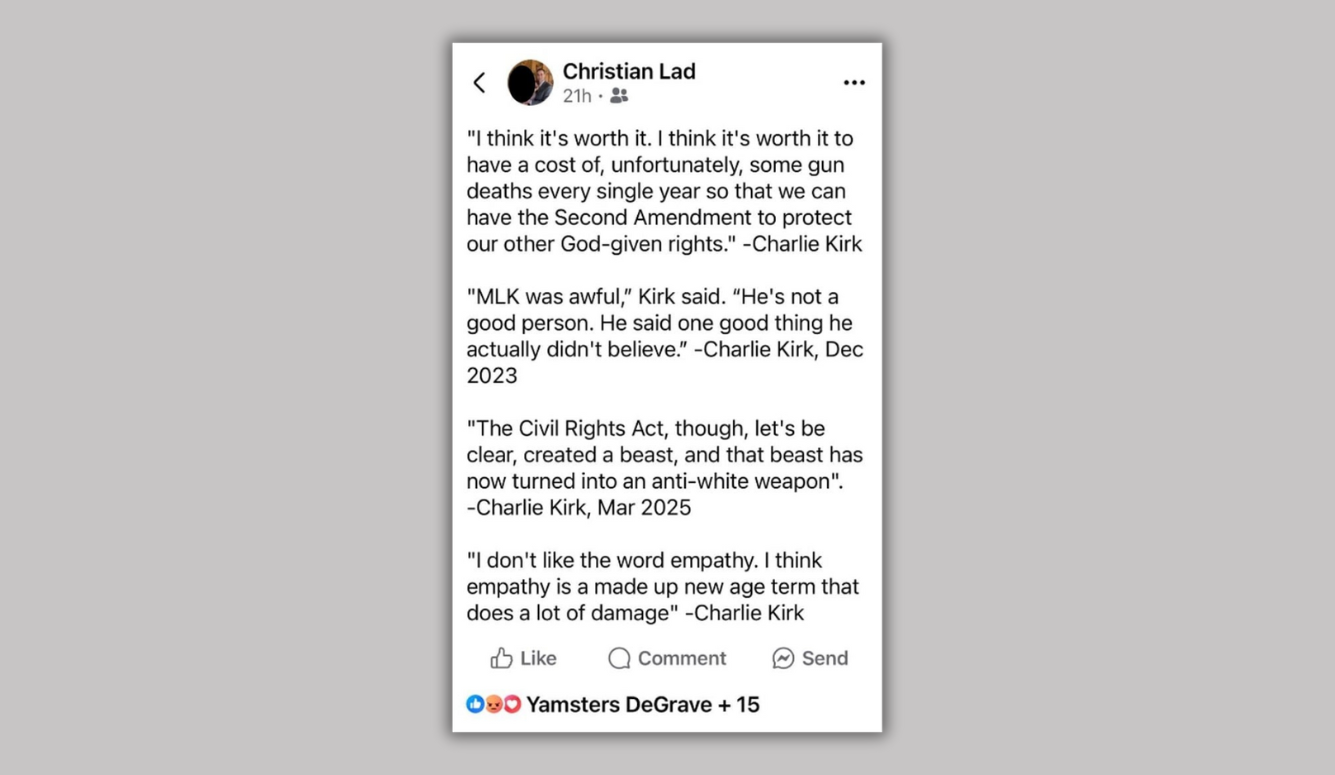
Other users found themselves in the crosshairs for quoting Kirk accurately. In a tweet that has 3,400 retweets and 5,400 likes as of this writing, we are invited to “meet” an Army officer who “has thoughts about the assassination of Charlie Kirk, and they don’t seem in the least sympathetic.” Included is a screenshot of a Facebook post that lists four accurate Kirk quotes, offered without any commentary.
In at least one remarkable case, the frenzy to expose and vilify others got so out of hand that a person who had said nothing about Kirk became the target of a deranged hate campaign:
West Side Elementary Associate Principal Cindy Rehberg said the calls began Friday afternoon.
“I answered the phone and someone was swearing on the other line—I knew right away something was wrong,” she said.
Over the weekend, the district had logged more than 800 voicemails, some of which were vulgar and threatening.
District leaders said someone lifted Rehberg’s photo and placed it under another person’s post that included critical comments about Charlie Kirk’s death, creating the impression she wrote the remarks.
The person who sicced an online mob on Rehberg is Ryan Fournier, a MAGA influencer with 1.2 million followers on X. Fournier eventually deleted his tweets targeting Rehberg and admitted that “Cynthia Rehberg was not the individual who made those comments.” But he did not bother to apologise, and his retraction was too late for Rehberg, her colleagues, and the schoolchildren, 100 of whom did not show up to school on the Monday after Fournier’s post. The school has increased the police presence on campus and Rehberg has installed security cameras in her home.
III.
Earlier this week, someone remarked to me that the current cancel-culture frenzy is the craziest since the lunacy of the George Floyd riots in 2020. That was a time when a centre-left Nashville choral composer could be stripped of his music career for objecting when rioters vandalised his city’s historic courthouse. “Enjoy burning it all down, you well-intentioned, blind people” Daniel Elder tweeted, “I’m done.” A backlash followed, and his publisher handed Elder a pre-written apology that conceded he could offer “no justification” for his “insensitive and wrongly-worded” post. Elder refused to sign it. As Robby Soave reported a year later, “[Elder’s] publisher has blackballed him. Local choral directors refuse to program his music for fear of provoking a backlash. They won’t even let him sing in the choir.”
 Quillette
Politicians on the populist Right promised that they would end this kind of madness. In 2023, when Joe Biden was still president, Elon Musk announced, “If you were unfairly treated by your employer due to posting or liking something on this platform, we will fund your legal bill. No limit. Please let us know.” And on 20 January 2025—the day of his second inauguration—Donald Trump signed Executive Order 14149, which was titled “Restoring Freedom of Speech and Ending Federal Censorship.” In February, J.D. Vance travelled to Munich in Germany and delivered a twenty-minute speech in which he lectured Europeans about their failure to protect free expression.
But the problem of cancel culture has become much more dangerous in the Trump era, because it is now backed by the coercive power of the state at the highest levels. When Vance guest-presented the Charlie Kirk Show on 15 September, the vice-president of the United States told viewers to report anyone they saw celebrating Kirk’s murder: “Call them out, and hell, call their employer,” he said. “We don’t believe in political violence, but we do believe in civility.” The following day, attorney general Pam Bondi declared: “There’s free speech and then there’s hate speech, and there is no place, especially now, especially after what happened to Charlie, in our society. ... We will abso-lute-ly target you, go after you, if you are targeting anyone with hate speech. And that’s across the aisle!”
Bondi’s top lieutenant, deputy attorney general and former Trump defence lawyer Todd Blanche, said that anyone chanting at Trump in a restaurant could be locked up for years for RICO violations. On 13 September, Stephen Miller, arguably the most powerful presidential advisor in the government, appeared on Sean Hannity’s Fox News show to discuss “the Left’s dangerous rhetoric.” Miller told Hannity that the last message he received from Kirk before he was murdered urged the administration to “dismantle and take on the radical Left organisations in this country that are fomenting violence.” So that, he vowed, is what the administration would do:
Under President Trump’s leadership. I don’t care how—it could be a RICO charge, a conspiracy charge, conspiracy against the United States, insurrection—but we are going to do what it takes to dismantle the organisations and the entities that are fomenting riots, that are doxxing, that are trying to inspire terrorism, and that are committing acts of wanton violence. It has to stop! And my message is—to all the domestic terrorists in this country spreading this evil hate—you want us to live in fear? We will not live in fear, but you will live in exile. Because the power of law enforcement under President Trump’s leadership will be used to find you, will be used to take away your money, take away your power, and if you have broken the law, to take away your freedom, Sean.
Representative Clay Higgins (R-La), meanwhile, promised “to use Congressional authority and every influence with big tech platforms to mandate immediate ban for life of every post or commenter that belittled the assassination of Charlie Kirk.” Higgins said he will use the power of government to demand that such people “be banned from ALL PLATFORMS FOREVER. I’m also going after their business licenses and permitting, their businesses will be blacklisted aggressively, they should be kicked from every school, and their drivers’ licenses should be revoked. I’m basically going to cancel with extreme prejudice these evil, sick animals who celebrated Charlie Kirk’s assassination. I’m starting that today. That is all.” Higgins immediately wrote a letter to social-media companies citing his authority over “Federal regulatory law enforcement” and warning them not to “shield” people who celebrated Kirk’s murder.
Celebrating Charlie Kirk’s killing is disgraceful, but it is also constitutionally protected speech. So, for a government official to promise to use state power to punish it ought to be profoundly shocking. But this kind of thing is in danger of being normalised by its ubiquity and the eagerness with which those on the Right are flocking to support it. Even a supposedly libertarian senator like Rand Paul has said: “I think it is time for this to be a crackdown on people.”
Until November 2024, many of these people insisted that they were against cancel culture. But with Trump in power, they have discovered that they can say what they want and also silence their opponents and they are finding this a lot more convenient than the doctrine of tolerance they preached when they were out of power. The unvarnished euphoria is not especially surprising. As lawyer Ken White said in response to Rand Paul’s call for a “crackdown”:
Just a reminder: they were never actually against cancel culture. They were against the cancellation of people they agree with or like. They’ve always been enthusiastically in favor [of] cancelling people they don’t like. If you took them at their word you’re a useful idiot.
On 17 September, ABC reporter Jonathan Karl asked Trump about Pam Bondi’s “hate speech” remarks. Here’s how Fox News reported Trump’s response:
The exchange occurred after Karl asked the president at the White House, “What do you make of Pam Bondi saying she’s going to go after hate speech? Is that, I mean, a lot of people, a lot of your allies, say hate speech is free speech.”
“She’ll probably go after people like you, because you treat me so unfairly,” Trump replied, speaking over Karl as he asked if that would be appropriate. “You have a lot of hate in your heart. Maybe they will come after ABC. ABC paid me $16 million recently for a form of hate speech. Your company paid me $16 million for a form of hate speech, so maybe they will have to go after you.”
Donald Trump recently filed one of the most frivolous defamation lawsuits in history: a US$15 billion lawsuit against the New York Times that reads like it was written in crayon. However, on 19 September, a judge summarily dismissed the suit with leave to refile, writing: “As every lawyer knows (or is presumed to know), a complaint is not a public forum for vituperation and invective—not a protected platform to rage against an adversary. A complaint is not a megaphone for public relations or a podium for a passionate oration at a political rally.”
But Trump knows what he’s doing. After all, ABC did settle with him over comments made by George Stephanopoulos, although it was for US$15 million not US$16 million. Trump presumably confused that settlement with the payout he received from Paramount for a bogus lawsuit over innocuous edits that 60 Minutes made to an interview with Kamala Harris before the election. But these companies capitulate because they know that if they defy Trump, he will use government power to scuttle lucrative corporate mergers.
In the Paramount case, Trump’s FCC had the ability to stop a major merger with Skydance Media. So Paramount effectively bribed Trump with a multimillion-dollar settlement and fired Stephen Colbert for good measure. In the Kimmel affair, Nexstar Media had “announced a $6.2 billion acquisition of rival Tegna, which would give it 64 additional news stations in 51 markets to go with the 200 owned and partner stations it already has.” But approval of that deal was also subject to the FCC loosening regulations. So Nexstar immediately caved to Carr’s demands.
As for ABC, it’s owned by Disney, and in April, the Justice Department announced that it is “looking into Walt Disney Co.’s deal to take a controlling stake in streaming company FuboTV Inc.” As Bloomberg reported, “In January, Disney agreed to merge its Hulu + Live TV streaming service with the online sports-focused company Fubo, creating the second-biggest digital pay-TV provider, according to people familiar with the plans.” So Disney and ABC suspended Jimmy Kimmel (and declined to contest the Stephanopolous lawsuit).
Disney needs DOJ approval for its merger. Nexstar and Paramount needed FCC approval for their mergers. So all these companies must pay protection money and do what Trump wants. Sure, they can blame ratings or untruthful comedy monologues if they want, but money talks in the media marketplace. In each of these cases, we saw a shakedown, and the companies decided to pay rather than risk having their legs snapped in half.
IV.
Donald Trump has had startling success in turning the Republican Party into a facsimile of a cult, where people forfeit their dignity to shower him with effusive praise, cater to his every capricious whim, and exile insubordinate dissenters. Trump’s cabinet meetings are morbidly embarrassing exercises in idol worship, where officials compete for the honour of delivering the most obsequious and servile tribute to their mad king. Media interviews require GOP House and Senate members to humiliate themselves by defending Trump’s latest outrage or absurdity. And there is nothing—not naked bribery, not extrajudicial killing in the Caribbean, not pardoning insurrectionists who beat Capitol police officers, nothing!—that these people won’t defend in front of a television camera when called upon to do so.
I call it a “facsimile of a cult” because many of these flunkies privately despise the man before whom they grovel. If you pay attention to plugged-in reporters who routinely talk to GOP officials off the record, they say that many of these politicians tell them—no doubt in a whisper—that they dislike Trump’s personal ethics, and disagree with him profoundly on a range of issues, from his ruinous tariff policy to his alliance with Russia against Ukraine. But they will never say so in public.
And that’s just fine with Trump, who probably doesn’t like them much either. He doesn’t care about sincerity, he cares about obedience. And he has obtained that obedience by ruthlessly targeting his critics, threatening them with primary challenges, and mobilising his base against them. The last decade is littered with the political corpses of Republicans who dared to speak up against him. Those who survived have learned their lesson. If they wish to remain in the modern GOP, they must suck up or shut up or both.
Now Trump is taking the show on the road, and bringing the same pressure to bear on the entire country. His goal is aspirationally Stalinist: to create a society in which anyone who opposes him is afraid to say so. And he’s unembarrassed to use state power to accomplish this goal, especially now that the murder of Charlie Kirk has given him an excuse to do so. Indeed, the entire story of Donald Trump’s second presidency can be boiled down to this: If you are with Trump, he will use the government to help you. If you are openly against him, he will use government to crush you.
Trump has made it clear that states’ access to governmental services like disaster relief depend upon whether or not that state supports him politically. Trump has issued executive orders calling for specific critics to be targeted for criminal investigation, but he pardons his friends, whether they are 6 January cop-beaters or just people who have bribed him. He gives prominent spots in the White House press pool to new media sycophants who ask laughably deferential questions, while he blackballs (and threatens the broadcast licences of) organisations that don’t toe the line. He hires and fires federal employees based entirely on his assessment of their loyalty, and his personal attorneys staff the highest ranks of the Department of Justice. He targets universities, law firms, and visa holders who say things he doesn’t like. I could easily extend the length of this piece fourfold with further examples of the ways in which Donald Trump has used the levers of government to target speech he doesn’t like.
In many ways, Trump is following the authoritarian template forged by Viktor Orbán in Hungary:
Political scientist Peter Kreko says Orban is targeting the last bastions of Western democracy in Hungary. “Orban just thinks that the West is unable to survive and the democratic and liberal practices of the West have weakened the West,” he says.
Kreko has mapped out the 15-year process Orban has taken to dismantle Hungary’s democracy. Orban began, he says, by weakening Hungary’s courts, filling them with loyalists. He then applied pressure on media companies, either turning them into state propaganda or putting them out of business. Then, says Kreko, Orban took control over universities, appointing leaders loyal to him.
Kreko says Orban focused on ridding Hungary of any institution capable of checking his power, and he says he sees similarities to how President Trump is carrying out his second term in office. The difference, says Kreko, is the pace at which Trump is operating. “I think Trump went further in two months than Orban could in 15 years,” observes Kreko. “In the United States, it reminds me of a constitutional coup, where everything happens very rapidly.”
And as we watch Jimmy Kimmel swept unceremoniously from the airwaves, we should admit that it’s working like a charm. Some observers have speculated that the Trump administration miscalculated by sticking its oar into the debate about Kimmel when a grassroots backlash might have done the work of toppling Kimmel for them. But as Nick Catoggio has pointed out in an essay for the Dispatch:
To believe that Trump and Carr made a strategic mistake by not letting a grassroots backlash against Kimmel develop organically, you need to believe that the president wants American institutions to fear right-wing cultural power.
He doesn’t. He wants them to fear his power.
It would have done nothing for Trump personally if spontaneous public outrage had driven Kimmel’s show off the air. He wants cultural stakeholders to answer to him and his government—not Republican consumers—for their crimes against MAGA. And he wants the right itself to warm up to that idea by getting comfortable with the prospect of state censorship. They’ve been whining about left-wing media bias for generations. It’s time to let their hero do something about it.
We were long told that leftwing cancel culture was the worst possible type because the Left had captured the institutions of media, entertainment, and higher education. But cancel culture backed by state power is worse, for two very important reasons. First, there is no competition, and second, the state has a monopoly on lawful violence. Threatening a broadcast licence may not sound like a pointed gun, but if the threat is carried out, and if everyone responsible for obeying the order resists, sooner or later someone is going to have a gun pointed in his face.
V.
This has been a depressing essay, so let me try to end it on a hopeful note. The day after Charlie Kirk’s murder, Daniel Elder—the choral composer cancelled during the Floyd riots—posted a sober and mature essay on his website titled “Eulogy: A few thoughts on the assassination of Charlie Kirk.” It begins like this:
Yesterday, as of this writing, our society lost a far more impactful soul than it has yet realized. Today, as we meander warily on the far side of the Rubicon, we should all ask ourselves: What have we done?
For far too long a destructive ideology has festered among us; one that accepts the idea that words themselves hold the power to harm, and that the differences inherent in disagreement can be considered a form of violence. This belief, cradled in academic institutions in a decades-long insidious creep, has taken our infantilized population by storm. Nowhere can this be seen more poignantly than in the tragedy of Charlie Kirk.
Deeper into the essay, Elder remarks:
I’ve seen far too many people say yesterday and today that Charlie “Lived by the sword (of damaging words) so he died by the sword (an answering bullet).” I caution any and all of you who may flirt with this sentiment to seriously consider the fire you’ve been so cavalierly toying with. Treating disagreement as a deadly threat opens a very black door of the soul, one I’m quite sure most of you aren’t ready to discover. One such door was cracked open yesterday, and in its shadow millions collectively grieve for a widow and two fatherless children—all because of words. Who will be next?
Daniel Elder’s cancellation did not involve violence. Elder is not the martyr to free speech that Charlie Kirk has become. But Elder’s entire livelihood was threatened over an inoffensive social-media post, and that’s not nothing. It was evidently an experience that has turned a choral-music composer from Nashville into an eloquent and thoughtful defender of free speech.
I will conclude by passing the mic to the podcaster Russ Roberts, who articulates a sentiment very much like the one expressed by Elder:
The murder of Charlie Kirk is a double tragedy. The first is a man’s life cut short, his friends and family bereft, his voice stilled. The second is that the costs of speaking up and speaking out have now risen dramatically. Not just democracy but civilization falters when people become afraid to express themselves or become the public face and voice of an idea. In a civilized society, speaking up and speaking out should not make you fear for your life. In that sense, this death is an act of terror. It makes every thoughtful public figure who writes and speaks worry that they might be next. That this happened to someone who loved to engage in calm debate makes the whole thing even sadder.
All any of us can do is continue to speak up—that is the point of a free society. Let’s hope we can do so with courage and honesty and without fear of being fired or shot to death because of the words we write or utter.
Keep reading
Apocalypse ’92
Love and Theft
AI Is Not About To Become Sentient

The Innovation Trap

Treating Myths as Science