COVID-19
Poultry Farming, COVID-19, and the Next Pandemic
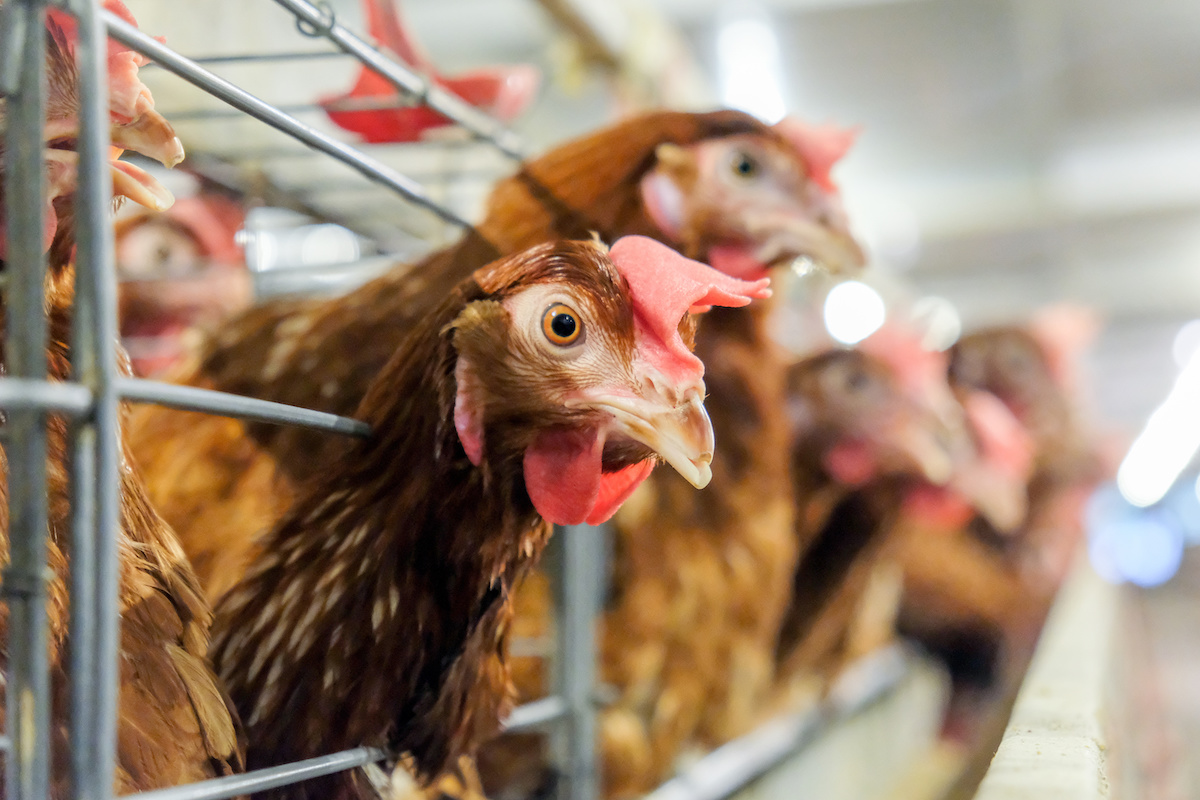
No animal on Earth is treated with more inhumanity than chickens, and this industrial cruelty has in turn made chickens and other birds one of the gravest threats to our health.

I

Upton Sinclair published The Jungle in 1906 to expose the horrific conditions in American factories at the turn of the century. While he intended to highlight the misery and abuse of the workers, his graphic descriptions of disgusting and unsanitary conditions at slaughterhouses were what most outraged the public. President Theodore Roosevelt was among the indignant readers, and he used the outcry over The Jungle to push for passage of the 1906 Food and Drugs Act and the Federal Meat Inspection Act. “I aimed for the public’s heart,” Sinclair later wrote, “and by accident hit it in the stomach.” Jonathan Safran Foer’s Eating Animals (published in 2009)—and the chapter “Influence/Speechlessness,” in particular, about the US poultry industry and the risks it poses to our health—ambitiously aims for the reader’s heart and stomach at the same time.

Foer gives us a glimpse into the hellish life of the more than nine billion factory farmed chickens “produced”—all 56.8 billion pounds of them, as the National Chicken Council (NCC) proudly announces—by the industry every year. “It’s hard to get one’s head around the magnitude of 33,000 birds in one room,” Foer writes, something he witnessed firsthand when he broke into a poultry farm with an unnamed animal rights activist. He points out that the NCC “indicates an appropriate stocking density to be eight-tenths of a square foot per bird,” roughly the size of a piece of printer paper. A decade after Eating Animals was published, the NCC advertises this figure as if it’s evidence of poultry producers’ heroic effort to protect the well-being of their birds: “The Council for Agricultural Science and Technology (CAST) states that the minimum space is one-half square foot per bird, so industry practice is well in excess of this space requirement. By nature, as the old saying goes, the birds do tend to flock together.”
It’s extraordinary that the NCC would use the word “nature” to describe sheds containing tens of thousands of birds stacked on top of one another, with no room to satisfy any of their basic instincts like nest building, dustbathing, and perching, and where disease and serious injury are constant facts of life. Or the fact that “broilers” (chickens raised for meat) grow so quickly that their bones can’t cope with the weight. These conditions are so stressful that they lead to what’s known as “sudden death syndrome”—a fit of stress-driven convulsions and cardiac arrhythmia that virtually never happens outside factory farms.
Hundreds of millions of factory farmed chickens also suffer broken bones and wings every year. According to the NCC Animal Welfare Audit Checklist, a chicken producer gets a full score if three percent or fewer of its birds have “broken or dislocated wings.” Given the number of chickens produced every year, three percent would be 270 million birds. However, producers can still get partial credit if up to four percent of their birds (360 million) have broken wings.
Many birds remain conscious as they make their way down conveyor belts (hanging upside down by their ankles) toward an automated throat slitter. Foer points out that this mechanism isn’t always effective: “Blood will slowly drain out of the bird, unless the relevant arteries are missed, which happens, according to another worker I spoke with, ‘all the time.’” Foer summarizes how the NCC felt about this problem at the time: “According to the National Chicken Council… about 180 million chickens are improperly slaughtered each year. When asked if these numbers troubled him, Richard L. Lobb, the council’s spokesman, sighed, ‘The process is over in a matter of minutes.’” The NCC makes the same point about its “humane slaughter” process today—it’s supposed to be brief and painless.
The process includes scalding, which makes broilers easier to pluck. According to the United States Department of Agriculture (USDA), the water is between 124 and 147 degrees Fahrenheit, and the scalding process typically lasts between 30 seconds and two minutes. It’s clear from USDA guidance that some birds are scalded alive: “Evidence of improper stunning may include birds entering the scalder that are still breathing, or an increased number of cadavers at the inspection station.” This echoes what Foer discovered: “I spoke to numerous catchers, live hangers, and kill men who described birds going alive and conscious into the scalding talk. (Government estimates obtained through the Freedom of Information Act suggest that this happens to about four million birds each year.)” No wonder the Humane Methods of Slaughter Act “does not apply to chickens or other birds.”
If the cramming, bone-snapping, throat slitting, and scalding aren’t enough to stir your sympathy, Foer summarizes a few of the other maladies factory farmed chickens routinely suffer: “Beyond deformities, eye damage, blindness, bacterial infections of bones, slipped vertebrae, paralysis, internal bleeding, anemia, slipped tendons, twisted lower legs and necks, respiratory diseases, and weakened immune systems are frequent and long-standing problems on factory farms.” Around 50 billion chickens are slaughtered in this way around the world every year, while billions more (such as male chicks of laying hens or hens that aren’t productive) are thrown into grinders, suffocated in bags, and gassed.
In 1961, poultry accounted for 12 percent of global meat production. By 2013, that number that had surged to 35 percent, while the total amount of meat produced around the world increased more than four-fold. Foer asks, “Where does it end?” Sadly, not until consumers begin to recognize that the incomprehensible suffering we’re inflicting on these animals is putting human lives at risk—perhaps on an enormous scale. So let’s move from the heart to the stomach.
II
Most health experts indicate that COVID-19 likely originated at a wet market in China. Like the devastating Spanish flu pandemic that killed more than 50 million people from 1918 to 1919 and infected one-third of the world’s population (around 500 million people at the time), COVID-19 is a zoonotic disease, which means it spreads from animals to humans. The H2N2 virus that left 1.1 million people dead worldwide (including 116,000 in the United States) in 1958 – 1959 was also a zoonotic disease, originating from an avian influenza A virus. As was H3N2, which killed a million more a decade later. SARS, MERS, H5N1, and H7N9 are all zoonotic.
Wet markets pose a unique risk because they bring dozens of species together (many of which wouldn’t normally come into contact with one another) in a single confined space, where blood and other fluids mix as animals are slaughtered on the spot. As Steven Osofsky, a professor at Cornell University’s College of Veterinary Medicine, puts it: “Pathogens are meeting species that they’ve never met before. That’s when we have these opportunities for viral jumps, including the ones that lead to humans and create the situation we’re in now.” The demands for China to shut down its wet markets are becoming louder and louder—something that should happen as soon as possible. But Americans are ignoring the threat in their own backyard.
According to the CDC, more than 2.8 million people in the US get antibiotic-resistant infections every year, and more than 35,000 of them die. This is why the agency describes antibiotic resistance as “one of the biggest public health challenges of our time”—a challenge made far more difficult by the widespread use of antibiotics in the animal industry. A 2015 article in the American Journal of Public Health argues that the “indiscriminate use of antibiotics for animal agriculture is irresponsible and misguided” and explains:
Of all antibiotics sold in the United States, approximately 80 percent are sold for use in animal agriculture; about 70 percent of these are ‘medically important’ (i.e., from classes important to human medicine)… There is growing evidence that antibiotic resistance in humans is promoted by the widespread use of nontherapeutic antibiotics in animals. Resistant bacteria are transmitted to humans through direct contact with animals, by exposure to animal manure, through consumption of undercooked meat, and through contact with uncooked meat or surfaces meat has touched.
Although the FDA recommends caution in interpreting the 80 percent figure because it’s unclear how many of the drugs are actually being used, it’s safe to assume companies aren’t buying huge amounts of antibiotics only to throw most of them away. While the amount of antimicrobial drugs “approved for use in food-producing animals” declined in the two years after the aforementioned article was published (and the proportion of those drugs considered “medically important” dropped to 52 percent), it increased again in 2018. And 52 percent is still a staggering figure considering the sheer amount of drugs being administered in the animal industry—these are drugs that people need, and we’re teaching pathogens how to resist them.
 Jonathan Kay
Factory farms are pumping non-human animals full of antimicrobial drugs, often for trivial reasons, such as to increase growth rates, and breeding antibiotic resistance on a massive scale. As the CDC warns: “anytime antibiotics are used, the drugs can contribute to the development of antibiotic resistance,” and nowhere are they used more widely than on factory farms. Antibiotic resistance isn’t some far off problem, either—it’s an immediate threat.
According to a 2012 study in the Lancet, the 2009 H1N1 pandemic killed between 151,700 and 575,400 people around the world in its first year. The CDC reports that 29 percent to 55 percent of those deaths could be attributed to “pneumonia cases as a result of secondary bacterial pneumonia.” Former CDC director Julie L. Gerberding points out that antibiotic resistance is particularly alarming during a pandemic like the one we face today: “The patients at greatest risk from superbugs are the ones who are already more vulnerable to illness from viral lung infections like influenza, severe acute respiratory syndrome (SARS), and COVID-19.” She cited a recent Lancet study which found that half of the patients who died from COVID-19 had a secondary bacterial infection.
At a time when the CDC considers antibiotic resistance “one of the biggest public health challenges of our time,” factory farms are systematically overusing antimicrobial drugs. This is creating the conditions for the emergence of dangerous superbugs capable of making the jump to human beings—a reckless experiment that should come to an end.
III
“Influenza A viruses,” according to the CDC, “are divided into subtypes based on two proteins on the surface of the virus: the hemagglutinin (H) and the neuraminidase (N). There are 18 different hemagglutinin subtypes and 11 different neuraminidase subtypes. All known subtypes of influenza A viruses have been found among birds, except subtype H17N10 and H18N11 which have only been found in bats.”
The flu that left 1.1 million dead between 1958 and 1959 was “comprised of three different genes from an H2N2 virus that originated from an avian influenza A virus.” A decade later, the H3N2 flu pandemic—which killed a million people around the world, including 100,000 in the United States—was caused by “two genes from an avian influenza A virus.” H5N1, which has only infected around 700 people but which kills 60 percent of its victims and has “pandemic potential” according to the CDC, is another avian flu. And the Spanish flu, which killed more people than World War I (perhaps many more) and infected one-third of humanity—indiscriminately cutting down the young and old, healthy and sick—was caused by an “H1N1 virus with genes of avian origin.” Avian flu is one of our species’ deadliest disease enemies, and our ever-expanding poultry farms are functioning as vast petri dishes for new mutations.
Keep reading

The Ape in the Basement


Our Foreign Aid System Is Broken. Thanks to Trump, We Have a Chance to Rebuild It

The Real End of the Arab–Israeli Conflict?

Israel's Most Consequential Election