Politics
Rubio in Athens
During his speech in the Greek capital, the US secretary of state dispensed with the hypocrisy that has cloaked America’s globe-spanning ambition in recent decades.

I. The Hellenic World, and Ours
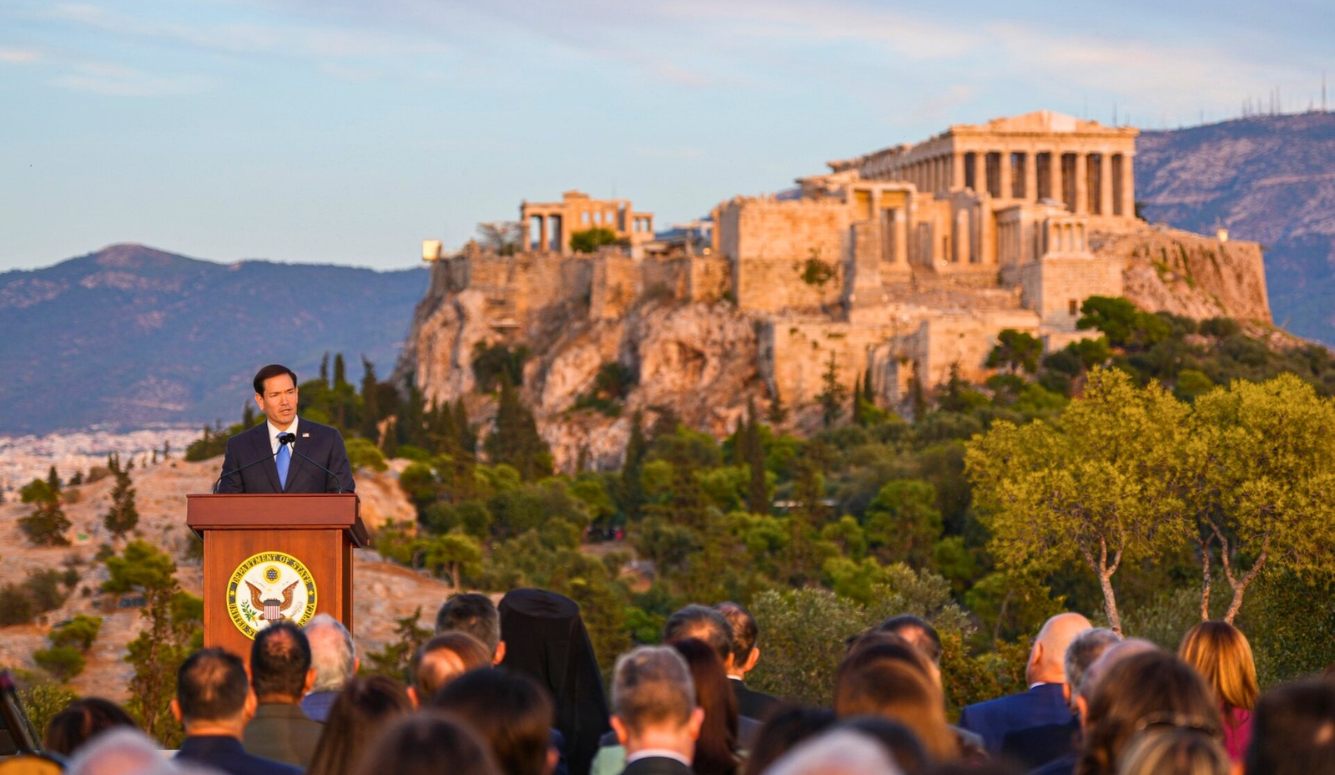
In ancient Greece, the Pnyx was a hillside in central Athens where citizens gathered to host their popular assemblies, making it one of the earliest and most important sites in the history of democracy. On 7 October, US secretary of state Marco Rubio extolled his own country’s virtues from that spot, enlisting the cradle of democracy to defend the great republican empire. In his remarks, Rubio said that of all the ancient civilisations, the Greeks of antiquity have a special claim in the Western imagination, exerting “an almost mystical hold on our memory.” He specifically addressed the “debt” that Westerners in general and Americans in particular owe to the philosophers and statesmen of ancient Athens, and of the society they built and sustained on the eastern edge of the Mediterranean.
For 25 centuries after Pericles, Rubio declared, “the Parthenon has stood” amid the larger bounty of ancient Athens, bearing witness to the empires that rose and fell in its shadow. “And the progeny of the men who built it—the sons of Athens and Rome—have carried their civilisation with them to the ends of the earth.” Rubio elaborated on the distinctive content of that civilisation. “Athens gave us democracy. Plato and Aristotle gave us Western philosophy. Our ideas of law, of virtue, of citizenship, and republican government were shaped in the Greek city-states. Even much of our political vocabulary—words like democracy, tyranny, the word ‘politics’ itself—found its origins here.”
Worthy as that record of political and philosophical achievement was, Rubio went on, the legacy of Greece runs deeper. The character of Greek civilisation was even more profound than those institutions and ideas, which were only “the outward expression of more fundamental qualities we see in the ancient Greeks.” The true greatness of Greece lay in “the essential traits that would come to define the West: fierce individuality and relentless ambition; daring exploration and invention; a yearning for discovery, for adventure, risk and glory. An insatiable curiosity about the world and the principles by which it operates, a hunger to know the mysteries of nature and grasp the secrets of the cosmos. An impatience with the notion of impossibility, chafing at all boundaries and limits, straining to peer into the depths of the unknown.”
Rubio’s paean to Hellenic virtues is hardly original. The American founders sang the praises of the Greek experiment, and President Kennedy liked to define happiness using the ancient Greek concept—eudaimonia, or “the full use of your powers along lines of excellence.” But Rubio deserves credit for singling out one virtue in particular: thymos (he transliterates it as thumos): “The thumos, as the ancient Greeks called it—the fire of passion, strength, courage, pride—is the heart of great civilisation.” It is this spiritedness that marks the true grandeur of the human spirit. In ancient Athens, it made “the pursuit of excellence … the very principle of man’s existence.”
It was this quality that “organised all of civic life around contest, ambition, competition: in philosophy and poetry, in sculpture and drama, in athletics and art, in war and statecraft. The classical Greek city was an arena for great men to test and prove themselves, to hone their potential through perpetual struggle—to be the best, the strongest, the most beautiful, straining to inch ever closer to perfection.” The result was that ancient Greek city-states were filled “with intense passion and rivalry and faction and conflict. But from that constant struggle for distinction … came the great flowering of art and philosophy and political and intellectual energy that would transform a collective of Mediterranean cities into the birthplace of the greatest civilisation in the world.”
On both sides of the Atlantic, there is a time-honoured custom (to which Rubio has lent his voice) of viewing Greece as the birthplace of the West, and of interpreting the history of the West as a more or less unbroken chain of events that began in the agora. This reading of the Western idea as a lineal progression “from Plato to NATO” remains popular, though it has not gone without challenge.
In his 1993 essay “The Clash of Civilizations?” Samuel P. Huntington argued that with the Cold War over, the future of geopolitics would be civilisational, with tribal and cultural rivalries replacing ideological conflict. According to this view, the United States anchored a lonely and embattled West that embodied the values of individualism, liberalism, constitutionalism, human rights, equality, liberty, the rule of law, democracy, free markets, and the separation of church and state. Huntington pointedly excluded Greece from this bloc, with its “Orthodox” identity only “lightly touched” by “the common experiences of European history”—the Renaissance, the Reformation, the Enlightenment, the French Revolution, the Industrial Revolution, and so on.
This kind of scepticism about a coherent “West” beginning in Greece has recently been echoed by the historian of political thought Georgios Varouxakis in his dense academic tome, The West. Varouxakis argues that this popular impression about the centrality of Greece in the story of the West owes less to historical reality than it does to a distinctly Anglo-American determination—beginning in the 19th century—to impart some metaphysical ballast to the Anglosphere. He would certainly view Rubio’s construal of Western history in that light.
Be that as it may, there is something to Rubio’s contention that the history of Greece does not merely offer us “a glimpse of our institutions in their earliest forms,” but also “an image of ourselves.” Even if there is not a seamless overlap of values and heritage in the social and political canopy enveloping Hellenic civilisation and its modern descendants, there are trace elements of classical antiquity across the Western world and embedded in the warp and woof of the American system. The influence of Greece can be found in the architecture of the American capital, as well as in the constitution that governs its affairs. Rubio stated that the most commonly cited author in the Federalist Papers is “not an Enlightenment philosopher or political theorist. No, the most commonly cited author in the Federalist Papers was Plutarch, the Greek biographer of Greece and Rome’s great men.”
The echo of Greece can also be discerned in the ambitions and historical vocation that America adopted at its inception and has thus far largely maintained. America’s particular combination of the pursuit of excellence and its primal yearning for greatness has manifested itself in diffuse ways over the centuries, but the demand for recognition has been a constant.
The concept of thymos invoked by Rubio is the part of the soul that craves recognition of dignity. As Francis Fukuyama pointed out in his 2018 book Identity: The Demand for Dignity and the Politics of Resentment, isothymia is the demand to be respected on an equal basis with other people; while megalothymia is the desire to be recognised as superior. The latter desire animated Athens and certain Greek city-states in its orbit as well as the United States today. As Fukuyama suggests, this quality “thrives on exceptionality: taking big risks, engaging in monumental struggles, seeking large effects, because all of these lead to recognition of oneself as superior to others.” There is something essentially and irreducibly Greek in this self-identity. As Rubio put it, “the Greek aspiration for new horizons became the American frontier spirit. The civilization of Athens and Rome transformed an infant seaboard republic into a continental empire.”
Keep reading
Rubio in Athens
How France Lost Control of Its Streets

How to Suppress Men’s Writing
Back to the Dark Ages

Prison or Peer Review