Europe
France’s Imaginary Austerity
France’s protesters are rioting against austerity that doesn’t exist. Macron might as well give them the real thing.
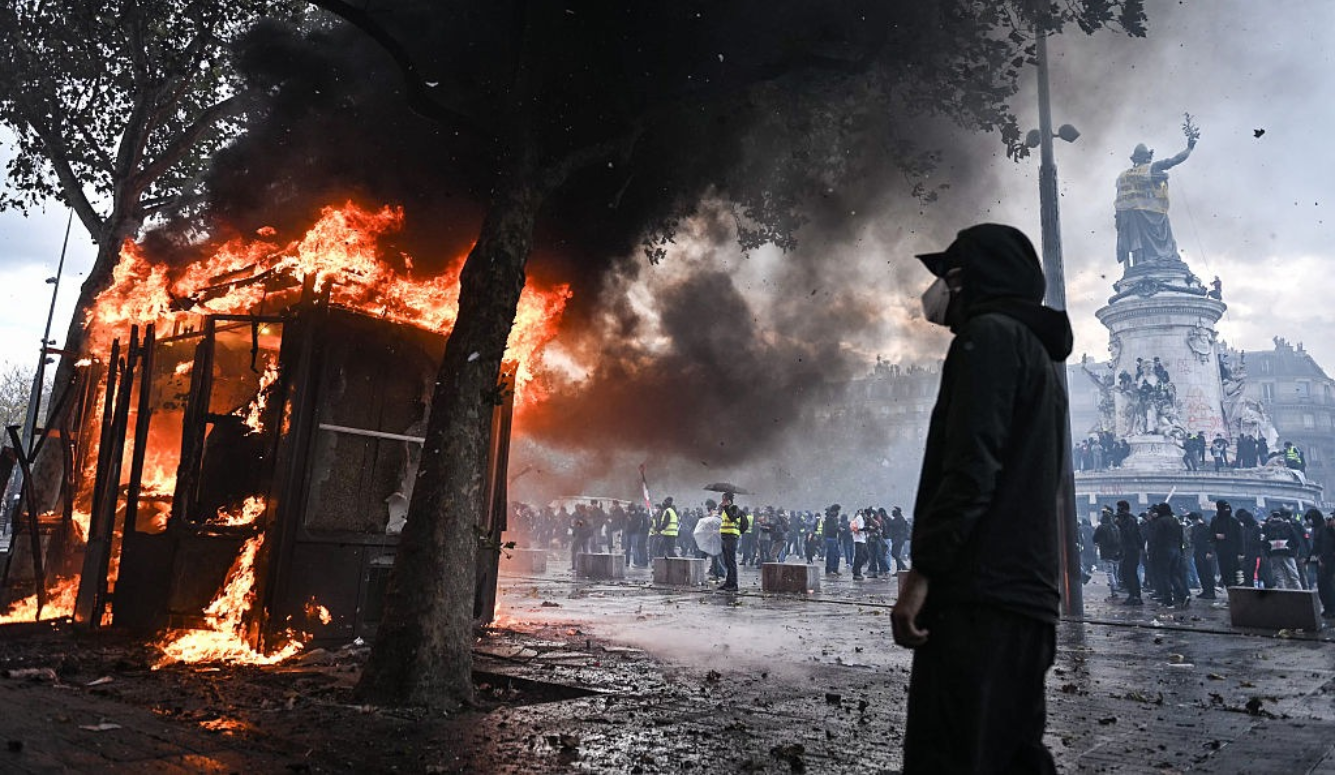

At the time of writing, the riots in France finally seem to be calming down (although I will refrain from making any predictions, because I’m sure they would age badly). They have caused hundreds of millions of euros in damage, and quelling them has required extreme measures, such as local curfews.
As so often when an event attracts widespread attention, observers indulge in confirmation bias, interpreting it as a vindication of whatever their worldview happens to be. If you lean towards the populist Right, you will zoom in on pictures showing a high concentration of people who appear to be second-generation immigrants, and blame the riots on immigration. If you are a more old-school conservative, you will blame nihilism and a loss of traditional values. If you are a centrist, you will zoom in on the most reasonable-sounding protesters, and see it as a campaign for better education that just got a bit out of hand. If you are on the Left, you will blame them on “neoliberalism” and “austerity.”
The last of these is probably the easiest case to make, because to the extent that the protesters themselves articulate any political beliefs, they seem to be mostly of the trendy anti-capitalist variety, so this is not just projection by the Anglosphere Left. The protesters also enjoy the enthusiastic endorsement of socialist presidential candidate Jean-Luc Mélenchon, so it is not unreasonable to assume that the same is true in reverse.
 Joel Kotkin
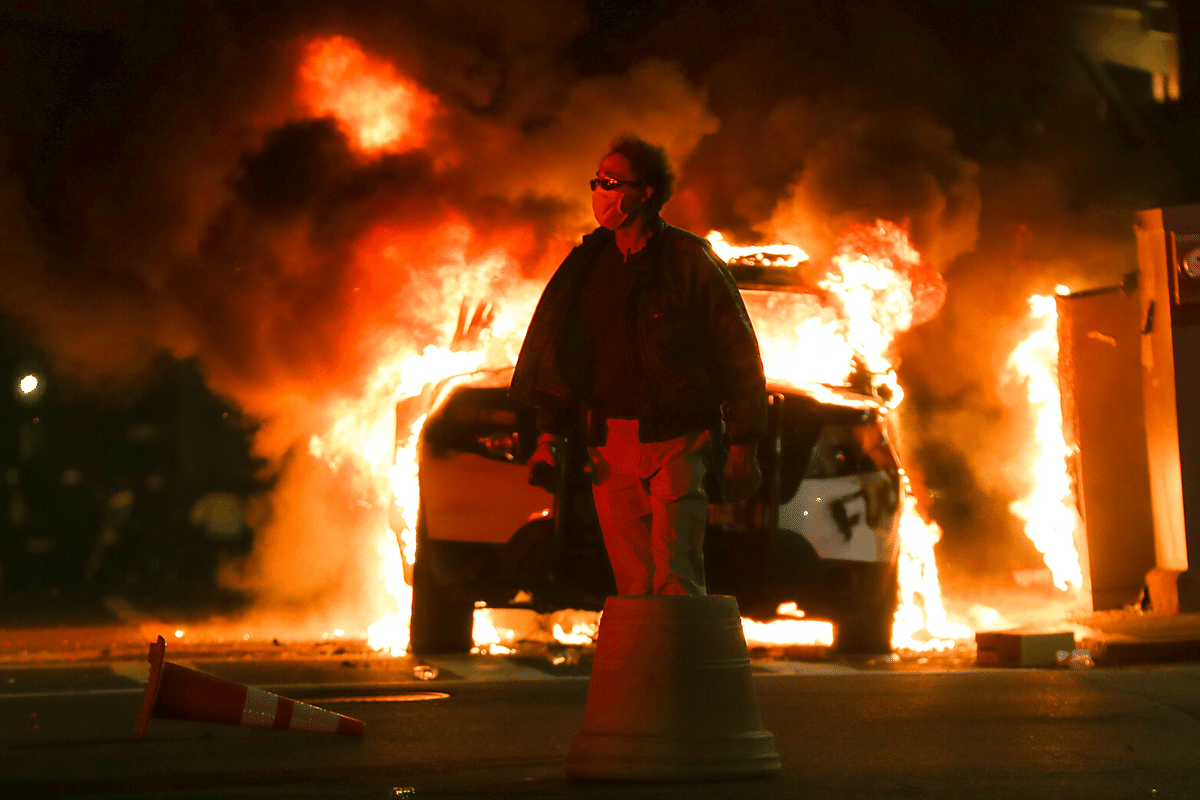
The fact that the protesters think they are taking a stand against “neoliberal austerity” does not mean that “neoliberal austerity” is truly the cause of the riots, though. France is practising a very strange kind of “neoliberal austerity” indeed. Government revenue in France (taxes, social security contributions etc.) currently stands at a little over 51 percent of GDP, and it has not been much lower than that since the early 1980s. Since a tax take worth more than half of France’s entire economic output is, apparently, still not enough, the French state has also been running persistent budget deficits—currently around 5 percent of GDP—for decades, which is why the national debt now stands at over 110 percent of GDP. Adding in all the borrowed money, total public spending rises to a staggering 57 percent of GDP. It has, again, not been much less than that since the early 1980s.
Given all this government largesse, I am almost tempted to write a spoof article arguing that the French protesters are really radical neoliberals who are clumsily trying to draw attention to the dysfunctions of Big Government.
Granted, the fact that government spending is very high overall does not mean that every public-sector institution in France is swimming in money. Aggregates do not capture the intergenerational distribution, and public spending in France is heavily skewed towards the elderly.
The French state spends close to 14 percent of GDP on pensions and old-age benefits, one of the highest levels in the world. It spends a further 10 percent of GDP on healthcare, which, although one can of course get sick at any age, shows a steep age gradient as well. Add in another 2.5 percent on social care, and it becomes quite clear where the priorities of the French state lie.
If we look at education spending in isolation, France is not in any way exceptional. The French state spends about 5 percent of GDP on education, almost exactly the same as the OECD average. French schools, in other words, benefit relatively less from all this government largesse than other sectors. In that sense, the first-wave protesters had a bit of a point, and in fairness to them, it is not their fault that the protests have quickly turned into mindless hooliganism. Protests are not political parties; they do not have written manifestos or mission statements, and they have no mechanism to expel people who do not align with their values. The thugs who burned down the Limoges town hall or the looters who helped themselves to some Louis Vuitton fashion accessories are quite clearly not education campaigners, but that does not mean that nobody involved in these protests is.
None of this means that French schools are “underfunded,” though. France’s education budget seems austere relative to France’s pension budget, but then, most things do: France’s pension budget is an extremely high bar. French schools are no more “underfunded” than Dutch, German, Austrian or British ones, and spending per pupil has actually increased slightly in real terms over the past ten years. Besides, anyone who thinks a larger education budget would have prevented these riots needs to explain why they spilled over so easily into neighbouring Belgium, where the education budget is already over 6 percent of GDP, one of the highest levels in the world.
There will always be disagreements about what the appropriate role and size of the state should be. These riots are not going to settle that question for us. What they do show, and what I believe even proponents of a very large state should acknowledge, is that demand for public spending is insatiable. In the English-speaking world, proponents of an enhanced role for the state often talk about a “properly funded health service,” “properly funded schools,” “properly funded social care,” “properly funded old-age pensions,” “properly funded social services,” and so on, as if there were some logical upper limit to how much can be spent on these areas, beyond which demands for further increases would go away. Yet even the French and the Belgians have not reached that limit. Because no such limit exists. However much a government spends, someone will always demand more. Someone will always say that some public service is “scandalously underfunded,” and denounce “crushing austerity.” This would still be true even under a President Mélenchon.
A lot of economic commentators believe that France is fundamentally unreformable, because the moment a government even hints at touching any entitlement programme, there will be mass strikes at best, and riots at worst. But my interpretation of the current riots is a rather different one. If I were in Emmanuel Macron’s position, my approach would be: if they are going to riot anyway—you might as well give the rioters something to riot about. If they are rioting about fictional cuts that never happened—give them some real cuts. If they are going to riot about imaginary austerity—give them some actual austerity. Right now, France has the riots that would accompany fiscal consolidation, but none of the benefits, because it is not actually doing any fiscal consolidation. So give the rioters the thing they think they are rioting against. What are they going to do about it? Riot?
The second largest trade union in France is calling for a general strike in November. We are broke and yields on French treasury bonds have been steadily rising for months, but they are demanding more spending across the board. I don't think we're going to make it to be honest. https://t.co/NROxXQX5Dq
— Philippe Lemoine (@phl43) October 21, 2026
I would start with some major, quick hikes to the retirement age—not just the official one, but the effective one as well, by abolishing early retirement schemes. The employment rate among French people in their early 60s is only 42 percent, and among people in their late 60s, it drops to a mere 11 percent. The equivalent figures for Australia are 60 percent and 34 percent. On average, French people spend about a quarter of a century in retirement.
Raising the retirement age is one of the most effective fiscal consolidation measures a government can pursue, because it simultaneously reduces public spending and increases public revenue. Every year by which you delay your exit from the labour market is an additional year during which you are a fiscal net contributor, and a year less during which you draw a pension.
Raising the effective retirement age could, quite quickly, mobilise a hitherto underused part of the labour force, and reduce spending on old-age benefits. This would lead to a noticeable drop in pension contributions, and I’d recycle a large part of those savings into building up a retirement savings scheme comparable to Australia’s superannuation funds. Private pension funds are almost unheard of in France. They exist, but the asset wealth they manage only amounts to about 13 percent of France’s GDP, whereas Australian superannuation funds manage assets worth more than 130 percent of Australia’s GDP.
In the longer run, this would lead to a less politicised retirement system. French pensioners depend almost entirely on the state, with no other notable sources of old-age income to fall back on. So it is no surprise that they take a more active interest in pension policy than Australians do.
France will never be a small-state economy. There will never be a Gallic Singapore or a Gallic Hong Kong. But what French reformers could realistically aim for is something that looks more like the market-friendly social democracy practised by their Nordic neighbours.
In Denmark and Sweden, the tax burden is in the same ballpark as in France, but unlike France, Denmark and Sweden are relatively business-friendly places in other ways. They score much more highly on measures such as the World Bank’s Ease of Doing Business ranking, on economic freedom indices or on indices of labour market flexibility. They can get away with a high tax burden, because they get many other things right. The Nordic countries can also borrow at sensationally cheap rates, because despite their high spending levels, their public finances are remarkably solid.
France is not a basket case: it gets some things right too. Counterintuitively, France is sometimes singled out positively by free-market YIMBYs in Britain, because the French do something which the supposedly “liberal” countries practising “Anglo-Saxon capitalism” do not really do any more: they build things. If you want to build houses, offices, infrastructure or power stations, you are far better off in France than in Britain, Australia or much of the US. That is the reason why the French economy is not actually doing all that badly, all things considered. In terms of real GDP per capita, the French are almost exactly in line with the EU-27 average and with the UK.
Their most immediate, pressing problem right now is that they need to get their public finances under control. They have reached the limit of how much tax revenue they can squeeze out of the productive economy, they have also reached the limits of how much they can borrow, and as long as they are inside the eurozone, they cannot inflate their debt away either. Something has to give. Whether the population is “prepared” to accept spending cuts is a moot question: there are no additional fiscal resources, and you cannot riot them into existence. The choice which France faces is between unsystematic, panicky cuts, and a credible fiscal consolidation plan which makes cuts in the least painful way and calms bond markets in the process. There will be further protests either way, and the reaction to a 1 percent spending cut will not be hugely different from the reaction to a 10 percent or a 20 percent spending cut. So never let a good riot go to waste.
Quillette invites thoughtful responses to its essays.
Selected responses are published once per week as part of a curated Letters to the Editor feature. If selected, letters appear under the contributor’s real name and may be edited for clarity and length.
To submit a letter for consideration, please email [email protected].
Keep reading
France’s Imaginary Austerity
A Clockwork Filmmaker


The Insight Trap

Cornell and Consent