Art & Culture
They Walked in Line
A look back at the heyday of cinema’s lurid Nazisploitation subgenre, from ‘Ilsa’ to ‘The Night Porter.’

I.
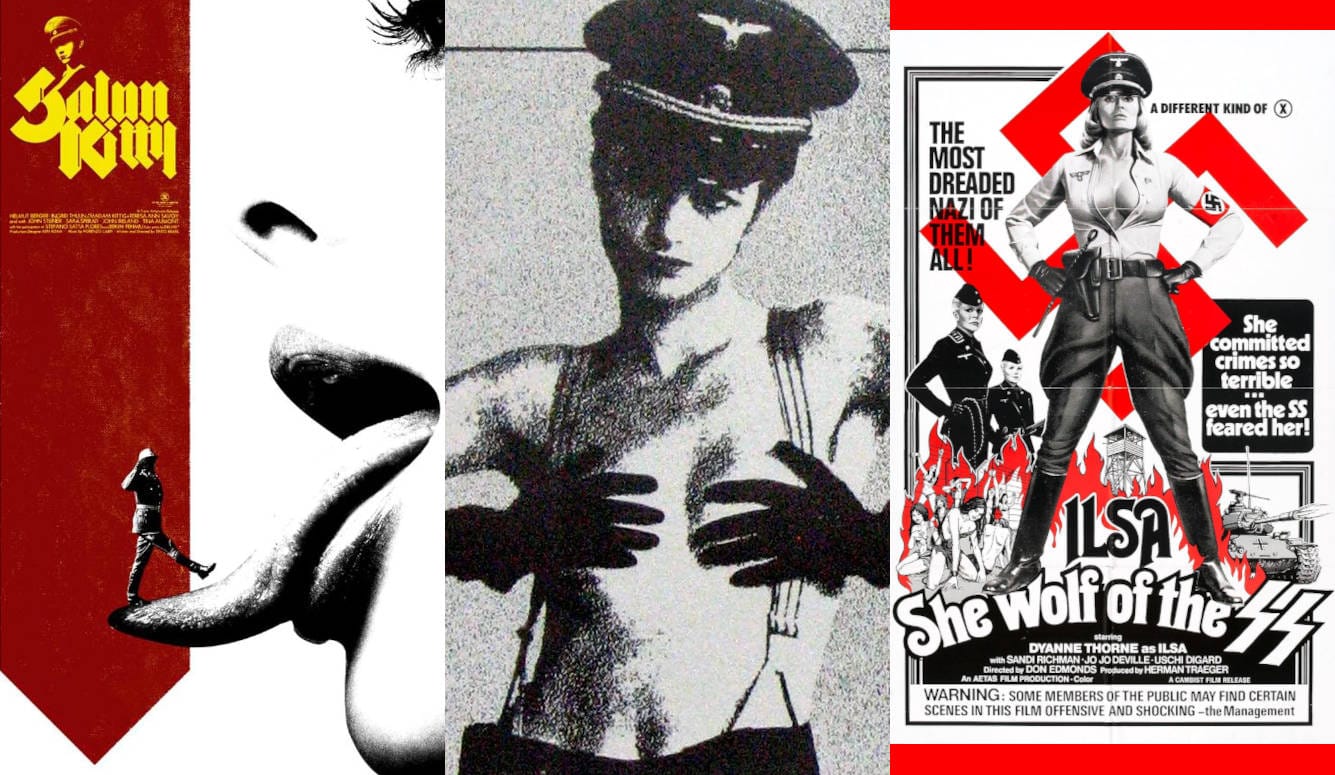
The 1970s saw the rise and fall of a peculiar subgenre of film that became known as “Nazisploitation”—an unusual and never-to-be-repeated mixture of SS atrocities and sex. Many of the movies made by American and Western European (mostly Italian) directors during this brief era were low-budget cheapies destined for urban grindhouses and the suburban drive-in circuit: SS Girls, SS Hell Camp, Gestapo’s Last Orgy (all 1977), and so on. But a smattering of big-name directors also tackled the theme, and the results occasionally acquired cult and even arthouse status. In 1976, Tinto Brass directed Salon Kitty, a seedy melodrama set in an SS-operated brothel in 1939 Berlin. Brass had acquired an avant-garde reputation with his 1970 film Dropout and his award-winning 1971 film La Vacanza, both of which starred Franco Nero and Vanessa Redgrave. Salò, or the 120 Days of Sodom, was the last film completed by Pier Paolo Pasolini before his murder in November 1975. While Salò was not about Nazis per se, it transposed the Marquis de Sade’s most infamous novel to the fascist puppet state established by the Germans during their occupation of Italy from 1943 to 1945.
But the crown jewel of arthouse Nazisploitation was Liliana Cavani’s bizarre 1974 film The Night Porter, starring Dirk Bogarde and Charlotte Rampling. During the early 1960s, Cavani had produced a series of television documentaries dealing with Nazi concentration camps and their victims. While she was making Women of the Resistance (1965), she interviewed a woman who had been a prisoner at Dachau as a teenager. This woman confided to Cavani that after the war she would spend her summer vacations at Dachau. “I asked her why she didn’t go to Hawaii or someplace instead,” Cavani told a New York Times reporter in 1974. “She couldn’t explain. It was the victim returning to the scene of the crime.” To dramatise this strange compulsion, Cavani turned the woman’s story into a twisted tale of erotic obsession involving Max (Bogarde), a sadistic SS functionary at a concentration camp, and Lucia (Rampling), a teenage inmate who becomes Max’s pet prisoner and the object of both his torment and his perverse version of love. After the war, the pair meet by chance and continue their sadomasochistic affair.
In the film’s most famous—and controversial—scene, Lucia dances before a room filled with SS officers while she sings a torch song by Friedrich Hollaender. Her hair is cropped short and she is decked out in Max’s SS peaked cap, over-the-elbow black gloves, and a pair of trousers held up by suspenders that caress her bare breasts. Hollaender was the composer of the music for Josef von Sternberg’s 1930 Marlene Dietrich vehicle, The Blue Angel, a film that had come to epitomise the decadent sexuality of the Weimar Republic. Max rewards Lucia for her performance with the severed head of a fellow inmate about whose unwanted attention she had complained. As Max points out, this is a reenactment of the New Testament story of John the Baptist, in which Salome asks for the prophet’s head on a platter as a reward for her dance. That single scene ignited a fire of “Nazi chic” in outrage-provoking dress and accoutrements among punks, goths, rock stars, clothing designers, and metal freaks in the 1970s and early 1980s. In 1982, British singer Siouxsie Sioux famously posed topless in an homage photo that added spiky leather bracelets and black fingernail polish.
Film critics at the time were not impressed, however. The Night Porter was mercilessly derided upon its release by nearly everyone who reviewed it. In the New York Times, Vincent Canby called it “romantic pornography”; in the Chicago Sun-Times, Roger Ebert described it as “a despicable attempt to titillate us by exploiting memories of persecution and suffering”; and in the New Yorker Pauline Kael remarked that the fact it had been directed by a woman simply demonstrated that “women can make junk just as well as men.” In 1992, Ohio State University professor Linda Mizejewski lumped The Night Porter in with a number of other self-described “antifascist productions” dealing with Nazi Germany that, she said, replicated the very “fascism” and “misogyny” they purportedly condemned.
Nevertheless, The Night Porter has accrued a cult following over the years, and this has been followed by a critical reappraisal of sorts. In an essay accompanying the film’s remastering for the Criterion Collection in 2014, Princeton professor Gaetana Marrone argued that “Lucia and Max show the fundamental face of Nazism, the cold exhibition of a rational violence perpetrated on the individual within controlled systems of power.” Certainly, the film’s defenders object to any attempt to bracket Cavani’s work, with its A-list stars and sophisticated cinematography, with the low-budget drive-in fodder that the word “Nazisploitation” usually conjures up. But the resemblance is inescapable.
Keep reading
They Walked in Line

Anti-Catholic Social Panics, Then and Now
A Dishonest (and Dangerous) Nobel Laureate

Common People
How Genetics Rewrote History