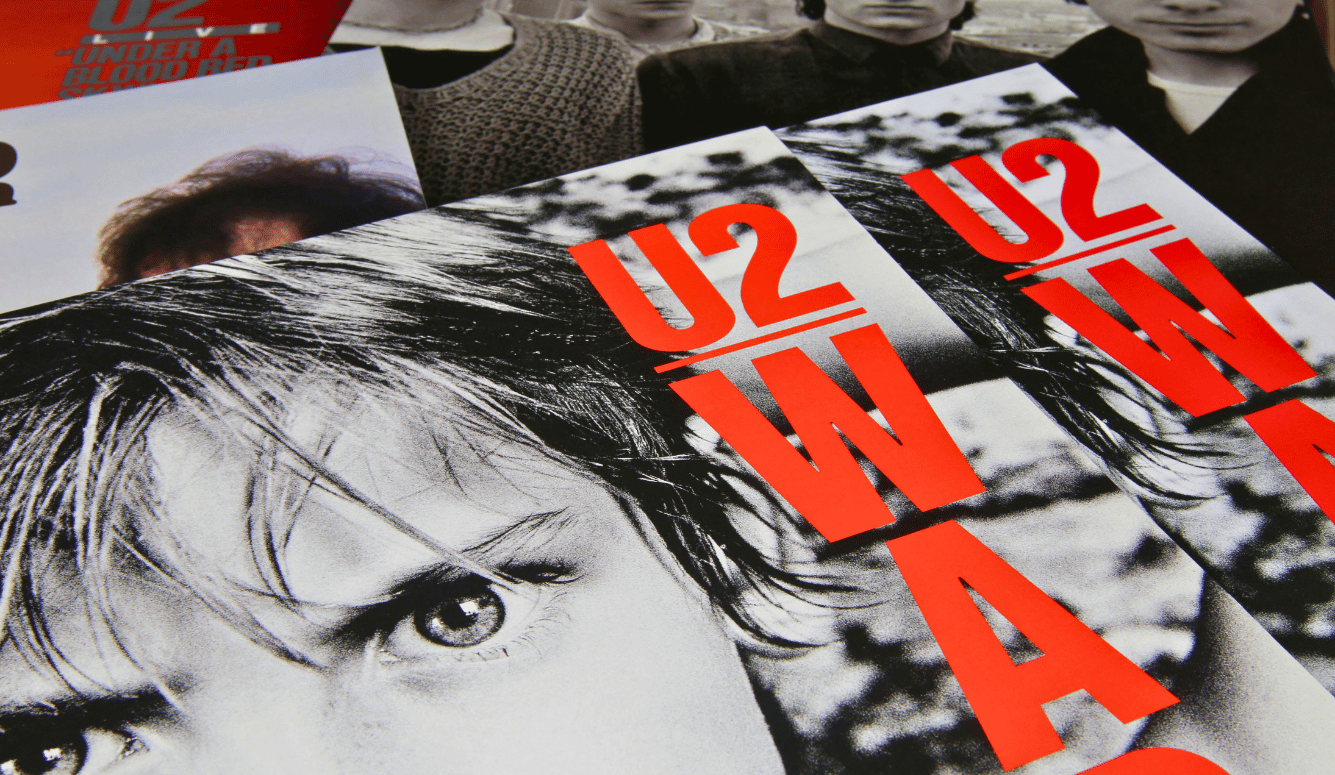

On a November afternoon in 2019, I was sitting at home when my phone pinged to announce the arrival of an email from one of the most famous musical figures of the past half-century. It’s not every day—or indeed any day—that U2’s frontman contacts me. But back in the late ’80s, when the Irish band arrived to play in New Zealand in the first flush of their global conquest, we had exchanged some words. And this, it turned out, was what he wanted to discuss.
In 1989, I was working as a staff writer at the Evening Post, a now-defunct New Zealand daily. I had been tasked with writing a feature about U2’s career to date, which was to run on the day of their big concert at the Athletic Park stadium in Wellington on 8 November 1989. Although my article had some kind things to say about the band here and there (their third LP, I wrote, “is a great album by almost anyone’s reckoning”), I was a young and opinionated music critic with a generally less-than-ecstatic view of U2’s place in the modern world. Their commercial breakthrough, The Joshua Tree, had appeared in 1987 and transformed an already popular act into something like a global weather event. It was followed the next year by Phil Joanou’s documentary Rattle and Hum and the phenomenally successful double album of the same name. I didn’t care for either record, or for the band’s lurch into American music. About The Joshua Tree, I wrote:
Like Van Morrison, and more recently The Pogues, his is an act taking a deep bow in the direction of the young, gifted, and black denizens of North America. But that’s not a good reason to buy the thing.
The Joshua Tree took its title from the spot in the Californian desert where Gram Parsons spent much of his short life zonked out at the local inn. This was close to where Anton Corbijn shot his iconic cover photo of U2 in Death Valley. The album also takes us into English and Canadian mining towns, Plaza de Mayo in Buenos Aires, and One Tree Hill in Auckland, New Zealand. Bono stands on a hill in El Salvador (or possibly Nicaragua), shaking his fist at US-manufactured jets overhead. A few minutes later, we’re off to Chile. Raves and record sales notwithstanding, The Joshua Tree looked less a musical statement to me than precocious travel writing with guitars. Even the catchiest stuff just seemed to noodle along—a few decent songs, but even those were almost always missing what I called the “tension-climax-resolve” rule of the best art.
My article evidently irked Bono. That evening, he read excerpts from the stage before 50,000 fans who joined him in derision. This left me with the dubious distinction of becoming the first (and possibly only) music writer to be written into a U2 show. He seemed to be particularly annoyed by the “tension-climax-resolve” line, and he used it to introduce a song that he said demonstrated that U2’s music most certainly did follow that songwriting rule.
In his 2019 email, Bono recalled using my old article “as a prop” during the tour, before arriving at the sentence that refused to behave like a footnote (the ellipses were in the original): “I can’t remember what I said... I’m sure it was meant to be funny, but wasn’t.… apologies.... Unlike your review, which was meant to be serious—and it was, even if snotty and youthful in its own way.” He followed this with a personal invitation to see the band’s latest (and last) Australasian show, a new performance of The Joshua Tree, in Auckland. “And you don’t have to like it this time around either for all its gospel brightness, it’s a black beauty.”
Revisiting U2’s music this month as the supergroup approaches its fiftieth anniversary, I’ve thought about that apology and my Evening Post feature. Had I, in all my snotty, youthful confidence, been talking through my hat? Perhaps what I once dismissed as their absurdity was inseparable from what has made them endure. And perhaps our dispute, ostensibly about songwriting, was actually about something else: the earnest feeling that U2’s early music expressed. But to unriddle that, it helps to go back before The Joshua Tree—before the stadiums and the sunglasses and the sermons and the serrated guitar solos—to the place the band first emerged, when Bono was just Paul Hewson.
U2 were an Irish band before they were an international brand: Dublin schoolboys brought together by a notice pinned to the bulletin board at Mount Temple Comprehensive by Larry Mullen Jr, a fourteen-year-old drummer in search of bandmates. Mullen, Hewson, bassist Adam Clayton, and guitarist Dave Evans (who would soon become The Edge) first met together in Mullen’s family kitchen in the northern suburb of Artane on 25 September, fifty years ago. Mullen and Hewson had both been born in Ireland, but Clayton had been born in Oxfordshire, and Evans was born in Essex to Welsh parents.
They called themselves Feedback, then the Hype, before settling on U2: a name vague enough to suggest a spy plane, a bad pun, or just something that might look good on a poster. They began rehearsing in their school’s music room and Evans’s garden shed before settling on a small cottage backed on to a graveyard. One of the first songs that eventually bloomed during this period was called “I Will Follow,” a catchy mix of ringing drones and yearning harmonics and Joy Division drumming. The song’s memorable mantra (if you walk away, walk away/I will follow) rounds off the effect nicely, even if the singer’s young bandmates had no idea what the songwriter was driving at. “The song is a suicide note,” Bono later explained in his memoir Surrender. “It’s about some kid who wants to find his mother, and even if she’s in the grave, he will follow her there.” Which is where she was; Iris Hewson had died unexpectedly in 1974 from a brain aneurysm while she was attending her own father’s funeral. Her son was just fourteen at the time. She was buried in the cemetery just a few yards from the cottage where the band rehearsed.
By the time of their debut, Boy, in 1980, Bono was telling music writers in London (rockcrits were a sparse commodity in the Irish capital in those days) that songs like “I Will Follow” certified U2 as “one of the great groups,” in the vibe of the Rolling Stones or the Beatles. “In some ways, probably more so than those other groups,” The Edge told me when I asked him about it once. He acknowledged that U2 still had some way to go commercially, “but there are four very strong identities within our band, each with their own importance. There are no structures within the group that eliminate any of the others from decision-making.” He added, “We stick together.”
That kind of unshakeable self-belief says plenty about the group’s durability, and about the missionary energy with which they went about selling themselves in the early years. Bono would later recall endless days spent “schlepping from indifferent promoter to baffled journalist” to deliver demo tapes in person. This was followed by nights playing sparsely attended shows where the fans barely outnumbered the band members. Some of the early reviews were brutal, too. Robert Christgau wrote this in the old Village Voice about their first album:
Their youth, their serious air, and their guitar sound are setting a small world on fire, and I fear the worst. No matter where they’re starting off—not as big as Zep, maybe, but not exactly on the grunge circuit either—their echoey vocals already teeter on the edge (in-joke) of grandiosity, so how are they going to sound by the time they reach the Garden? What kind of Christian idealists lift their best riff from PIL (or from anywhere at all)? As bubble-headed as the teen-telos lyrics at best. As dumb as Uriah Heep at worst.
What Christgau missed—and would go on missing through the release of October in 1981 and War in 1983—was that U2 were still just four truant teens learning in public just how large their smallness might be made to sound. Most New York punks were already well into their twenties before they entered a studio; many of their British counterparts had passed through art school first. U2, on the other hand, sounded as if they had just escaped detention. Mostly self-taught, they reached for atmosphere where other bands reached for technique. Their limitations were not incidental to the sound; they helped to produce it.
What took these high-school drop-outs into stranger territory was the arrival of Brian Eno and Daniel Lanois, who understood that those limitations could be made to sound like scale. Eno’s taste for “oblique strategies” and Lanois’s flair for texture gave the band a vocabulary of echo, delay, drift, suggestion. The alchemy worked well on The Unforgettable Fire in 1984, which even managed to impress Christgau. Those sessions in a book-lined library inside Ireland’s Slane Castle in County Meath were enough, he said, to “make a skeptic believe temporarily in miracles.”
But before U2 could turn atmosphere into empire, they had to outgrow their earnestness. In the early 1980s, Bono, Edge, and Mullen became involved with a Dublin Christian fellowship called Shalom, whose New Testament demands sat uneasily beside the grubby business of becoming rock stars. For a time, they wondered whether ambition itself might be a form of bad faith. This crisis was resolved, in suitably U2 fashion, by theology colliding with contract law: when they told their manager, Paul McGuinness, that they might have to dissolve the band, he is said to have asked with a burst of laughter whether the Lord really wanted his earthbound representatives to break a legal agreement.
 David Cohen
This is more than just a funny story. U2’s piety was part of the machinery: it anchored their sound and helped to explain why they annoyed some people so much. They wanted to succeed, certainly, but they also wanted their success to mean Something Important. This is why the music so often teetered between grandeur and grandiosity. They were not just four young men under the mercury lights by the River Liffey trying to become famous. They were trying to make fame answerable to conscience.
And they were trousering a good amount of dosh along the way. By the time of The Joshua Tree, the screen was expanding, and it would continue to do so as the 1990s opened: bigger choruses, bigger causes, bigger stages, bigger ticket sales. The old Dublin elements had not vanished; they had found a larger surface on which to project themselves. That new canvas was America, or at least a funhouse Irish version of America: bleached-out highways, low-lit bars, Graceland, the Deep South, civil-rights struggles, and the canyons of New York. The album did not so much discover America as turn it into a vast moral backdrop, roomy enough for yearning, grief, geopolitics, and a lot of guitar delay. Sometimes the canvas wobbled, just as Ireland can wobble in the hands of Stateside artists trying to apprehend it. Even the hit single “Pride” managed to misplace Martin Luther King Jr’s assassination from evening to “early morning, April 4.”
The band’s 1991 follow-up, Achtung Baby, which reunited the band with Lanois, offered an escape hatch. Having made themselves ridiculous by taking America too seriously, U2 survived the 1990s by making the ridiculousness deliberate. Instead of being sinners trying to sound like saints, they would be saints trying even harder to sound like sinners. “The right to be irresponsible and stupid is something I hold very dear,” Bono later explained. “And luckily it is something I do well.” The Zoo TV tour turned that permission into a method. The prophet became a fraud, the sermon acquired static, and the old grandiosity survived by putting quotation marks around itself.
Now and then, the joke even worked, as in 1995, when Bono was being driven through Tokyo and began to speak about a dog he’d never owned:
The strangest thing has happened. I really missed my dog. That’s never happened to me before. You know, on a long tour you do hear people saying they miss their pets. I never have. But last night I started really missing my dog. It’s very odd, ’cause I don’t have a dog.
This schtick worked until it didn’t. Eventually the old homilies returned in the 21st century, without quite the old authority. By this point, alas, Bono’s public role as a political campaigner and self-styled ambassador for debt relief had begun to grate, even on those broadly sympathetic to his favoured causes. Then came the tax arrangements, the corporate tie-ins, the compulsory Apple album that dropped into everyone’s damn devices like a humanitarian intervention nobody had requested. The growing suspicion was that U2’s oldest artistic flaw was finally overtaking their gift...
That, at any rate, is the naysayers’ case, and it is not a shabby one. But it still doesn’t explain why U2 remain so hard to ignore. In 2026, they remain one of the world’s highest-grossing live acts. Beneath the sermon, when the tunes work, there is something else. One of the best cases for the musical defence—preceded by a little throat-clearing about the couple of items he found unfit for purpose—was made in 2011 by Eric Hynes, who wrote this for Slate:
The problem is how ultimately these records lack everything that makes rock roll, that makes pop crackle, that makes soul. It’s not about coolness—it’s about desire. I can’t get no, you can’t always get, I can’t quit you, I put a spell on you, I still haven’t found, please, please me, why don’t we do it, wouldn’t it be nice, I saw her standing, how could you just leave me standing, burning, desire. At its best, U2 doesn’t merely satisfy our desires, but takes us somewhere, marching into the shadows, exploring spaces within and without, risking failure and greatness, and giving us something worth confessing in the end.
This is the part of the case that I now find most difficult to dismiss. Hynes is certainly right that U2 were probably not at their best when judged album by album. Their power usually came song by song, including from some that I underpriced the first time around or later heard differently in the acoustic and piano-led arrangements collected on Songs of Surrender, the anthology that coincided with Bono’s autobiography.
Listen. Songs like “One” make the point: a soft anthem of regret over the painful end of a failed affair (later given a sepulchral second life by Johnny Cash). “Beautiful Day” might be another. It starts out like something the Eagles might have written before lifting into a giddy vocal workout over a bombastic hook and a nicely echoed guitar. The old impulse still flickers in recent work, including this year’s six-track EP Days of Ash, whose “Wildpeace” sets a spoken tribute to the Israeli poet Yehuda Amichai to music, recited by the Nigerian broadcaster Adeola Fayehun. This last example was also a ballsy gesture at a time when much of the entertainment business has grown skittish about making humane overtures towards anything involving Israel.
Returning to their work now, I find that The Unforgettable Fire, which I disliked in 1989, has grown on me. War, on the other hand, which I had praised, I now find hard to listen to. And yes, perhaps I did overlook a few of the tracks on The Joshua Tree the first time. One of my sons certainly thinks so, and who wants to argue with one’s son? Or, for that matter, with Bono when he writes a generous and unexpected message to make amends for his earlier frivolity at my expense. I couldn’t make it to Auckland that night—every flight to New Zealand’s largest city was full (of U2 fans, presumably). But I wrote and thanked him all the same, and I mentioned that one of my kids loved his band’s music—particularly the songs on The Joshua Tree.
A couple of days later another email pinged into my phone from the same source. This one came with an attached clip from the Auckland performance I had been unable to attend. The song was “I Still Haven’t Found What I’m Looking For,” one of the group’s great hymns, and one I did not care for at all at the time of its release. Watching it again after thirty years, though, I heard more space in it than I remembered. The rhythm section seemed to hang a little longer; with Evans no longer cascading quite so heavily on guitar, there was room to hear the song breathe. There is a fine bridge in the middle, too, while Anton Corbijn’s commissioned Death Valley footage did its stark work across a 200-foot screen.
So: was I wrong then, or am I wrong now, as we mark U2’s fiftieth? Or is this the kind of question that only idiot critics imagine still matters? Towards the end, as the group played under New Zealand’s marquee moon, Bono offered a shoutout to my son by name. The critic in me still remembered some of the old objections, but the old man heard something else.
Quillette invites thoughtful responses to its essays.
Selected responses are published once per week as part of a curated Letters to the Editor feature. If selected, letters appear under the contributor’s real name and may be edited for clarity and length.
To submit a letter for consideration, please email [email protected].
Keep reading
How to Suppress Men’s Writing
Back to the Dark Ages

Prison or Peer Review

France’s Imaginary Austerity

The Limits of Perfectionism