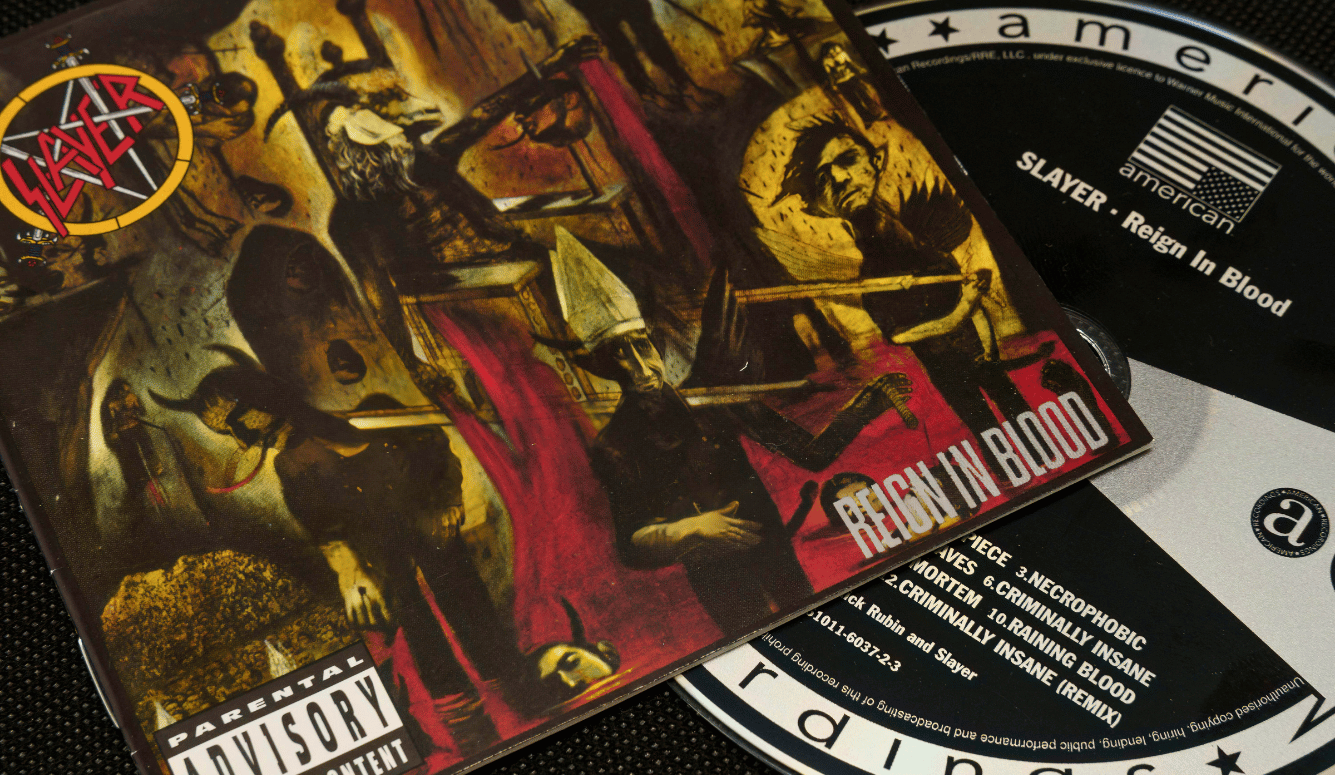

In January 1986, four skinny, long-haired twenty-somethings from Huntington Park, California, walked into a recording studio in Los Angeles. Three weeks later, they emerged with Reign in Blood—a 28-minute and 55-second sonic blitzkrieg that became an instant thrash-metal classic. This wasn’t just another metal album. It was an assault that redefined just how fast and just how uncompromising music could be. If John Coltrane pioneered sheets of sound, Slayer fired sheets of shrapnel from the opening bars of “Angel of Death.” There is no atmospheric intro, no fade-in, and no warning—just a surgically precise cymbal and guitar punch before vocalist Tom Araya releases his battle cry.
Reign in Blood hasn’t aged a bit since its release on 7 October forty years ago—it still feels just as exciting, dangerous, and terrifying today as it did then. I was thirteen years old that year, and I had spent the previous week haunting Soundclash Records waiting for the copies to arrive. As part of the last generation to understand this kind of deferred gratification, I felt those seven days crawl by like torture. By day five, the guy behind the counter was calling out, “Not yet, Noel,” before my foot even crossed the threshold.
When the album finally arrived, I ran all the way home, hurtled upstairs, and locked the bedroom door. And when I dropped the needle, those ten tracks felt like getting thrown headfirst into a particle accelerator. I was already familiar with American hardcore bands like D.R.I., Bad Brains, and Minor Threat, so I was used to high-velocity guitar music. But Reign in Blood was something else entirely. When the thunderstorm sample faded out at the end of “Raining Blood,” I immediately flipped it over and played it again. And then again. Then I copied it to an old cassette so that I had a portable copy. The album’s brevity meant a TDK D-90 could accommodate the entire album three times over.
That first vinyl copy survived about a week. Slamming and moshing around my bedroom caused the needle to jump and skid across the platter, leaving a deep scratch all the way to the run-out groove. My second copy lasted a decade and became the soundtrack to my awkward, testosterone-fuelled teenage years, but eventually the vinyl slipped from its jacket, landed edge-first and chipped the run-in groove. I’m now on to my third LP and a compact disc that I’ve played so often it spins around the spindle hole.
Keep reading
Robert Lynch on Status, Humour and the Apes We Pretend Not to Be | Quillette Cetera Episode 74

The Radicalisation of Tucker Carlson

A Pop Fiction Master and Monster
Australia’s Coming Censorship Machine

Anatomy of a Book Promotion