Art & Culture
L’Affaire Shirer Revisited
The rise, fall, and rise again of one of the 20th century’s most important journalists.
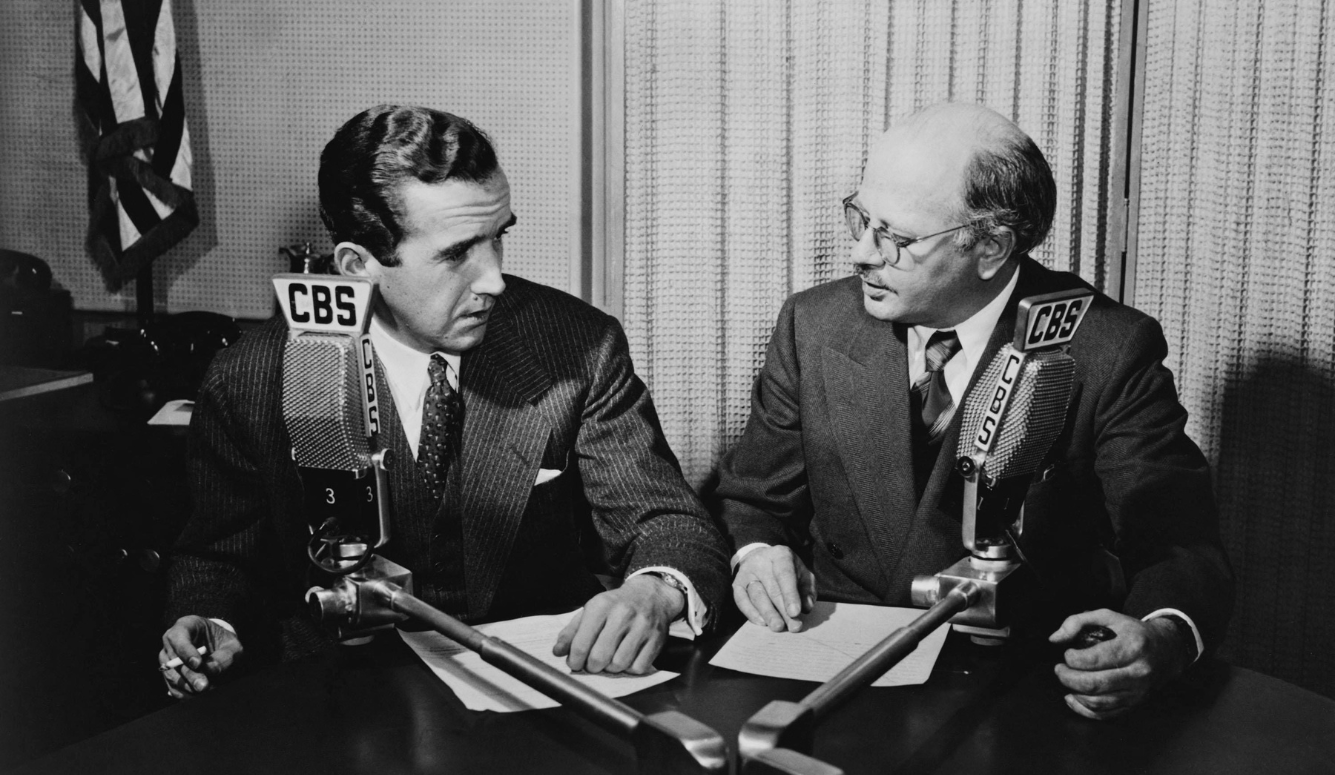

(Former) 60 Minutes correspondent Scott Pelley is not the first high-profile CBS newsman ejected from the airwaves for mouthing off to his superiors. In 1947, William L. Shirer, the pioneering broadcast journalist who covered the rise and fall of the Third Reich for CBS Radio, was deemed an inessential employee after balking at a time-slot demotion and venting his gripes on air. Like the Pelley termination, the ousting of Shirer was not treated as an internal personnel matter but interpreted as an event of singular media-cultural significance. At the dawn of the Cold War, “l’affaire Shirer” (as it was known) was an occasion to ponder a journalist’s right to have an opinion and a network’s responsibility to air it.
Like Pelley, Shirer was one of the most prominent faces—or rather voices—working at CBS News. Born in Chicago in 1904 and raised in Cedar Rapids, he graduated from Coe College in 1925. Immediately fleeing what he called “Prohibition, fundamentalism, puritanism, and Coolidgeism,” Shirer lit out for Paris, the promised land for disaffected ex-pats with a literary bent, where he landed a job as copy editor for the Paris branch of the Chicago Tribune. His first global scoop came when, unlike his clueless editor, he sensed that a daring young American pilot flying from New York to Paris would not disappear over the Atlantic. On the evening of 21 May 1927, he set out for Le Bourget Field in his car. Forced to abandon the vehicle in a traffic jam, he then hoofed it to the airport. The Spirit of St Louis taxied to a stop right in front of him.
Shirer spent the next seven years as a roving correspondent. He may have looked like a small-town shopkeeper—balding, bespectacled, stout—but his appearance belied a bulldog tenacity, courage under fire, and a knack for being in the right place at the right time. He survived malaria and dysentery in India and Afghanistan; befriended Gandhi; and lost an eye skiing in the Alps. In 1934, he accepted a post in Berlin as a representative of William Randolph Hearst’s Universal News Service. While reporting on the 1936 Berlin Olympics, he had his first run-in with Nazi propaganda minister Joseph Goebbels, who condemned Shirer—by name—for exposing how the Nazis were (temporarily) removing antisemitic signage so as not to upset the tourists.
When the Hearst outfit folded, Shirer was tossed a lifeline by Edward R. Murrow, chief European representative for CBS radio, already the romantic personification of the dashing broadcast journalist. In October 1937, Murrow appointed Shirer central European representative for CBS. He was one of the first “Murrow’s boys,” the fraternity that would dominate CBS News until the end of the 20th century. And despite recurrent bouts of “mike fright,” he thrived in radio news. His arrival on air coincided with a technological marvel—the development of reliable transatlantic shortwave transmissions. The sonic atmospherics of Nazism were beamed right into American living rooms, loud and clear—Hitler’s high-decibel harangues, the clomp-clomp-clomp of goose-steps on cobblestone, and the roar of rapturous crowds bellowing “Heil Hitler!” and singing the Nazi Party’s anthem.
The legend of Edward R. Murrow—patron saint of broadcasting journalism, television star—has so overshadowed every other radio newsman covering Nazism in the 1930s that pioneers like Shirer tend to get short shrift. Yet Shirer (and his rival at NBC, Max Jordan) were just as intrepid and influential. They reported on Hitler’s speeches to the Reichstag (and translated on the spot), and they tracked the course of a continent hurtling towards war: the annexation of Austria, the Munich Pact, the dismemberment of Czechoslovakia, and the invasion of Poland. All of Shirer’s radio reports from Berlin had to be vetted by Nazi censors and he anguished over the compromises necessary to get anything on the air. At what point did submitting his radio copy to Nazi censorship override the importance of CBS having a reporter on the scene?
Shirer remained in Nazi Germany until December 1940, by which time wartime Nazi censorship had made his job impossible, but before leaving, he was on site for one last surreal scoop. On 22 June 1940, Shirer (for CBS) and William C. Kerker (for NBC) broadcast the capitulation of France to Germany, live from the forest at Compiègne. The Nazis wanted the signing of the armistice to be as humiliating as possible, so they insisted that it be held in the very railway car where, 22 years before, the Germans had signed the armistice that ended World War I. “Here was one instance where the microphone eavesdropped on history in the making,” remarked radio critic Ben Gross in the New York Daily News on 23 June 1940. In a steady, matter-of-fact voice, Shirer described the scene: “We are standing now about 35 yards from that historic railroad car. ... At 6:50 o’clock the gentlemen in the car started affixing their signatures. ... It was all over in a few minutes.” He ended his report with a word picture that defined the art of radio journalism:
The skies were slightly overcast. A mile down the road you could see French refugees slowly, tiredly, filing by. ... They did not know that an armistice had been signed and that the fighting would probably be over soon. But judging by their tragic weary half-starved faces, they wanted it to be.
In 1941, back stateside, Shirer published Berlin Diary, an eyewitness account that revealed the behind-the-microphone stories that could not be told over the airwaves controlled by Joseph Goebbels. Shirer was “one of the men who made radio history,” wrote Lewis Gannett in the New York Herald Tribune in June 1941. “You can read his book as an inside story of the death of Europe—as good a one as has been written—or as the insider story of the rise of radio as a serious factor in international news coverage.”
For most of World War II, Shirer remained on the home front as a news commentator for CBS, but he returned to Europe in May 1943 to cover the Eighth Air Force, and in October 1944 to cover the final push to Berlin, his old beat. In 1945, he was in the courtroom for the Nuremberg Trials, to which he could have been called as a witness to testify against defendants he knew. He emerged from WWII as one of the most respected news analysts on radio. He retained his “war news” slot on CBS on Sundays from 5:45 to 6:00 pm, a show he had helmed since 1941, and transitioned smoothly from reporting the hot war against the Nazis to the cold war against the Soviets. He had solid ratings and his sponsor, the soap manufacturer J.B. Williams Company, seemed to be happy with the five million listeners he introduced to Glider shaving cream, “the new-type, ‘no-brush’ shaving cream.”
In addition to reporting the news, Shirer used his forum to express his opinion on the controversial issues of the emergent Cold War. Usually, he operated within a zone of consensus within the forty-yard lines of American opinion—criticising the end of the wartime Office of Price Administration or defending David E. Lilienthal’s appointment to the Atomic Energy Commission. However, he also ventured into more treacherous ideological terrain by speaking out against the Truman Doctrine, which committed the US to providing economic and military aid to any democratic nation fighting communism. He decried Truman’s Executive Order 9835, which mandated anti-communist loyalty oaths for federal employees, a practice that soon spread to civilian employers, including the broadcasters at CBS.
Keep reading
Prison or Peer Review

France’s Imaginary Austerity

A Clockwork Filmmaker

The Insight Trap