Art & Culture
Dangerous Liaisons and the #MeToo Wars
Nearly 250 years on, Laclos’s novel of seduction and treachery continues to scandalise.

On 6 June, a play that has been decried as too “toxic” and “problematic” for the age of #MeToo ended an acclaimed, sold-out run at London’s National Theatre. A filmed version of the production also began screening in cinemas across the United Kingdom, the United States, Australia, and other countries from 25 June. The play is Christopher Hampton’s Les Liaisons Dangereuses, the (now-updated) 1985 adaptation of Pierre-Ambroise Choderlos de Laclos’s eponymous 1782 novel.
The book has also been denounced plenty of times since it first appeared—back then, it was described with words like “execrable” or “infamous.” Its authorship reportedly got Laclos, an artillery officer with a literary hobby, blacklisted from some respectable homes. But it has also been hailed as a masterpiece and remained a topic of heated debates: is it immoral or moral? Depraved or romantic? Feminist or misogynistic? The new stage play, which is far less rich in ambiguity and nuance than the novel, still has enough of both to intrigue and offend, scandalise and seduce. And its sexual politics are still challenging.
I.
Libertine literature flourished in 18th-century France, but Les Liaisons Dangereuses still managed to shock contemporaries with its dark tale of seduction and treachery and its appalling yet magnetic antiheroes, the vicomte de Valmont and the marquise de Merteuil, whose correspondence is the core of the epistolary novel.
The very first letter in that correspondence—the second one in the book—plunges the reader into a depravity made all the more disturbing by the witty and playful flair with which it is written. Merteuil wants Valmont, her ex-lover, friend, and secret partner in sexual intrigue, to seduce her fifteen-year-old cousin, the convent-educated Cécile de Volanges. Cécile is now engaged to a man with whom the marquise has a score to settle: he once left her for another woman. Since the man hopes to escape “the inevitable fate” of cuckoldry by choosing his bride wisely, Merteuil thinks it would be hilarious to cuckold him in advance and make it “the talk of Paris” after the wedding.
Valmont, vacationing at his elderly aunt’s country château, balks at the assignment because it seems too easy, and he’s after far better game: the famously virtuous and pious Madame de Tourvel, who is staying at the same château while her magistrate husband presides over a conveniently lengthy trial. Merteuil, who regards Tourvel as a dull and frumpy prude, scoffs at the idea; but when the vicomte won’t give up his project, she deftly hijacks it. A virtuoso account of her night of pleasure with her latest lover piques Valmont’s jealousy and ego enough to goad him into soliciting the marquise’s renewed favours—which she offers as a “prize” for success with Tourvel. (The bonus, she points out, is that the start of the vicomte’s new love affair will thus set up his first infidelity—just the sort of extra spice the libertine pair relishes.)
While Valmont pursues his “devout beauty” by posing as a rake awakened to love and goodness while quietly doing dastardly things like bribing and blackmailing her maid into helping him get his hands on Tourvel’s mail, Merteuil develops an alternate plan to relieve Cécile of her virginity by encouraging her secret romance with the 20-year-old Chevalier Danceny. Then, things take an even darker turn: Valmont, serving as a go-between for the young lovers after Cécile’s mother takes her to the same château, decides to claim the girl as his own trophy after all—both for his own revenge against the mother, who has set him back by warning Tourvel against him, and to impress the marquise. Soon, he sends her a victory report, written in his usual flippant and mischievous tone; but the “victory” is somewhere between manipulative coercion and outright rape.
Tourvel’s undoing comes next, despite her attempt to vanquish her feelings for the vicomte by fleeing to Paris; the complication is that it also becomes Valmont’s undoing, as Tourvel’s passionate surrender leaves him in thrall to an “unfamiliar enchantment.” Still, he strenuously denies that he’s in love—a shameful weakness in the libertine philosophy he and Merteuil profess—and the marquise easily plays on his vanity to get him to send Tourvel a vicious breakup letter of her own composition. The tensions between the two libertines erupt into war, and things end very badly for all, with Valmont and Tourvel dead, Cécile in a convent, and Merteuil exposed and effectively unpersoned.
The scandalous reputation of Les Liaisons Dangereuses at the time of publication probably derived less from its sexual content—it is far less explicit than other mainstream 18th-century works such as Diderot’s Orientalist erotic novel Indiscreet Jewels—than from its unsettling combination of sex and dark psychological drama in a modern and realistic setting. Laclos’s novel sometimes reads like drawing-room comedy or boudoir farce (at one point, during an overnight stay at an unnamed comtesse’s château on his way to his aunt’s estate, Valmont coaxes a former mistress to his bed across the hallway from her jealous husband and her clueless current lover, then stages a clever rescue when she locks herself out of her bedroom). But turn the page, and we find oneself in an elegant hellscape of seductive evil, impressed in spite of ourselves by the fiendishly clever schemes of the two protagonists, who regard their human playthings as lesser mortals. Turn the page again, and those same protagonists reveal a human and even sympathetic side. What’s more, while Laclos’s diabolical duo is ostensibly condemned and finally punished, a number of critics have felt that the libertines’ transgressive charisma vastly eclipses the condemnation and that the belated wages of sin pale next to its allure.
The book is also daring in its treatment of female sexuality. There were plenty of pleasure-loving women in 18th-century literature—but none like Merteuil, who clearly calls the shots in her partnership with Valmont and in her relations with other men, fiercely defends her sexual autonomy, and takes pride in being a self-made woman (“I could say that I am my own creation,” she writes to Valmont). Even the “pious prude” Tourvel finds not only exalted romantic love but intense sensual fulfilment in her doomed affair with Valmont—while Cécile quickly discovers, after some nudging from Merteuil, that she can easily love one man and enjoy sex with another.
With a turn towards more censorious mores, the notoriety of Les Liaisons Dangereuses made it the target of official bans, on grounds of “public morality,” in France and in a number of other countries for much of the 19th century. While the novel’s admirers included literary giants like Byron, Stendhal, and Baudelaire, the tastemakers of the era, such as the eminent critic Charles-Augustin Sainte-Beuve, tended to dismiss it as tawdry at best, “perverse and poisonous” at worst. The “immoral novel” label clung to it for a long time (sometimes bestowed by immoralists like the great diplomat Charles-Maurice de Talleyrand, who was easily its antiheroes’ match in both sex and scheming). That changed in the 20th century, as moral and sexual taboos crumbled and modernism challenged literary norms. For cultural rebels like André Gide, the “sulphurous” reputation of Liaisons was a plus: when Gide wrote in his preface to a 1940 English-language edition that Laclos’s novel was written “hand in hand with Satan,” it was clearly meant as a compliment.
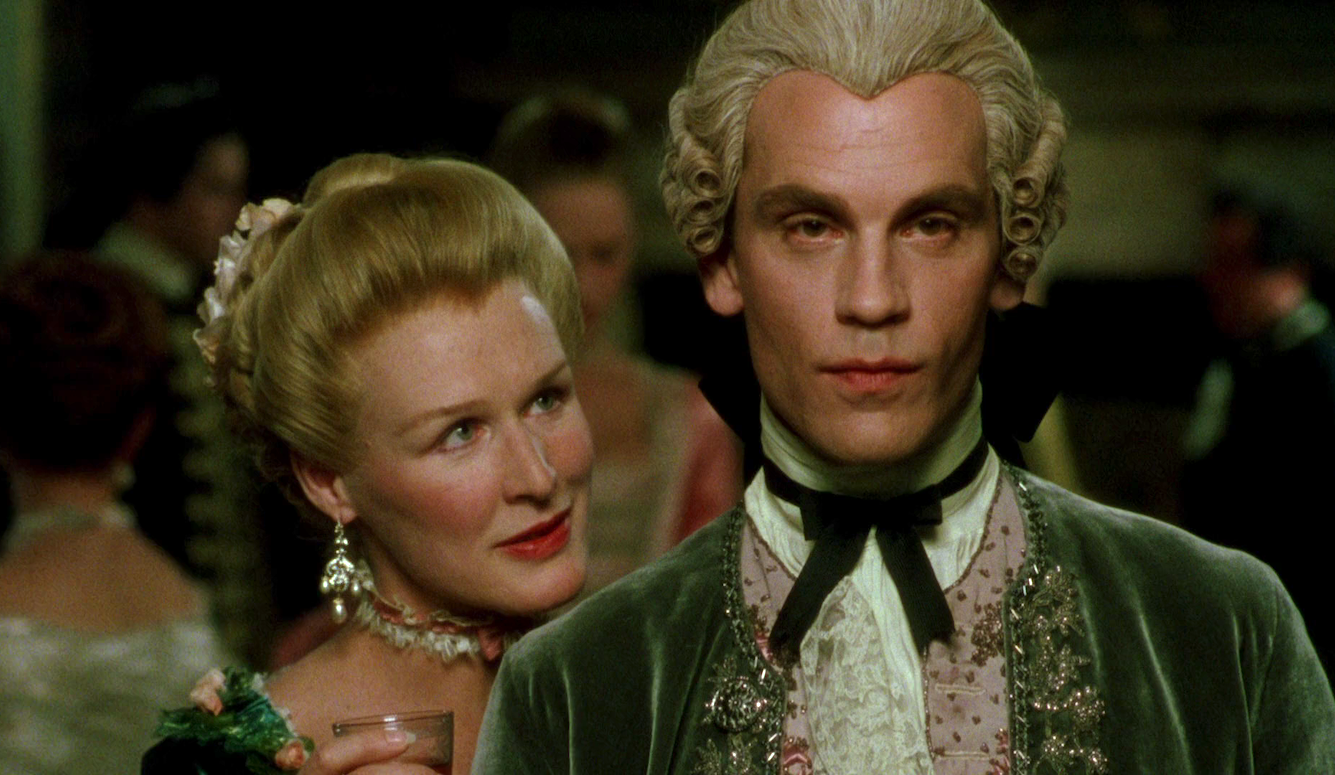
By the mid-20th century, Les Liaisons Dangereuses was firmly established as one of the great European classics—recognised, among other things, as a pioneering and superb psychological novel. Towards the century’s end, its international stature was further enhanced by the Hampton play (whose premiere in London and New York featured the late Alan Rickman as Valmont) and especially the Hampton-scripted 1988 Stephen Frears film with John Malkovich as Valmont, Glenn Close as Merteuil, and Michelle Pfeiffer as Tourvel. More adaptations followed, including Chinese and Korean period films, an opera, and the 1999 teen romantic drama Cruel Intentions, which reimagined the plot’s machinations at a contemporary posh private high school in Manhattan.
Yet in the 2010s, amid resurgent feminism with a strong focus on women’s sexual victimisation by men, Liaisons clashed with a new set of moral strictures—as evidenced by attempts to grapple with its adaptation. In 1987, reviewing the Hampton play’s Broadway debut in the New York Times, Frank Rich noted the uneasy mix of humour and horror and called it a “compelling [but] thoroughly nasty evening.” But that was not seen as an obstacle to success. Nearly thirty years later, when the play’s 2015 London revival came to New York shortly before the 2016 presidential election, director Josie Rourke felt that its tepid reception was coloured by Donald Trump’s then-fresh sexual harassment scandals. Two years later, a staging in Dallas, Texas, received a scolding from a Dallas Morning News theatre critic who complained that it was a “tone-deaf play to perform during the #MeToo era.” And last year’s Liaisons production at the Stratford Theatre festival in Toronto elicited a flurry of rhetoric in the local press about #MeToo, “rape culture” and Jeffrey Epstein. Some reviewers wondered whether the play was still fit for the stage at all.
There have also been attempts to reframe the source material from a #MeToo perspective. A 2021 radio play for the BBC’s Radio 4, scripted by Sian Ejiwunmi-Le Berre, tried to deconstruct a supposed heroic mythos around Valmont—whom Ejiwunmi-Le Berre admitted she loathed so much she found it “traumatising” to write him. (She was far more sympathetic to Merteuil as a “feminist icon,” however flawed her feminism.) Ejiwunmi-Le Berre’s answer was to bring in a modern female narrator who sometimes jumped into the action to lecture Valmont on consent or reproach the dying Tourvel for grieving over “an abuser.”
Last year’s French-language HBO Max six-part miniseries Merteuil, aired as The Seduction in the United States and billed as a loose “adaptation”—both a “prequel” and a rewrite of the novel’s plot—gave Merteuil a #MeToo “origin story” as a victim of sexual violence and abuse by several men; a traumatised girl forced to become a ruthless woman to survive. (As Rutgers University scholar Jennifer Tamas noted, this ostensibly feminist revisionism completely “obliterates [Merteuil’s] agency”; it is also drastically at odds with the backstory Laclos gave the marquise in an autobiographical letter that is, in some ways, the novel’s centrepiece.) The series’ Valmont, despite some caddish moments, was also defanged with a sympathetic makeover, and the pair’s manipulation of Cécile, Danceny, and Tourvel was made far more benign.
Merteuil as a trauma survivor also shows up in other recent stage and screen treatments. In a 2024 French stage version of Liaisons, the marquise tremulously recounted losing her virginity in a brutal marital rape—quite a contrast to the Laclos text in which she coolly recalls her wedding night as an eagerly anticipated learning experience. A 2022 American “prequel” series on the Starz cable channel reinvented the young Merteuil as a poor orphan raped and forced into prostitution before being propelled into the aristocracy via some ludicrous plot twists. (Laclos would be spinning in his grave if his gravesite at a military fort in Italy hadn’t been destroyed in 1815 during the Bourbon restoration.)
The 2023 play Merteuil by French actress Marjorie Frantz, which imagines a confrontation between Merteuil and Cécile fifteen years after the novel’s events, took the opposite route of turning its feminism against Merteuil. In this iteration, the marquise is indicted as a traitor to womanhood who seeks power through identifying with the oppressor and is reduced, by the end of the play, to an abject figure: pathetically devoted to the dead Valmont despite revealing that he raped her to collect his “prize” for the Tourvel seduction, defeated by an anachronistically feminist Cécile in a battle of wits, and finally exposed as suffering from late-stage syphilis. At times, it seems, #MeToo feminism becomes indistinguishable from a very old-fashioned “slut-shaming.”
II.
#MeToo controversies over Les Liaisons Dangereuses have also percolated in literary analysis, such as the 2024 book, The New Logic of Sexual Violence in Enlightenment France by University of Tennessee scholar Mary McAlpin. McAlpin’s discussion of 18th-century literature is framed in starkly modern and political terms, referencing, for instance, the 2018 sexual assault accusations against Supreme Court Justice Brett Kavanaugh, and she essentially accuses Laclos of producing rape-culture propaganda.
Keep reading
The Genetics of Crime and Punishment
Jerry Kaplan on AI Doomers


Payback Time for Steven Galloway