Politics
China’s Last Moonshot
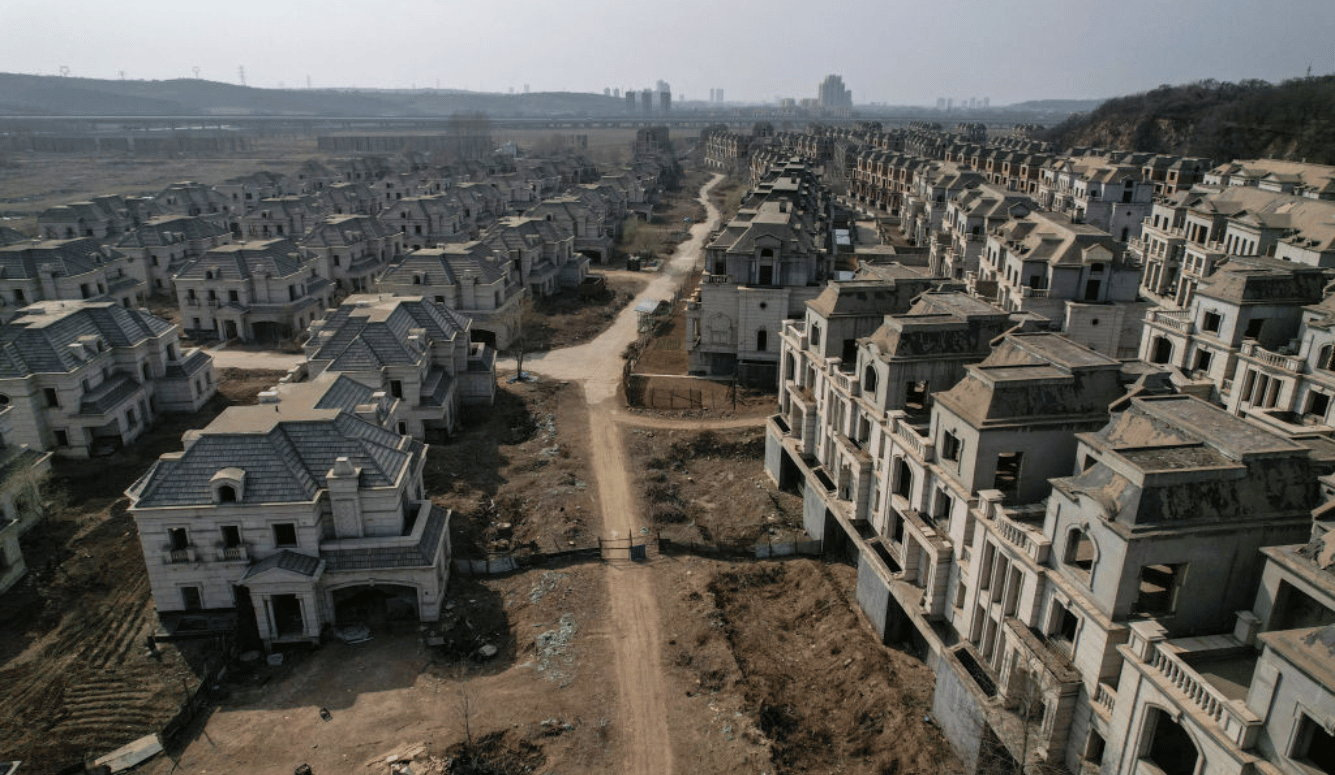
China’s ghost cities are like a mocking glimpse of the Chinese century we were told to expect, and for which we are still waiting.

Our rockets can find Halley’s Comet and reach Venus.
But our fridges don’t work.
~Mikhail Gorbachev
In the hills of northeast China, the “State Guest Mansions” sit empty and silent, like the well-preserved ruins of some lost civilisation. There are 260 of these mansions, huge but tediously uniform, each of them close to completion. The project was abandoned a couple of years after launch in 2010. Now local farmers plough the surrounding land. Cattle roam the villas, along with the occasional feral dog. Inside, urban explorers climb through the open jambs and fly their drones down marble hallways, creating creepy home movies.
Similar sights can be seen all over the country, of course, in China’s famed “ghost cities” (or sometimes “ghost districts”). The skyscrapers in Tianjin’s Binhai New Area may rise no higher than in any other major city, but the silence and emptiness of the surrounding neighbourhood makes the buildings feel truly enormous: looming, forbidding, watchful. In his 2024 book Vampire State, Ian Williams describes a “ghostly conurbation” on the other side of the country, near Dongguan, that boasts the world’s largest shopping mall:
Cavernous dusty halls, layer upon layer of meandering marble-lined walkways beside the shells of hundreds of shops, but not a soul to be seen. Wires hung from ceilings like an infestation of snakes. An artificial river wound through the complex, its water stagnant and dark green.
These vast monuments to state folly provide an apt picture of the Chinese economy: the speed and scale, the single-minded vigour, and then the waste left behind. The latter feature is partly due to China’s modern problem (communists with their central planning) and partly due to China’s ancient problem (a kowtowing mandarin culture that rewards impressive visible display over efficiency).
The rot spreads far beyond the ghost-city phenomenon. Georgetown professor Ning Leng carried out research in fifteen cities across China. She found that local governments had prioritised the building of expensive wastewater treatment plants over the construction of underground sewage pipes and drainage systems. They had focused on big treatment facilities because these looked more impressive to their bosses in Beijing. Without a vital subterranean root system of pipes and drainage, the treatment plants were operating far below capacity, and pollution was pumping into rivers and lakes.
And so on, and so on. China’s vaunted high-speed rail network piled up a trillion dollars in debt; most lines now run at a loss. In 2024, 90.6 percent of the country’s regional airports had fewer than one flight per day on average. Something similar is even happening in the wake of China’s protracted real-estate downturn, as the CCP tries to rescue the Chinese economy by pouring billions into a small handful of strategic industries—AI, robotics, chips, green energy.
This bold strategy is the Communist Party’s last great moonshot (itself actually the name of a major Chinese AI startup). The fear is that if Beijing can’t dominate in these industries then it will become technologically dependent on foreign powers. The hope is that high-tech sectors can replace the fallen giant of real estate and together constitute a new driver for the Chinese economy, while simultaneously enabling Beijing to “seize the commanding heights of technological competition and future development,” leapfrogging Washington into the position of global hegemon.
Keep reading

Jerry Kaplan on AI Doomers

Payback Time for Steven Galloway
War Stories

Life in The Grim Old Days