Deeply Problematic
How About We Just Play Baseball?
Athletes have every right to reject Pride symbols that—as activists themselves loudly insist—signify an increasingly radicalised set of ‘queer’ political demands.

Anthony Bass pitched in the major leagues for more than a decade, appearing in almost 400 games with seven different teams—including two stints with my own beloved Toronto Blue Jays. He had a great year in 2022. But otherwise, the right-handed reliever was your basic journeyman.
The way his career ended was not so basic, however. On May 29, 2023, two weeks before the Jays were set to host their fourth annual Pride Weekend, Bass reposted an Instagram video describing the sale of Pride merchandise as a “demonic” affront to his Christian faith. He also urged followers to boycott various commercial products, including Bud Light, which was then under fire for a (historically disastrous) social-media campaign featuring a uniquely irritating female-identified TikTok personality named Dylan Mulvaney.
Statement from Anthony Bass: pic.twitter.com/UXLrx1HVO5
— Toronto Blue Jays (@BlueJays) May 30, 2023
The next day, somewhat predictably, Bass apologised. Following what one presumes to have been a script prepared by the Blue Jays organisation, he told reporters that “I’m accessing Blue Jays resources to better educate myself, to make better decisions going forward.” Because of course, that is absolutely how professional baseball players really talk.
Unhelpfully, Bass also indicated that his personal feelings about the issue hadn’t changed. He simply wouldn’t be discussing them publicly any more.
A week later, as Pride festivities were starting up, the Blue Jays cut Bass from the team. The team’s general manager, Ross Atkins, could have pretended that he was simply divesting himself of a mediocre performer who was on the wrong side of 35. (By this point in the season, Bass’s ERA was up at 4.95, with a WHIP of 1.40.) Instead, he made it clear that Bass had turned himself into a marketing liability.
Readers familiar with my views may suspect I was on Bass’s side during this mini-scandal—free speech and all that. But that’s not the case.
Baseball is a business, and the athletes are what the ad people put in the front window. Toronto is a socially liberal city, which is why Bass’s comments made him unpopular with fans, who booed him upon his next on-field appearance. Bad publicity means fewer tickets sold, which means less income to pay star players, which means fewer wins, which means…fewer tickets sold.
The other thing to note here is that the Blue Jays hadn’t exactly asked Bass to sashay around the bullpen wearing a feather boa, or share his pronouns on the public address system during the seventh-inning stretch. The front office knows full well that many of its stars are religious Christians. (By one admittedly unscientific survey, baseball players are, per capita, far and away the most religious group of professional athletes within North America’s four major sports leagues.) There was no compelled speech going on here: management would have been perfectly happy if Bass had simply kept his views to himself.
The Blue Jays hadn’t exactly asked Bass to sashay around the bullpen wearing a feather boa or share his pronouns on the public address system during the seventh-inning stretch. All he had to do was keep his views to himself.
Moreover, the annual Pride events run by the Blue Jays tend to emphasise the fun and festive parts of the Pride tradition—not the dreary social-justice sermonising that’s now become common. The 2023 Jays Pride festivities, for instance, centred on family-friendly party-themed atmospherics and a Rainbow Flag Jersey giveaway.

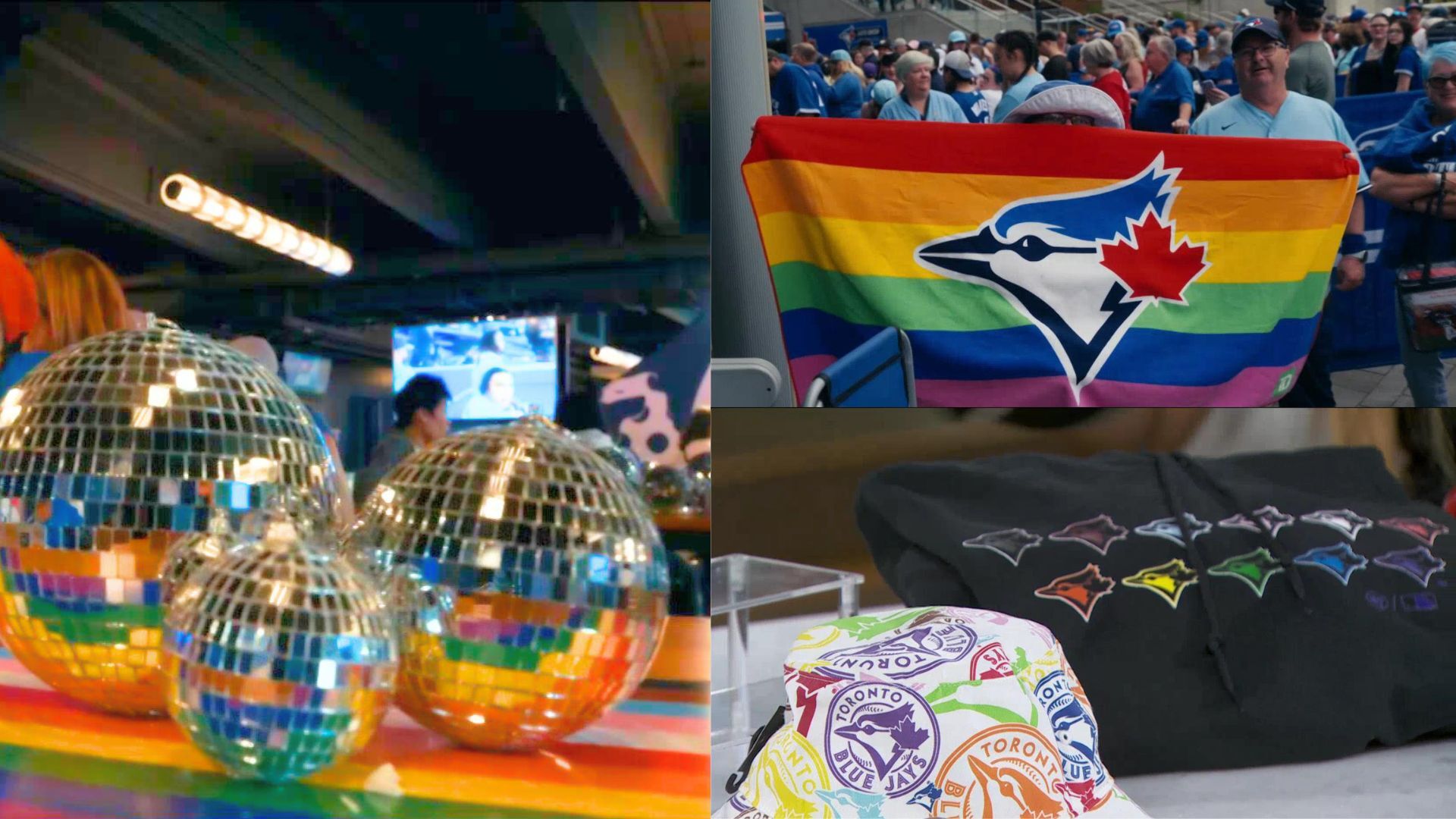
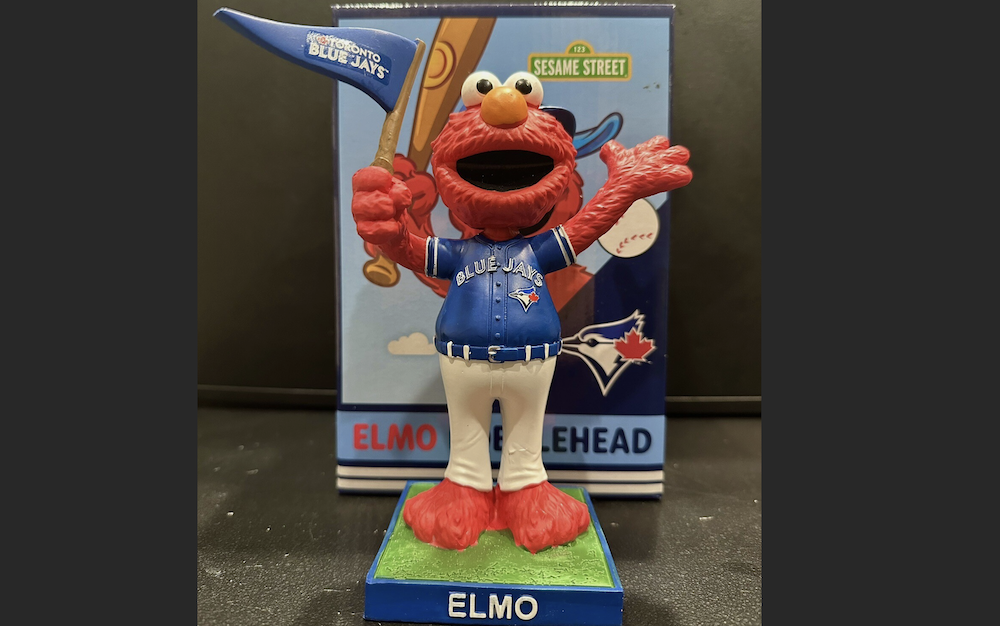
Like most corporate entities, the Blue Jays treat Pride as an opportunity to build their brand, demonstrate civic bona fides, and attract new customers. (Yes, gay people like baseball, too.) In this regard, it’s not that different from the dozens of other themed promotions that the team has staged, including special events for Mother’s Day, Canada Day, Caribbean Carnival, Harry Potter Day, Fan Appreciation Weekend, Grateful Dead Day, and something called Sesame Street Day (when fans got a free Elmo Bobblehead).
But things go too far when teams pressure the players themselves to actively enlist as Pride promoters, which, depending on context, really can get us into compelled-speech territory.
Until 2023, National Hockey League (NHL) players were encouraged to wear Pride patches on their warm-up jerseys. Most did so, but some refused, citing religious concerns. (A few Russian players also suggested that doing so could put them offside of their country’s so-called “Gay Propaganda Law.”) Predictably, the whole thing became a shambles when the media began trying to shame players who refused to wear the patch. Amidst a cascade of Seinfeldian who-doesn’t-want-to-wear-the-ribbon? memes, the NHL announced that, beginning in 2024, players would be prohibited from wearing any special event-themed uniforms (or even using rainbow-coloured hockey tape) during games or warm-ups.
One subplot here is that professional athletes typically come from backgrounds very much removed from the hyper-progressive journalists who cover them. When Venezuela defeated the United States to claim its first-ever World Baseball Classic championship earlier this year, Eugenio Suárez, who’d blasted the game-winning hit, exclaimed, “God is good. All the glory is for the Lord Jesus! He was with us the whole time. We have to glorify [Him], put His name in front of everything.” It’s the sort of sentiment that would horrify North American newsrooms in pretty much any other context, but which (by industry convention) is politely ignored when emitted by an exuberant athlete (especially someone such as Suárez, whose intersectional Latinx-ness makes things complicated for white progressives).
Indeed, sports journalists have made such a regular habit of studiously ignoring athletes’ religiosity that (like some team owners, apparently) they’ve convinced themselves it can be easily shoved to the margins when Pride rolls around so everyone can get out their rainbow pom poms.

Needless to say, activists—duly tended to by CBC stenographers—were up in arms about the NHL’s anti-rainbow diktat. But it was the correct decision—and not just because it allowed the league to avoid further embarrassment when religious players refused to “wear the ribbon” as it were. There are more substantive ideological factors at play, too.
As briefly noted above, Pride now has a dual character. On one hand, it’s a sunny, corporate-friendly hooray-for-everyone festival of inclusion and belonging. On the other hand, the Pride brand has increasingly been co-opted by radicalised constituencies within LGB&T communities that a lot of us, professional athletes and ordinary people alike, find obscene, hateful, and even violent.
Ben Appel
As gay writer Ben Appel wrote in his recent memoir, Cis White Gay, the promotion of basic rights for gay men and women, which is what Pride was once about, is now dismissed as passé by the larger queer movement. Instead, members of the “2SLGBTQIA+ community” (I wish I were joking—that’s actually what Canadians have been instructed to call it) are increasingly focused on promoting speedy “affirmation” of gender dysphoric children, and demonising women who seek to exclude female-identified men from protected female spaces; as well as a welter of completely unrelated progressive causes, such as anti-capitalism and extolling the many ways in which “queerness intersects with genocide and international law in the context of Palestine.”
Activists themselves are endlessly hectoring the more party-oriented members of their own communities that “Pride is political.” As a result, various Pride marches have banned participation by police, supporters of Israel, Jewish organisations, politicians, and members of the military. A lot of these events have become festivals of exclusion—the exact opposite of what Pride once stood for.
Amid all the brightly coloured balloons, it’s easy to know which version of Pride the Blue Jays are promoting at their Pride events—the sunny, upbeat, inclusive version that we all fondly remember. Very few people I know, progressive or conservative, have any problem with that type of Pride. But when an athlete (or anyone, in fact) is instructed to wear a generic Pride badge, the branding is more ambiguous. You don’t have to be a religious Christian (or, indeed, a Russian) to be wary of a symbol that may be seen as connecting you to a radicalised “queer“ political movement that even many mainstream gay and lesbian activists now denounce as alienating and misguided.
The people who own and manage most sports teams are smart enough to know all this. Alas, there are exceptions, such as the York Revolution, a minor-league baseball team based in York, Pennsylvania. When team members refused to wear the prescribed Pride Night rainbow jerseys on Thursday, the team decided to forfeit the associated game, lest the LGBT-themed festivities be tainted by association with a game featuring non-Pride-attired players. (It’s notable that the Revolution isn’t associated with the farm system of any major-league franchise, and so the decision didn’t risk up-chain brand damage.)
The York Revolution have made changes to their scheduled Pride Night after “a number of [their] players have refused to wear the scheduled Pride Night jersey.” pic.twitter.com/UFLHPB1vNp
— Indy Ball Nation (@IndyBallNation) June 18, 2026
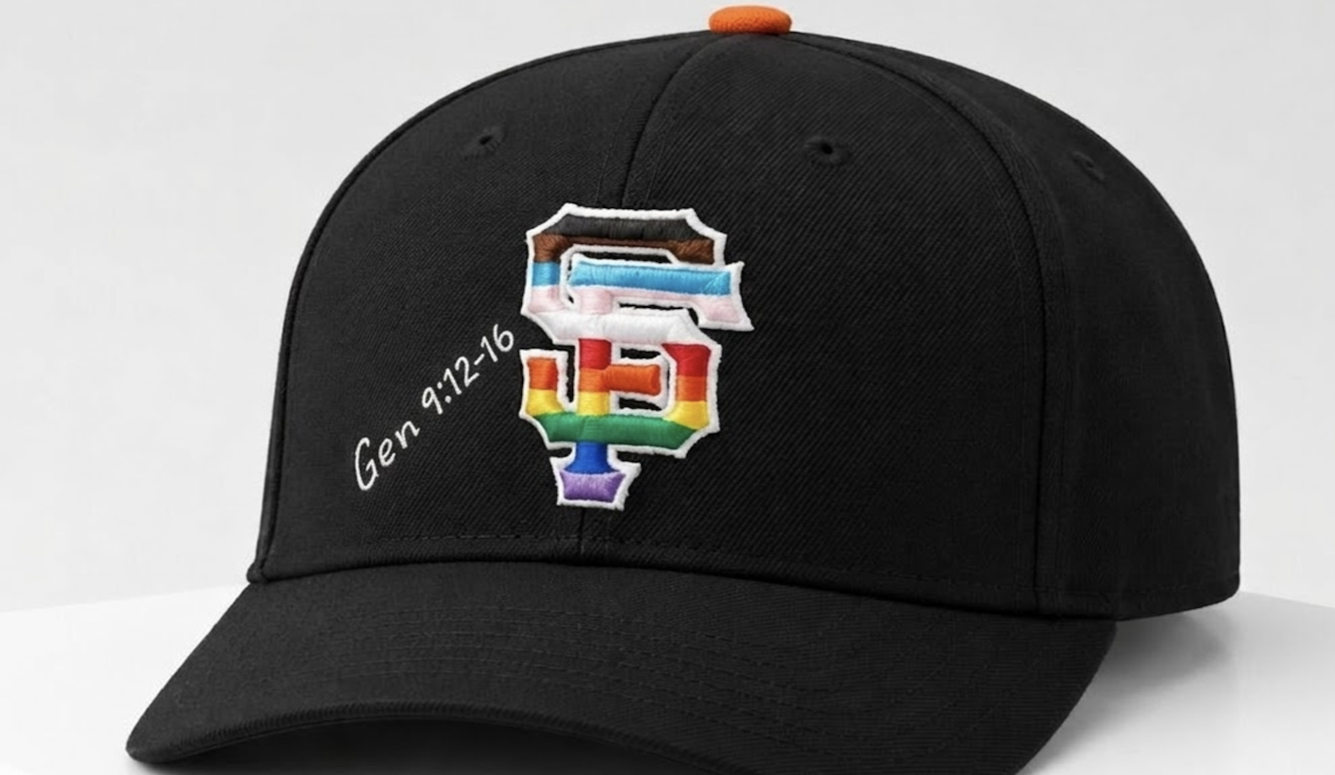
Then, getting back to the major-league level, there’s the case of the San Francisco Giants. On 12 June, the Giants held what they called a “celebration of Pride and the LGBTQIA+ community,” which took place before the day’s scheduled game against the Chicago Cubs. In a city where one in six people identify as some flavour of LGB or T, that makes good marketing sense. But the team took things too far, and supplied the players themselves with rainbow-themed Giants hats to wear during the game, thereby turning their bodies into Pride props.
Three (evidently) religious members of the Giants’ pitching staff—starter Landen Roupp, plus relievers JT Brubaker and Ryan Walker, all of whom pitched in the game—protested by writing citations to Biblical verses on the caps—Genesis 9:12-16, which has become the go-to scriptural reference in this sort of situation (for reasons explained here).
I admire the boldness of Clayton Kershaw, he wrote Genesis 9:12-16 on his pride Dodgers hat.
— Jacob (@Jacobtheclipper) June 15, 2025
Context:
The rainbow is a sign of God's covenant with humanity, not a sign of pride
Genesis 9:12-16 NKJV
"And God said: "This is the sign of the covenant which I make between Me and… pic.twitter.com/V7HooC9T68
Even if the Giants never should have asked the players to wear the caps in the first place, this act of protest crossed a line for me: The whole idea of a uniform is to symbolise the fact that you’re all on the same side. The act of defacing it, even in the service of principles you regard as important, means putting your own interests ahead of team cohesion. That’s one reason why the league explicitly specifies that “a player may not write, attach, affix, embroider or otherwise display nicknames or messages on apparel or playing equipment.”
I wish this dissident trio had followed the example of teammate Sam Hentges, who staged a more muted form of protest by simply swapping out his rainbow-themed Giants cap for a regular one. Unlike Roupp’s stunt, Hentges’ approach was consistent with rights granted under the Major League Baseball Players Association’s 2022 agreement with the league, which specifies (in anticipation of exactly this kind of situation), that “a player who declines to participate, in whole or in part, in any MLB-designated theme day shall be permitted to wear any item or use any equipment he would otherwise use/wear during a non-theme day.”
Keep reading
Jerry Kaplan on AI Doomers
Payback Time for Steven Galloway
War Stories

Life in The Grim Old Days
In Defence of Academic Standards