Memoir
Cis, White, and Gay
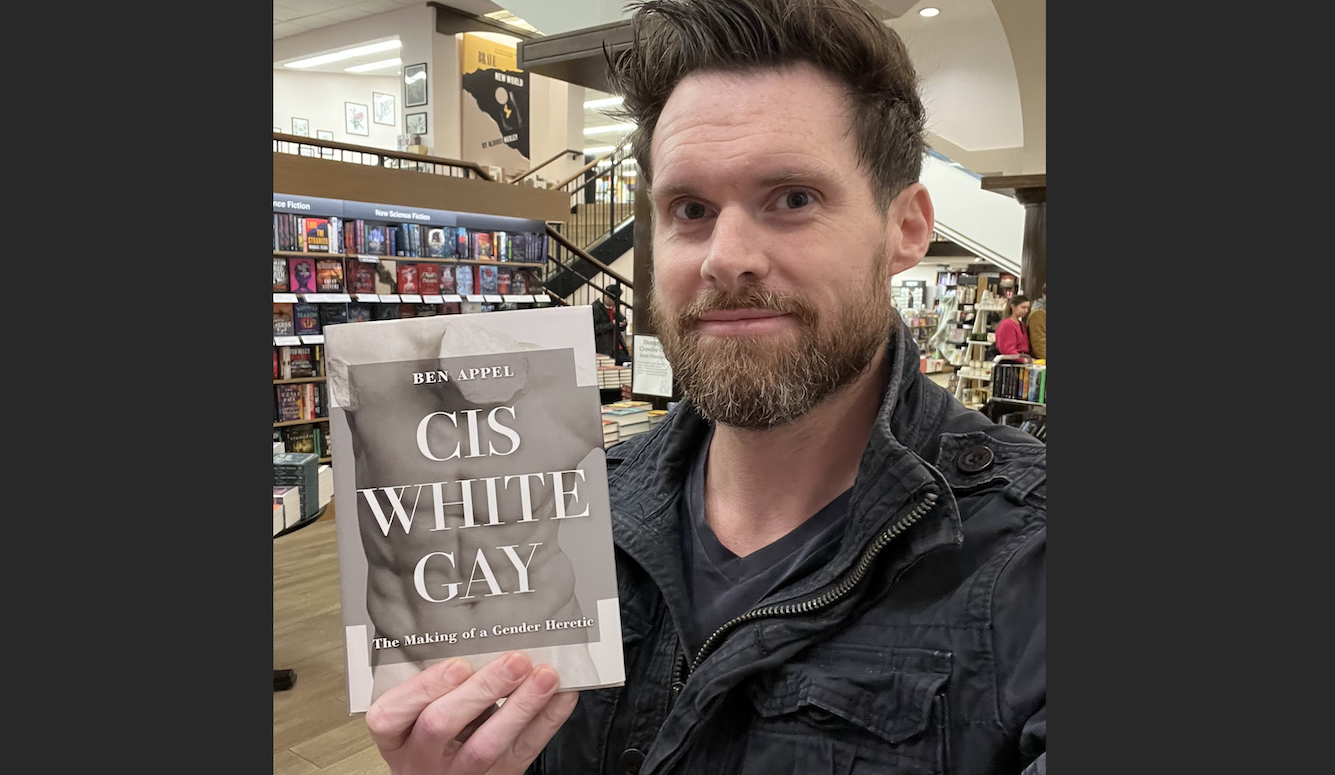
In a new book, Ben Appel describes his journey from closeted Christian cult child, to recovering addict, to social-justice warrior, to self-confessed ‘gender heretic.’


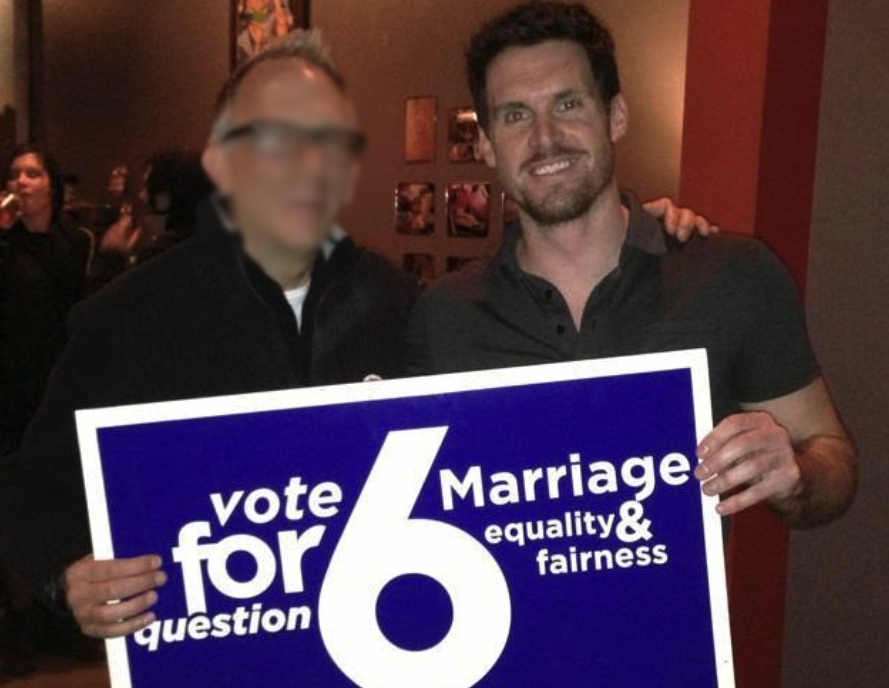
November 6, 2012, the day Barack Obama was re-elected as U.S. president, was bright and blisteringly cold in Maryland. I remember because I spent much of that day outside Elkridge Elementary School, somewhere between Baltimore and Washington, D.C., holding a large blue sign that read Vote Yes on Question 6, otherwise known as the Maryland same-sex marriage referendum.
Obama and Vice President Joe Biden were up against former Massachusetts governor Mitt Romney and his Republican running mate, Wisconsin congressman Paul Ryan. The previous May, during an ABC News interview, Obama had publicly stated for the first time that he no longer opposed same-sex marriage. In four states—Maine, Maryland, Minnesota, and Washington—the question of whether gay couples should be allowed to marry was now on the ballot.
I was twenty-eight years old. If you’d asked me a year earlier what I thought about same-sex marriage, I would have responded that I didn’t care much. Sure, I wanted gay marriage legalized for equality’s sake. But I had no intention of tying the knot myself. Deep down, I didn’t believe gay men were capable of truly falling in love, especially the kind that would make them want to enter a lifelong legal commitment.
But on a summer night in 2011, that changed. I was at the Hippo, a gay bar in downtown Baltimore, when a man caught my eye. We made eye contact, and I approached.
Drew had come up from D.C. to celebrate a friend’s birthday. We flirted for a few minutes, then exchanged phone numbers and parted ways.
A week later, we went on our first date in Alexandria, Virginia, about a mile from the U.S. Patent and Trademark Office, where he worked as a lawyer. And that, as they say, was that. I fell fast and hard. Two months in, I told him, “I think I want to marry you.” His brown eyes lit up. “Me, too,” he said.
Suddenly, I had skin in the game: Marriage equality meant something real to me. And in February 2012, when the Maryland state legislature passed a same-sex marriage bill, I began to wonder if God or the Universe might be on my side.
To secure conservative support, however, legislators had added a caveat. The law wouldn’t go into effect until the first day of the following year, which meant that Republicans would have a chance to overturn it at the ballot box via referendum. I volunteered with Marylanders for Marriage Equality, an offshoot of the LGBT rights organization Equality Maryland, to help prevent that from happening—which is how I ended up spending the morning of election day waving a sign at passers-by outside a school.
By that time, I was familiar with the religious arguments against gay marriage—“God made Adam and Eve, not Adam and Steve,” and so on. But I was less educated about the arguments against gay marriage that came from within the gay community itself. For decades, there’d been a cultural battle raging between gay and lesbian “assimilationists” on one side, and queer/radical cultural “separatists” on the other.
The former wanted to integrate into society and enjoy the same opportunities and basic rights as their heterosexual peers. But the radicals wanted no part of it. To be homosexual, as they saw it, was to be oppressed in the same way as every other minority was oppressed—including by capitalism and white male patriarchy, evils that (in their view) are propped up by conventional bourgeois institutions such as civil marriage.
In the end, it was the moderate faction that won: After decades of tireless campaigning, gays earned the right to get married, serve proudly in the military, and raise families. But the queer radicals wouldn’t take the defeat lying down. As I’d learn following my return to university in the late 2010s, in fact, they’d respond by ideologically doubling down.
After waving my Question-6 sign all morning, I drove to Columbia, a town southwest of Baltimore where I worked as a hair stylist. Upon arrival at the salon, I bumped into Donna, a coworker in her sixties who’d recently told me on Facebook that I needed to find the Holy Spirit.
“Your cheeks are so flushed!” she said.
I told her I’d been outside, campaigning for marriage equality. She gave me a tight smile and walked away.
That night, I drove to the Baltimore Soundstage, an entertainment venue near the city’s Inner Harbor that marriage-equality campaigners had rented out. The election-night crowd included Governor Martin O’Malley, a Democrat and a gay-marriage supporter, along with a few liberal state legislators. When televisions flashed the news that Obama was projected to win the presidency, the room burst into cheers.
An hour later, a Democratic legislator named Maggie McIntosh took the stage to announce the final results of the marriage referendum: Our side had won by a margin of 52 to 48. For the first time in U.S. history, the right to marry had been extended to gay couples by popular vote—not just in Maryland, but in Maine and Washington as well. Balloons rained from the ceiling as Sister Sledge’s We Are Family blasted through the loudspeakers. I was stunned.
I felt determined to keep chasing that feeling—the sense of hope and empowerment that came with fighting for social justice. I’d been a hairstylist for nearly a decade. Suddenly, I had a new calling.
As I drove home in the early morning hours, shock turned to elation, so much so that I thought my car might take flight. I felt determined to keep chasing that feeling—the sense of hope and empowerment that came with fighting for social justice. By this time, I’d been a hairstylist for nearly a decade. Suddenly, I had a new calling.
A few weeks later, as I blew a client’s hair dry, she asked what was next on the agenda for gay-rights activists. Passing over the facts that marriage equality still wasn’t the law nationwide (something that wouldn’t change until 2015, when the U.S. Supreme Court issued its landmark ruling in the case of Obergefell v. Hodges), I held up my hands to form a T.
“Transgender rights,” I told her. This, gay-rights organizations and left-leaning media outlets were telling me, was the natural next step in the fight for equality. We—that is, we LGBT people—were a coalition. Or so I believed.
At the time, I knew only one transgender person, a transwoman maybe ten years my senior, whom I knew through the sober friends I’d made after dealing with alcoholism during my early 20s. I didn’t know a lot about her besides that she’d once been married to a woman and had children. I didn’t know if she was still married, or how her family had reacted to her transition. I was years away from understanding the many different motivations for a person to identify as trans.
I also knew little about what rights trans people wanted that they didn’t already have. But that hardly mattered to me. All I knew was that I cared about transgender people, just like I cared about all “marginalized communities.” The idea that someone, somewhere—anywhere—might continue to be unfairly oppressed and marginalized by our white, male, conservative Christian society filled me with righteous indignation. Just as importantly, I wanted to keep chasing that high I’d felt on the night we’d won the fight for marriage equality in Maryland.
Since 2001, the state’s human-rights law had included “sexual orientation” as a protected class, thereby barring discrimination against gay people in employment, housing, and public accommodations. In January 2013, shortly after Obama’s re-election, state legislation was introduced to include gender identity—defined in the bill as “the gender-related identity” of a person, regardless of sex, that he or she consistently asserts to be a “sincerely held” part of his or her “core identity.” An email from Equality Maryland informed me that the organization would be hosting a public rally for the bill in Annapolis later that month.
At the time, my understanding of the proposed legal change was that it would protect transgender Marylanders from discrimination in some general sense. What I didn’t know, possibly because progressives aren’t supposed to go down such mental avenues, was that because “gender identity” was to be given the same legal weight as “sex,” its inclusion in anti-discrimination legislation would lead to a conflict between the rights of women and the rights of trans-identified males. This, in turn, would serve to erode the protections offered by women’s spaces, such as bathrooms, locker rooms, rape-crisis shelters, and prisons.
I was also then unaware that the vaguely defined concept of “gender identity,” a central part of this ideological movement, would effectively invalidate the idea of homosexuality—since the doctrine teaches that men aren’t attracted to male bodies per se, but rather to some abstraction known as male gender identity.
The rally came on the heels of a snowstorm. Shivering in the cold, the forty or so of us who’d showed up cheered in front of the Maryland State House while a few politicians made speeches. Afterwards, we set out in small groups to lobby senators in their offices.
I met with a Republican from a conservative district north of Baltimore. I told him how much the legalization of gay marriage had changed my life—how I finally felt like a part of society, like I could hold my head up higher. “Passing this legislation might do something similar for transgender people,” I added.
The senator listened attentively, then asked me, “But what if a guy demands to show up to work in a wig or in something really inappropriate? We should take away an employer’s right to tell him he can’t?”
I rather smugly replied that he was confusing transvestism with transgenderism. “A transvestite is a man who likes to wear women’s clothes every now and then, and a transgender woman is a woman born in a man’s body…” I offered. But even in that moment, I realized that I didn’t actually know where the one category began and the other ended.
Moreover, how, exactly, could one be born in the wrong body? Aren’t our bodies…ourselves?
Perhaps what we were really talking about was some kind of soul, I reasoned. A soul could be female, and so maybe, through some karmic mix-up, a female soul could mistakenly enter a male fetus.
Or maybe it was the brain: One had the brain of a female and the body of a male.
I had no idea which was the correct explanation. But it didn’t really matter because, on some level, I instinctively knew they were both absurd.
Not for the first time, I wondered what the difference was between the hypothetical transgender person I was describing and myself—since for my entire life I’d always “felt” more like a girl than a stereotypical boy.
At the time, however, it didn’t matter to me whether any of it made sense. I reassured myself with slogans: Just like I was “born this way,” so were they. Besides, only a terrible person would vote against legislation that protected a marginalized group from discrimination.
The senator smiled and nodded noncommittally, as politicians do. The bill failed to pass that year, but my passion for social justice kept growing.
On October 25, 2014, Drew and I got married at the Belvedere Hotel in downtown Baltimore, two blocks from where we’d met. Jane Wiedlin, the guitarist from the 1980s girl group the Go-Go’s, officiated. We honeymooned in London and Paris.
Two months later, over Christmas Eve dinner, Drew and I spoke about our future. I found myself admitting how unfulfilled I felt in my job. Hairstyling offered me a creative outlet, and allowed me to build relationships with people from all walks of life. It had also provided a steady income for the first decade of my sobriety. But now, aged 31, I thought it might be time to go back to college, and pick up where I’d left off when addiction had derailed my studies.
My foray into activism had given me a new perspective—a new calling. Grandiose as my plans might sound, I told Drew, I really did want to help create a world in which gender-nonconforming young people, like the girly little boy I once was, aren’t shamed and bullied into conformity. I’d always wanted to be a writer, I said. Maybe I could write things that made a real difference.
“If that’s what you want, you need to go for it,” Drew said. When we finished dinner, I immediately started planning my new life.
The goal I settled on, which I’d eventually realize in 2017, was to move to New York City and take a writing program at Columbia University’s School of General Studies—in part because of the school’s connection to social-justice activism. I was particularly transfixed by black- and-white images of the 1968 student-led protests that still circulate widely in film and other media (often scored with John Lennon’s Imagine or a Jimi Hendrix riff ).
While I knew these protestors opposed the Vietnam War and racial injustice, I was hazy on the details—including the Marxist undercurrent pervading their politics. What I did know was that these kids were on the right side of history—just as I planned to be.
As a first step, I enrolled for a year at a local college, so I could get used to being a student again (and improve my chances of gaining admission to Columbia). In my history course, I inhaled the assigned text, and felt myself bursting with confidently held opinions about the way historical forces had shaped our socially unjust world. During my first English class, my teacher, a black poet, told us, “You are here to become the person you were meant to be.” I felt like she was speaking directly to me.
Shortly thereafter, Drew and I travelled to Manhattan with some friends to see a Björk concert at City Center theater, and took the opportunity to visit Columbia. After entering the campus through the wrought-iron gates at 116th Street and Broadway, we walked under trees wrapped in white lights. Students passed by in groups of twos and threes. I could barely contain my envy.
Keep reading
They Walked in Line
Anti-Catholic Social Panics, Then and Now
A Dishonest (and Dangerous) Nobel Laureate
Common People
How Genetics Rewrote History