Politics
Nixon Was Right
After all these years, the Communist Party is still handcuffed to its American rival, and it is unable to break free.
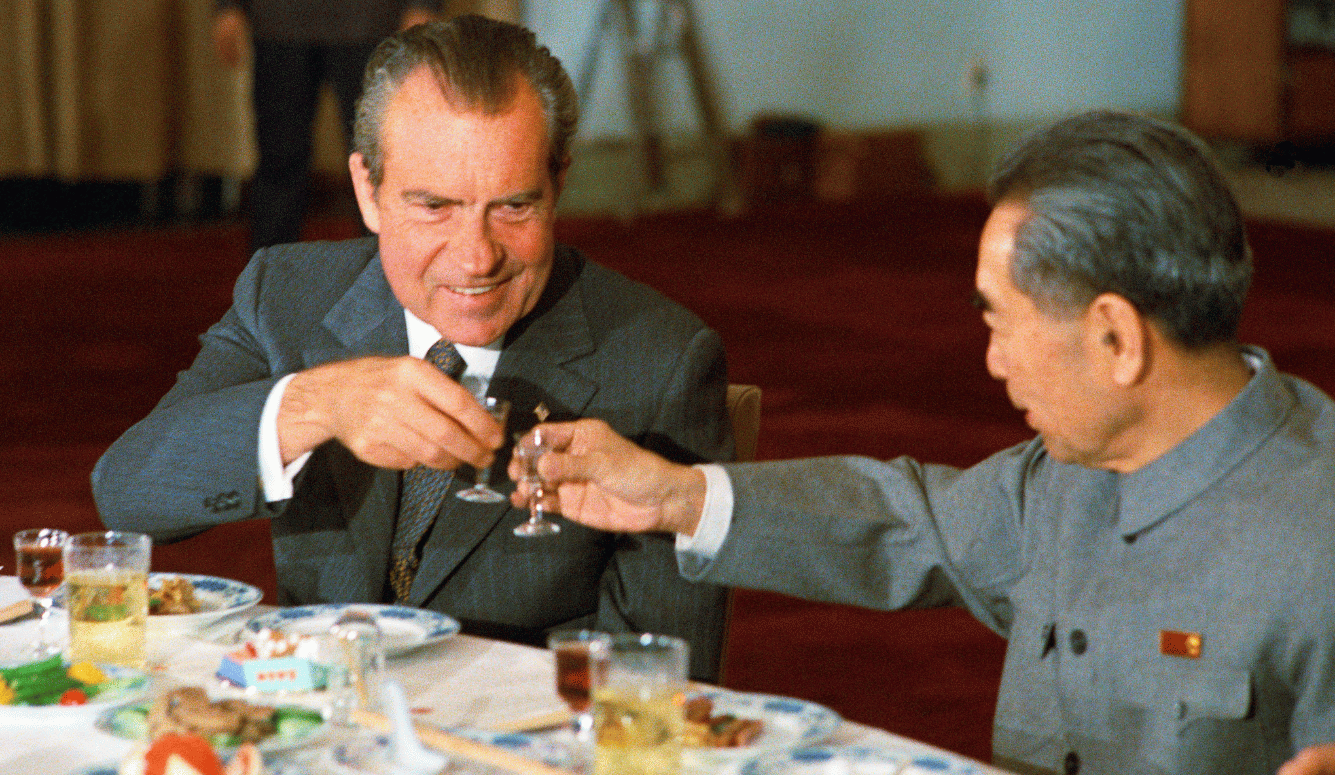

The world cannot be safe until China changes.
~Richard Nixon, 1967
In his history/memoir On China, Henry Kissinger provides a telling anecdote from the period just prior to Nixon’s 1972 rapprochement with Beijing. The US ambassador in Warsaw, Kissinger recalls, had instructions to approach China’s delegation at an event in the capital. When the CCP officials in attendance realised that two Americans were talking and pointing at them from the other side of the room, they left their seats and hurried for the exits. They had received no orders on how to deal with such a situation, and communists do not improvise. The Americans followed, the Chinese quickened their pace, and soon both groups of diplomats were running through the corridors, with the Americans shouting: “We want to meet your ambassador!”
This insistence on engaging the Chinese Communist Party over decades was typical of the United States. The US would try to draw China close, sharing knowledge and assistance, and make a friend of an adversary. There have been times when this approach has looked suicidally naïve, weakening the US while boosting a competitor in a way that never occurred with the Soviets. Huge mistakes were made. Washington was never as tough as it needed to be, and so Beijing grew in boldness and strength until it became difficult and costly for Washington to be tough at all.
Some commentators now believe that engagement itself was an unmitigated error. Even Wall Street looks back with regret after all those years as the Party’s number one cheerleader in the West. But while many specific policies of engagement were certainly short-sighted and self-defeating, the decision to draw Beijing close was the right one—for both strategic and humanitarian reasons.
"We made a huge mistake. And 'we' being business, government, and military."
— The Hill & Valley Forum (@HillValleyForum) April 17, 2026
Jamie Dimon on China:
"There was this general assumption they'd become more democratic and more free. And it didn't really happen that way."
"Too many people were changing the supply chains just… pic.twitter.com/qHZyD96yZn
Not at first, perhaps. Even before the Communist Party came to power, Washington was already lending an ill-judged hand. During the Chinese Civil War in the late 1940s, US General George Marshall persuaded KMT leader Chiang Kai-shek to pause hostilities and pursue a truce. The ceasefire lasted four months, which gave the CCP time to build up its army (with Soviet help). Marshall would later send American officers to train communist troops at Kalgan. There are various reasons for the CCP’s eventual triumph and seizure of power, not least among which was American interference. And while the KMT was a horrific regime (as it would go on to prove in Taiwan), there are degrees of horror: if the KMT had ruled China instead of the CCP, it’s highly unlikely that Chiang Kai-shek would have matched Mao Zedong’s 80-million kill count.
The revolution of 1949 froze relations with the United States for two decades. Then came Nixon’s thaw, an idea he’d spent years developing. The aim was to counterbalance the Soviet Union, and also to protect various East Asian allies from the threat of “Red China.” “We simply cannot afford,” the future President observed in 1967, “to leave China forever outside the family of nations, there to nurture its fantasies, cherish its hates, and threaten its neighbours. … There is no place on this small planet for a billion of its potentially most able people to live in angry isolation.” The task that lay before the United States was to “persuade China that it must change.”
The alternative was stark: a vast rogue nuclear state. And back in Nixon and Kissinger’s time, that rogue state was busily fracturing in the heat and turmoil of Mao’s Great Proletarian Cultural Revolution. There was a non-negligible chance that China could soon become a patchwork of regions controlled by factions of fanatical Red Guards in possession of nuclear warheads, antagonistic to the capitalist world and to each other.
So Kissinger was sent to Beijing in 1971, Nixon followed in 1972, and China was welcomed into the “family of nations.” Trade was unlocked and—slowly at first—China’s great rise began. But Nixon displayed none of the rosy-eyed naivety that would lead later presidents astray when it came to China. He knew only too well what he was looking at:
Keep reading
Robert Lynch on Status, Humour and the Apes We Pretend Not to Be | Quillette Cetera Episode 74
The Radicalisation of Tucker Carlson
A Pop Fiction Master and Monster
Australia’s Coming Censorship Machine

Anatomy of a Book Promotion