Skip to content

Deeply Problematic

British Columbia’s UNDRIP Fiasco

By enacting the Declaration on the Rights of Indigenous Peoples into provincial law, B.C. effectively handed veto power over policy-making to First Nations lobbyists.
· 6 min read
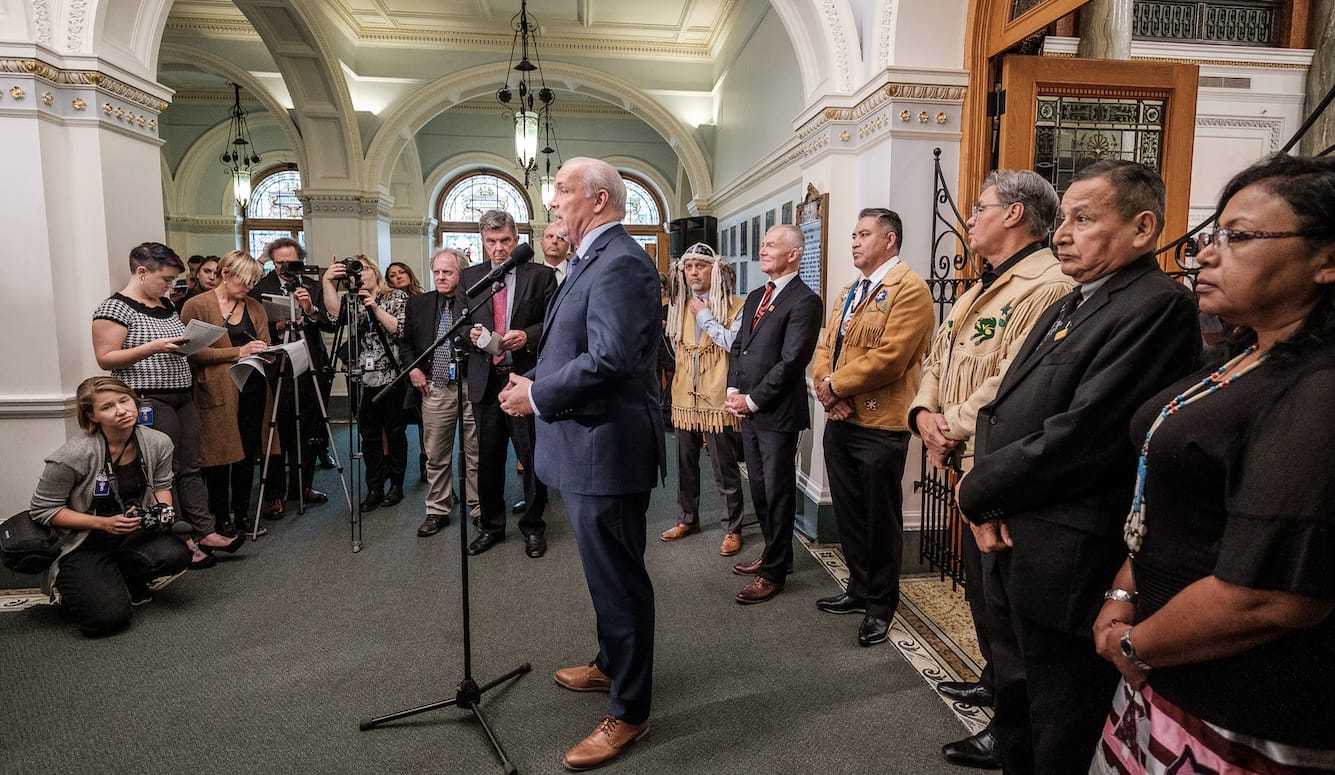
A man in a navy suit speaks at a microphone stand in an ornate government building rotunda, flanked by Indigenous leaders in traditional dress, while press photograph the event.
A 24 October 2019 B.C. government photo of former Premier John Horgan discussing his government’s plan to enact the UN Declaration on the Rights of Indigenous Peoples Act into provincial law.

Twenty years ago, the United Nations Human Rights Council adopted the draft text of a document known as the “Declaration on the Rights of Indigenous Peoples”—widely known by its (unfortunate) acronym, UNDRIP. Like many utopian UN manifestos of this type, it set forth a catalogue of aspirational principles that were easy to applaud but difficult to implement.

Article 19, for instance, instructs signatory states to “consult and cooperate in good faith with the indigenous peoples” to obtain their “free, prior and informed consent before adopting and implementing legislative or administrative measures that may affect them.” Since pretty much any law on the books “may affect” anyone, UNDRIP effectively gives Indigenous communities veto power over everything government does—right down to setting and enforcing speed limits.

This is why Canada opposed UNDRIP when it was approved by the UN General Assembly in 2007, noting that this sort of language is “overly broad, unclear, and capable of a wide variety of interpretations, discounting the need to recognize a range of rights over land and possibly putting into question matters that have been settled by treaty.”

The three other dissenters at the UN that day were New Zealand, the United States, and Australia, all democracies that have their own substantial Indigenous populations. Even Justin Trudeau, who had difficulty saying no to any Indigenous demand during his tenure as Canadian PM, balked at implementing UNDRIP. His Justice Minister at the time, an Indigenous woman named Jody Wilson-Raybould, bluntly told First Nations leaders that the idea was “unworkable,” in part because it would require Canada to “rip up” laws that had been around since the nineteenth century.

None of this deterred the provincial government of British Columbia, however. On 24 October 2019, B.C.’s left-wing New Democratic Party (NDP) government enacted the Declaration on the Rights of Indigenous Peoples Act (DRIPA), requiring the government to take “all necessary measures” to ensure its laws are consistent with UNDRIP. British Columbia thereby became the first jurisdiction on the planet that not only endorsed UNDRIP in the abstract (as Trudeau and other national leaders had done) but actually cemented its guarantees into law. In 2021, the province added a further legislative amendment explicitly requiring that “every Act and regulation must be construed as being consistent with UNDRIP.” 

Behind the scenes, then-Premier John Horgan and his cabinet were assuring legislators that the law would simply ensure that B.C. took advice and guidance from Indigenous groups. But as judges (predictably) concluded, that’s absolutely not what the law says.

In a landmark 2025 case known as Cowichan Tribes v Canada, B.C.’s Supreme Court judge ruled that an Indigenous band held Aboriginal title to land in the Vancouver suburb of Richmond, including more than 100 pieces of private property owned by local landowners. The judge in that case cited both UNDRIP and the enacting provincial legislation. The decision set off something of a panic among voters all over the province, great swathes of which are similarly claimed by other Indigenous groups. David Eby—Horgan’s successor, who was attorney general at the time B.C. enacted DRIPA—realised he had a problem.

That problem got worse later in 2025, when the province’s Court of Appeal decided Gitxaala v. British Columbia. The judges concluded that B.C.’s entire system of mineral rights was in illegal contravention of the Declaration on the Rights of Indigenous Peoples Act. The official case summary flatly stated that “UNDRIP and the [B.C.] mineral claims regime are inconsistent.”

“British Columbians were told by David Eby and the NDP that DRIPA was about symbolism, reconciliation, and ‘frameworks,’” the head of the province’s largest construction association said. “But the Court of Appeal makes it clear DRIPA is now hard law with sweeping consequences for every statute, regulation, permit and project in this province.”

Even by the standards of Canadian leftists, Eby has always been unusually fastidious about toeing the approved ideological line on issues connected to Indigenous communities. But the Gitxaala decision finally sobered him up. And in early 2026, he announced plans to suspend application of UNDRIP/DRIPA, and water down its language. Gone would be the wording about “taking all measures necessary” to make B.C. laws UNDRIP-compliant. Instead, there would be a vague call to “align” the statute books with UNDRIP principles.

This infuriated Indigenous leaders, who berated Eby for two hours in a closed-door meeting earlier this month, accusing the premier of “absolute betrayal.” That in turn caused Eby’s own NDP caucus to rebel. And so the premier, who’d just called his UNDRIP reforms “non-negotiable,” immediately flip-flopped—unwilling to chance his slim governing majority on a parliamentary confidence vote that he looked certain to lose.

Eby’s new solution, he said on 20 April, would be to leave his DRIPA legislation on the books untouched while “working together on a path forward” with an Indigenous lobby group called the First Nations Leadership Council (FNLC).

Which is to say that a week ago, British Columbians woke up to the news that a group many of them had never heard of is effectively now in an ad hoc power-sharing arrangement with their province’s elected NDP government. A veteran B.C. government lawyer who spent three decades advising provincial officials on Indigenous legal issues calls this the most stunning display of “ineptitude and incompetence” he’s ever witnessed.

One issue here is that the NDP itself has become a dysfunctional political brand. As I wrote last month, the former party of the everyday working man has now become an umbrella brand for upper middle-class Canadian activists who hate Israel, babble endlessly about gender identity, and disparage their own country as a genocide state.

The Tragicomic Death Throes of Canada’s (Former) Workers’ Party
The New Democratic Party, which once championed the country’s unions, is now in the hands of a radicalized anti-Israel activist who wants to nationalize grocery sales and shut down oil production.

And B.C. shows what kind of political meltdown can occur when this kind of entity gains real political power. Under Eby and his predecessor, public life has increasingly become infused with the idea that B.C.’s white residents—including Eby himself—are colonial contaminants in a land that was once an Indigenous utopia. With the premier himself having implicitly surrendered his own moral authority by signal boosting this theme for years, it’s hard to blame Indigenous leaders for trying to jump into the power vacuum he’s created.

But the lessons from this political fiasco extend well beyond B.C., and even beyond Canada. Earlier this week, an Australian law professor named Olivia Barr claimed to have made a groundbreaking legal discovery that, she says, “could transform Indigenous rights” in her country. Putting aside the substance of her legal argument (which I’m not qualified to judge), I found it hard to suppress an eye roll at this line: “All other major Commonwealth countries have managed to acknowledge Indigenous sovereignty without their systems of government being undermined.” What’s been happening in B.C. puts the lie to this idea.

In fact, Australia provides an interesting companion case. In 2023, that country held a constitutional referendum in which citizens were asked to vote up or down on the creation of something called the Aboriginal and Torres Strait Islander Voice—a proposed body mandated to make representations to the national government on issues related to Indigenous communities. “The Voice,” as many called it, was strictly advisory in nature, and so would have had nowhere near the disruptive effect on the political status quo as the legislative implementation of UNDRIP. Yet even that was decisively rejected by Australian voters.

Just as British Columbia implemented UNDRIP into its laws with the overwhelming approval of the province’s political class, the Voice received widespread backing from not only many politicians, but also celebrities, and even sports executives. Many of these elites were genuinely shocked when the Voice failed (since all their friends supported it), and some even bitterly suggested that it proved the country was racist.

As David Eby is discovering, however, there are plenty of perfectly good reasons to think twice before handing even partial political control of democratic institutions to ethnically defined constituencies.


Quillette invites thoughtful responses to its essays.
Selected responses are published once per week as part of a curated Letters to the Editor feature. If selected, letters appear under the contributor’s real name and may be edited for clarity and length.

To submit a letter for consideration, please email [email protected].