Skip to content

Books

The Many Faces of Tucker Carlson

Jason Zengerle’s new book about the degradation of a once-gifted writer and broadcaster also illustrates the downward trajectory of the entire news industry during the same period.
· 14 min read
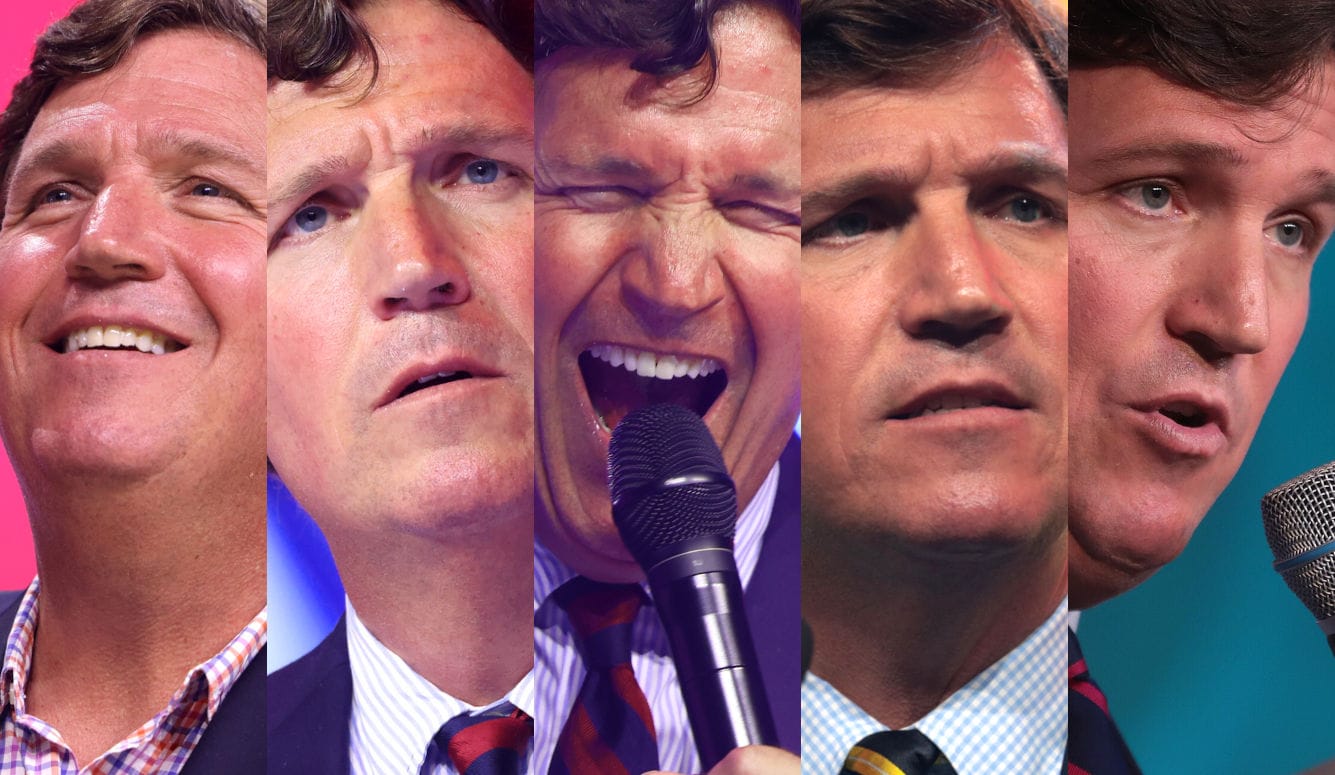
Composite image featuring Tucker Carlson's face making six different expressions.
All images by Gage Skidmore, Flickr

A review of Hated by All the Right People: Tucker Carlson and the Unraveling of the Conservative Mind by Jason Zengerle; 400 pages; Crooked Media Reads (January 2026)

In the autumn of 1980, as Jimmy Carter and Ronald Reagan were preparing for their second presidential debate, Tucker Carlson’s sixth grade teacher decided to stage a classroom debate between Carlson and Carlson’s best friend Russell. Although the pair were only eleven years old, they were already rabid political junkies, albeit of very different sorts. Carlson was an outspoken conservative, while Russell was a die-hard liberal. There was a twist, though: in the debate, Carlson would have to play President Carter, the Democrat, while Russell would play Reagan, the Republican, forcing each student to see things from the other side.  Russell dutifully studied Reagan’s positions, and when debate day came, he did an admirable job reciting them to the class. Carlson took an entirely different tack.  Rather than touting Carter’s policies, he simply went negative. “Ronald Reagan is like Lassie,” he told his classmates. “He’s a trained dog. They just put words in his mouth and he says them.” When the debate was over and the students were polled, Carlson/Carter won in a landslide.

This anecdote comes from Jason Zengerle’s excellent new book, Hated by All the Right People: Tucker Carlson and the Unraveling of the Conservative Mind. “I didn’t want to write a biography of Tucker Carlson,” Zengerle explained on a recent podcast. “I also didn’t want to write a hate-read.” And he has largely succeeded in that two-pronged aim. Neither hagiography nor hit-piece, Hated by All the Right People probably isn’t the kind of book that Carlson would want written about himself, but it’s just the kind of book he deserves. The story about Carlson’s sixth-grade debate is illustrative of Zengerle’s technique. The lesson, he explains, that Carlson learned from that youthful experience was that “a strong argument against someone can be far more effective than a strong argument for [someone].” Zengerle leaves it to readers to draw the other obvious conclusion—that, for Carlson, popularity has always outweighed principle.

That’s not to say that Carlson has no principles. He was a superb writer when he started out as a contributor to the Weekly Standard in the mid-1990s. “This kid was born knowing how to write a magazine article,” the Standard’s deputy editor John Podhoretz enthused upon reading Carlson’s first submission. Part of what made him so good was that he was willing to skewer his own side. Despite his conservative disposition, he often took potshots at Republicans, including George W. Bush, the GOP’s presidential candidate in 2000. “Though Bush can afford to shop anywhere,” Carlson wrote of the governor’s sartorial style, “he often looks as if he has just returned from an afternoon of shoplifting at Sears.” In a 1997 article for the New Republic, Carlson exposes Grover Norquist, the founder of Americans for Tax Reform, as a “cash-addled, morally malleable lobbyist” selling access to anyone with enough dough, from African strongmen to Fortune 500 CEOs. “Norquist assumed a revolutionary persona,” Carlson writes of his pudgy, bespectacled subject, “eschewing bourgeois conventions like a wife and family, table manners, even personal relationships. When I asked Norquist which of his friends could tell me what he’s like as a person, he suggested I speak to ‘anyone in leadership, House or Senate.’”

It also turned out that Carlson had a natural flair for television. In the broadcast era, print journalists rarely made TV appearances. That began to change after cable came along. Networks like CNN, Fox, and MSNBC had an enormous amount of airtime to fill, and the cheapest way to fill it was with pundits rather than hard news reporters. Carlson fit the bill perfectly. With his bow tie and blow-dried hair, he looked like a junior George Will, and while he might have lacked Will’s erudition, he was a quick study, easily (and enthusiastically) pontificating on a wide range of subjects. As Zengerle puts it, “he popped on-screen.”

In 2001, Carlson was invited to co-host Crossfire, CNN’s popular political debate show, alongside James Carville, Paul Begala, and Robert Novak. Friends like David Brooks and Christopher Hitchens urged Carlson not to give up his day job. They thought TV was just a side hustle—a way to promote their real work, which was on the page. Carlson took this line too, at first. When a viewer complained that his TV commentary wasn’t nearly as nuanced as his writing, Carlson acknowledged the point: “This is something I’ve thought about a lot and tried to correct. Partly it’s the venue—Crossfire exists to highlight clear arguments—partly it’s the medium: television isn’t conducive to nuance.” But the allure of television was too powerful. As Zengerle notes:

Carlson intuited more acutely than many of his ilk, that the brass ring we were all reaching for—the column in Time, the staff job at The New Yorker, the book contract with a major publisher—would be worth a whole lot less by the time any of us grasped it. Television, on the other hand, offered the surest path to what he sought.

And, for a time, he seemed to have it all. While other wealthy Washingtonians moved to the suburbs, Carlson stayed in the city, hobnobbing with elites in both parties. He was a regular at The Palm, DC’s most fashionable restaurant, frequented by people like Henry Kissinger, Eugene McCarthy, and Larry King. After Carlson promised to eat his shoe if Hillary Clinton’s book Living History sold a million copies, Clinton appeared on the Crossfire set, bearing a cake in the shape of a men’s wingtip—“a right wingtip,” she noted, just in case anyone missed the joke. Carlson was the toast of the town.

Until Jon Stewart ruined everything in 2004. Crossfire’s producers had been trying to get the late-night comedian on their show for ages. They knew that he was a critic of the program and that he would spar with the hosts, hopefully generating some good TV in the process. They ended up getting more than they bargained for. Stewart didn’t just spar with Carlson, he curb-stomped him, deriding him as a hack, a phoney, and a performer disguised as a journalist. This was when I first became aware of Carlson. I was in college at the time, and my friends and I adored Stewart. So when he mocked Carlson’s bow tie—which really did look ridiculous—and called him a dick on the air, we found it hilarious.

Rewatching the episode today, I’m much more sympathetic to Carlson. As Zengerle points out, Stewart’s complaints about Crossfire were overwrought. It’s true that the show was the intellectual equivalent of pro wrestling, but it wasn’t “hurting America,” as Stewart repeatedly averred. At least the two sides on the program were having friendly, good-faith debates, which is more than can be said about most political shows today, including Stewart’s own recent show on Apple TV+. Nonetheless, the damage was done. Stewart’s demolition of Carlson became an internet sensation—it helped to inspire the creation of YouTube—and Crossfire was cancelled a few months later.

Thus began Carlson’s time in the wilderness. For a year, he worked for PBS before moving to MSNBC, where he hosted a surprisingly highbrow show, at least by cable news standards. Guests included Harvard professor Graham Allison, neuroscientist Sam Harris, and many of Carlson’s old colleagues from the Weekly Standard, including David Frum and P.J. O’Rourke. Carlson also discovered the woman who would soon become the network’s biggest star, a little-known radio host named Rachel Maddow. The suits at MSNBC didn’t think a nerdy lesbian with short hair would be a good fit for television, but Carlson insisted that Maddow would be an excellent foil for him, which she was. The show, however, failed to catch on with the network’s left-leaning audience, and Carlson was sacked in 2007. He tried hosting a gameshow for CBS, which wasn’t picked up, and he even appeared on Dancing with the Stars, before finally landing at Fox as a part-time contributor—a humiliating demotion for someone who had once hosted his own primetime show.

With his TV career flagging, Carlson decided to return to magazine journalism. In 2010, he and his college roommate launched the Daily Caller, a web-based publication modelled on the Huffington Post. Though the Caller leaned right, it was meant to be an honest news broker. “The New York Times is a liberal paper,” Carlson told a CPAC audience in 2009, “but it’s also a paper that cares about whether they spell people’s names right, by and large. It’s a paper that actually cares about accuracy. Conservatives need to build institutions that mirror those institutions.”

What Carlson failed to realise was that the magazine business had changed a lot in the ten years he’d been in television. The stories that generated the most clicks on the Caller’s website weren’t vivid profiles or deep dives into public policy; they were reports of black-on-white crime and screeds about illegal immigrants. A giant television screen in the newsroom displayed statistics from Chartbeat, showing which of the Caller’s stories were getting the most traffic at any given moment. Carlson eyed it obsessively, hounding his staff to get more clicks. When one writer complained that the magazine was starting to cross a journalistic line, Carlson replied, “There is no line. The line is fake. They impose the line to put you in place. The sooner you stop believing in the line, the better off you’ll be.”

But no matter how many lines the Caller crossed, it always trailed Breitbart News. The magazines had been friendly rivals while Breitbart’s founder, Andrew Breitbart, was alive, but after he died in 2012 and Steve Bannon took over, a war of attrition began. Bannon began poaching the Caller’s staff, which prompted Carlson to hire more reactionary writers. There was Chuck Ross, who posted inflammatory essays about blacks and women on his blog; Jonah Bennett, who made Holocaust jokes on a secret listserv called Morning Hate; and Scott Greer, who nicknamed his desk the Eagle’s Nest, in reference to Hitler’s aerie above Berchtesgaden. The gambit failed. By hiring extremists, Carlson only managed to torch his own credibility. Readers still preferred Breitbart News by two to one. “Tucker was very frustrated that he had thought he was making something better than Breitbart,” one employee recalled, “but the market didn’t recognize it as better than Breitbart.”

Reporters used to joke that the most dangerous place in New York City was between Mayor Rudy Giuliani and a microphone. Something similar could be said of Carlson. God help whoever stands between him and a TV camera. His colleagues ribbed him about it all the way back in his days on the Weekly Standard. When Carlson was briefly detained in Vietnam, while covering Senator John McCain’s return to the country, 27 years after he was released from captivity there, David Brooks wrote a parody piece for the Standard under Carlson’s byline in the style of McCain’s bestselling war memoir, Faith of My Fathers. “Memories of home flooded my brain: the red light of the TV light when you’re on-air, the blue of Larry King’s veins, the white skin of the hosts of Crossfire,” Brooks-as-Carlson wrote. “It’d been hours since pancake make-up had been applied to my face, and I began to feel the first withdrawal tremors.”

Tucker Carlson speaking with attendees at the 2022 AmericaFest at the Phoenix Convention Center in Phoenix, Arizona (image: Gage Skidmore, Flickr)

It is easy to imagine how thrilled Carlson must have been when Fox gave him his own show in 2016, six days after the election of Donald Trump. It was Trump who made Carlson’s comeback possible. During the Republican primaries, hardly anyone at the network wanted to stand up for him. “The project at Fox of trying to find normal-seeming, television-camera-ready human beings who would make a sensible case for Donald Trump was no small lift,” a former Fox producer recalled. Carlson was more than happy to oblige. His experience at the Daily Caller had shown him what a potent force populism had become in American politics. “Trump is the ideal candidate to fight Washington corruption not simply because he opposes it, but because he has personally participated in it,” Carlson wrote in Politico in 2016. “He’s not just a reformer; like most effective populists, he’s a whistleblower, a traitor to his class.”

Privately, Carlson made little attempt to hide his disdain for Trump. “I hate him passionately,” he told a friend. Publicly, he was a loyal soldier. Instead of defending the president, he took the fight to his enemies. Protesters, college professors, DEI advocates, Mexican immigrants, members of Black Lives Matter, and special counsel Robert Mueller all wound up in Carlson’s crosshairs. His ratings soared. In July 2020, Tucker Carlson Tonight became the highest-rated show in cable-news history, drawing an average of 4.33 million viewers every night.

One of those viewers was the president himself. “You can’t work in this White House and not watch Tucker Carlson,” Jared Kushner, Trump’s son-in-law, told a new hire. Trump took to calling Carlson after his show. Rather than cozying up to the president the way his colleagues Sean Hannity and Lou Dobbs did, Carlson kept him at arm’s length, sometimes sending Trump to voicemail. He understood that the best way to influence Trump was through television, not one-on-one conversations, and he programmed his show accordingly. Once a self-described “Episcopalian neo-con,” he’d now become an isolationist. Once a proud free marketeer, he now disparaged “vulture capitalism.” Previously, Carlson had poured cold water on conspiracy theories. “There is no evidence that the US government, its employees, Americans of any kind had anything to do with 9/11 other than responding to it,” he scolded 9/11 truther Scott Ledger in 2012. Now, he fanned them. “We don’t know how many votes were stolen on Tuesday night,” he told viewers, four days after the 2020 presidential election. “We don’t know anything about the software that many say was rigged. ... But here’s what we do know: on a larger level, at the highest levels, actually, our system isn’t what we thought it was.”

Even some of his Fox colleagues were disturbed. After Carlson released Patriot Purge, a three-part documentary series that suggested the 6 January 2021 attack on the Capitol was a false-flag operation orchestrated by the FBI, Jonah Goldberg and Steve Hayes resigned from the network in protest. In text messages with his producer Alex Pfeiffer, Carlson admitted that the claims about software manipulation were “absurd.” When Pfeiffer sent him a text on 5 November 2020 saying “many on ‘our side’ are being reckless demagogues right now,” Carlson agreed. “Of course they are,” he replied. “We’re not going to follow them.” It was these texts, among others, that forced Fox to pay out US$787 million to Dominion Voting Systems in 2023, after the company filed a US$1.6 billion libel suit against the network. They may also have ended Carlson’s career at the network. It remains a mystery why he was axed in 2023—his show was still enormously popular at the time—and Zengerle, unfortunately, is unable to shed much light on the matter. Carlson himself is convinced that he was part of the settlement between Dominion and Fox: Dominion got his scalp, while Fox got to keep the other US$800 million demanded in the lawsuit.

Unilateral Illiberalism
Tucker Carlson’s fawning interview with Vladimir Putin shows that he will never pose a threat to despotism.

Less than two months later, Carlson relaunched his show on Twitter. Within a year, it was the most popular political podcast on Spotify. Guests flocked to the show, including Donald Trump, Vladimir Putin, Mike Huckabee, Alex Jones, Candace Owens, and Robert F. Kennedy Jr. It quickly became hard not to notice how often the villains in his segments were Jews. This was true even while he was still working at Fox. “If you didn’t catch the German shepherd whistles where he [Carlson] praised Henry Ford and then went into a diatribe of [sic] a Jewish financier, you know, I don’t know what universe you’re existing in,” the white supremacist Mike Enoch crowed on his Daily Shoah podcast.

It’s only become more blatant now that Carlson isn’t constrained by a TV network. In September 2024, he invited podcaster Darryl Cooper on to his show to explain why Winston Churchill “was the chief villain of the Second World War,” having been “put in place by people, financiers, by a media complex” who “shared his interests in terms of Zionism.” The episode drew widespread condemnation from historians, journalists, and Jewish organisations. Carlson, however, was unperturbed. A year later, he interviewed Nick Fuentes, a self-declared Christian nationalist who has said that Hitler was “really fucking cool.” Carlson’s defence at such times is that he’s “just asking honest questions.” Yet, as Carlson knows, it matters what questions you ask. Fuentes got nothing but softballs from Carlson, even when he praised Joseph Stalin and began deriding “organised Jewry in America.” Senator Ted Cruz, a longtime supporter of Israel, on the other hand, was given a much tougher time:

CARLSON: How many people live in Iran, by the way?
CRUZ: I don’t know the population.
CARLSON: At all?
CRUZ: No, I don’t know the population.
CARLSON: You don’t know the population of the country you seek to topple?
CRUZ: How many people live in Iran?
CARLSON: 92 million.
CRUZ: Okay.
CARLSON: How could you not know that?

In some respects, little has changed over the past thirty years. Carlson is still married to the same woman, Susie, whom he met in high school and wed in 1991. The bow tie is long gone, but otherwise the getup is much the same: two-tone Rolex, loafers with no socks, hair perpetually mussed, as though he just finished a game of squash. He looks more like the commodore of a yacht club than a tribune for the common man. Nevertheless, that’s what he’s become. Like Trump, he portrays himself as a traitor to his class. I know the system is rigged, he tells his audience, because I’ve hung out with the people who rigged it. And like Trump, he’s willing to entertain some pretty wild-eyed conspiracy theories. Recent episodes of The Tucker Carlson Show have included discussions of chemtrails, “lights in the sky,” demonic possession, and how Brigitte Macron, the First Lady of France, is actually a man in disguise.

Made in Moscow
The foreign origins of Candace Owens and Tucker Carlson’s antisemitism.

It’s sad to see Carlson peddling such tripe. Once a gifted essayist and broadcaster, comparable to Joseph Mitchell and George Plimpton, he now sounds like a supermarket tabloid published by the Kremlin. But this is what makes him such a fascinating figure. He’s the Zelig of political journalism, popping up at every recent inflection point, from the advent of cable news to the rise of Donald Trump and the takeoff of longform podcasts. By focusing on Carlson’s degradation over the past thirty years, Zengerle shows how the entire news industry has degraded during the same period.

Carlson is sometimes compared to Father Charles Coughlin, the demagogic radio priest of the 1930s. But Zengerle thinks Carlson more closely resembles Joseph Sobran, William F. Buckley’s protégé at National Review, who gradually became consumed by his hatred for, first, Israel and then Jews generally. In 1993, Buckley fired Sobran because, as Buckley delicately phrased it, “readers of some of his work could reasonably conclude that he was anti-Semitic.” Sobran spent his final years self-publishing an odious little newsletter and hanging around with the disgraced historian and Holocaust denier David Irving. Not long thereafter, Carlson claimed to have spotted Sobran sitting alone in a suburban Denny’s, talking to himself since no one else would listen. 

It’s ironic that Carlson eventually wound up taking much the same ideological turn. The big difference between the two men is that Carlson isn’t babbling to himself in a diner. He’s talking to the president on a regular basis. He’s got millions of loyal listeners. His son works for vice president J.D. Vance. Trump’s attack on Iran is obviously a setback for Carlson, who counselled restraint in the Middle East, but it’s unlikely to signal the end of his influence in American politics. He’s overcome bigger obstacles in his career. And, as he’s shown time and again, he’ll do anything for an audience.


Quillette invites thoughtful responses to its essays.
Selected responses are published once per week as part of a curated Letters to the Editor feature. If selected, letters appear under the contributor’s real name and may be edited for clarity and length.

To submit a letter for consideration, please email [email protected].