Books
The Modern Mythology of AI
LLMs are incredibly useful, even astonishing. But they aren’t “thinking” about anything.
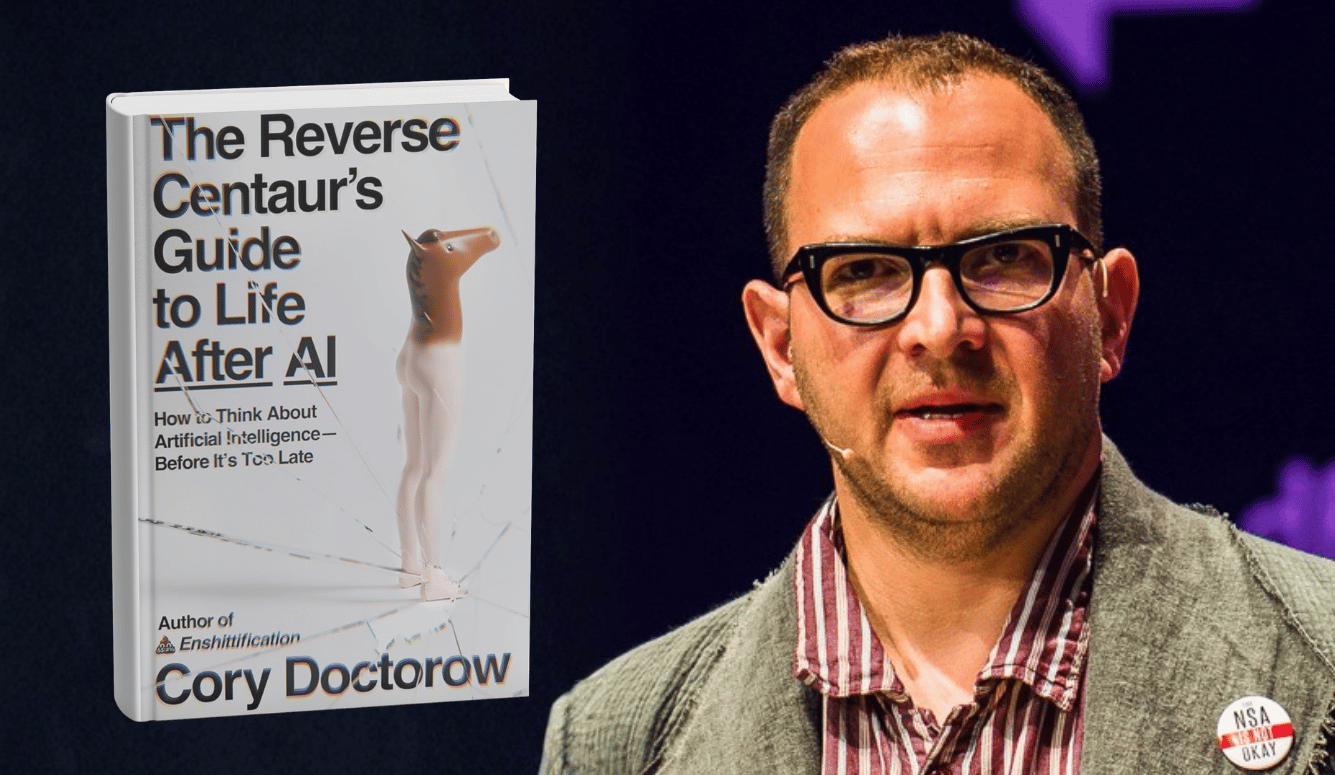

A review of The Reverse Centaur’s Guide to Life after AI by Cory Doctorow; 240 pages; Verso (June 2026)
In late August 2010, I was a senior Obama-appointed official in the office of the Secretary of Veterans Affairs, and I received a message informing me that the secretary wanted to see me right away. These encounters never start well and usually end with someone’s head on a pike. The nerve centre of a 400,000-person agency, that office works on dozens of projects at the same time, and I had no idea which one had just blown up.
VA used to be a non-political and mostly bipartisan place. There were very few things we did, or could do, that had a “D” or an “R” attached to it. There is no better mission in government than providing health services and earned benefits to people who volunteered—and sometimes risked their lives—to serve in uniform. When I beamed myself into the secretarial suite, he was already with another official whose job I can best describe as “don’t let stupid things happen.” Both looked grim. I started doing mortgage recalculations in my head.
A couple of weeks before the secretarial summons, the president had announced that VA was going to make veterans’ health records available to them at “the push of a button.” If a veteran wanted their longitudinal health record—including all prescriptions, lab results, allergies, diagnostic images, and clinical notes—we were going to provide it, in an easy-to-read computer file. No special tools, applications, or extra permissions would be required. This was the genesis of the Blue Button program, which Craig Newmark described as “VA’s gift to the country.”
Today, most people in the United States, and anyone who gets federally provided clinical services, have access to their health records, including members of the armed forces and their families, as well as Medicaid and Medicare beneficiaries. VA was a pioneer in making all this possible. But on that day, in the secretary’s office, the concern was about how this new technology might embarrass the president and cost him votes in the next election.
The core problem was that the assistant secretary for error avoidance was convinced that “nobody thinks this is a good idea.” They had taken an informal poll of stakeholders—without the benefit of a good explanation—and all (uh, six) of the respondents had said they saw no need or purpose for access to their data, so why risk the leak of medical information? I said, “I could go to the park across the street and find six people who think trees are a bad idea. That doesn’t mean we don’t need trees.”
The secretary, of course, was in a bind. The program was about to go live, and all the announcements and press releases and promotions were locked, loaded, fuelled, and ready to launch. Together we hit upon an idea. What if we launched without fanfare? The president had already announced it, of course, but who would remember? Who would care? How would anybody find out? I lunged for the compromise. I knew that our primary stakeholders, the veteran-service organisations like American Legion and Veterans of Foreign Wars, scoured the website every day for changes anyway, and I was confident that someone would find it, whether we promoted it or not. Everybody agreed to move forward.
Within a few days, people were chattering about how they could get their records, bring them to their doctor, or pharmacist, or caregiver, and see things about themselves that they had never seen before. The scheme was a resounding success. The product-release strategy—a kind of manual “screen scrape”—worked like a charm.
In his wonderful new book The Reverse Centaur’s Guide to Life After AI, Cory Doctorow tells us that the most important fact about a technology isn’t what it does, it’s who it does it for, and who it does it to. For veterans, and later for the country, Blue Button was a blow-out win; it helps millions of people manage their care, and it harms nobody.
Today, of course, screen scrapes that mimic human reading are fully automated, and the robots hoovering up the information are not surveilling for new digital services. They’re indiscriminately looking for any kind of text, regardless of source, quality, veracity, or intent. Indeed, the entire internet is the training ground and the raw material for a new kind of application: large language models or LLMs.
Doctorow’s evaluation of LLMs has a harsh outcome. Unlike veterans, service-members, and Medicare and Medicaid enrollees, the main beneficiaries of LLMs are a very concentrated group of investors, inventors, and insiders; most of society will suffer dilatory consequences. More distressing, according to Doctorow, are the hapless employees whose jobs, their bosses think, will be replaced by the chatbots.
Many technologies have an indisputably positive impact. Wireless communications, satellite navigation, and advances in life science, transportation, fixed nitrogen, electric power, and semiconductor devices come to mind. Each of these inevitably carries its own set of liabilities too—from economic displacement to environmental degradation—but only flat-earthers would want to return to an era where we didn’t have GPS, vaccines, air travel, abundant food, and ubiquitous light switches and sockets.
LLMs, on the other hand, suffer three enormous deficits. The first is the perverse disincentive of human employment. The second is that LLMs cannot do what their hucksters say they can do. Consequently, the target customers—businesses that run call centres, for example—think they’re buying expert automation, which is a ChatGPT-class hallucination. Some businesses have already rehired the workers they fired.
Keep reading
A Clockwork Filmmaker

The Insight Trap

Cornell and Consent

Robert Lynch on Status, Humour and the Apes We Pretend Not to Be | Quillette Cetera Episode 74