Politics
Why Recognise Palestine Now?
The timing of the UK’s announcement suggests there is more to the prime minister’s decision than fear of political retribution at the ballot box.
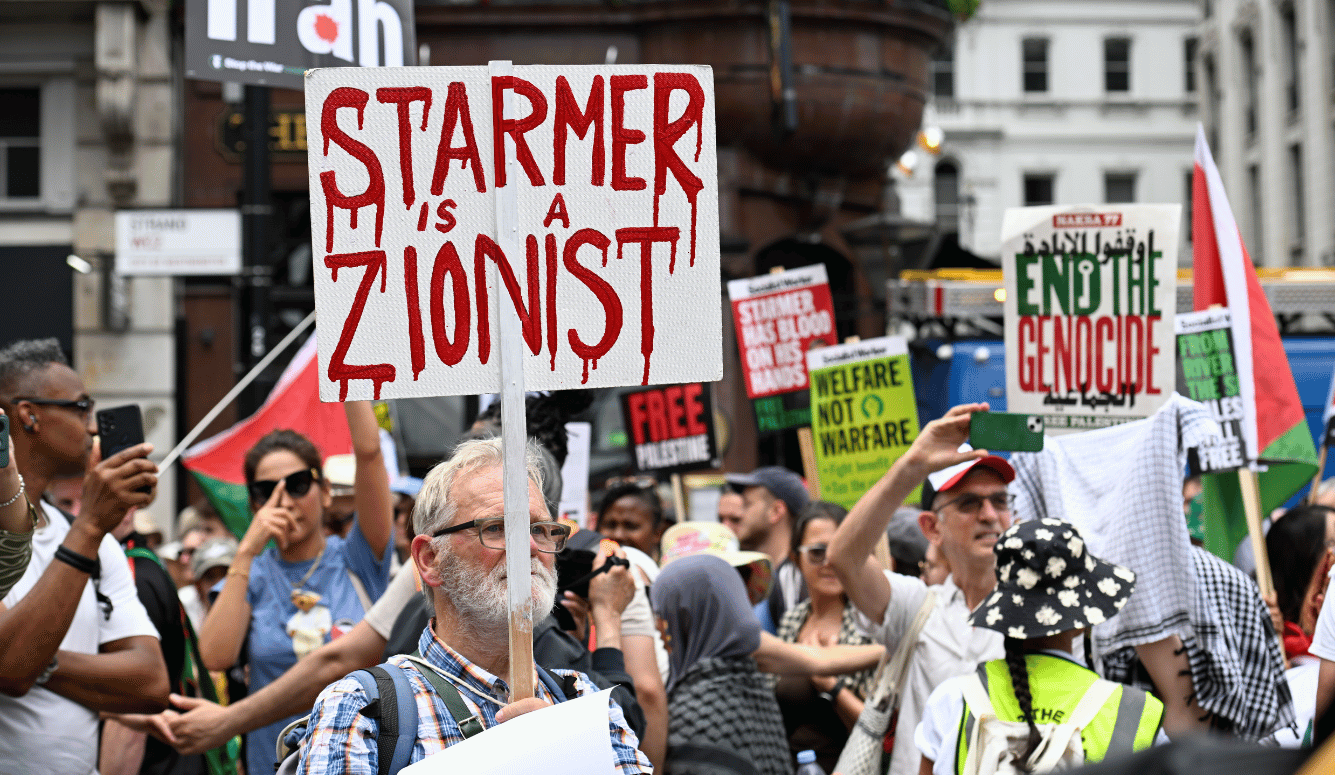

Most of the world’s nations now recognise a Palestinian state. In May 2024, the ranks of those nations were swelled by Spain, Ireland, and Norway. Under Emmanuel Macron and Keir Starmer, respectively, the French and British governments have now signalled their commitment to joining them in September. As conditions deteriorate in Gaza, one British government minister has even said that the UK should recognise the state of Palestine “while there is a state of Palestine left to recognise.”
Palestine is usually said to comprise Gaza and parts of the West Bank, with its capital in East Jerusalem. But in the real world, the West Bank enclave is ruled by Fatah, what remains of the Gaza Strip is still nominally ruled by Hamas, and East Jerusalem is not the capital of anything. With the two mutually hostile Palestinian parties locked in a frozen conflict, there is no prospect that either will hand over control to the other. And neither Hamas nor Fatah can be considered democratically legitimate because neither has held elections in decades.
So, what does it mean to recognise a physically discontinuous, politically divided polity as a single state? And why have no conditions for recognition been placed upon Hamas—a detail that has led some British commentators to see the promise of recognition as a reward for the pogrom of 7 October 2023?
I. History
The international expectation is that a Palestinian state will be established within borders “based upon” the 1949 armistice lines that existed on 4 June 1967, the day before the Six Day War. But no Palestinian state existed before that war. Indeed, no Palestinian state existed even before Israel’s 1948 declaration of independence.
Until 1918, “Palestine” was an impoverished backwater of the Ottoman Empire, ruled from Constantinople hundreds of miles away. And like most parts of the Ottoman Empire, it was inhabited by multiple ethnic groups. Following the breakup of the Ottoman Empire—which had picked the wrong side in the First World War—the territory was temporarily administered by the British under the name of “Mandatory Palestine.”
Throughout this period of British administration, there was substantial immigration from elsewhere in the Middle East. Many of the new arrivals were Jews, a persecuted minority in the Arab world, which had learnt (like many persecuted peoples of the day) to dream of national self-determination. Some Arabs wanted to make peace with the Jews, but the dominant force in Arab politics was Amin al-Husseini, the British-appointed Mufti of Jerusalem and a Jew-hating Nazi collaborator.
In 1937, after a failed but extremely bloody revolt, al-Husseini fled Mandatory Palestine, and a British Royal Commission led by Robert Peel recommended that the Mandate be dissolved and the territory divided to separate its Arab and Jewish populations. Ten years later, in 1947, the United Nations proposed a similar plan. On both occasions, the partition proposals were accepted by Jewish leaders and rejected by Arab leaders. In 1937, not much happened and then the Second World War began. But in 1947, a nasty civil war erupted before Arab armies from Lebanon, Egypt, Jordan, and Syria invaded (with Iraqi involvement) with the explicit intention of extinguishing the Jewish state that had just declared its independence. By the time the war ended, the Arab armies had been routed and the new state of Israel was in control of most of former Mandatory Palestine.
Egypt and Transjordan had seized the rest. The Gaza Strip was occupied by Egypt in 1948, while East Jerusalem and the West Bank were occupied by Transjordan in 1949, and formally annexed the following year. Egypt never did offer citizenship to the inhabitants of Gaza (which is why heavily built-up neighbourhoods there are incongruously referred to as “refugee camps”). Jordan, meanwhile, gave the Palestinian residents it acquired only temporary citizenship, which it revoked in 1988. This ensured that the Arab denizens of these two territories, and their children and grandchildren, would remain refugees in perpetuity—prisoners of their fantasy status as future citizens of a phantom Palestinian state.
In 1964, the Arab League midwifed the creation of the Palestinian Liberation Organisation (PLO), a militia dedicated to the creation of a single Arab state across the entirety of former Mandatory Palestine. From bases in Jordan, Egypt, Lebanon, and Syria, the PLO began a campaign of attacks against Israeli civilian targets. Then, in 1967, Egyptian president Gamal Abdel closed the Straits of Tiran to Israeli shipping, expelled the UN peacekeepers from the Sinai peninsular, and began massing troops on the Israeli border.
Israel responded with a devastating series of pre-emptive strikes, and Jordan was dragged into the resulting war thanks to the mutual defence pact it had recently signed with Egypt. Syria swiftly followed, but within six days, Israel had conquered the West Bank from Jordan, the Golan Heights from Syria, and the the Gaza Strip and the Sinai from Egypt. These developments only intensified PLO terrorism, with the lethal ambush of a school bus in 1970 and the torture and massacre of Israeli Olympic athletes at the Munich Olympics in 1972. In 1973, Egypt and Syria launched another war, which ultimately led to the return of the Sinai and a peace treaty between Egypt and Israel in 1979.
The PLO continued to engage in air piracy and terror attacks on Israeli citizens until 1993, when it formally renounced violence and recognised Israel. With the Oslo Accords of 1994, the PLO was reconstituted as the Palestinian Authority, and it became the closest thing to a Palestinian national government that had ever existed.
Keep reading
How France Lost Control of Its Streets
How to Suppress Men’s Writing

Back to the Dark Ages

Prison or Peer Review

France’s Imaginary Austerity