Politics
Oversimplify and Vilify
‘The Message’ is a lopsided, unserious, and frequently embarrassing essay, the real target of which is the very existence of Israel.
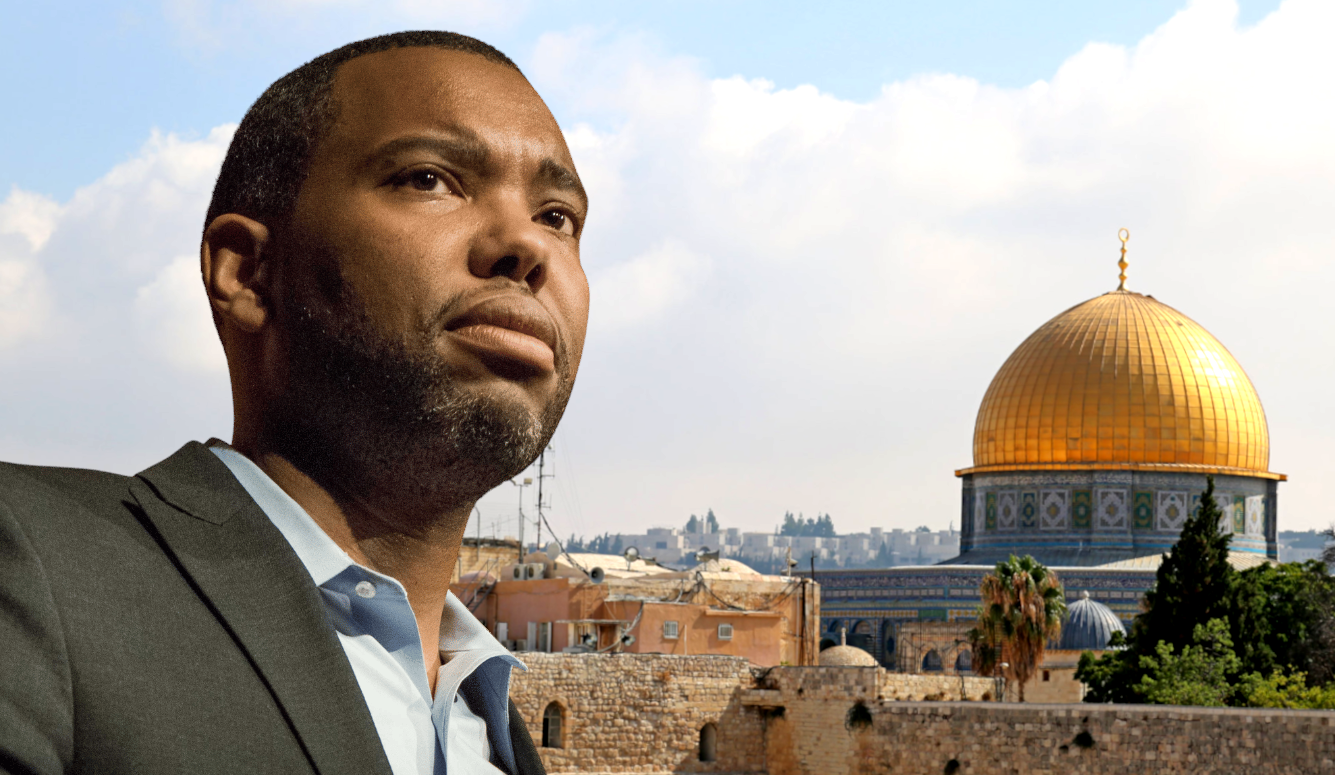

Is there anything left to say about Ta-Nehisi Coates and his ten-day reporting trip to Israel last year? The Message—now in its eighth week on the New York Times bestseller list—has been widely celebrated on the Left for its truth-to-power indictment of the Jewish state on multiple counts of apartheid, genocide, and white supremacy. But his account has also been thoroughly vivisected by critics, who have sliced their way through the text, correcting errors, supplying missing context, and making the case for Israel that Coates impatiently dismisses as disinformation force-fed to gullible innocents like him for years.
For the best of these rejoinders—here, here, here, and here—answering Coates’s tract was almost too easy. They point out that he elides the distinction between Palestinians living under occupation in the West Bank and Arab citizens of Israel, who enjoy the same civil rights and legal protections as all Israelis; that he shows no interest in Palestinian politics and recent Israeli history; that he ignores terrorism altogether, and never mentions Iran, Hezbollah, Hamas, 7 October, or even the current war in Gaza; that he doesn’t seem to understand the rules governing who can visit the Haram al-Sharif and the Wailing Wall; that he thinks Yad Vashem is in Palestine... and so on.
But never mind. Coates believes that morality trumps facts, and he derides invocations of “complexity” by Israel’s defenders. “I would sooner hear a defense of cannibalism,” he declares, “than I would hear any brief for what I saw with my own eyes in Hebron.” Try to explain the whys and wherefores of Israeli policies to Coates and you’re no better than Chico Marx’s con-man in Duck Soup: “Who you gonna believe, me or your own eyes?” Coates the reporter claims that his powers of observation are all he needs to achieve moral clarity. And on that basis, he need not consider the views of his opponents because no context or explanation of Israeli conduct could possibly be exculpatory.
But many critics have missed that The Message is not what it purports to be. It is not, as Coates claims, an account of what he saw on his whirlwind visit, which he insists should be grounds alone for any sentient person to understand Israel’s depravity. Most of The Message is, in fact, based on Coates’s selective reading. The result is a gerrymandered history of Israel and Zionism going back two centuries, all of which comes from a handful of books and articles cited in an online source note. The result is a lopsided, unserious, and frequently embarrassing essay that reads like an undergraduate paper composed for an introductory Middle East Studies class.
Like most people who have spent more time in Israel than Coates—and that isn’t saying much—I did my own read-through of The Message, underlining passages, scribbling “ugh” and “not true” in the margins, but also noting here and there when he actually describes something fairly accurately. I have been to the same places Coates visited, I’ve taken the same curated tours Coates took, and I’ve spoken to some of the same Palestinians and Israelis Coates met.
So, for example, when he describes the appalling situation on Al-Shuhada Street in Hebron, a part of the Old City now closed to Palestinians, I know exactly what he’s talking about. I’ve walked the same street and been shown around by some of the same people. The section of Hebron that anti-occupation tourists see is patrolled by a large contingent of Israeli soldiers who protect a small contingent of extremist Israeli settlers. It is indeed a horrifying situation, in theory and in practice, particularly for the Palestinians who have to live there.
But what Coates does not say is that this sliver of occupied Hebron is the anomalous result of a side-agreement to the Oslo Accords negotiated by Yassir Arafat and Bibi Netanyahu in 1997. After the breakdown of Oslo, the Hebron deal, which was meant to be temporary, became frozen. And so today, anti-occupation tours lead visiting Europeans and Americans around H2 (as this neighbourhood is called), and allege that it is representative of the entire Palestinian experience in the West Bank and Gaza. But it isn’t. It is a highly idiosyncratic arrangement, designed to protect a small group of pugnacious settlers who have been living there since the 1970s.
Unlike Coates, I’ve also visited the rest of Hebron—the much larger Palestinian-controlled city where the Palestinian Authority, not the Israeli army, rules. Here, 100,000 Palestinians go about their business in the bustling economic engine of the Palestinian economy. It is off-limits to Israelis, but Coates doesn’t even mention it. And yes, divided Hebron is typical of the occupation in many ways. It is fraught, irrational, and deeply unfair to the 20,000 Palestinian residents of H2. But as the product of a singular political moment, H2 is just one chapter in the larger ongoing tragedy of the Israeli-Palestinian conflict. Were Coates interested in nuance or complexity, he might have grasped this. But because he isn’t, his portrait of the city is almost useless.
There are certainly terrible injustices being perpetrated throughout the West Bank, and acknowledgement of this reality is now more urgent than ever. The occupation is hard to defend, especially if you’ve seen it up close. But as Coates starts filling in his own explanation for why the conflict persists, his claim that no other explanation is worth hearing starts to look rather bizarre, particularly given the strangeness of some of his own theories.
The Message starts conventionally enough, with a familiar rehash of the settler-colonial theory popular on Western campuses today. Coates sweetens the mix with a dollop of intersectionality, clumsily linking American struggles with racism and white supremacy to the Palestinian cause. But Coates gets weird in a hurry. Nineteenth-century proto-Zionists, he argues, modelled many of their early colonial schemes on Jim Crow, which is also where the Nazis drew inspiration for their racist policies (another voguish theory that Coates discovered in a controversial book catering to his own preoccupations). In other words, Nazism and Zionism are cousins, and their shared ancestor is American racial segregation.
“The war that resulted in so much Jewish death, World War II, was as much a race war as a world war—one with deep roots in America,” Coates writes. From this, he concludes that Zionism is merely an instrument of a global white-supremacist network—also encompassing the US, Nazi Germany, and, eventually, South Africa—in which race is the principal organising concept. The problem with this hypothesis is that Coates can’t decide whether or not Jews are white. “In the immediate postwar years,” he writes, “the place of Jews in the tent of whiteness was still uncertain,” and he illustrates this observation with some lurid examples of postwar American antisemitism.
But then he adds:
Against this backdrop, Congress passed an immigration bill in 1948 that employed geographical and time restrictions in the hopes of keeping Jewish immigration to a minimum. That same year, the United States became the first country to recognize Israeli independence. The cause of Jewish whiteness was thus advanced by keeping “them over there”—and better still, over there warring against natives and savages.
None of this makes any sense. Yes, the US and Britain turned many Jewish refugees away because of antisemitism, but there was never any plan to send Jews to Palestine to subdue restive Arabs on behalf of whites. To the contrary, the British did everything in their power to keep Jews out of Palestine throughout the 1940s, and they did so in deference to Arab wishes.
Coates then cherry-picks an assortment of quotes from early Zionist texts, which he lifts out of their original context to confirm Zionist complicity in his global racial conflict. “Just as the pioneers of the Confederacy openly confessed their affiliation with enslavement,” he writes, “the early Zionists openly associated themselves with colonialism. And just as the modern defenders of the Confederacy claim slavery had no part in their cause, so too do modern Zionists declare the colonizing impulse irrelevant to their movement. But the truth was right there. Written down.”
Coates wants us to understand that these pre-state thinkers were confessing their own guilt for the crime of settler-colonialism a hundred years before the term was invented. A little Herzl here, a bit of Jabotinsky there, and oddly enough some Moses Hess for good measure. Why he includes Hess—the German communist writer best known for supplying Marx with the phrase, “religion is the opiate of the people”—is beyond me. Hess died in Paris in 1875, two decades before Herzl wrote Der Judenstaat.
 Coleman Hughes
More baffling ideas follow. Coates claims that modern Israeli culture shares the same bitter resentments that energised the American South during Reconstruction. Without bothering to marshal any evidence, he insists that Israel has the same honour-based culture found in the American South. He even uses the phrase, “the Lost Cause of the IDF.” Having been “humiliated” by the Nazis during the Holocaust, the Jewish people sought to restore their lost honour by humiliating Palestinians. “By routing the savage ‘Arab,’ by murdering his leaders, by confining him to the Bantustans of Tuba, or the reservations of Gaza, or the ghettoes of Lydd, Jewish national honor was restored in the traditional manner of Western European powers.” Coates writes.
This really is a kind of madness. Zionism predates the Holocaust. Coates never mentions the Yishuv’s fight against British colonial rule, which also shaped their political struggle. Nor does he mention the Zionist leadership’s willingness to accept the UN partition plan and share the land, or that in 1948, the fledgling state was invaded by the armies of five Arab nations who had sworn to destroy it. Amid all this talk of how humiliation shapes politics, Coates never stops to consider how the humiliating defeats suffered by the Arabs in 1948 and ’67 shaped Arab politics.
Nevertheless, race—not religion, not national origin, not geopolitics—determines most of Coates’s version of Middle East history. “I don’t think I ever, in my life, felt the glare of racism burn stranger and more intense than in Israel,” he declares. But when he is faced with a black Israeli soldier—presumably a Jew of Ethiopian descent—he says the young man is not really black. “In fact, there were ‘black’ soldiers everywhere lording their power over the Palestinians,” he admits, “many of whom would, in America, have been seen as ‘white.’” What? So, if a US police officer stopped a black American Jew for a broken tail light, this hypothetical motorist would be treated as white?
“Race is a species of power and nothing else,” Coates writes by way of explanation. The awkward fact that a majority of Israeli Jews today are of African and Middle Eastern descent, and are therefore not white at all, doesn’t come up. As far as Coates is concerned, an IDF soldier may look black, but according to the power dynamic of Israelis and Palestinians, the soldier is white and any Arab—even if they are blond or have blue eyes, as some Palestinians do—is black. But if that is the case, then why bring race up at all?
As Israeli journalist Matti Friedman explained recently:
The story of the Jewish minority in Europe and in the Islamic world, which is the story of Israel, has nothing to do with race in America. … The occupation of the West Bank is supported by many Israelis mainly because they have rational fears of rockets and suicide bombings, tactics that weren’t quite the ones endorsed by the American civil-rights movement. All of this is to say that although Israel, like America, is deeply messed up, it’s messed up in completely different ways.
But Coates has a one-track mind. When he sees an Israeli soldier sporting sunglasses it reminds him of a Southern sheriff in mirrored Ray-Bans (because why else would someone wear sunglasses in the Middle East?). He never mentions the Islamisation of the conflict or the atrocities committed by Palestinians on 7 October and during the Second Intifada. But he does mention the Fort Pillow massacre, Angela Davis, the Ku Klux Klan, Confederate Civil War re-enactors, Dylann Roof, and American filmmaker D.W. Griffith (twice!).
Confused? Now try to imagine Coates watching a video recorded by Hamas last October that shows Palestinian fighters beating a terrified, unarmed black man who was neither Jewish nor Israeli. He was a Tanzanian foreign labourer, working in a kibbutz, and that day in October he was pleading for his life. He was then executed on camera as part of Hamas’s war of extermination against Israel. If race is merely a social construct, then who were the white supremacists in that scene?
Keep reading
Jerry Kaplan on AI Doomers
Payback Time for Steven Galloway
War Stories

Life in The Grim Old Days