Art & Culture
Jordan Peterson and the Failure of the Left
The hyperbolic uniformity of the leftist attack on Peterson is emblematic of the growing tendency to reduce left-of-center thought to the status of a rigidly simplistic ideology.
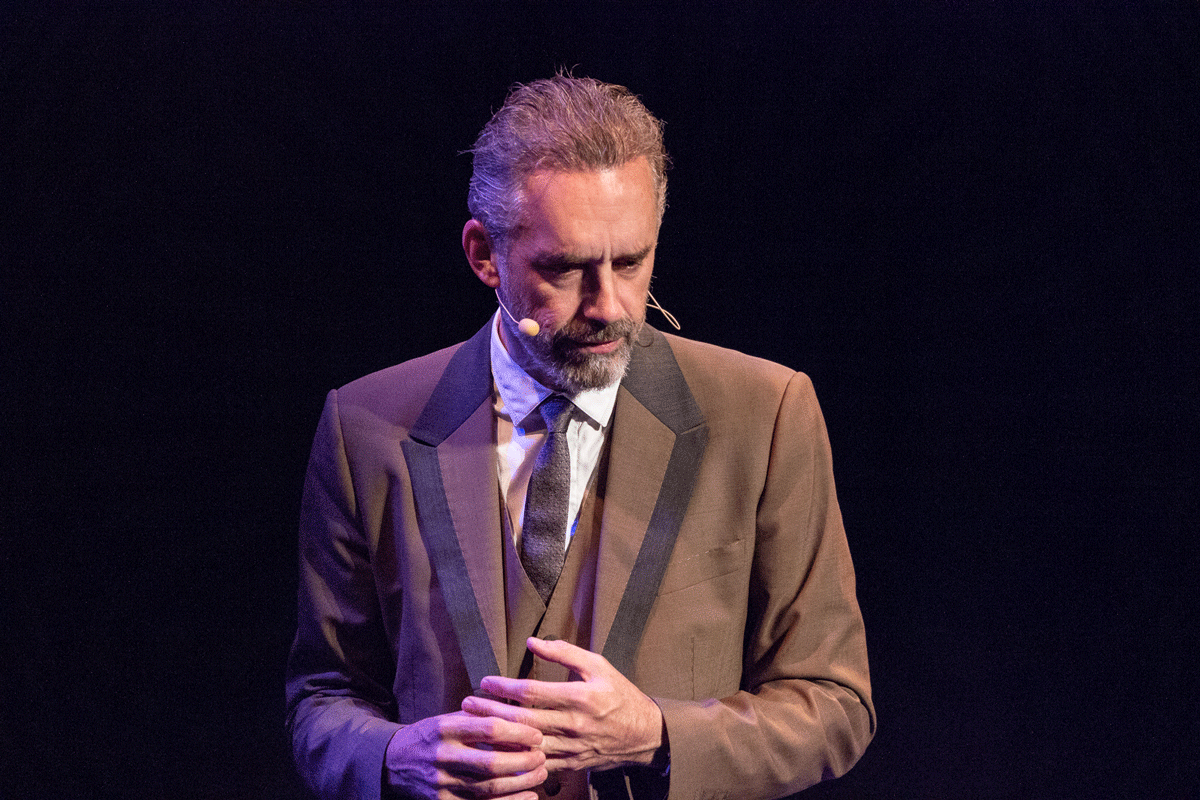

Like most people, I’d never heard of Jordan Peterson until a short time ago. In my case, the first signal of his arrival on the cultural scene was a friend’s series of Facebook posts vividly denouncing him as a reactionary cult-like leader. Seeing a Canadian psychology professor be the subject of such alarm piqued my curiosity. As an American ex-academic, I tend to stereotype Canadians as almost laughably polite, and professors as largely contained in their own hyper-specialized, politically irrelevant bubbles. The vision of a wild-eyed Canadian psych prof with a fanatical alt-right following on YouTube was an intriguing challenge to my priors.
Soon, I found myself going down the Peterson rabbit-hole with countless others. I listened to several of his lectures on reinterpreting Bible stories as archetypical myths. Contradicting my friend’s warnings of hate-filled right-wing propaganda, I found Peterson’s discussions intellectually engaging, personally meaningful, and a refreshing departure from the standard discourse on such issues. I read up on Peterson’s battles over Canadian hate speech legislation and watched his infamous Cathy Newman interview. Here again, I found Peterson’s commentary to be largely thoughtful and thought-provoking. I tuned into his podcast discussions with Sam Harris, and started exploring Harris’s work as well. I even bought and read 12 Rules for Life, and put Maps of Meaning on order at my local public library.
Although my newfound interest in Peterson might seem to put me in good company—he’s selling out 5,000-plus seat lecture halls regularly and 12 Rules for Life is now a #1 bestseller—this isn’t the case at all. On the contrary, it puts me into a pretty isolated, alienated, and uncomfortable position. The reason for this is simple: I’ve always identified strongly with the left-leaning side of the political and cultural spectrum. And, as anyone who’s been following Peterson’s bizarrely rapid rise to fame knows, his growing popularity has been strongly countered by progressive commentators, who keep sounding the alarm against him at increasingly higher volumes.
If you follow the news stream, it seems that virtually every right-thinking left-leaning (pun intended) journalist, blogger, and social media maven agrees: Peterson is an alt-right wolf in professorial sheep’s clothing, a self-serving charlatan who dresses up old-school misogyny, racism, and elitism in faux-intellectual, fascist mystical garb.
Breaking My Silence
I don’t buy it. I’ve read and listened to enough Peterson to make up my own mind and that’s not how I see him at all. Rather than being forthright about this, though, I’ve tended to cower silently in my alienated corner, fearful that revealing my rejection of the stock anti-Peterson narrative will cause my progressive friends to denounce me and the social media mobs to swarm.
It’s not that I’m an uncritical Peterson devotee. Although I find both his work and the furor surrounding him quite fascinating, I don’t share his way of thinking about the political issues (such as socio-economic inequality) that most concern me at all. That said, I would never look to someone like him, who I see as a classical conservative, to provide thought leadership on such matters. That’s the role of the Left. And in my view, the Left is doing an abysmal job on that front.
‘The Left’ is admittedly an overly broad and imprecise term. Still, it’s certainly possible to identify a dominant leftwing discourse in the U.S. and Canada today. And within that discourse, a stock anti-Peterson line indisputably exists. The Left faces many challenges, and the issues surrounding Peterson only represent one. Still, it’s important. The anti-Peterson crusade is an instructive example of a larger dynamic that needs to be named, discussed, and hopefully, addressed.
The hyperbolic uniformity of the leftist attack on Peterson is emblematic of the growing tendency to reduce left-of-center thought to the status of a rigidly simplistic ideology. Increasingly, what passes for progressive political thought today offers little more than a scripted set of weaponized hashtags (you must be pro- #metoo and anti-patriarchy, no further thought required). This narrowing of our public discourse is disturbing, and worrisome on multiple, mutually reinforcing levels.
The Downward Spiral
First, it’s unconvincing to everyone who’s not some sort of true believer or faithful follower (or, more cynically, a journalist looking to please an editor demanding yet another Peterson hit piece). No doubt, I’m not the only person who’s wondered what all the fuss is about, decided to take the time to listen to one of Peterson’s YouTube lectures, and come away feeling that the Left’s commentariat is trying to sell me a fake bill of goods. The gap between Peterson’s obvious intelligence and the Left’s scathing denunciation of him as an alt-right idiot is simply too large for many of us to ignore.
Second, the Left’s attack on Peterson is so unrelenting, so superficial, and quite frequently so vicious, that many of us who work and/or live in left-leaning social environments feel scared to speak up against it. We don’t want to alienate our friends, damage our professional reputations, or attract the attention of fire-breathing activists.
The problem here is not simply that this is unpleasant for people like me. More importantly, our silence further impoverishes everyday political discourse by eliminating more nuanced left-of-center voices. This, in turn, reinforces the already powerful trend toward weaponized hashtag ideology instead of serious political thought. It also drives more people to right-of-center alternatives or away from politics altogether.
Peterson is just one example of this larger trend. Viewed as such, the situation he represents is extremely concerning, and even dangerous. We desperately need a revitalized Left that’s capable of speaking to today’s pressing issues of socio-economic inequality, environmental devastation, and spiritual malaise in informed, intelligent, and inspiring ways. Instead, we’re inundated by shallow ideological crusades dedicated to demonizing thoughtful conservatives like Peterson, who actually have some important ideas to offer—just not on the issues that properly concern the Left.
 Jonathan Anomaly
Repositioning Peterson
Given my life-long identification with the social democratic (or, in U.S. terms, left-liberal) side of the political spectrum, I’ve reflected quite a bit on why my response to Peterson seems so out of step with dominant left-of-center discourse. It may be that I’m actually not as alone as it seems. Although I can’t prove it, I suspect that there are many others who feel as I do but are keeping quiet, as they don’t want to risk the blowback that comes with countering the often frightening force of today’s ideological tides.
Beyond this, as a former political science professor, my thinking is informed by an unusual (and unusually long) education that exposed me to quite a bit of classical political philosophy. This enables me to contextualize the political dimensions of Peterson’s work in ways that are likely unfamiliar to most people.
Specifically, I see him as part of a tradition of conservative political thought that’s deeply committed to trying to understand the fundamentals of what was classically called ‘the human condition.’ This is not the sort of conservativism that most Americans and Canadians think of when they hear the term ‘conservative.’ For example, it has no necessary connection to the sort of uncritical championing of corporate capitalism favored by conservatives today. Rather, it is concerned with issues such as the fragility of cultural norms that help provide individuals with a sense of purpose, and enable societies to remain relatively peaceful and functional.
Conservatives of this stripe mistrust radical movements that are ready to rip apart a cultural fabric that took generations to weave in pursuit of some idealistic vision of social justice. They believe that there is such a thing as ‘human nature,’ and that it’s highly fallible, and inevitably bedeviled by problems such as envy, corruption, and greed.
Consequently, such conservatives have no faith in leftist visions of a transformational ‘revolution’ that will definitively destroy oppression and establish a truly just society. Instead, they see them as dangerously naïve, and likely to produce violent anarchy and/or repressive authoritarianism. While acknowledging the realities of social injustice, they believe that political reforms need to be cautiously incremental—in a word, conservative.
Not Stupid
Although Peterson’s professional work is rooted in the study of Jungian psychology rather than political philosophy, his worldview fits quite well into this tradition of conservative political thought.
For example, Peterson is concerned with how postmodern anti-foundationalism undercuts longstanding cultural norms. He sees the ‘social justice’ Left as filling the resulting vacuum with shallow anti-oppression platitudes. He believes that human existence is inevitably full of suffering and that it’s not easy to chart an ethical course through life. The upside is that the struggle to do so provides a vital sense of meaning and purpose.
These are not stupid concerns.
More examples could be given, but the basic point is this: Although I’ve never considered myself a conservative, I’ve learned a lot from studying conservative political philosophy and take its insights seriously. Given this orientation, when I hear Peterson rearticulating classically conservative concerns in a new way, I find it interesting. I don’t agree with everything he says, and would not look to him to speak knowledgeably on every issue.
But I like the fact that he’s discussing how we might understand some of the foundational narratives (e.g., Bible stories) that have informed our culture for generations in new ways. I find it not only interesting, but in many ways resonant with my own life experience. The Story of Job, the Sermon on the Mount—these are not idiotic topics to engage with. Notwithstanding the scorn of the leftist commentariat, the deeper issues they raise remain relevant.
Keep reading
Robert Lynch on Status, Humour and the Apes We Pretend Not to Be | Quillette Cetera Episode 74
The Radicalisation of Tucker Carlson
A Pop Fiction Master and Monster

Australia’s Coming Censorship Machine

Anatomy of a Book Promotion